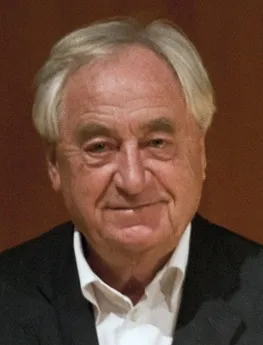
Cees Nooteboom
Human Design Chart
Biography
Noorteboom's father Hubertus Maria Nooteboom (13 February 1897, Den Haag, 17 March, Voorburg) was a merchant. He married the much younger Johanna Carolina Christina Sophia Pessers (29 December 1910, Tilburg - 7 January 2008, Loon op Zand). The family moved a lot. In the seven years before the war broke out he lived on seven addresses in Den Haag and Rijswijk. With his father, he watched the bombardment of airport Ypenburg by the Germans on 10 May 1940. On 5 Augustus 1943 his father left the family, on 28 March 1944 he divorced and on 3 March 1945 he got severely wounded during the Bombing of the Bezuidenhout. The targets of the the allied forces were V2-launching sites, but the 67 tonnes of brisant bombs fell on on a not yet evacuated part of Den Haag. As fire engines and firemen had been sent to Germany, the resulting fire was unchecked, killing 511 people.
After the war there followed again a lot of moves of house. For details see the DBNL. In 1948 his mother remarried a very strict Catholic. Nooteboom was sent to of Franciscan and Augustinian monastery schools. He was bright enough for the Gymnasium, but he attended four of them, without attaching to really one of them and without getting ever the desired diploma. In 1951 he left home after an argument with his stepfather. He got a job as bank clerk in Hilversum , but still studied in the evening for the Lyceum diploma.
In 1953, after being rejected for the Dutch military service as too meagre (1952), Nooteboom started to travel abroad, typically by hitch-hiking in Scandinavia and France, as he had little money. He met his travelling friend, the half Jewish Dutch photographer Philip Mechanicus (13 Augustus 1936, A'dam - 30 July 2005, A'dam) in Paris. In 1954 he started writing his début novel "Philip en de anderen" (Philip and the others) that appeared in 1955.
The Human Design of Cees Nooteboom: Generator 1/3
Generator 1/3 — Design at a Glance
Cees Nooteboom's design shows a tendency towards great endurance and inner drive. As a Generator, he had much sacral energy, which drove him like a strong workhorse – provided that he found tasks for which this power was available. His life force did not ignite through spontaneous initiatives but rather in response to impulses from the environment. The motto of his design is: do not initiate, but wait until life sends a signal and his inner self responds with a clear 'yes'.
This mechanism created two specific challenges. If he engaged in things that did not resonate internally, he wasted his energy and tended towards exhaustion. Conversely, he suffered when external constraints hindered him from continuing to work on his heart projects despite still having full power available. He only acted successfully if he responded to life signals and then consistently followed through. Living in harmony with this reactive strategy 'from the gut' rewarded his system with a deep sense of fulfillment. If he constantly initiated against his inner rhythm, sooner or later he encountered persistent frustration and energy deficiency. His path to satisfaction therefore did not lie in forcing results but rather in trusting his own reactive power.
Sacral Authority
Cees Nooteboom's design points towards intuitive, body-based decision-making. As a Generator, he possessed sacral authority, meaning that his strategy and inner guidance were identical: wait for external stimuli and then respond from the gut. This configuration greatly simplified his process as no cognitive weighing between strategy and authority was necessary.
A prerequisite for this clear line was his open emotional center. Thus, he remained protected against impulsive, emotional misjudgments; his decisions arose not from fleeting moods but from a stable sacral response. This often manifested as spontaneous physical reactions – an inner 'yes' or sudden energy boost – making him vital and enthusiastic. Once his motor started, he acted with great joy and without compulsive purposefulness.
Additionally, his activated spleen center served as supportive authority. It gave him quick, instinctive access to his bodily well-being. He could react spontaneously and precisely to situations, guided by a deep perception of what served or harmed him. This combination of sacral endurance and spleen-induced speed marked him as someone who moved through life listening to his physical signals and trusting that they led him to activities truly fitting.
The 1/3 Profile — Investigator / Martyr
Cees Nooteboom's design points towards profound research always coupled with practical experimentation. As a 1/3 profile – Researcher and Experimenter – he lived the principle of trial and error. Line 1 demanded theoretical knowledge and withdrawal for reflection, while line 3 urged action and testing. This tension shaped his approach: He sought not only abstract truths but also tested them through direct experience.
Especially relevant was Gate 33 in line 1. It emphasized wisdom in a weak position and the necessity of retreat for survival. Unreflective courage here was seen as risky; communication followed inner condensation. Parallel to this, Gate 24 in the third line led through trial and error to exposing false knowers. This configuration allowed him to recognize irrational patterns and create new conceptual frameworks.
Cees Nooteboom thus appeared as someone who only considered insights valid when they were both theoretically grounded and practically tested. His judgment was based on this double check: withdrawal for meaning-making followed by active verification in reality. Through this method, he could overcome regressions and generate authentic knowledge validated not just superficially but through his own mistakes and successes.
Triple Split Definition — Defined & Open Centers
Cees Nooteboom's Human Design profile indicated a tendency towards constant mental pressure and a deeply rooted, reliable identity. His Head Center and Ajna Center were defined, creating a permanent internal drive for questioning and conceptual thinking. However, this mental process was not directly connected to energy sources that could immediately set ideas into the world; instead, it served to inspire or put others under pressure to think independently. His defined Throat Center allowed him to clearly and consistently express these mental concepts, while his defined G Center provided a firm self-identity and clear sense of direction. Additionally, he had defined Sacral and Root Centers, giving him immense vital energy and a specific way to handle stress. This combination required patience: the mental pressure could not be relieved through hasty actions but needed to follow its own timing.
In contrast, his Heart, Solar Plexus, and Spleen Centers were open. The open Heart Center made him vulnerable to trying to prove his worth through promises or competition, often ending in frustration as he lacked the consistent willpower for it. His open Solar Plexus absorbed emotions from the environment, leading him to identify foreign moods as his own and feel emotionally unsettled when not alone. The open Spleen Center carried a fundamental fear of survival and a tendency to hold onto things that were not good for him just to simulate a sense of security. Instead of making spontaneous decisions or emotional identifications, he benefited from using these fields as informative windows: observing the emotional climate and intuition of others without misusing them as his own authority. His strength lay in enduring mental pressure until his sacral energy responded correctly to an appropriate invitation rather than taking initiative or getting entangled in the cycle of proving worth.
Channels for reflection, maturation and mental abstraction.
Cees Nooteboom's Human Design profile was characterized by a deep engagement with experience and its processing. He collected life stories and secrets, reflecting on them quietly before passing them along. This approach stemmed from the Lost Son Channel 13-33, which connected Listening (Gate 13) to Withdrawal for Reflection (Gate 33). Patience was crucial in recognizing the hidden truth of an experience and making it usable as a lesson for others.
Parallel to this, he went through a process of maturation via the Ripe Fruit Channel 42-53. This channel linked the Gate of Growth (42) with the Gate of Beginnings (53). It was about experiencing cycles fully and drawing wisdom from them before new experiences began. Suppressing expectations and simply letting oneself be part of the process allowed him to avoid frustration and utilize the depth of experience.
Mentally, he worked through the Abstraction Channel 47-64, which connected Understanding (Gate 47) with Confusion (Gate 64). His mind filtered every experience through a kaleidoscope of images and possibilities. Although this sometimes led to mental unrest, it was the source of his ability to recognize complex connections and formulate inspiring stories or new perspectives once clarity emerged.
Additionally, Gates like 19 (Resources, Territory), 24 (Inner Silence, Renewal) and 44 (Awareness, Transformation) shaped how he engaged in communities and handled changes. Gate 59 drove a genetic strategy towards binding, while Gate 62 stood for logical pattern recognition. Overall, his design showed someone who drew meaning from life through patient observation, cyclical learning, and mental abstraction.
Collective Circuitry — Circuit Signature
Cees Nooteboom's Human Design profile indicated a tendency toward cyclic emotional waves revolving around reflecting on the past. As a person with Triple Definition, his chart consisted of three separate, not directly connected energetic blocks. The Seeker Circuit significantly shaped this structure by connecting specific centers into three isolated groups: Head and Ajna Centers, Throat and Identity Center, as well as Sacral and Root Centers. This separation meant that the energetic flows existed parallel to each other without forming a common stream. The circuit directed his attention towards emotional experiences from the past, which flowed in wave-like patterns – with clear beginning, middle, and end. Through channels like Abstraction (Gates 64-47), Lost Son (33-13) and Ripe Fruit (42-53), he processed felt insights. These internal processes served to share with the collective to learn together from past events. The energy tended towards being inexplicable or illogical, as it did not orient itself toward cool reason but rather emotional truth of earlier events. This configuration created a life task to uncover hidden connections of the past and convey them in a way that others could take on.
Right Angle Cross of the Four Ways 2
Cees Nooteboom's Human Design configuration set a specific tendency towards a multi-layered and often paradoxical life path. This setup, known as the right cross of the four paths, did not describe a linear progression but rather a cycle of alternating phases and perspectives. Instead of pursuing one clear goal, he followed an internal logic that required him to sequentially take on different roles and areas of life.
This mechanism acted as a driving force for constant realignment. Cees Nooteboom was seen in periods of intense focus on a particular theme or activity, followed by phases of letting go and searching for new horizons. The design promoted the ability to learn from diverse experiences and integrate them into a broader understanding. It wasn't about contradiction in a negative sense but rather the necessity to experience different aspects of existence sequentially to reach full maturity.
This structure shaped his way of engaging with the world: through variety, by experiencing opposites, and by continuously reinventing himself. The four paths symbolized not only external circumstances but primarily inner states that were activated one after another. Cees Nooteboom lived this dynamism out by embracing changes and accepting them as a necessary part of his journey.
Saturn Return · Uranus Opposition · Chiron Return · 2nd Saturn Return — Life Cycles
Cees Nooteboom's Human Design configuration set a tendency towards cyclic affirmations, which condensed through external recognition. His first Saturn Return around the age of 30 often marked the transition from preparatory work to a stable structure. This was evident in 1963 with the Lucy B. en C.W. van der Hoogt Prize for *De ridder is gestorven*, a success that solidified his position.
The Uranus Opposition around age 38 often brought a phase of rupture or realignment. For Nooteboom, this was active in 1971 with the publication of *Bitter Bolivia. Maanland Mali*, a career boost that broadened his perspective and ventured into new paths.
The Chiron Return around age 49 is a fulfillment cycle in Human Design where one's inner purpose increasingly unfolds if strategy and authority are respected. This was evident for Nooteboom in 1982 with the Mobil Oil Pegasus Literature Prize for *Rituale*, a flowering of his work that made his purpose tangible.
The second Saturn Return around age 58 further condensed these achievements into established authority. In 1991, his novella *Die folgende Geschichte* reached a broader German audience, completing this process of anchoring and recognition. This sequence underscores how Nooteboom's design responded to structural milestones that stabilized and made visible his work.
Generator · Sacral Authority — Synthesis
Cees Nooteboom was a Generator whose life was marked by deep, sacral energy (Generator Type). This driving force manifested in an unceasing urge for research and experimentation (Profile 1/3), coupled with the ability to learn through action and experience. The defined Head Center generated constant mental pressure to question and understand the world – a process amplified by Channel 13-33 of the 'Lost Son', where experiences were reflected upon and transformed into deeper insights. This cycle of activity, reflection, and sharing of knowledge shaped his approach to the world and was evident in recurring successes (Saturn Return, Chiron Return), which rested on years of practical engagement with his themes.
A central paradox lay in the combination of a need for constant exploration and the cyclical nature of his emotional processing (Soul-Finding Circuit). On one hand, experimentation propelled him forward (Line 3); on the other, he needed phases of withdrawal and reflection to process gained experiences and grasp their deeper meaning. This tension between the drive for novelty and the need for integration led to a body of work that bore witness both to an adventurous spirit and profound contemplation.
3 Defined Channels
Incarnation Cross - Right Angle Cross of the Four Ways 2
Solar Return
The Solar Return shows the moment when the sun returns to its exact birth position - your personal solar year.
Life Cycles
Discover the life cycles with a detailed triple view (birth chart, cycle chart, composite).
Human Design Profile
- Type
- Generator
- Strategy
- To respond - wait for something to respond to
- Authority
- Sacral Authority
- Profile
- 1/3 - Investigator / Martyr
- Definition
- Triple Split
- Incarnation Cross
- Right Angle Cross of the Four Ways 2
- Date of Birth
- 31.07.1933 16:00
- Place of Birth
- Den Haag, NETH
Frequently Asked Questions
What was Cees Nooteboom's Human Design type?
What Profile did Cees Nooteboom have in Human Design?
Which Authority guided Cees Nooteboom?
What incarnation cross was assigned to Cees Nooteboom?
When was Cees Nooteboom born?
Discover your own Human Design
Are you also a Generator? Find out in a personal reading how to use your sacral energy correctly and discover deep satisfaction.
More Personalities
Back to overviewAaliyah

Alain-Fournier
Alexia

Angèle

Angeli

Anne-Marie