
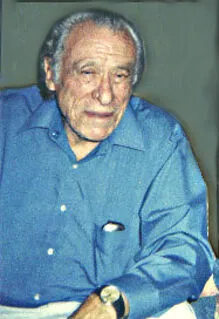
Charles Bukowski
Human Design Chart
Biography
The FBI kept a file on him as a result of his column Notes of a Dirty Old Man in the LA underground newspaper Open City.
Bukowski published extensively in small literary magazines and with small presses beginning in the early 1940s and continuing on through the early 1990s. He wrote thousands of poems, hundreds of short stories and six novels, eventually publishing over sixty books during the course of his career, including his Poems Written Before Jumping Out of an 8 Story Window, published by his friend and fellow poet Charles Potts, and Burning in Water, Drowning in Flame. His poems and stories were republished by John Martin's Black Sparrow Press (now HarperCollins/Ecco Press) as collected volumes of his work. As a reviewer noted, "Bukowski continued to be, thanks to his antics and deliberate clownish performances, the king of the underground… stressing his loyalty to those small press editors who had first championed his work."
Time called Bukowski a "laureate of American lowlife.
Charles Bukowski — Manifesting Generator with Profile 6/2
Manifesting Generator 6/2 — Design at a Glance
Charles Bukowski revealed himself as a hybrid being that combined the constant energy of a Generator with the lightning-fast execution power of a Manifestor. His design inclined him to quickly pull things into his life and skip steps. This speed was a double-edged sword: it allowed him to push multiple projects forward simultaneously and fall into a playful mode when inner approval was present. If this wasn't the case or he reacted impulsively without sacral confirmation, skipping necessary phases led quickly to frustration – his specific non-self theme.
The mechanics of his Manifesting Generator demanded strictly reactive action rather than initiating it. Only when his Sacral Center responded with a clear 'Yes' to an impulse could he effectively utilize his creative power. Then he enjoyed the variety and worked gladly on various tasks at once. If he tried to work against this strategy or ignored feedback from his inner authority, initial enthusiasm quickly turned into exhaustion. His satisfaction thus depended directly on whether he learned to channel his enormous speed through patient waiting for the right life impulses rather than blindly pushing forward.
Sacral Authority
Charles Bukowski showed himself as someone who did not make life decisions through intellectual deliberation but reacted to immediate physical signals. As a Generator, he possessed sacral authority, an inner guidance unique to this type whose strategy was identical with internal decision-making. This fundamentally simplified his process: he waited for the external trigger before acting.
His reaction manifested not in thoughts but as a physical response in the abdominal area – a kind of 'gut feeling' that expressed itself through sounds like grunting or an affirming 'Mhm'. When this resonance occurred, Charles Bukowski felt an immediate surge of energy and vital force, giving him inexhaustible endurance. He then approached his tasks with great enthusiasm, driven by joy and satisfaction without the need for a lofty purpose. His design suggested that he was born to immerse himself in what internally sparked him.
Furthermore, his active Spleen Center acted as a supportive instance to sacral authority. This connection allowed him quick, spontaneous reactions and direct access to his instinctive perception as well as physical wellbeing. He could reliably rely on these inner signals, enhancing his ability to act decisively in the moment without falling into analytical delays.
The 6/2 Profile — Role Model / Hermit
Charles Bukowski revealed himself as someone whose early life was marked by an intense experimental drive. Until around age thirty, he followed the pattern of Line 6 in its youthful expression: seeking experience through trial and error. This did not mean random action but a phase of consciously overstepping rules to learn self-control from resulting consequences – often felt as punishment. Patience was the decisive factor; he cared less for prescribed answers and wanted to shape his life himself.
After withdrawing into his inner 'cave' around age thirty, this dynamic fundamentally changed. Line 6 became active, initiating a period of deep reflection and distance from earlier excesses. This phase served healing and self-awareness by looking back at life experiences with detachment. From this introspective work emerged his later role as an example to others. His contributions arose from natural talent often unusual and in service to the collective. Although individual contribution for group goals was not always recognized, this selflessness preserved the integrity of his individuality. He ultimately emerged as a wise person whose life wisdom could attract others to learn from his deep introspection ability.
Single Definition — Defined & Open Centers
Charles Bukowski revealed himself as someone whose design was based on a solid inner identity and a direct, unfiltered way of expression. His defined G Center gave him a reliable sense of self and a clear direction; he knew who he was without needing external validation to prove it. This inner security flowed into his defined Throat Center, serving as an anchor to clearly and honestly convey messages from the whole body out into the world. His voice spoke not from speculation but from this grounded truth.
As a Generator with a defined Sacral Center, he had a massive source of vitality and generative energy. However, this power was only available when he responded to external stimuli – his mantra was “Do not initiate.” Once he answered life with an inner yes or no, the full sacral energy was released, carrying him through phases of stagnation until breakthroughs occurred. Initiating actions without this confirmation led to frustration and exhaustion.
At the same time, his design had several open centers, making him vulnerable to external conditioning. His open Head Center lacked a consistent inner inspiration; instead, he tended to absorb mental pressure from others or get entangled in questions that weren’t his own. The open Ajna Center meant his conceptual thinking was flexible but didn’t have a fixed conceptual truth – he could take on and reflect ideas without interpreting them as personal dogmas.
His lack of an open Heart Center meant it lacked consistent willpower in the sense of competition or promises; he wasn’t designed to prove his worth through performance. Instead, his open Solar Plexus absorbed emotions from his environment, leading him to personalize foreign feelings and get lost in emotional waves of others. Additionally, his open Root Center took on external stress rather than generating it himself, intensifying it. The open Spleen Center made him vulnerable to survival fears and the temptation to make spontaneous decisions or cling to unhealthy environments just for a false sense of security.
Channels for endurance, creative expression and rhythmic power.
Charles Bukowski revealed himself as someone who drew attention through the full life expression of his individual identity. This effect was based on the Channel of Inspiration 1-8, connecting his G Center with his Throat Center. Through Gate 1 of Self-expression and Gate 8 of Contribution, his unique nature became visible not through explanations but as a public outlet for creative potential. He was designed to get attention simply by being himself; his example inspired others to live out their own uniqueness.
This creative presence received its driving force from the Channel of Beats 14-2. This connection channel between Sacral and G Center linked Gate 14, skillfully handling power, with Gate 2 of Higher Knowledge. As one of the tantric channels, it promoted mutation and innovation. Bukowski used his generative sacral energy to provide material resources for new directions. By trusting reactions from within himself, he brought a reinforcing, mutative effect into his environment without having to plan ahead.
Parallel to this, the Channel of Discovery 29-46 shaped his dedication to deep experiences. It connected Gate 29 of Saying Yes with Gate 46 of Self-Determination. Here it was about letting go of expectations and fully immersing oneself in the depth of an experience. Through persistent endurance in the process – supported by the patience of the Sacral Center – he found his significance at the right time and place. This path required no control but a clear commitment that only revealed its discoveries at the end of the journey.
Additionally, individual gates were active: Gate 4 allowed logical formulas for future security while Gate 31 steered the transmission of forces in the collective. Gate 27 promoted genetic care, and Gate 59 pursued a strategy of binding beyond personal preferences. Gate 49 reacted sensitively to principles through emotional waves, while Gate 33 created necessary withdrawal for reflection and memory.
Individual Circuitry — Circuit Signature
Charles Bukowski revealed himself as someone whose inner drive and public expression were inseparably intertwined. His energy flowed directly from the source of his life force through his identity to his voice. This direct connection between Sacral-, Identity-, and Throat Center created an uninterrupted flow: what he deeply felt within became his essence and found immediate words.
This flow consisted of two specific impulses. The Channel 8-1 provided spontaneous inspiration – sudden insights that came like lightning from nowhere, driving him forward. Parallel to this, the Channel 2-14 acted as a rhythmic beat, a pulsing almost musical energy structuring his expression. Together they formed the Knowledge Circuit: Bukowski followed an original path by not only gathering new knowledge but transforming and acoustically bringing it into the world. His creativity was no abstract idea but a physical expression of his individuality.
Alongside this dynamic flow, there existed a separate second power: the Meaning-Finding Circuit. Here only Channel 46-29 connected Identity with Sacral Center. This connection did not serve immediate expression but reflection. It allowed him to penetrate past experiences and discover their deep meaning. While one stream pushed forward – impulsive and loud – this second strand pulled energy inward to learn from the past. Both systems worked parallel: one created new work through inspired rhythm, the other condensed life experience into emotional depth.
Left Angle Cross of Revolution 2
Charles Bukowski exhibited a fundamental disposition marked by the left cross of Revolution. This configuration described an impulse to question existing structures and norms not out of pure destruction but to break free from outdated patterns and make space for something new. It was an inner drive that pushed him to stand against rigid authorities or conventional life plans when they restricted his autonomy.
In Human Design, this cross marks a specific energetic alignment: the desire for change and liberation from what is felt as unnatural or oppressive. For Charles Bukowski, this meant he often found himself in conflict with established systems not out of spite but because his design demanded authenticity that was incompatible with prevailing rules. He lived this tension by forging his own paths, which were frequently perceived by society as provocative or deviant.
The mechanics of this cross suggested that his rebellion always had a constructive undercurrent: it aimed to break through the old so something genuine could emerge. Charles Bukowski used this energy to free himself from expectations and live a life guided by his inner compass, even if it meant staying outside established norms. His stance was thus an expression of a deep need for freedom and self-determination against external constraints.
Saturn Return · Uranus Opposition · Chiron Return · 2nd Saturn Return — Life Cycles
Charles Bukowskis design indicated a tendency towards late but profound life turning points. His Uranus opposition around the 40th year marked a break with earlier structures. In 1960, he published over forty books of poetry and prose – a success that showed the sudden opening of new possibilities, as this configuration often brings: old patterns dissolve to make room for authentic expression.
The Chiron return from age 49 to 51 served as a fulfillment cycle in which his incarnation purpose crystallized. In 1971, his first novel “The Man with the Golden Arm” was published. This was no coincidence but the flowering of his inner work: what he had previously sought or prepared now emerged as tangible work and gave his life clear direction.
His second Saturn return around age 57 anchored this new identity in everyday life. In 1977, he met Linda Lee Beighle. This relationship was not just an event but the structuring of the previously gained freedom into a stable partnership. The Saturn return cemented the achievements of previous phases and created a solid foundation for the rest of his life by translating past experiences into lasting connections.
Manifesting Generator · Sacral Authority — Synthesis
He was a Manifesting Generator, whose life was marked by constant sacral energy (Sacral Center) and the urge to quickly initiate things – a combination of initiation and reaction. This dynamic manifested in his path as an author who did not wait for conventional paths but found his unique voice through living out personal experiences and experiments (6/2 Profile). The defined communication and manifestation area enabled him to bring this inner world outward, often directly and unfiltered, driven by the inspiration of Channel 1-8.
A central paradox lay in the tension between his need for authentic expression (Knowledge Circuit) and withdrawal for reflection. Early years were marked by experimentation followed by phases of intense self-observation (6/2 Profile), which eventually made him appear as a wise mentor. This sequence of activity and retreat was reinforced through key moments like the success of his publications (Uranus opposition around 1960) and achieving new career goals (Chiron return in 1971), while personal connections (Saturn return 2, 1977) found their place within this rhythm.
3 Defined Channels
Incarnation Cross - Left Angle Cross of Revolution 2
Solar Return
The Solar Return shows the moment when the sun returns to its exact birth position - your personal solar year.
Life Cycles
Discover the life cycles with a detailed triple view (birth chart, cycle chart, composite).
Human Design Profile
- Strategy
- To respond - wait for something to respond to
- Authority
- Sacral Authority
- Profile
- 6/2 - Role Model / Hermit
- Definition
- Single Definition
- Incarnation Cross
- Left Angle Cross of Revolution 2
- Date of Birth
- 16.08.1920 22:00
- Place of Birth
- Andernach, Germany
Frequently Asked Questions
What was Charles Bukowski's Human Design type?
Which Profile did Charles Bukowski have?
What Authority did Charles Bukowski have?
What incarnation cross did Charles Bukowski have?
When was Charles Bukowski born?
Discover your own Human Design
Are you also a Manifesting Generator? Find out in a personal reading how to unfold your multi-talents and direct your energy wisely.
More Personalities
Back to overviewAlain-Fournier

Aldair

Alizée

Angeli

Arletty

Artus
