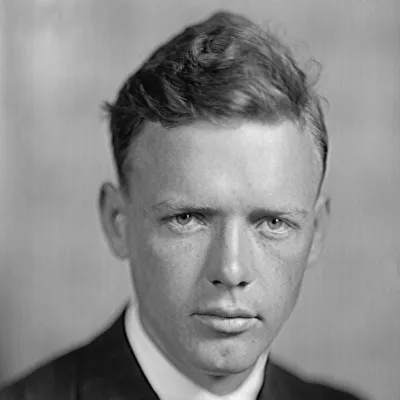
Charles Lindbergh
Human Design Chart
Biography
Lindbergh was raised an only child on a farm in Little Falls, Minnesota. His father, C. A. Lindbergh, was Republican congressman for the Sixth District of Minnesota from 1907-1917. His mother was Evangeline Lodge Land, a science teacher from a prominent Detroit family. While attending the University of Wisconsin, Lindbergh became enamored of flying, and he began barnstorming, stunt-flying and performing exhibitions at County and State fairs. In late 1926, Lindbergh decided to pursue the Ortieg Prize, a $25,000 award offered to the first person to cross the Atlantic in a heavier-than-air land or water aircraft alone. Lindbergh and his plane, "The Spirit of St. Louis," left Roosevelt Field, Long Island, at 7:52 A.M. on 20 May 1927 and landed in Paris at Le Bourget Airport, 3600 miles and 33 l/2 hours later, on 21 May 1927 at 10:22 P.M. A few days later, when he arrived at Corydon airport in London, crowds and photographers were waiting for the man who had become "The Lone Eagle" in the eyes of the world.
His second long-distance solo trip was in 1927, a 2100-mile flight from New York to Mexico City in 27 hours 10 minutes. While in Mexico City, he met Anne Spencer Morrow, the daughter of U.S. ambassador to Mexico, Dwight Morrow. The two fell deeply in love and they were married in May 1929.
Charles Lindbergh as a Generator 2/4 in Human Design
Generator 2/4 — Design at a Glance
Charles Lindbergh's design showed a tendency towards high endurance with impulse-driven work. As a Generator, he had plenty of sacral energy, which made him extremely strong and resilient – comparable to a working horse – provided this power was used for tasks that resonated internally with him. His central functional principle was not to initiate himself but to react to signals from life. This strategy of waiting for the inner impulse was key to avoiding frustration and achieving deep fulfillment.
His energy became free mainly when his sacral center gave a clear „Yes“. Lindbergh showed his best form when he acted from his gut and responded to concrete incentives. Disregarding this principle inevitably led to problems: If he did things that he had no interest in, or if he was kept away from his heart project while still full of power, he tended towards burnout and energy deficiency. Living not according to this design – especially through constant initiating – met with persistent frustration. Successful use of his energy, however, led to him being unstoppable and rewarded with a deep sense of satisfaction.
Sacral Authority
Charles Lindbergh's decision-making process was oriented toward clear inner resonance. As a Generator, he had sacral authority, meaning that his strategy and internal guidance were identical: responding to external stimuli rather than initiating himself. This configuration greatly simplified his path to clarity as no conflicting internal signals arose.
His confirmation manifested physically in the form of gut feelings or an energetic boost. He learned to listen to bodily sounds like grunts or affirming „Hmm“s. When this reaction occurred, he felt vitality and inexhaustible energy that enabled him to engage with great enthusiasm in activities – without rigid purposefulness coming into play.
Additionally, his active spleen center acted as a supportive instance for sacral authority. This gave him the ability for quick, spontaneous reactions and decisions. Through direct access to his instinctive perception and physical well-being, he could reliably guide himself from these deep impulses. The combination of the response strategy and this intuitive speed shaped his way through life: reactive, energy-charged, and focused on essentials once the inner motor started.
The 2/4 Profile — Hermit / Opportunist
Charles Lindbergh's design showed a clear tendency towards a pendulum rhythm between deep withdrawal and the need for selective community. As a person with Profile 2/4, the Natural Talent or Networker, he was in constant tension between Line 2, which demanded solitude and selectivity, and Line 4, which sought out networks.
Line 2, represented by Gate 13, brought high sensitivity to disturbances. This position tended towards forming prejudices or taking selective stances to protect his own space. The withdrawal served not only isolation but was essential for gaining inner clarity and separating from external influences. Only after this phase of condensation was completed did Line 4 open up.
This second component connected solitude with creativity. Gate 1 in Line 4 emphasized that creative impulses had to arise independently of external interference. The harmony of this position worked transpersonally and required a protected space for mutations of new ideas. For Charles Lindbergh, it was therefore crucial to communicate clear boundaries: When was Me-Time necessary to regenerate and reflect, and when was he ready to bring his individually developed insights into his network? This shift between the lion's den and social exchange shaped his way of taking in knowledge, processing it, and ultimately sharing it with others. The ability to consciously steer these two needs allowed him to develop brilliant ideas that only matured under the protection of solitude to then become effective within the community.
Triple Split Definition — Defined & Open Centers
Charles Lindbergh's design is characterized by massive inner stability and constant drive, which contrasts sharply with situational openness in communication and emotion. Seven defined centers created a foundation of persistent inner authority: The mental pressure between Head Center and Ajna Center generated a permanent impulse to question and understand, coupled with a reliable sense of self-identity and direction in the G Center. This was complemented by available willpower in the Heart Center, generative life energy through reaction rather than initiation in the Sacral Center, as well as intuitive momentary perception for health in the Spleen and defined handling of stress in the Root.
This structural density stood in contrast to the openness of Throat and Solar Plexus Centers. The open Throat Center meant that manifestation and communication were not consistently self-generated; instead, the design waited for external invitations to gain attention rather than having to force it. Simultaneously, the open Solar Plexus Center absorbed emotions from the environment and amplified them without possessing its own emotional waveform. This required the ability to not take foreign feelings as one's own identity but to view them as transient information. While the defined centers provided a clear, unshakable foundation, the openness in Throat and Solar Plexus served to flexibly respond to the emotional climate and communicative occasions of the environment without losing sight of the inner compass. Thus, the mechanics showed a person with deeply rooted inner strength who adapted his outward expressions and emotional reactions to the flow of circumstances.
Channels & Gates
Charles Lindbergh revealed himself as someone whose mind was not subject to arbitrary control but rather waited for spontaneous inspirations that condensed into clear insights. This mental architecture was shaped by the Channel of Awareness 61-24: Spontaneous impulses from the Head Center (Gate 61) mutated in the Ajna Center (Gate 24) into rational responses and inner truth. His mind was a receiver for "white noise" that condensed into knowledge only in silence; he could not control his thinking but had to trust happy coincidence as to when a mutation would occur.
This internal timing found its counterpart in biological flow through the Channel of Rhythm 5-15. This connected the Sacral Center with the G Center, keeping him anchored in fixed habits (Gate 5) while simultaneously integrating the diversity of society into his life stream (Gate 15). He had a sense of timing determined by his inner rhythm; when he followed it, everything seemed effortless.
Additionally, he carried the energetic structure of the Channel of Devotion 44-26, linking Spleen and Heart. This gave him instinctive alertness (Gate 44) and the ability to lead others through ego strength and conviction (Gate 26), making him a skilled seller of ideas or products. The Channel of Life Struggle 38-28 in his design drove him to find meaning in resistance against external forces (Gate 38) and to choose battles worth leading (Gate 28) to preserve his individual integrity.
Individual Gates complemented this picture: Gate 1 emphasized his uniqueness and creativity in the here-and-now, while Gate 7 projected his need for leadership and hierarchy. Gate 13 ensured continuity through collective memory, and Gate 2 allowed him to transform external changes into new evolutionary directions. The combination of auditory mind, biological rhythm, and instinctive conviction shaped how he experienced and designed the world.
Circuit Signature
Charles Lindbergh's Design featured a tendency towards strategic clarity and cooperative resource utilization, flanked by pulsating creative impulses. As a Triple Defined individual without the Solar Plexus Center, he was emotionally neutral in strategic thinking; his focus lay on rational sharing of insights and mutual support rather than individual emotionalization.
The Knowledge Circuit connected two separate segments: the Head with the Ajna Center as well as the Spleen with the Root Center. This created a pulsating, acoustic energy for new ideas and awareness, coupled with the power of life struggle for transformation. Parallel to this, the Understanding Circuit worked through the connection between Identity and Sacral Centers. Here, focused visual logic and strategy dominated, aiming to share rational insights free from conditioning and direct them into the future.
The Ego Circuit rounded out the picture by connecting the Heart and Spleen Centers. This channel of dedication promoted cooperation and the joint creation of resources through mediation and communication. Since this circuit did not connect to the Sacral Center, there was no constant life force; this required Charles Lindbergh to take necessary breaks for regeneration to sustainably build energy for the Root. The tension between the impulsive creativity of the Knowledge Circuit and the focused logic of the Understanding Circuit was balanced by the cooperative moderation of the Ego Circuit, creating a stable foundation for collaborative work.
Right Angle Cross of the Sphinx 1
Charles Lindbergh's design carried the imprint of the Right Cross of the Sphinx. This configuration was not just a tendency but a deep structural orientation towards essence and truth beyond appearances. Those who carry this cross in their chart often move at the intersection between the visible and the hidden. It is an energy that does not seek superficial validation, but rather seeks to understand the deeper nature of things and deliver this insight authentically.
For Charles Lindbergh, it meant that his inner compass was always directed towards the essence of things. The Right Cross of the Sphinx grants a particular clarity in dealing with what is truly real, beyond illusions or societal expectations. It's about an integrity based on fully accepting one's own nature and acting from this position. This structure fostered a stance of deeper perception, where it mattered less to achieve external success in conventional terms and more to align oneself with a higher truth, often spiritual or existential.
The energy of this cross acts like a filter that sorts out the non-essential and focuses on the core issue. Charles Lindbergh lived in a tension field between material existence and striving for transcendent meaning. This design supported him in using moments of deep insight to determine his direction. It was a driving force that encouraged him not just to function but to be – in a way that went beyond the everyday and sought connection with the universal.
Saturn Return · Uranus Opposition · Chiron Return · 2nd Saturn Return — Life Cycles
Charles Lindbergh's life followed a clear rhythm of astrological cycles marking public turning points. In 1930, at age 28 during his first Saturn Return, his son Charles III was born. This cycle often condensed years of groundwork into tangible results and solidified his family structure.
Ten years later in 1941 at the age of 39, he experienced the Uranus Opposition. This phase released internal tensions outwardly. Lindbergh gave his speech “Who are the War Agitators?”, naming groups pushing the USA into war. The opposition provoked a public crisis and broke with established expectations.
At age 51 in 1953, he reached his Chiron Return. This fulfillment cycle allowed him to unfold his incarnation cross and make his life purpose experiential. Lindbergh published “The Spirit of St. Louis”. The work was not a healing of old wounds but the flowering of his previous experiences now articulated and shared.
His second Saturn Return followed in 1957 at age 55. This cycle often demands a reorientation of personal structure. Lindbergh began a relationship with Brigitte Hesshaimer. This development showed as a profound change in the private sphere, challenging his established life order and reshaping it anew. Each of these cycles did not act randomly but structured his development through clear phases of condensation, rupture, fulfillment, and reorientation.
Generator · Sacral Authority — Synthesis
Charles Lindbergh primarily lived through his sacral energy (Generator Type) and reacted to external stimuli by experiencing a deep physical vitality – an impulse that brought him alive in his activities. This reaction, coupled with a defined Head Center, led to a steady flow of inspirations and questions shaping his thoughts. The profile as a natural talent and networker amplified this inner shift between the need for withdrawal and the search for connection, a rhythm that had him alternating phases of intense self-reflection with exchanges in selected communities. Through the Right Cross of the Sphinx 1, he was oriented towards generating knowledge and initiating transformation through his unique perspective.
A central paradox lay in Lindbergh's defined Head Center producing inspirations but these having to be filtered by sacral authority – a process that placed him simultaneously in a state of deep concentration and reaction to current events. While gaining new insights (Knowledge Circuit), he was also dependent on them aligning with his inner drive to truly make an impact. This showed in cycles where successes and crises were closely intertwined – a dance between the urge for innovation and the necessity to act in harmony with his energy.
4 Defined Channels
Incarnation Cross - Right Angle Cross of the Sphinx 1
Solar Return
The Solar Return shows the moment when the sun returns to its exact birth position - your personal solar year.
Life Cycles
Discover the life cycles with a detailed triple view (birth chart, cycle chart, composite).
Human Design Profile
- Type
- Generator
- Strategy
- To respond - wait for something to respond to
- Authority
- Sacral Authority
- Profile
- 2/4 - Hermit / Opportunist
- Definition
- Triple Split
- Incarnation Cross
- Right Angle Cross of the Sphinx 1
- Date of Birth
- 04.02.1902 01:30
- Place of Birth
- Detroit, MI, United States
Frequently Asked Questions
What was Charles Lindbergh's Human Design type?
What Profile did Charles Lindbergh have?
Which Authority guided Charles Lindbergh?
What incarnation cross did Charles Lindbergh have?
When was Charles Lindbergh born?
Discover your own Human Design
Are you also a Generator? Find out in a personal reading how to use your sacral energy correctly and discover deep satisfaction.
More Personalities
Back to overviewAaliyah

Alexia

Angèle

Anne-Marie

Arcángel

Arno