
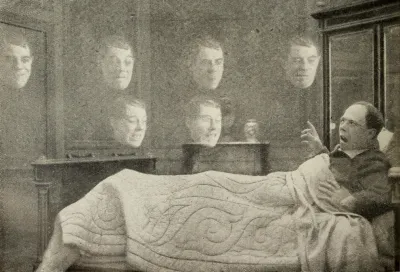
Charles Prince-Rigadin
Human Design Chart
Biography
On 20 December 1900 in Paris he married Emily Straham-Cager, a music hall artiste who performed under the name Miss Campton (1882-1930). They divorced two years later. He married Gabrielle "Gabby" Marchoux in Saint-Maur-des-Fossés on 1 September 1914. She was a comedian-actress nicknamed Totoche. He died on 18 July 1933, aged 61, in Paris, France.
What does Projector 1/3 mean for Charles Prince-Rigadin?
Projector 1/3 — Design at a Glance
Charles Prince-Rigadin revealed himself as someone who could identify weaknesses in systems and interpersonal dynamics with sharp acumen. His Projector design endowed him with a dense, focused aura akin to a bright flashlight that would be directed at dark spots around others. This trait allowed him to immediately recognize where processes were faltering or relationships were bumpy.
However, this direct confrontation with flaws was often counterproductive. When Charles Prince-Rigadin suddenly expressed his observations, it felt like glaring light in the face of those around him and frequently provoked resistance. The more effective way for him to express his design was by being a harmonious role model himself. By successfully shaping his own relationships or work methods, he became attractive to others; they would then seek out his advice on their own initiative.
The central strategy in his life was thus waiting for a respectful and honest invitation from others before bringing forth his leadership skills. Since his Sacral Center was undefined, Charles Prince-Rigadin lacked a constant source of life energy. He worked in phases of high intensity but had to take mandatory rest periods to avoid burning out. Living by this rhythm and the strategy of invitation rewarded him with success; ignoring these mechanisms led sooner or later to the typical bitterness experienced by Projectors.
Splenic Authority
Charles Prince-Rigadin guided his life decisions based on a subtle, immediate impulse. His inner authority lay in his defined Spleen Center, which required a specific configuration: both the Emotional and Sacral Centers were open. This structure grants unique survival intelligence that does not manifest through logical deliberation but as spontaneous inner knowledge. For Charles Prince-Rigadin, the first intuitive thought was always the right path; it served directly to enhance his physical well-being and health.
This Spleen impulse appeared only once per moment. It was subtle and could easily be drowned out by external influences, requiring high vigilance. Often, it helped him to briefly withdraw to hear this quiet voice clearly. Since knowledge of the right action was always available only in the present, his plans frequently changed short-term. Long-term commitments were therefore difficult and often counterproductive. Charles Prince-Rigadin needed a lot of space and flexibility to live up to this nature. He took good care of himself and rigorously distanced himself from harmful environments or societies. His decisions were made in the moment, guided by intuition and physical sensation rather than delayed through thought. This ability for spontaneous boundary setting was central to his well-being.
The 1/3 Profile — Investigator / Martyr
Charles Prince-Rigadin showed a tendency to validate theoretical knowledge always with practical experience. His design leaned towards a dual approach: laying the groundwork first, then experimenting and learning from mistakes. As someone with Profile 1/3, the Investigator and Experimenter, testing inspiration was paramount for him. He often felt unsure when he did not know enough but his inner drive pushed him to test new ideas in reality.
This dynamic resulted from the interaction between Line 1 and Line 3. Line 1 demanded individuality and careful scrutiny of whether a thought was truly novel or merely repeating old knowledge. Simultaneously, Line 3 required commitment in relationships and resource management as well as vigilance in dealing with the environment. For Charles Prince-Rigadin, this meant that his judgment about something became absolutely trustworthy once he had intellectually and practically examined it thoroughly. His strength did not lie in mere theory but in self-discovered knowledge through trial and error. He learned that productivity and mutual dependence in relationships were crucial to successfully implementing his ideas. His path was marked by the necessity of overcoming uncertainties with concrete actions while continuously testing the quality of his inspiration.
Split Definition — Defined & Open Centers
Charles Prince-Rigadin was characterized by a persistent internal mental pressure. The definition between the Head Center and Ajna Center created a constant process of questioning and understanding connections. However, this process was not directly linked to energy for implementation; lacking a connection to the motors meant that he often carried ideas as impulses waiting for the right moment or others to act upon them. At the same time, his clear willpower through his defined Heart Center allowed him to control his resources and promises independently, giving him strong self-esteem as long as he kept his word. His defined Spleen Center provided spontaneous intuition in the present moment, helping him recognize health and existential warning signs immediately.
In contrast, Charles Prince-Rigadin was open in several areas, making him susceptible to conditioning. His open Throat Center tended to feel pressured to demand attention through speaking rather than waiting for natural invitations to speak. The open G Center led to a lack of firm identity; he often adapted to his environment and sought direction through relationships and places instead of asserting himself. His undefined Sacral Center made him vulnerable to borrowed energy, which could lead to overloading since he did not always know when enough was enough. Additionally, his open Solar Plexus absorbed the emotions of others, making him emotionally vulnerable and prone to personalizing foreign moods as his own. Finally, his open Root Center took on external stress, often putting him in a cycle of trying to release this pressure through activity rather than simply avoiding it or using it consciously.
Channels for clear vision and instinctive devotion.
Charles Prince-Rigadin was characterized by a mental design that relied on sudden insights rather than linear logic. His thinking did not follow the past or measurable patterns but sought silence to receive inspirations from the subconscious. This was influenced by Channel of Awareness 61-24, connecting the Head Center with the Ajna Center. Here, the pressure to know the unknown transformed into rational answers. His mind repeatedly pondered topics until a moment of Satori occurred—a spontaneous mutation of knowledge he could not control. He had to learn to distinguish what was worth knowing from what wasn’t and surrender to the happy coincidence of this inner truth.
Simultaneously, Charles Prince-Rigadin possessed an instinctive sharpness in handling resources and people. Channel of Devotion 44-26 connected his Spleen Center with the Heart Center, giving him a deep tribal memory and the ability to intuitively recognize what others needed before they knew it themselves. He used the awareness of Gate 44 together with the willpower of Gate 26 to convincingly communicate his ideas or products. As an entrepreneur or promoter, he did not seek constant office work but acted efficiently in compressed phases. His success depended on whether the market or his tribe recognized and provided him a platform for his gifts.
Additionally, individual gates influenced him. Gate 19 connected him with the need for secure resources and territory as well as spiritual approach within the community. Gate 33 challenged him to actively withdraw and reflect to process experiences and avoid repetition. Gate 51 gave him strong willpower and the ability to respond to shocks with adaptation or mystical potential, which could be used both competitively and spiritually.
Individual Circuitry — Circuit Signature
Charles Prince-Rigadins design tended towards isolated, separate energetic focal points. As a person with Split Definition, he did not have an uninterrupted connection between his power centers; instead, two parallel independent energy blocks existed side by side. This shaped his experience as a series of distinct impulses that did not directly communicate with each other.
The Knowledge Circuit worked through him via the Channel of Awareness (Gates 24-61). This connected the Head Center to the Ajna Center, promoting innovative flashes and creative intuition translated immediately into conceptual structure. It was about generating new knowledge and forming it instantly, driven by a pulsing acoustic energy in the here and now.
Independently, the Ego Circuit acted through the Channel of Devotion (Gates 26-44). This connected the Heart Center to the Spleen Center, involving cooperation, mutual support, and joint creation of resources. Here, communication ability was central, paired with a conservative traditional approach for prosperity and material security. Since these two circuits were not linked in Charles Prince-Rigadin, his creative impulses from the Head area remained separate from his strategic resource-oriented actions in the Heart-Spleen domain. He had to learn to use these different energies as distinct tools without forcing them into one continuous flow.
Right Angle Cross of the Four Ways 1
Charles Prince-Rigadin's Human Design profile suggests a deep, often unspoken search for inner truth. This configuration, the right cross of four paths one, does not describe external hustle or a drive for immediate action but rather an intense focus on personal spiritual and psychological development.
For Charles Prince-Rigadin, this was a path marked by quiet observation and internal reflection. The right cross of four paths one in Human Design mechanics refers to energy that is not primarily discharged through external events but through the processing of experiences. It was a process of learning through life itself, where Charles Prince-Rigadin tended to penetrate situations internally first before bringing them outward.
This structure supported an attitude of patience and trust in his own inner rhythm. Rather than being guided by external expectations, his design followed a pattern of self-discovery. The energy of this cross promoted the ability to gain deep insights from personal challenges without necessarily having to display these publicly. For Charles Prince-Rigadin, this meant that his greatest strength lay in the authenticity of his internal stance. He lived a truth more defined by being than by words. This path did not require a grand stage but rather the willingness to stay true to oneself and acknowledge one's experiences as teachers.
Saturn Return · Uranus Opposition · Chiron Return · 2nd Saturn Return — Life Cycles
Charles Prince-Rigadin revealed himself in his second half of life as someone whose professional identity and personal fulfillment increasingly aligned. His design laid out a structure that around the age of forty led to a phase of bloom, where his potential fully unfolded. This Chiron Return did not mark a healing process in a psychological sense but rather an achievement cycle: those who had previously lived according to their inner authority now experienced the meaningfulness of their path as tangible reality. For Rigadin, this was reflected in the balance sheet of his film career; by 1920 he had made over two hundred films and thus firmly established his role as "Rigadin." This success was the logical consequence of a long-term orientation towards his natural expression.
Previously, two planetary cycles had shaped his personal commitments. The first Saturn Return around 1900, at age twenty-eight, brought stability and responsibility into focus, which was evident in his marriage to Emily Straham-Cager. Later, during the Uranus Opposition in 1914, a need for change and liberation emerged. At forty years old, he married Gabrielle "Gabby" Marchoux, a step that reflected his desire for new dynamics in partnership. These events illustrate how his astrological cycles accompanied concrete life decisions: from establishing a foundation to seeking something new, culminating in the final affirmation of his life's work.
Projector · Splenic Authority — Synthesis
Charles Prince-Rigadin lived a process of continuous expansion and refinement of his understanding. As a Projector with defined Spleen authority and the Profile of the Researcher/Experimentor (1/3), he was oriented towards recognizing patterns and testing them through personal experience. The connection between Head Center and Ajna Center (Channel of Awareness) indicates an ability to gain sudden insights and transform them into rational knowledge – a process that drove him deeper into material exploration and sharpened his judgments. Repeated evidence of relationships coinciding with significant cycles (Saturn Return, Uranus Opposition) underscores a lifestyle marked by a love for experimentation and the desire to learn through interaction.
A central paradox in his design lay in the tension between his Projector nature – the need to "bring light into darkness" and recognize errors – and his fine Spleen authority, which pointed towards instinctive perception of health and boundaries. He was thus destined to see and address patterns while his inner guidance simultaneously warned him against inappropriate situations. This dynamic suggests that he often found himself in a position where he felt the urge to correct things as well as the necessity to protect himself.
2 Defined Channels
Incarnation Cross - Right Angle Cross of the Four Ways 1
Solar Return
The Solar Return shows the moment when the sun returns to its exact birth position - your personal solar year.
Life Cycles
Discover the life cycles with a detailed triple view (birth chart, cycle chart, composite).
Human Design Profile
- Type
- Projector
- Strategy
- Wait for the respectful invitation
- Authority
- Splenic Authority
- Profile
- 1/3 - Investigator / Martyr
- Definition
- Split Definition
- Incarnation Cross
- Right Angle Cross of the Four Ways 1
- Date of Birth
- 27.04.1872 16:00
- Place of Birth
- Maisons Laffitte, France
Frequently Asked Questions
What was Charles Prince-Rigadin's Human Design type?
What profile did Charles Prince-Rigadin have in Human Design?
Which authority guided Charles Prince-Rigadin's decisions?
Which incarnation cross determined Charles Prince-Rigadins life path?
When was Charles Prince-Rigadin born?
Discover your own Human Design
Are you also a Projector? Find out in a personal reading how to unfold your leadership qualities and recognize the right invitations.
More Personalities
Back to overviewSissy Spacek

Alain-Fournier

Anémone

Ann-Margret

Arletty

Arno
