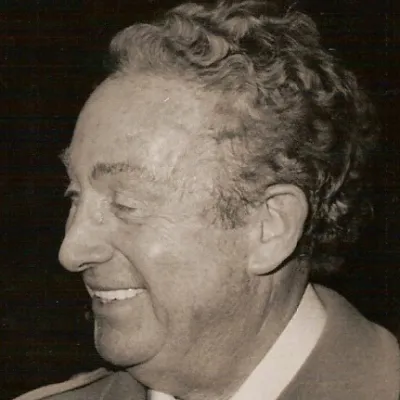
Charles Trenet
Human Design Chart
Biography
The Human Design of Charles Trenet: Generator 3/5
Generator 3/5 — Design at a Glance
Charles Trenet's design points to a tendency towards great endurance and inner strength, comparable to a workhorse that provides its energy as long as it is fueled by the task at hand. As a Generator, he had a lot of sacral energy, but it was released not through spontaneous initiatives, but through reactions to signals from life. The motto was clear: not to initiate, but to react. When his sacral center gave a clear 'yes', he responded with action. This strategy of reacting from the gut was the key to his effectiveness.
Living in harmony with this pattern rewarded him with deep satisfaction and a sense of fulfillment. The energy then flowed naturally and kept him upright. However, stepping outside this framework, such as doing things he had no desire to do or being prevented from his heart project while still full of power, threatened frustration and energy depletion. The danger was wasting energy or being forced to stop by external constraints before his inner drive was exhausted. His design thus showed that his strength lay in listening to impulses and responding to them, rather than fighting against the current or stopping prematurely.
Emotional Authority
Charles Trenet's design points to emotional wave movements. He showed himself as someone whose perception of the world was strongly colored by the current mood. In one moment, he could be totally enthusiastic about something, in the next, he could see the same matter negatively. These fluctuations were not whims, but expressions of his inner authority: emotional authority.
This authority was defined by his emotional center. A central mechanism of this center is that once it is defined, it always represents the inner authority - regardless of which other centers are also defined. Charles Trenet was thus subject to permanent ups and downs of feelings. However, his immediate feeling upon first impression was only a snapshot, not necessarily his deeper truth. Quick, spontaneous decisions from such an emotional peak could therefore have negative consequences.
The mechanics of his authority required patience. The more time he took to let a decision mature, the deeper and more comprehensive he could perceive the situation. This meant reconsidering decisions multiple times and 'sleeping on them'. Over time, the intense feelings subsided, he gained emotional distance. Only then did clarity and calm set in. This process was particularly essential for long-term, life-defining decisions. Charles Trenet therefore had to take his time and ask himself multiple times before acting to ensure he had gone through the emotional process and achieved true clarity.
The 3/5 Profile — Martyr / Heretic
Charles Trenet was someone who walked the path of the heroic adventurer and humorous rebel. His design as a 3/5 profile shaped him into an experimenter who initially accepted nothing and had to try everything himself. This line of the adventurer drove him to collect practical knowledge through trial and error. From these experiences, including failures, he later developed solutions for others. The line of the hero and rescuer made him present this treasure of life experience, which made him attractive to his environment, which wanted to learn from his insights.
This mechanism was connected with specific energetic patterns. In Gate 8, the question of style versus content was in the foreground; the external appearance was crucial for success, while the pure content remained secondary. Saturn disciplined the tendency towards hypocrisy here by limiting superficiality and forcing Charles Trenet not to hide his true nature to be accepted. Parallel to this, Gate 30 with its fifth line was at work. Here, irony and realism in expectations were key. The transience of goals was recognized, but Jupiter supported trust in progress, even in setbacks. Pluto warned against anger over the limits of the life cycle, while calmness and engagement helped find practical solutions. Thus, Charles Trenet learned from his experiments and transferred this self-learned knowledge to solve the problems of others, which flattered the role of the hero, but could also be painful when attempts failed in public.
Split Definition — Defined & Open Centers
Charles Trenet's design showed a tendency towards constant, conceptual clarity. His defined Ajna Center ensured a trustworthy mental function that created concepts and theories in a consistent manner. This internal structure combined with a defined Throat Center, allowing him to reliably translate what his mind conceptualized into language and action. His communication was thus not a spontaneous whim, but an expression of a firm inner logic.
Parallel to this, a defined G Center shaped his identity. He had a stable sense of his own direction and self-love, enabling him to show others new paths without needing their approval. This inner security was supported by a defined Heart Center, which gave him the willpower and ability to keep promises and determine his life. He preferred to work independently to control his ego and resources according to his own mechanisms.
As a Generator with a defined Sacral Center, he possessed a vast source of vital energy. His strategy was not to initiate but to respond to questions, to use his energy correctly and avoid frustration. This endurance was supported by a defined Root Center, which gave him the physical pressure to move forward in the world and master existential challenges.
In contrast, his open Head Center revealed a vulnerability to mental pressure. Without constant inspiration, he tended to get entangled in the doubts and questions of others or seek answers that were not his own. This center was a mirror of the thought world of his environment, meaning he had to learn to separate this external mental noise from his inner authority to avoid confusion.
Channels for meaning, inner strength and growing clarity.
Charles Trenet was someone who combined stubborn determination with a deep, almost mystical competitiveness. His design was marked by the Life Struggle Channel 38-28, which drove him to find personal meaning in every resistance and fight against external forces to maintain his integrity. This energy was amplified by the Initiation Channel 51-25, which linked natural competitiveness with universal love; it awakened in others the urge to transcend their limits and saw in every triumph a step towards individualization.
At the same time, he had the ability to logically organize complex patterns. The Accepting Channel 17-62 ensured that he translated visual impressions into precise language. He mentally organized details before speaking and found satisfaction in precisely explaining his opinions and what he understood or did not understand. This gave him the gift of structuring information in a way that was understandable to others.
His life force followed the Discovery Channel 29-46, which led him to fully immerse himself in experiences without expectations. Only through this unconditional yes could he remain persistent and be in the right place at the right time to forge new paths. This process of maturation was supported by the Maturation Channel 42-53, which required completing each cycle to gain wisdom.
Emotionally, he was driven by an intense desire for new impressions. The Recognition Channel 30-41 linked restless energy with the ability to deeply feel emotions. He had to wait for his emotional wave to gain clarity before jumping into his desires. Additional nuances included Gates like Gate 14, which handled power with grace, and Gate 55, which brought extreme mood swings. His design was a complex mix of combative individuality, logical structuring, and emotional depth.
Collective Circuitry — Circuit Signature
Charles Trenet's design showed a split structure that featured two independent, parallel existing power fields. One field connected the Ajna with the Throat Center, the other included Identity, Heart, Sacral, Root, Spleen, and Solar Plexus Centers. This separation meant that rational strategies did not directly flow into the emotional or powerful expression.
The Understanding Circuit connected Ajna and Throat Center in him. This promoted the sharing of logical, rational insights, free of emotional coloring, with a focus on future structures.
The Centering Circuit connected Identity and Heart Center. This gave him stable, courageous personality traits and strong convictions. However, without a connection to the Throat Center, these firm convictions often remained internal and were not necessarily articulated outwardly.
The Knowing Circuit connected Spleen and Root Center. This supported the expression of a unique identity through intuitive decisions and the handling of stress or life struggles, seeking new paths.
The Meaning Circuit connected Identity, Sacral, Root, and Solar Plexus Centers. Here, energy revolved around emotions and experiences from the past. Feelings and insights were processed in waves to learn together with the collective from the past and find meaning. These four circuits shaped his essence as a combination of separate but simultaneously active energy streams.
Right Angle Cross of Contagion 2
Charles Trenet's Human Design featured the right cross of infection. This configuration shaped a specific way of emotionally and energetically absorbing from the environment. In Human Design, this cross describes a particular sensitivity to the moods and energies of others, not just observed but deeply integrated into one's own system. It was not passive observation but an active, almost physical resonance with what was happening in the immediate surroundings.
This mechanism meant that Charles Trenet often acted as a mirror for the feelings of his environment. What others felt or radiated could lead to intense internal reactions in him. This created a connection that was both sensitive and binding. The energy of others was not blocked but integrated, leading to a deep understanding of human dynamics, but also to a high burden from foreign emotions.
The right cross of infection thus showed a capacity to directly absorb the vibrations of the world into himself. This shaped his way of interacting with others: through an immediate, almost intuitive connection that took place on the level of feelings and energies. It was a quality that fostered closeness, but also made the boundary between self and other permeable. Charles Trenet lived this dynamic by not just registering the energies of his environment but processing them as part of his own experiential world.
Saturn Return · Uranus Opposition · Chiron Return · 2nd Saturn Return — Life Cycles
Charles Trenet's Human Design showed a tendency towards intense, often confrontational life phases, where inner clarity was forced through external testing. This was evident in 1963, at the age of 50, when he was sued for the seduction of a minor. The accusation led to a trial in which he was acquitted on appeal. For his Human Design, this period marked the Chiron Return, a cycle of fulfillment and bloom. During this phase, between the ages of 49 and 51, the individual's incarnation cross unfolds increasingly in life. If the person has lived according to their strategy and authority, the inner meaning and purpose become experiential. The crisis of 1963 was not a moment of healing old wounds but a point where the deeper life task of Charles Trenet manifested in reality. The Chiron Return functioned here as a fulfillment cycle, in which the essential aspects of his design came into effect. The legal confrontation and subsequent acquittal were part of this process, in which the inner structure condensed and became visible outwardly. It was a phase in which his own identity and life direction were confirmed and strengthened through a severe test, without mythological narratives of injury or healing taking center stage. Instead, the pure efficacy of the design came to the fore.
Generator · Emotional Authority — Synthesis
Charles Trenet was a Generator, whose life was marked by a deep, sacral energy. He followed an inner logic (defined Ajna Center), characterized by a need for continuous processing and organization of information (Channel 17-62). This nourished his ability to collect experiences and transform them into stories – an expression of his Profile as an Explorer and Hero (3/5 Profile). He drew from a rich reservoir of experiences that he enjoyed sharing and which attracted others, while he remained in search of new experiences. This combination of inner processing and the desire to impart knowledge formed the red thread of his work.
At the same time, Charles Trenet lived in a tension field between the need for authentic expression and the emotional wave of his authority. His emotional authority required time to mature decisions, while his sacral center urged him to embrace the here and now and find energy for what truly excited him. A documented event, a legal confrontation (Chiron Return 1963), highlights the challenge of aligning these two forces and illustrates the complexity of his decision-making.
6 Defined Channels
Incarnation Cross - Right Angle Cross of Contagion 2
Solar Return
The Solar Return shows the moment when the sun returns to its exact birth position - your personal solar year.
Life Cycles
Discover the life cycles with a detailed triple view (birth chart, cycle chart, composite).
Human Design Profile
- Type
- Generator
- Strategy
- To respond - wait for something to respond to
- Authority
- Emotional Authority
- Profile
- 3/5 - Martyr / Heretic
- Definition
- Split Definition
- Incarnation Cross
- Right Angle Cross of Contagion 2
- Date of Birth
- 18.05.1913 16:00
- Place of Birth
- Narbonne, France
Frequently Asked Questions
What was Charles Trenet's Human Design type?
What Profile did Charles Trenet have in Human Design?
What Authority did Charles Trenet have?
What incarnation cross did Charles Trenet have?
When was Charles Trenet born?
Discover your own Human Design
Are you also a Generator? Find out in a personal reading how to use your sacral energy correctly and discover deep satisfaction.
More Personalities
Back to overviewSissy Spacek

Aaliyah

Alexia

Anémone

Angèle

Ann-Margret