
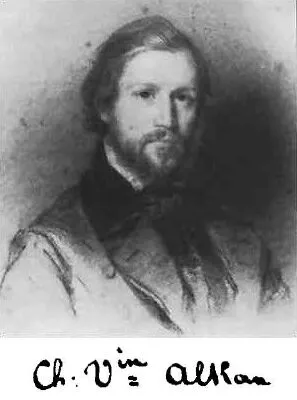
Photo: Wikimedia Commons
Charles Valentin Alkan
Human Design Chart
Biography
Crushed to death by falling bookcases 29 March 1888, Paris.
Human Design Analysis: Charles Valentin Alkan as Projector 3/5
Projector 3/5 — Design at a Glance
Charles Valentin Alkan had a focusing aura that acted like a bright flashlight, making system errors in his environment immediately visible. His design predisposed him to illuminate the way for others by bringing light into darkness. With his Sacral Center undefined, he did not have constant intrinsic life energy. Instead, he experienced phases of high productivity followed by mandatory rest periods to avoid burnout.
Direct confrontation with other people's flaws would have provoked rejection in him, similar to shining a bright light directly into someone's face. His most effective strategy was to attract others through his own harmony. When he lived a functioning lifestyle himself, people sought him out for advice. This happened sustainably only if he waited for a respectful and honest invitation.
If Charles Valentin Alkan followed this mechanism of attraction rather than imposition, he was rewarded with success. Ignoring the necessity of waiting for an invitation or trying to push his energy against environmental resistance led sooner or later to bitterness as an expression of not living in accordance with himself. His design thus demanded a balance between clear perception and patient restraint.
Emotional Authority
Charles Valentin Alkan was subject to an emotional wave that manifested in constant ups and downs of his feelings. His inner authority resided in the defined Solar Plexus Center; this instance always took precedence over all other defined centers of his design. He saw the world colored by his current mood: one moment full of enthusiasm, the next deeply negative. However, his feeling at any given moment was only a snapshot and not necessarily his truth. Quick, spontaneous decisions based on emotion often had negative consequences for him.
His mechanism required time and patience. He needed to let decisions mature, which meant multiple reconsiderations. It was important for him to be asked repeatedly and to take the time to reflect. Over time, intense feelings subsided; he gained emotional distance, leading to clarity and calmness. Only then had he gone through the process. This mechanism particularly shaped long-term decisions with significant influence on his life path. By waiting until the emotional wave calmed down, he could recognize his deeper truth beyond the often misleading first impression.
The 3/5 Profile — Martyr / Heretic
Charles Valentin Alkan revealed himself as someone who gained knowledge not from books but through personal, often painful experimentation. His design inclined him to initially doubt everything and only find his own truth through practical experience, including all mistakes and failures. This aligned with the dynamics of Profile Line 3, the experimenter line, for whom every failure was a necessary lesson to ensure future security.
This self-acquired, practical knowledge he did not use just privately. As Line 5, the Hero Line, he presented these insights to others to solve their problems. His ability to translate complex experiences into understandable solutions made him attractive in his environment and drew people who wanted to learn from his stories. This role of helper or 'hero' flattered his ego and gave him significance.
At the same time, this configuration harbored a specific tension: The need for validation through the hero role conflicted with the reality of experimentation. When he tried new paths in front of others and failed, it was particularly painful for him. His design challenged him to repel negative forces and use rest periods to maintain his steadfastness regardless of external approval or criticism. His strength lay in creating order from the chaos of his own mistakes, helping others.
Single Definition — Defined & Open Centers
Charles Valentin Alkan revealed himself through a defined Heart Center as someone with strong willpower and a pronounced need for self-determination. He preferred to determine his life himself, control his resources, and work independently to follow his inner rhythms. His ego strength was a natural source of authority; he knew his worth and expected recognition for his contribution. Yet this constant power met an equally defined Solar Plexus Center that functioned as emotional authority. Here lay the crucial dynamic: While the Heart offered immediate action capability, the Solar Plexus demanded patience. The truth revealed itself not in the moment of impulse but only at the end of the emotional wave. Alkan was designed to wait out the ups and downs of his feelings before making decisions. Spontaneous action from ego strength often led to chaos; true clarity emerged only through enduring the depth of emotion.
This internal tension was amplified by several open centers. The open Head Center made him vulnerable to mental pressure and the temptation to solve others' questions or get caught up in intellectual whirlwinds. He tended to wonder if he must find inspiring answers, which distracted him from his inner authority. Similarly, his Ajna Center being open gave him a flexible mind but also brought the risk of adopting other people's concepts as his own truth or pretending to be certain where no certainty existed. The open G Center meant a lack of fixed identity; he often sought direction and love through external initiation rather than from inner certainty. Additionally, the open Root Center absorbed external stress, which could push him to rush unnecessarily to escape this pressure. The wisdom of his design lay in holding back the immediate willpower of the Heart until the emotional wave of the Solar Plexus subsided – a process that required time and patience instead of impulsive power release.
Channels for communal connection and liberation.
Charles Valentin Alkan exhibited a foundational stance based on building deep, emotionally grounded connections. His design suggested that he did not take belonging for granted but rather sought it as something established through mutual recognition and clear agreements. This was not superficial social contact but a need for a community where everyone had an honourable place.
This tendency resulted from the Community Channel 37-40. This channel connected the Solar Plexus Center with the Heart Center, integrating the energy of the Friendship Gate (37) as well as that of the Solitude Gate (40). The mechanics of this channel described a dynamic tension between the desire for affection and the need to withdraw. A "good deal" or bond could not arise spontaneously here; it required careful consideration and emotional clarity with temporal distance. Only in this way was it ensured that the agreement – meaning "I do this for you if you do that for me" – would be sustainable for both parties. Spontaneous or impersonal contacts were rejected; instead, Alkan waited for a personal invitation, often accompanied by direct touch or intense contact over an extended period.
Additionally, other energies influenced his design. Gate 16 promoted experimenting and identifying with new skills, while Gate 9 provided the ability to work on details and perfect through repeated pattern correction. On the personality level, Gate 55 with its extreme mood swings and Gate 22 with its graceful ease and readiness to listen shaped his inner experience. This combination underscored the necessity of going through emotional waves before stable structures could be created. Alkan saw himself as a bridge-builder between individuals, ensuring that connections were based on willpower and mutual respect, not hierarchy or material calculation.
Tribal Circuitry — Circuit Signature
Charles Valentin Alkan was marked by a close connection between will and emotion. His design linked the Heart Center, seat of authority and the drive to act, directly with the Solar Plexus Center, origin of emotional waves. This configuration created a dynamic interaction: decisions were not only made rationally or willed but went through a process of emotional resonance. The emotional wave acted like a gear; it allowed feelings to be stored and processed before a clear stance was established.
This mechanism formed the core of the active Ego Circuit in him. Although the name sounds individual, this circuit belonged to the Family Group and focused on cooperation as well as the joint creation of resources. In Alkan, this was specifically pronounced through Channel 37-40, embodying the principle "Today I give you, tomorrow you give me." It was about mutual support and a balance between giving and taking within a community. This energy promoted conservative, traditional approaches to stabilize cohesion.
Since his design had no connection to the Sacral Center, the constant rhythmic life force of this center was missing in the Ego Circuit. This made adequate rest periods essential. Without these regeneration phases, the ability to produce resources for the Family would have been impaired. Alkan's structure therefore required an awareness that emotional processing and willful decisions needed time to stabilize before they translated into collective action. The energy was not flowing like water but built up, stored, and then acted with some inertia, requiring stability as well as the necessity of a pause.
Right Angle Cross of Planning 4
Charles Valentin Alkan revealed a deeply rooted tendency to grasp the big picture and align his steps coherently. His design indicated an ability to strategically plan ahead while always keeping the long-term goal in sight. This aligned with the archetypal energy of strategic planning, as marked by the right cross of Planning 4. This configuration emphasized an overview of life's path and encouraged understanding details not in isolation but as part of a larger pattern. For Charles Valentin Alkan, this meant that he often made decisions within the context of a broader vision, giving his actions an inner logic and direction. The mechanics of this cross supported him in deciphering complex situations and developing a clear plan that considered both short-term requirements and long-term ambitions. Thus, he could focus on what was essential and eliminate distracting influences, helping him pursue his goals with greater precision and determination. This strategic orientation shaped his actions and allowed him to maintain a steady compass even during uncertain times, guiding him through various life phases.
Saturn Return · Uranus Opposition · Chiron Return · 2nd Saturn Return — Life Cycles
Charles Valentin Alkan's life followed a clear structure marked by three turning points, which were delineated by Saturn return and Uranus opposition cycles. These phases shaped his development from a public crisis through a career change to a consolidated return to compositional work.
In 1844, at the age of 31, he experienced his first Saturn Return. This was a moment of structural testing: His symphony for large orchestra was announced and discussed in the press but never performed or published. The non-realization of this major project represented a public crisis, typical of the initial confrontation with the limits of one's ambitions.
The Uranus opposition cycle led to a brief career change in 1851 when he was 38 years old. He temporarily took over as organist at the Paris Jewish temple. This step marked a deviation from his original path, an entry into the sacral domain that did not last long-term.
His second Saturn Return in 1873, at age 60, brought consolidation. Alkan now aimed for cycles of "Six petits Concerts de musique classique." Instead of large, isolated works, he focused on smaller, cyclical forms. This showed a maturation towards a more sustainable approach after earlier attempts had failed. The mechanics of these cycles illustrated how structural turning points shaped his work: from disappointment through an alternative route to final consolidation in a more fitting form.
Projector · Emotional Authority — Synthesis
Charles Valentin Alkan lived deeply rooted in the observation and understanding of others' dynamics. His design as a Projector, paired with emotional authority, indicates a natural ability to recognize errors and potentials in systems—both in other people and complex structures. However, this sharp perception required patience; he needed time for his emotions to subside and clarity to emerge before sharing his insights. The combination of open Head and Ajna Centers suggests an ongoing intake of information that made him receptive to new ideas but also vulnerable to conditioning by others. He gathered knowledge and experiences to use in his environment—a pattern reinforced by his Profile as Explorer/Hero (3/5).
A central paradox in Alkan's design lies in the interplay between openness and a need for recognition. His open centers made him susceptible to other people’s energies, while his defined Heart Center signaled a strong ego and desire for self-determination. This led to tension between absorbing influences and insisting on his own inner truth, constantly navigating between adaptation and authenticity. He relied on others recognizing and inviting him to bring forth his gifts, yet he also had to protect himself from being overwhelmed by external influences.
1 Defined Channel
Incarnation Cross - Right Angle Cross of Planning 4
Solar Return
The Solar Return shows the moment when the sun returns to its exact birth position - your personal solar year.
Life Cycles
Discover the life cycles with a detailed triple view (birth chart, cycle chart, composite).
Human Design Profile
- Type
- Projector
- Strategy
- Wait for the respectful invitation
- Authority
- Emotional Authority
- Profile
- 3/5 - Martyr / Heretic
- Definition
- Single Definition
- Incarnation Cross
- Right Angle Cross of Planning 4
- Date of Birth
- 30.11.1813 15:00
- Place of Birth
- Paris, France
Frequently Asked Questions
What was the Human Design type of Charles Valentin Alkan?
Which Profile did Charles Valentin Alkan have?
What Authority did Charles Valentin Alkan possess?
What incarnation cross did Charles Valentin Alkan have?
Discover your own Human Design
Are you also a Projector? Find out in a personal reading how to unfold your leadership qualities and recognize the right invitations.
More Personalities
Back to overviewSissy Spacek

Aaliyah

Alain-Fournier

Alexia

Alizée

Anémone
