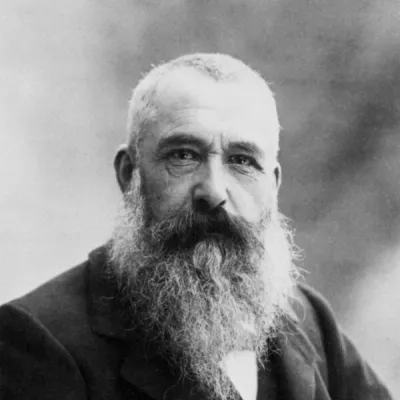
Claude Monet
Human Design Chart
Biography
Monet was raised in Le Havre, Normandy, and became interested in the outdoors and drawing from an early age. Although his mother, Louise-Justine Aubrée Monet, supported his ambitions to be a painter, his father, Claude-Adolphe, disapproved and wanted him to pursue a career in business. He was very close to his mother, but she died in January 1857 when he was sixteen years old, and he was sent to live with his childless, widowed but wealthy aunt, Marie-Jeanne Lecadre. He went on to study at the Académie Suisse, and under the academic history painter Charles Gleyre, where he was a classmate of Auguste Renoir. His early works include landscapes, seascapes, and portraits, but attracted little attention.
Human Design Analysis: Claude Monet as Projector 4/1
Projector 4/1 — Design at a Glance
Claude Monet's Human Design reveals a tendency towards a focusing aura, immediately recognizing system errors. As a Projector, his energy shone like a bright flashlight on areas others were still in the dark about. However, this ability to identify flaws instantly carried risks: directly addressing these issues often provoked resistance, akin to shining a bright light into someone's face.
Instead, his most effective strategy was passive attraction through his own harmonious glow. By embodying harmony himself, he became naturally attractive to others; people came to him seeking advice without prompting. This underscored the importance of always waiting for a respectful invitation to avoid making his dense aura seem unwelcoming.
Since his design lacks a constant energy center, he lived through phases of high activity followed by mandatory rest periods. These pauses protected against burnout and prevented bitterness, his non-self theme in the case of not living according to design. Through this rhythmic energy management, he secured success that Projectors achieve when correctly aligned with their path.
Emotional Authority
Claude Monet's decision-making was characterized by the need to fully experience emotional waves before acting. His inner authority resided in the defined Solar Plexus Center, meaning his perception was always colored by current feelings. He could be enthusiastic about something one moment and see it negatively the next. These fluctuations were not instability but a natural rhythm of his emotional energy.
The mechanics of this configuration dictated that spontaneous decisions based on immediate emotions were unreliable and potentially harmful. The feeling in the moment was merely a snapshot, not the deeper truth. Therefore, clear orientation required patience and time. Claude Monet had to take his time and sleep on decisions multiple times. Only when intense feelings subsided and emotional distance was gained did calmness set in. This process was essential for long-term direction setting as only then could he achieve comprehensive understanding. Emotional authority always took precedence over other defined centers in his design, regardless of further configurations. This protected him from impulsive reactions and allowed him to make decisions that truly aligned with his deepest nature rather than fleeting moods.
The 4/1 Profile — Opportunist / Investigator
Claude Monet's Human Design established a deep, unchangeable rooting of his essence. As the holder of Profile 4/1, the only fixed profile in Human Design, his character was barely deviant from his innate path. This marked the transition from 'I' to 'You', connected with a large heart that protected itself from wounds. Monet reacted sensitively to impulses for change; people who did not fully accept or criticized him cautiously excluded themselves from his emotional environment. Externally, this often appeared as stubbornness or lack of critical thinking, which could temporarily weaken his self-confidence.
This stance resulted from the combination of transpersonal fixation on deep knowledge (Line 4) with the Recruit energy of enduring (Line 1). Line 4 brought rigidity in knowledge transmission while Line 1 enforced commitment to struggle and learning through experience. Monet needed time to grow and understand when endurance was necessary. Once he found inner security and recognized his life theme, however, he became stable like a rock in the waves. In this phase, he could effectively communicate his insights and teach others magnificently by overcoming initial blockages through linguistic clarity. His development showed the path from defensive boundary setting to stable authority in dealing with his deeply rooted knowledge.
Triple Split Definition — Defined & Open Centers
Claude Monet's design inclined towards constant mental activity and deep emotional processing. His defined Head and Ajna centers generated a continuous pressure for inspiration, questioning, and concept formation. However, this mental flow was not directly manifestable through energy; it primarily served to stimulate others. Simultaneously, his defined Solar Plexus center acted as an inner authority. Emotional clarity was only achieved after going through his emotional wave, which prevented impulsiveness and required patience and waiting. The combination of mental pressure and emotional depth shaped his strategy: he waited for resonance and clarity before taking action or communicating.
This architecture meant that the mental pressure should not be misinterpreted as a directive to act. Hasty implementation of ideas without energetic support or emotional impulsivity before achieving clarity was among the typical pitfalls of his non-self behavior. His defined Throat center allowed him to express these processed concepts and feelings, while his defined Heart Center provided willpower and ego strength to keep promises and control resources. The defined Spleen and Root Centers supported him through intuitive signals in the present moment and a stable handling of stress.
In contrast, his vulnerability was evident in the open centers. His open G Center led to not having a fixed identity but blending with the environment and needing external initiations to find direction. He tended to question who he truly was or where true love could be found instead of trusting external initiations. His open Sacral Center made him susceptible to borrowed energy; he couldn't know when enough was enough, risking exhaustion through overexertion due to a lack of a consistent generative energy reserve. He had to learn to set boundaries and trust his inner authority rather than external energy flows.
Channel 43-23: Structuring — Channels & Gates
Claude Monet's design inclined towards a unique, mutative mind. He received insights as spontaneous breakthroughs and expressed them through assimilation. This configuration came from the Channel of Structuring 23-43. This channel connected the Ajna Center with the Throat Center. Gate 43 received inspired knowledge as sudden clarity, while Gate 23 processed it into articulate form. The challenge lay in letting go of control over the mental process. Monet had to wait until the timing was right for his innovative perspectives to be understood by the collective and not dismissed as foreign. His mind often felt like an outsider until the right words fell.
This individual spirit was complemented by the Channel of Logic 63-4. This channel connected the Head Center with the Ajna Center, bringing healthy skepticism into play. Gate 63 asked questions while Gate 4 examined patterns to find stability. This combination filtered information continuously to see if it held up. Doubt here was essential for logic; an answer was only considered true when it proved itself in practice and could be verified. Monet used this skepticism to validate his own insights before sharing them.
Additionally, juxtaposed energies acted situatively. The Channel of Synthesis 19-49 connected the Root Center with the Solar Plexus Center. It provided a fine sense of tribal belonging and emotional bonds based on principles and needs. Simultaneously, the Channel of Devotion 26-44 offered entrepreneurial instinct by connecting the Spleen Center with the Heart Center, enabling an intuitive grasp of what the tribe needed to be convinced. These channels did not consistently belong to his personality but appeared as situational aspects of belonging and persuasiveness in certain situations.
Tribal Circuitry — Circuit Signature
Claude Monet's design inclined towards structured, acoustic creativity driven by the Sun in Gate 43. This showed as pulsating energy seeking its true path. The Knowledge Circuit connected his Ajna and Throat Centers (Channel 23-43). This connection allowed structuring new knowledge into articulate form. The energy was focused on transformation through new expression.
Parallel to this, the Understanding Circuit worked. It linked the Head Center with the Ajna Center (Channel 63-4), creating a logical visual focus on the future. Claude Monet used this connection to share rational insights and develop strategies free from conditioning. The energy here was focused and goal-oriented.
A third, separate stream formed the Ego Circuit. As it wasn't connected with the other groups, it existed as parallel power. It comprised two parts: Heart and Spleen Centers (Channels 26-44 and 49-19) along with Solar Plexus and Root Centers. In the first part, it was about devotion and synthesis within cooperation and resource creation. The second part involved emotional waves impacting base energy. This circuit required pauses for calm as there was no direct connection to Sacral Air. The three definition types worked alongside each other: creative structuring, logical visioning, and cooperative resource building.
Juxtaposition Cross of Insight
Claude Monets design reveals a profound inclination towards perception: the drive to look beyond the apparent surface and penetrate the essence of complex situations. This attitude was not a fleeting mood but his fundamental archetypal imprint, defined by the Insight Cross.
This configuration pushed him to uncover illusions and bring clarity into the chaos of everyday life. The energy of this cross functioned as his central life task, promoting pattern recognition and awakening the desire to make hidden connections visible. It was not about superficial observation but a deep penetration of things to grasp their true nature.
For Claude Monet, this meant that his entire existence was marked by this quest for insight. He constantly sought truth beneath the surface world and tried to structure this clarity. The mechanics of this cross thus described his core identity: an insatiable desire to separate the essential from the inessential and bring light into dark corners through sharp perception. This archetypal force determined how he saw and understood the world, driving him always to seek the underlying order.
Saturn Return · Uranus Opposition · Chiron Return · 2nd Saturn Return — Life Cycles
Claude Monets design was structured by recurring astrological cycles marking his life phases. In 1868, at age 28, he received commissions from the shipowner Gaudibert in Étretat and Fécamp. This coincided with his first Saturn return, a time when years of groundwork often condenses into tangible results and new responsibilities are taken on.
Ten years later, in 1879, his first wife Camille died at age 32. Monet was then 39, corresponding to his Uranus opposition. This cycle often brings sudden changes or breaks that dissolve the status quo and force new paths.
Another turning point came in 1890 when Monet, now 50 years old, purchased the house in Giverny he had been living in for seven years. This marked his Chiron return, a fulfillment cycle of blooming. During this phase, one's incarnation cross increasingly unfolds in life; meaning and purpose become experiential if lived according to strategy and authority. It was not about healing old wounds but the realization of an inner plan.
Finally, Monet built a second studio in Giverny in 1897 at age 57, coinciding with his second Saturn return, a period of consolidation and deepening of established structures. These cycles shaped Monets path through clear milestones of building, transformation, fulfillment to consolidation.
Projector · Emotional Authority — Synthesis
Claude Monet was a projector defined by his Head and Ajna Centers (Channel 63/4), constantly searching for patterns and their constancy. This ability to identify system errors and formulate questions marked his perception and inspired him to see the world differently – a process connected with an inner pressure. His Profile as a 4/1 Networker reinforced this tendency towards deeply rooted individuality; he made connections only when they respected his core values and withdrew if others seemed to try changing him.
A central paradox in his design lay in the interplay of emotional authority and the knowledge circuit. While the emotional wave prompted him initially to perceive things from a certain mood and let decisions mature, the knowledge circuit simultaneously drove him to discover new things and initiate changes through creative impulses. This tension between inner maturity and the drive for innovation was evident in documented events – from early career commissions to the acquisition and expansion of his home – as a continuous cycle of withdrawal, observation, and creative unfolding.
4 Defined Channels
Incarnation Cross - Juxtaposition Cross of Insight
Solar Return
The Solar Return shows the moment when the sun returns to its exact birth position - your personal solar year.
Life Cycles
Discover the life cycles with a detailed triple view (birth chart, cycle chart, composite).
Human Design Profile
- Type
- Projector
- Strategy
- Wait for the respectful invitation
- Authority
- Emotional Authority
- Profile
- 4/1 - Opportunist / Investigator
- Definition
- Triple Split
- Incarnation Cross
- Juxtaposition Cross of Insight
- Date of Birth
- 14.11.1840 19:26
- Place of Birth
- Paris, France
Frequently Asked Questions
What was Claude Monet's Human Design type?
What Profile did Claude Monet have in Human Design?
Which Authority guided Claude Monet's decisions?
What incarnation cross did Claude Monet have?
When was Claude Monet born?
Discover your own Human Design
Are you also a Projector? Find out in a personal reading how to unfold your leadership qualities and recognize the right invitations.
More Personalities
Back to overviewSissy Spacek

Alain-Fournier

Anémone

Ann-Margret

Baekhyun

Balthus