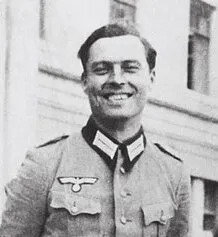
Claus von Stauffenberg
Human Design Chart
Biography
Stauffenburg became Chief of Staff; however, he gradually began to display his utter contempt of Hitler and the Reich. Joining the conspirators of the underground resistance, he became a key figure in the July assassination plot. It was he who carried an explosive in his briefcase to the guest barracks in Hitler's headquarters on 20 July 1944. The explosion failed to kill Hitler as he left the podium minutes before it went off. Stauffenburg was captured and shot the same day at the Bendlerstrasse, Germany.
Claus von Stauffenberg as a Manifestor 3/5 in Human Design
Manifestor 3/5 — Design at a Glance
Claus von Stauffenberg was someone who not only observed the world but actively sought to lead it. His Human-Design type was Manifestor – a configuration that marked him as a pioneer and visionary. The mechanics of this type compare him to a Roman emperor: He had the grand vision of an empire, yet he did not fight the battles himself; instead, he sent others to realize his plans.
This progressive mindset brought with it a central challenge: misunderstandings and polarization. As Claus von Stauffenberg often thought ahead of his surroundings, he was loved and followed by some but rejected or even hated by others due to his comprehensive visions. To minimize these tensions and find the right followership, it was essential for him to communicate his intentions and plans in a timely and precise manner. This strategy of informing served to preempt resistance and create clarity.
The consequences of this dynamic were emotionally palpable. When Claus von Stauffenberg followed his nature and informed before acting, his design rewarded him with a sense of inner peace. If he acted against this mechanism – without sufficient information or in secrecy – it resulted in an enduring, deep-seated anger within him. His path was thus marked by the tension between the necessity to exercise leadership and the risk of encountering rejection due to lack of transparency.
Emotional Authority
Claus von Stauffenberg's design showed a tendency towards cyclical decision maturity: He found inner clarity not at the moment of the first impulse but after experiencing emotional waves. His inner authority was emotional, carried by his defined Emotional Center. In Human-Design mechanics, this means that this center always takes precedence over all other defined centers – regardless of what else is activated in the chart. Stauffenberg was subject to a constant emotional wave, an up and down of feelings that colored perception continuously. What appeared inspiring at one moment could be negative the next. His immediate feeling was thus only a snapshot, not the final truth. Spontaneous actions based on current moods were unreliable and risky for his system. Instead, his structure required patience: Decisions had to ripen, often over several sleep cycles. 'Allowing oneself to be carried' was not hesitation in a negative sense but a necessary process. Over time, intense feelings subsided, emotional distance arose, and true calmness followed. Only then did deep, comprehensive clarity set in for Stauffenberg, which was required for long-term, life-defining steps. This mechanism systematically undermined quick judgments; only the patient showed itself as reliable.
The 3/5 Profile — Martyr / Heretic
Claus von Stauffenberg was someone who did not passively absorb knowledge but acquired it through radical personal practice. His design inclined him to initially question everything and experiment himself – a process of 'trial and error' that required failure and criticism before true competence emerged. This inner stance of Line 3 (Gate 43) propelled him to adapt through experience and seek renewal, independent of external reactions.
This hard-won knowledge then became the foundation of his impact on others. Line 5 (Gate 4) used these practical experiences to offer solutions and encourage others to take responsibility or protect themselves from punishment. He was attractive because he presented a treasure trove of lived experience that others wanted to embrace. Yet, this role of 'hero' carried a dilemma: It depended on recognition by the environment. Without this support, the solution remained incomplete; public failure during the experimentation phase could be painful. Stauffenberg thus moved within a dynamic where he had to learn and fail in secrecy before later appearing publicly as a competent problem-solver who charmed others with his gained wisdom and rewarded them.
Single Definition — Defined & Open Centers
Claus von Stauffenberg was characterized by a mechanical directness: what he thought was directly spoken or acted upon. His design united a defined Ajna Center with a defined Throat and a defined G Center. This constellation created consistent mental concepts that were translated into external communication without delay, driven by a firm inner identity. There was no separation between his thinking and manifestation; his voice served as the vehicle for this clear direction.
At the same time, his Solar Plexus Center was defined, making him an emotional authority. He had the ability to dive deeply into emotional waves and practice patience until clarity emerged at the end of the cycle. This contrasted with his open centers. The open Head Center made him vulnerable to external mental pressure; he tended to take on questions from others rather than seek his own inspiration. His open Heart Center lacked consistent willpower, posing a risk of wanting to prove himself through promises instead of trusting inner guidance.
The open Sacral Center made him sensitive to the energy of his environment; he could easily overextend by absorbing borrowed vitality from others rather than listening to his own episodically available power. Additionally, his Spleen Center was open, bringing a fundamental insecurity regarding health and well-being; he unconsciously sought security through others instead of making spontaneous decisions in the moment. Finally, his open Root Center absorbed external stress, making him vulnerable to overload when trying to release pressure not originating from himself. This combination shaped an individual with a clear voice and identity who had to learn how to protect himself from conditioning by foreign energies, emotions, and mental demands.
Channels for structuring, logical leadership and emotional openness.
Claus von Stauffenberg emerged as a leadership figure whose actions were based on a tension between logical structure and emotional intensity. His design inclined towards collective authority but was filtered through individual mood-driven impulses.
This dynamic constellation primarily formed through the Alpha Animal Channel 7-31, connecting the G Center with the Throat Center to create a profile for logical, collective leadership. Claus von Stauffenberg had the ability to recognize trustworthy patterns and articulate them clearly. His influence rested on being recognized as someone who understood existing societal trends. He did not seek absolute dominance but rather an influential position within a 'pack,' where he gained trust through competence and logical arguments. His leadership role depended on the majority inviting him to take up this task; without collective approval, his potential remained unfulfilled.
Simultaneously, the Openness Channel 22-12 fundamentally shaped his mode of communication. This pathway connected the Solar Plexus Center with the Throat Center and subjected his expression to the ebb and flow of his emotional wave. Claus von Stauffenberg did not articulate himself rationally cold but rather with passion, melancholy, or dramatic intensity. His words had a transformative effect on his environment, yet this power only fully ignited when he was in the right mood. Forced social interaction led him to harshness and misunderstandings; patience until the appropriate emotional timing was crucial for his interpersonal effectiveness.
Additionally, the Structuring Channel 43-23 influenced his approach by connecting the Ajna Center with the Throat Center. This gave him spontaneous mental insights and innovative perspectives that he translated into clear concepts. These individual realizations could enhance efficiency and change thought patterns if communicated at the right time.
In summary, Claus von Stauffenberg's profile utilized logical leadership patterns to gain trust, whose true expression depended on emotional resonance and individual mental clarity.
Individual Circuitry — Circuit Signature
Claus von Stauffenberg exhibited a tension between emotional transformation and rational strategy. His design linked Ajna, Throat, and Solar Plexus Centers in the Knowledge Circuit, fostering creative flashes of insight and the expression of individual identity through emotional waves. Simultaneously, the Understanding Circuit via the Alpha Animal Channel (31-7) connected the Throat with Identity Center, focusing on clear, logical insights for societal improvement free from conditioning.
These two circuits formed distinct energies: one pulsing creativity and emotional authenticity, the other visual strategic logic for the future. Claus von Stauffenberg integrated these forces by expressing new identities through emotions while sharing rationally structured solutions. The simplicity of his definition allowed a clear flow within these groups without external disruptions hindering the process. Thus, a dynamic emerged between individual innovation and social responsibility – a synergy of heart and mind driving both personal and collective change.
Right Angle Cross of Explanation 4
Claus von Stauffenberg's Human Design profile established a profound, often unconscious loyalty to an internal truth. His existence appeared less as a result of intellectual deliberation and more as a direct response to an inner quest for integrity and authenticity. This configuration described the right cross of Manifestor 4, whose energy compelled him to make his life itself a statement.
The clarity about his path did not arise through planning beforehand but rather in the process of living itself. It was about the quality of being as an explanation for action, independent of external validation or understanding. Claus von Stauffenberg demonstrated an unconditional commitment to this inner truth. The mechanics of this cross emphasized that authenticity was the central driving force; he lived his existence as proof of a higher purpose. This was not a strategic decision in the conventional sense but a structural necessity of his design, which compelled him to fully submit to this internal logic, even if it did not always appear comprehensible from the outside.
Saturn Return — Life Cycles
Claus von Stauffenberg's Human Design profile indicated a tendency towards structured self-determination that intensified as he transitioned into adulthood. This was evident in 1933: at age 26, he was promoted to Oberleutnant. For his Human Design, this marked the typical moment of the first Saturn Return cycle. This cycle signifies the consolidation of identity and the transition into full adult responsibility. During this period, the foundation for long-term life structure is laid down, where inner maturity confronts external expectations. The promotion was not just a career step but reflected a deeper mechanical development: his self-understanding was solidified and translated into a clear position. Claus von Stauffenberg lived through this process of identity formation by embracing new responsibilities. The first Saturn Return served as a catalyst to stabilize previous developments and establish a sustainable basis for future actions. Confrontation with the demands of this new role helped him sharpen his inner structure and align himself with the long-term goals of his design.
Manifestor · Emotional Authority — Synthesis
He was a Manifestor, who through the defined Mental Center (Ajna) and the Channel of the Alpha Animal (Gate 7-31), developed a clear vision of logical leadership. This combination shaped a character not only oriented towards initiating new paths but also on designing them with strategic foresight. His profile as an Innovator/Hero/Rescuer (Profile 3/5) reinforced this trait, by gathering knowledge through personal experiences to guide others – a pattern that repeated in attempts to question existing structures and highlight alternative pathways. Emotional authority required time for decision maturation, which created internal tension within his goal-oriented nature.
A central paradox lay in the connection between the Manifestor drive for change and the emotional wave. While the design was geared towards quick initiation and implementation, emotional authority demanded a process of feeling and waiting. This led to dynamics where he had a clear vision of the future (Alpha Animal) but could not implement it without considering internal processes – a blend of impulsive vision and reflective evaluation.
3 Defined Channels
Incarnation Cross - Right Angle Cross of Explanation 4
Solar Return
The Solar Return shows the moment when the sun returns to its exact birth position - your personal solar year.
Life Cycles
Discover the life cycles with a detailed triple view (birth chart, cycle chart, composite).
Human Design Profile
- Type
- Manifestor
- Strategy
- To inform others before acting
- Authority
- Emotional Authority
- Profile
- 3/5 - Martyr / Heretic
- Definition
- Single Definition
- Incarnation Cross
- Right Angle Cross of Explanation 4
- Date of Birth
- 15.11.1907 01:00
- Place of Birth
- Jettingen, GER
Frequently Asked Questions
What was Claus von Stauffenberg's Human Design type?
What profile did Claus von Stauffenberg have?
What authority guided Claus von Stauffenberg?
What incarnation cross did Claus von Stauffenberg have?
When was Claus von Stauffenberg born?
Discover your own Human Design
Are you also a Manifestor? Find out in a personal reading how to use your initiation power peacefully and dissolve resistance.
More Personalities
Back to overviewChristian-Jaque
Kesha

Laurent-Eynac
Lucebert
Masaccio

Papus