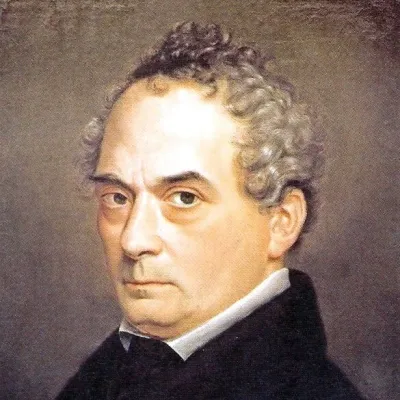
Clemens Brentano
Human Design Chart
Biography
The Human Design of Clemens Brentano: Manifesting Generator 6/2
Manifesting Generator 6/2 — Design at a Glance
Clemens Brentano revealed himself as someone marked by a hybrid energy configuration: He possessed the constant power of a Generator but also had the ability to accelerate processes and skip steps. This design allowed him to pull things into his life at lightning speed, enabling him to act with a velocity that pure Generators could not match.
This mechanism arose from the active connection of his Motor Centers to the Throat Center, thereby integrating Manifestor qualities. Nevertheless, his primary strategy was Reacting: He should not initiate but respond to inner impulses. Only when his Sacral Center gave a clear "yes" did his speed become effective.
Without this alignment, Clemens Brentano tended to move too quickly and neglect important intermediate steps, often leading him to return to fill gaps. Additionally, he frequently responded to multiple impulses simultaneously and started various projects in parallel. This multitasking ability was not a distraction for him but an essential part of his creative power. As long as he respected his inner authority and entered into a playful mode, he drew deep satisfaction from this variety. The pressure to focus on one thing stood in opposition to his natural rhythm; rather, he needed the freedom to pursue different strands simultaneously to optimally use his energy and prevent frustration.
Sacral Authority
Clemens Brentano lived as a Generator whose decision-making was marked by sacral authority. This inner voice did not manifest in the Head Center but rather as physical reactions to external stimuli: spontaneous grunts, hums, or simple "mmms" signaled agreement and energy. Once his sacral motor kicked in, he felt vital and acted with great enthusiasm, completely free of compulsive purposefulness. His strategy was to wait for this inner response before reacting – simplifying his process since strategy and authority were identical.
The prerequisite for this clear sacral leadership was his open Emotional Center. This allowed him to avoid the trap of interpreting emotional waves as immediate truth; instead, he trusted the immediate physical resonance in his belly region. Additionally, his activated Spleen Center served as a supportive instance. Through this connection, Clemens Brentano had quick and instinctive access to his well-being. He could spontaneously and reliably listen to his inner perception, enabling him to make decisions quickly that aligned with his bodily intelligence. His life thus followed the rhythm of these inner signals: energy came when he let himself be guided by sacral responses, and contentment arose through engaging in activities that received this inner affirmation.
The 6/2 Profile — Role Model / Hermit
Clemens Brentanos Design is characterized by a clear biphasic development in his life path. In his younger years, he acted as an experimenter who learned through trial and error. This early phase was marked by the necessity to gather many personal experiences, with retreats following failures being the driving principle. Initially, he sought immediate practical experience to find himself without possessing a fixed wisdom.
This dynamic resulted from his 6/2-line in Human Design. Before turning thirty, the energy of the 3-line dominated, aiming at spontaneous action and learning through direct consequences. Only after this turning point did the 6-line fully activate. Clemens Brentano then withdrew into a phase of intense distancing to reflect on his earlier experiments. This retreat served for healing and deeper self-knowledge.
From this introspective period, he eventually developed a clear methodology. His aura changed from that of a searching individual to that of a tribal leader who checks alignments and follows his own path. He refused to blindly adopt foreign methods if they contradicted his personal interests. Instead, he created a system that could serve others. Other people recognized his acquired wisdom and came to him to learn from his ability for deep introspection. His role was not to offer mere inspiration without solutions but through mindfulness to gain mental security and overcome confusion.
Triple Split Definition — Defined & Open Centers
Clemens Brentano lived with a constant internal pressure to ask questions and understand connections. His defined Head and Ajna centers created permanent mental activity; inspiration for him was often just the beginning of a question, not the answer itself. This state could cause concern when he tried to immediately turn unresolved issues into actions, instead of giving others space to think.
His energy source lay in his defined Sacral center. As a Generator, he possessed vital power that could only be unfolded through reaction. Initiating actions without prior questioning often led to resistance and exhaustion. His defined Heart and Spleen centers gave him willpower as well as a sharp instinct for what was healthy at the moment. He had the resources to fulfill promises and could intuitively distinguish between beneficial and harmful influences.
At the same time, Clemens Brentano was open in two areas and thus vulnerable to conditioning: the G center and the Solar Plexus center. Without a firm internal identity, he tended to blend with his environment or seek a borrowed direction. He often wondered if he was at the right place or who he actually was, instead of waiting for the right moment and people to initiate him.
His open Solar Plexus absorbed other people's emotions like a sponge. This led him to feel foreign moods as his own, which could result in inner confusion or a desire to avoid conflict. He had to learn not to personalize these emotional waves. Only by distancing himself from these foreign feelings and trusting his sacral response and spleen instinct did he find clarity in a life that oscillated between intense mental inspiration and the search for external validation.
Channels for logic, focus, intuition and devotion.
Clemens Brentano's design tended towards analytical skepticism, paired with the ability to focus intensely on details. The Logic channel 63-4 connected Head and Ajna centers, making his mind constantly filter patterns to check stability. Doubt was essential here; only through logical experimentation and verification did he arrive at a valid answer. This created an active mind that asked questions to provide useful predictions for the collective instead of accepting unfounded beliefs.
Parallel to this, the Concentration channel 52-9 between Root and Sacral centers worked. Through the Gate of Non-action (52) and the Gate of Focusing (9), he maintained a calm pressure to remain silent and keep distractions at bay. This format energy allowed him to focus precisely on facts and challenge or perfect patterns as soon as his sacral reaction prompted him.
His creative expression was shaped by the Wavelength channel 48-16, connecting Spleen with Throat centers. Here, the intuitive depth of Gate 48 sought life-critical information while Gate 16 perfected skill through repeated practice. Clemens Brentano thus combined inner intelligence with technical mastery to gradually refine his talent and develop a unique expression form that sought recognition.
Additionally, the Devotion channel 44-26 between Spleen and Heart centers showed an entrepreneurial instinct power. With watchful perception (Gate 44), he recognized tribal needs and used willpower (Gate 26) to convincingly convey appropriate solutions or ideologies. This combination of logical scrutiny, focused work, talented refinement, and intuitive conviction defined his way of moving and acting in the world.
Collective Circuitry — Circuit Signature
Clemens Brentano's design presented three separate energetic blocks that existed parallel without directly flowing into each other. This triple definition created an internal complexity from various forces not always integrated.
In the Understanding Circuit, the Logic channel connected Head and Ajna centers. This generated a direct flow of impulsive ideas to focused processing. Parallel to this, two further disconnected segments of the same circuit worked: The Wavelength channel connected Throat and Spleen centers, meaning the ability to articulate intuitive perceptions verbally. Unconnected from this, the Concentration channel flowed between Sacral and Root centers, a pure energy source for endurance and physical presence. These three strands did not form a cohesive experience but separate operational units: pure ratio without emotional coloring of Solar Plexus.
The second block lay in the Ego Circuit, belonging to the tribal group. Here, the Devotion channel connected Heart and Spleen centers. This connection promoted cooperation and joint creation of resources through mutual support. Since this circuit did not connect to the Sacral center, constant life force was lacking; instead, this configuration required rest pauses for energy regeneration for the tribe.
The third block consisted of the isolated Heart Center within the group with Throat and Spleen (connected by the Ego channel). Overall, Clemens Brentano appeared as someone whose energies worked in these three specific spatially separated clusters: on one hand rational processing and intuitive communication, on the other tribal cooperation and physical endurance – all existing side by side but not energetically seamlessly connected.
Left Angle Cross of Dominion 2
Clemens Brentanos design indicated a tendency towards deep, often unspoken authority. He did not assert his will loudly or forcefully but rather through a quiet inner certainty that drew others in unconsciously or challenged them. This structure, the left cross of Authority Zone 2, described an internal foundation based on the ability to bring order and stability into chaotic situations—not through external control but by radiating reliability and groundedness.
For Clemens Brentano, this meant his true strength lay in serving as a reliable anchor during uncertain times. He possessed a natural authority that was less about claiming power than leading others through his own presence and consistency. This energy required patience; it did not manifest immediately but condensed over time. His challenge was to avoid mistaking external titles or coercion for inner mastery. Instead, his chart showed a life task: mastering the art of subtle leadership where influence is gained through trust and constancy rather than command. This shaped his interactions profoundly as he learned that true authority stems from inner peace and others only follow when they feel this stillness as safe.
Saturn Return · Uranus Opposition · Chiron Return · 2nd Saturn Return — Life Cycles
Clemens Brentanos design indicated a tendency towards profound life turning points structured by cyclical planetary influences. His first Saturn return in 1806, at the age of 28, marked a point of condensation and crisis: the death of his wife Sophie Mereau as well as the birth of his third child. This cycle was a moment when personal responsibility and loss were simultaneously active.
Ten years later, in 1818, he encountered the Uranus opposition at age 40. This influence brought sudden changes in relationships: Luise Hensel's conversion to Catholicism and the beginning of recording Anna Katharina Emmerick's visions in Dülmen. Here, the potential for unexpected turns was evident, dissolving existing structures and opening new spiritual directions.
The Chiron return in 1824, at age 46, functioned as a fulfillment cycle where his inner purpose further unfolded—though accompanied by the death of Anna Katharina Emmerick. This time emphasized the connection between personal development and letting go of tight bonds.
His second Saturn return in 1833, at age 55, brought structure and new relationships: meeting Swiss painter Emilie Linder and publishing his work “Das bittere Leiden unsers Herrn Jesu Christi”. This cycle condensed years of spiritual labor into a concrete result. Clemens Brentanos design thus showed a life line where crises and turning points did not appear as coincidences but as structural moments of maturation and meaning.
Manifesting Generator · Sacral Authority — Synthesis
Clemens Brentano lived a life marked by a continuous interplay between inner drive and the need for retreat. As an Manifesting Generator, he had the ability to quickly initiate things (sacral center), yet his design required a reaction to impulses rather than self-initiated action. This dynamic process, combined with the 6/2 profiling, points towards a life path characterized by experiments in youth followed by intense reflection and wisdom in old age—a constant oscillation between action and contemplation (Authority Zone 2 cross). The defined Head Center (Logic Channel) intensified this inner pressure to question patterns and formulate insights while the connection to Ajna Center created a deep longing for understanding.
A central paradox in Brentanos design lay in the interplay of quick energy and the need for thorough examination. Sacral authority challenged him to follow bodily impulses and surrender to life force, yet the defined Head Center (Gate 63) generated constant doubt and the necessity to filter everything logically. This tension between the impulsive action of a Manifesting Generator and the analytical rigor of the mind circuit likely led to phases of intense activity followed by times of inner withdrawal—a cycle of movement and stillness further emphasized by documented cycles (death, relationship, death).
4 Defined Channels
Incarnation Cross - Left Angle Cross of Dominion 2
Solar Return
The Solar Return shows the moment when the sun returns to its exact birth position - your personal solar year.
Life Cycles
Discover the life cycles with a detailed triple view (birth chart, cycle chart, composite).
Human Design Profile
- Strategy
- To respond - wait for something to respond to
- Authority
- Sacral Authority
- Profile
- 6/2 - Role Model / Hermit
- Definition
- Triple Split
- Incarnation Cross
- Left Angle Cross of Dominion 2
- Date of Birth
- 09.09.1778 04:00
- Place of Birth
- Koblenz-Ehrenbreitstein, Germany
Frequently Asked Questions
What was Clemens Brentano's Human Design type?
Which Profile did Clemens Brentano have in Human Design?
Which Authority guided Clemens Brentano's decisions?
What incarnation cross did Clemens Brentano have?
When was Clemens Brentano born?
Discover your own Human Design
Are you also a Manifesting Generator? Find out in a personal reading how to unfold your multi-talents and direct your energy wisely.
More Personalities
Back to overviewAlain-Fournier

Aldair

Alizée

Angeli

Arletty
Artus