
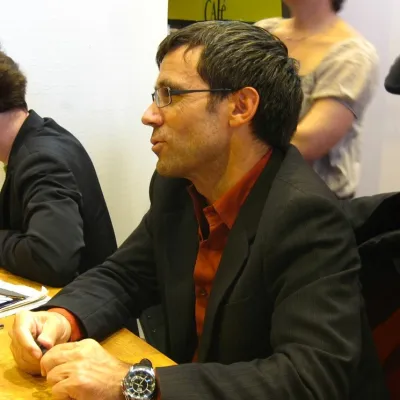
David Pujadas
Human Design Chart
Biography
What does Manifesting Generator 6/2 mean for David Pujadas?
Manifesting Generator 6/2 — Design at a Glance
David Pujadas was shown to be someone who worked with hybrid energy: he possessed the constant power of a Generator, yet also had the ability to accelerate processes and skip steps. This design tended towards lightning-fast implementation, allowing him to quickly pull things into his life. However, this speed carried specific risks. Often, he tended to overlook important intermediate steps, leading to the need to return and complete them later – a process that could quickly lead to frustration, as it touched upon the central non-self theme of the Manifesting Generator.
Sacral Authority
David Pujadas was shown to be someone whose decision-making relied on direct, physical resonance. His design suggested that he did not act through intellectual analysis but responded to inner signals. This results from his sacral authority, which is only available to the Generator type and here also represents the strategy. This alignment simplified his process: he did not have to choose between different inner voices but could trust in a single source.
A prerequisite for this was an open emotional center, ensuring that no emotional waves overlapped the clear physical response. His sacral authority manifested as a 'gut feeling' or a sudden surge of energy in response to external stimuli. He learned to pay attention to these physical noises – such as grunts, hums, or simple utterances like 'Mhm'. When his sacral motor engaged with something, he felt vital and alive. Then, he had almost inexhaustible energy at his disposal, enabling him to complete his work with great enthusiasm.
His design predisposed him to go through life with joy and satisfaction, fully immersed in his activities without the need for strict purposefulness. Additionally, a supportive spleen authority was at work. Since the spleen center was activated and possibly directly connected to the sacral center, David Pujadas could react particularly quickly and spontaneously. This gave him immediate access to his physical well-being and instinctive perception, which he could reliably follow.
The 6/2 Profile — Role Model / Hermit
David Pujadas was marked by a design that, in the first decades of life, was characterized by intensive experimentation and the principle of trial and error. Before the return of Saturn, that is, until around the age of 30, his 6/2 line primarily functioned as a 3-line. This created a phase in which he collected many of his own life experiences, often retreating after setbacks to recognize patterns.
With the activation of the sixth line after the age of 30, this dynamic fundamentally changed. David Pujadas metaphorically withdrew into a distance to look back at his earlier experiments from a great height. This phase of intense reflection served healing and deep self-knowledge. The mechanics of line 6 emphasized the joy of small successes and trust in details and the process itself. For him, the path to the goal became more important than the result alone; persistence and gratitude for each step characterized this period.
At the same time, the second line, which is associated with confusion and inner development, contributed to him often being observed from the outside. While he could be caught in thought loops himself, objective memories of others helped him gain clarity. From this combination of introspective distance and process-oriented persistence, wisdom eventually developed that he shared with others. People sought him out to learn from his ability for deep self-reflection and to partake in his life wisdom. His design thus described a path from chaotic experimentation to clarifying, shared insight.
Single Definition — Defined & Open Centers
David Pujadas was marked by a design that combined a consistent, trustworthy mental function with a clear inner direction. His defined Ajna Center ensured that he created concepts and theories in the same way every time, allowing him to inspire others to think by applying pressure, without being easily influenced from the outside. This mental stability flowed directly into his defined Throat Center, enabling him to articulate what his mind conceptualized. His voice served as a reliable anchor point to make this information effective in the world as communication and action.
At the same time, David Pujadas had a defined G Center, which gave him a firm sense of self-identity and a sense of his correct life direction. He could love others without being dependent on them and naturally showed them new ways. This inner security was reinforced by his defined Sacral Center, which provided a vast source of vital energy. As a guardian of this power, he generated a constant energy reserve daily, but it only had a lasting effect when he responded to questions rather than initiating them himself. His sacral response—a clear yes or no—determined whether energy was available for a task and protected him from exhaustion when he followed this mechanical truth.
Despite this strong inner structure, David Pujadas was vulnerable to external conditioning through several open centers. His open Head Center lacked a consistent way to process mental information; he tended to get stuck in doubting monologues when trying to find answers to questions that were not his. His open Heart Center lacked consistent willpower, which could lead him to find himself in a cycle of promises and disappointment to prove his worth. Additionally, his open Solar Plexus absorbed the emotions of his environment, causing him to avoid confrontation to avoid triggering emotional waves. His open Spleen Center made him vulnerable to fears and the urge to hold onto things that gave him a false sense of security, while his open Root Center amplified external stress that he did not generate himself. These open centers challenged him to not identify with foreign pressure, emotions, or fears but to trust his defined inner resources.
Channels for rhythm, inspired expression and curious search.
David Pujadas drew attention to himself through his mere presence and authentic expression without actively seeking it. This attitude was rooted in the mechanics of the Inspiration Channel 1-8, which connects the G Center with the Throat Center. This channel allows a mutative perspective to be creatively expressed; the effect is not achieved through explanation but through the exemplary life of one's individuality, inspiring others to unfold their own uniqueness.
This inspiring presence was dynamically reinforced by the Beat Channel 14-2. As a connection between the Sacral and G Centers, this channel provides the generative energy and competence in handling resources to initiate new directions. David Pujadas could thus bring innovative perspectives into the world by trusting that life makes decisions through him, mechanically reinforcing others to find their own direction.
Parallel to this, the Channel of Curiosity 11-56, which links the Ajna Center with the Throat Center, drove him to constantly seek new ideas and perspectives, not to find definitive answers but to tell stories that stimulate the imagination of listeners. His communication served to convey information as living parables that invited others to question new beliefs.
This structure was supported by specific gates: Gate 9 promoted the ability to refine through repeated experiments. Gate 16 allowed mastery in skills through continuous experimentation. Gate 63 used doubt as a motor process to resolve uncertainties and improve patterns. Gate 64 helped interpret past experiences to gain clarity. Gate 12 brought a poetic, emotionally colored quality to the expression. Gate 15 ensured adaptation to natural rhythms and collective behavior. Gate 59 focused on genetic strategies of bonding and unification. Gate 62 established logical frameworks and pattern recognition. Gate 10 in the G Center integrated these influences and supported survival through the right behavior at the right time.
Individual Circuitry — Circuit Signature
David Pujadas exhibited a fundamental attitude based on the expression of a unique identity. His design connected the Throat Center, the Identity Center, and the Sacral Center directly. This connection allowed him to bring new insights and creative impulses—fed by the Inspiration Channel (Gates 1 and 8) and the rhythm of the 'Beat' (Gates 2 and 14)—immediately into the world. It was about the inherent path of initiating change through the expression of one's individuality.
Parallel to this, there was a separate, non-identity-related connection between the Ajna Center (Mind) and the Throat Center. This Channel of Curiosity (Gates 11 and 56) focused on perceiving and reflecting on past experiences. While the first stream was pulsating and creative, directed at the moment, this second stream followed a cyclical, wave-like movement of emotions. David Pujadas used this structure to process felt insights from the past and share them with others. Both energies existed side by side: the powerful, innovative expressive strength of identity and the reflective, meaning-making processing through the mind, together shaping his way of transforming and passing on knowledge.
Left Angle Cross of Identification 2
David Pujadas is marked by the left cross of Identification, a configuration that brings a deep inclination towards self-discovery and distinguishing the essential from the non-essential. This design element promotes an attitude where the self is not seen as a fixed entity but as something dynamic, defined through constant questioning and reflection.
The mechanics of this cross direct attention to how one perceives oneself and how one is perceived by others. It is not about superficial identity but about the core question: Who am I truly, beyond roles and expectations? This inner work often requires a withdrawal from the general hustle and bustle to gain clarity. David Pujadas' design suggested that he used moments of isolation or contemplation to go through these inner processes.
The energy of this cross supports the ability to recognize patterns in one's own behavior and in the environment. It is a tool for sharpening one's perspective, helping to reduce confusion and find a more authentic alignment. Through this continuous process of identification, a stable foundation for decisions and actions that align with one's essence is created.
Saturn Return · Uranus Opposition · Chiron Return · 2nd Saturn Return — Life Cycles
David Pujadas is shown as someone who strengthened his professional identity through external structuring and temporal milestones. His design indicated a tendency to anchor himself in phases of maturation and confrontation with established systems.
In 1989, at the age of 25, Pujadas began his career as a television journalist at TF1. This marked his first Saturn return, a cycle that often brings years of groundwork to a solid result. Here, the inner discipline necessary to establish a foothold in a structured field became visible.
Later, in 2001 at the age of 37, he took over the moderation of the main news program '20 heures' on France 2. This fell during the Uranus opposition, a phase that brings deep changes and the questioning of previous roles. For his design, this was a moment of transformation, moving from an established position to a new, more responsible role. The mechanics show how external events mirror inner developmental steps: first laying the foundation, then expanding the structure. Pujadas' path illustrates how these astrological cycles shape concrete career turning points without him fighting against his natural rhythm.
Manifesting Generator · Sacral Authority — Synthesis
A central red thread runs through the design: the dynamic connection between initiation and reaction. As a Manifesting Generator (MG), he possesses the ability to accelerate processes and quickly initiate things, yet the sacral authority challenges him to primarily react to impulses. This combination of apparent freedom of action and inner guidance, reinforced by the Knowledge Circuit and the Channel of Inspiration (1-8), points to a person who both unfolds creative energy and takes on a role as an exemplar - especially after a phase of intense self-reflection (Line 6). The defined mental center allows him to form concepts and inspire others through his presence.
The central paradox lies in the tension between the drive to express and transform one's individuality (Knowledge Circuit) and the necessity not to rush (MG type). The left cross of Identification 2 underscores this inner conflict by highlighting the challenge of finding and living one's identity while simultaneously meeting others' expectations. Documented events at the ages of 25 (career start) and 37 (taking over a main moderation role) show how he navigated this dynamic throughout his life.
3 Defined Channels
Incarnation Cross - Left Angle Cross of Identification 2
Solar Return
The Solar Return shows the moment when the sun returns to its exact birth position - your personal solar year.
Life Cycles
Discover the life cycles with a detailed triple view (birth chart, cycle chart, composite).
Human Design Profile
- Strategy
- To respond - wait for something to respond to
- Authority
- Sacral Authority
- Profile
- 6/2 - Role Model / Hermit
- Definition
- Single Definition
- Incarnation Cross
- Left Angle Cross of Identification 2
- Date of Birth
- 02.12.1964 23:00
- Place of Birth
- Barcelona, Spain
Frequently Asked Questions
What is David Pujadas' Human Design type?
What Profile does David Pujadas have in Human Design?
What Authority does David Pujadas have?
What incarnation cross does David Pujadas have?
When was David Pujadas born?
Discover your own Human Design
Are you also a Manifesting Generator? Find out in a personal reading how to unfold your multi-talents and direct your energy wisely.
More Personalities
Back to overviewAlain-Fournier

Aldair

Alizée

Angeli

Arletty

Artus
