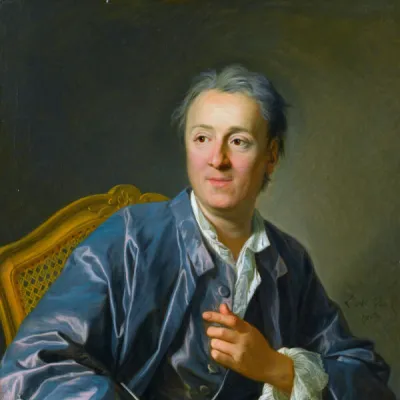
Denis Diderot
Human Design Chart
Biography
Diderot initially studied philosophy at a Jesuit college, then considered working in the church clergy before briefly studying law. When he decided to become a writer in 1734, his father disowned him. He lived a bohemian existence for the next decade. In the 1740s he wrote many of his best-known works in both fiction and non-fiction, including the 1748 novel Les Bijoux indiscrets (The Indiscreet Jewels).
In 1751 Diderot co-created the Encyclopédie with Jean le Rond d'Alembert. It was the first encyclopedia to include contributions from many named contributors and the first to describe the mechanical arts. Its secular tone, which included articles skeptical about Biblical miracles, angered both religious and government authorities; in 1758 it was banned by the Catholic Church and, in 1759, the French government banned it as well, although this ban was not strictly enforced. Many of the initial contributors to the Encyclopédie left the project as a result of its controversies and some were even jailed. D'Alembert left in 1759, making Diderot the sole editor. Diderot also became the main contributor, writing around 7,000 articles. He continued working on the project until 1765.
What does Manifesting Generator 3/6 mean for Denis Diderot?
Manifesting Generator 3/6 — Design at a Glance
Denis Diderot's Human Design profile inclines towards extraordinary speed paired with the ability to bypass established processes. As a Manifesting Generator, he combined the constant energy source of a Generator with the direct expression of a Manifestor, enabling rapid progress in his undertakings while simultaneously creating a specific risk: the tendency to skip important intermediate steps or become overwhelmed by pursuing multiple impulses at once.
Without inner resonance, this speed often led to frustration, his characteristic non-self experience. His mechanics therefore required a disciplined strategy of responding rather than simply initiating action. Only when his Sacral Center responded with a clear "Yes" to an impulse could he effectively utilize his energy. Regular checks on this internal agreement were crucial for maintaining his creative power and preventing frustration.
With proper application of this dynamic, a state of deeper satisfaction emerged. In this "Play Mode," working simultaneously on various projects was not a burden but a source of fulfillment. The requirement to focus on a single task would have blocked his natural energy. Instead, Denis Diderot drew his greatest strength from variety and playful engagement with his diverse interests, as long as he listened to the inner confirmation.
Emotional Authority
Denis Diderot's Design established a specific decision-making structure: His inner authority carried the defined Solar Plexus Center. In Human-Design mechanics, this means that this center always took the lead regardless of which other centers were also defined. This configuration marked him as someone whose perception and judgment were strongly influenced by emotional waves. His feelings underwent constant ups and downs; he saw the world colored by his current mood. What appeared totally inspiring in one moment could seem negative in the next.
However, this emotional impulse was only a snapshot, not necessarily his deeper truth. Quick, spontaneous decisions made from such an immediate situation would often have had negative consequences. The mechanics of his authority required patience and time. He needed the process of "multiple sleeps" to gain clarity. Only when intense feelings subsided and emotional distance emerged did calmness set in. This journey through the emotional wave was crucial for long-term decisions with significant influence on his life path. Only by this hesitation and waiting out initial impressions could he recognize his true direction, rather than being led by passing moods.
The 3/6 Profile — Martyr / Role Model
Denis Diderot's design set forth a development that took place in two clearly distinct phases. Until the age of about 29 years, he primarily acted as an experimenter. During this time, isolated action was at the forefront; Line 3 of his Profile demanded a certain separation from collective life to develop personal depth and taste. This occurred through conscious entering into and breaking out of relationships and making mistakes – a necessary protective mechanism to sharpen discernment.
With the return of Saturn around the age of 30, a fundamental shift took place. The reflective Line 6 became active and brought the playful energy of Line 3 together with wisdom and overview. Denis Diderot now often found himself in an internal tension field: externally, he might appear controlled, yet internally he felt torn between the desire for further playfulness and the urge for deep reflection. Line 6 brought the ability to solve problems, intended as an altruistic gift to enable others to have the right spirit. Since this mutation was not often accepted at that time, this insight could seem provocative or unwelcome. Only after the age of 50 did he fully integrate both perspectives and became a role model for others through his charm and accumulated wisdom.
Split Definition — Defined & Open Centers
Denis Diderot's design indicated a tendency towards constant, willful expression strength that was modulated by emotional cycles. His defined Heart Center provided willpower and self-responsibility; he liked to determine his life himself and kept promises. The defined Sacral Center delivered an enormous vital energy source, a constant hum of power that required activity. These energies flowed into his defined Throat Center, the pivot point for communication. His voice spoke reliably from these engines: 'I want this,' coupled with a consistent way of expressing himself.
At the same time, his open centers shaped a specific vulnerability. The open Head Center meant no constant mental focus; he was susceptible to pressure to find answers that were not his own and tended to get entangled in others' mental confusion or doubts. Similarly, the open Ajna Center offered a flexible mind that absorbed concepts from the environment rather than holding firm theories of its own. He could easily give an impression of certainty to be accepted, although his ideas often came from outside.
The open G Center lacked a fixed identity or direction. Diderot tended to blend with his surroundings and adopt 'borrowed' identities. He did not actively seek a solid sense of self but reacted to places and people that gave him temporary direction. The open Spleen Center amplified fears related to health and survival; he was sensitive to the well-being of others and tended to cling to individuals with defined spleen energy for a feeling of security rather than drawing his own intuitive boundaries.
This configuration created tension: The inner strength from Heart, Sacral, and Throat stood in contrast to the need to wait for emotional clarity. His defined Solar Plexus was his internal authority; he had to go through an emotional wave before making decisions. In the highs or lows of this wave, he tended towards impulsive actions that were later regretted. Only at the end of the cycle's calm did he find truth. The open centers Head, Ajna, and G required discipline not to be taken over by foreign opinions or identities, while the defined Root provided a constant pressure to move forward without becoming obsessive.
Channel 59-6: Mating — Channels & Gates
Denis Diderot showed himself as someone who sought deep intimacy but was strongly dependent on material self-determination, with his emotional authenticity regulated by a pulsing wave of joy and melancholy. This configuration combined the urge for merging with the will to master the material plane.
The Channel of Union 59-6 drove the desire for intimacy and fertility in relationships. Through the Gate of Sexuality (59) in the Sacral Center and the Gate of Friction (6) in the Solar Plexus, a powerful energy emerged that promoted personal, penetrating connections. However, patience was required: The emotional wave of the Solar Plexus had to be waited out to gain clarity and avoid confusion. Only after building a friendship could true intimacy develop.
Parallel to this, the Channel of Money Line 21-45 conveyed the will for control over work and resources. Linked through the Gate of Hunter (21) in the Heart Center and the Gate of Gatherer (45) in the Throat Center, this channel stood for responsibility on the material plane. Independence was central; Denis Diderot worked best as his own boss to avoid stress and follow his natural rhythm. The challenge lay in exercising control without being controlled while supporting others.
Additionally, the Channel of Emotions Release 39-55 shaped his emotional landscape. Through the Gate of Provocation (39) in the Root Center and the Gate of Spirit (55) in the Solar Plexus, a moodiness emerged that swung between ecstatic joy and melancholic uncertainty. This wave served to filter out the mind and enable authentic connections. It was crucial to act only in the right mood; otherwise, frustration or manipulative tendencies threatened. Accepting this emotional depth allowed him to express his inner truth and influence others through this authenticity.
Together, these three channels formed a profile that sought deep relationships, claimed material independence, and used emotional waves as filters for true connections. Synthesizing these energies required balance: waiting for emotional clarity before intimacy, securing material control without overburdening oneself, and accepting his moodiness as a source of creative power.
Tribal Circuitry — Circuit Signature
Denis Diderot's design presented two separate yet parallel existing energy systems. The first system connected the Solar Plexus to the Root Center via the Channel 'Emotions Release.' This generated a pulsating, acoustic energy that released emotional waves in rhythmic bursts. This configuration promoted individual identity and creative transformation through intuitive impulses without directly channeling these to other centers.
The second system linked the Heart with the Throat Center via the 'Money Line.' Here it was about resource-oriented cooperation: giving and taking on equal footing as well as material security. Without a connection to the Sacral Center, this energy required phases of rest for regeneration before new resources could be created.
A third aspect appeared in the Hunter Circuit through the Channel 'Union' between Sacral and Solar Plexus Centers. This connected the constant life force of the Sacral with the emotional waves of the Solar Plexus, supporting instinctive protection and care for one's environment.
This divided definition meant that Denis Diderot did not act as a single continuous energetic flow. Instead, the impulsive creative transformation energies of the Knowledge Circuit and the structured dynamics of the Ego Circuit operated as independent forces. The energy distributed to these areas since no central sun position existed, leading to an interplay between emotional innovation and resource-preserving structure.
Right Angle Cross of Tension 3
Denis Diderot's design indicated a tendency towards precise, analytical dissection of information. He was someone who fought against vagueness or unclear concepts and consistently sought logical consistency. This attitude stems from the right cross of tension 13 in his chart.
In Human Design mechanics, this cross symbolizes the archetypal power of intellectual clarity. It marks an internal boundary to irrationality and chaos. Those carrying this structure tend to not only understand complex connections but also present them through rigorous logic. The goal is always to eliminate ambiguity or multiple interpretations in favor of a clear, understandable truth.
For Denis Diderot, this meant a constant tension between the raw, often contradictory reality and the need to fit it into a coherent whole. His energy was directed towards resolving confusion. It wasn't mere curiosity but a deep drive for order through analysis. This mechanism shaped his way of seeing the world: as something that must be deciphered and rationally justified in order to truly understand it. Clarity was not an end in itself, but rather a tool against the chaos of unstructured experience.
Saturn Return · Uranus Opposition · Chiron Return · 2nd Saturn Return — Life Cycles
Denis Diderot's development proceeded in clear phases of consolidation and change. In 1740, at age 27, during his first Saturn return, he lived on Rue de l’Observance and moved several times. This cycle marked a time of structural consolidation, where external conditions were reordered.
Ten years later, in 1754 at the age of 41, the Uranus opposition occurred: Diderot regularly attended chemistry lectures by Guillaume-François Rouelle. This disruptive cycle promoted a need for new perspectives and intellectual renewal, moving away from established patterns towards experimental learning.
In 1761, at 48 years old, he reached his Chiron return – a fulfillment cycle. During this phase of bloom, he wrote the continuation of the novel “La religieuse,” while Richardson died. Here, the increasing unfolding of his life purpose was evident; inner clarity translated into concrete creative achievement without focusing on healing past wounds but rather on realizing his essence.
Finally, in 1770 at age 57, his second Saturn return shaped his career: Diderot wrote a review for “Garrick, or the English actors” and changed his understanding of theater. This cycle condensed years of experience into a stable, mature position. The recurring planetary influences structured his life from structural order through radical renewal to deep self-realization and final consolidation.
Manifesting Generator · Emotional Authority — Synthesis
He possessed dynamic energy that showed in the combination of sacral persistence and manifesting speed (Manifestor Generator). This configuration drove him to quickly grasp and implement ideas – a process amplified by emotional waves (Emotional Authority). The initial phase of his life was marked by experimental joy (Profile 3/6 Line 3), an unceasing trial of various paths, later complemented by deeper reflection and the need for overview (Line 6). His defined communication and manifestation area indicates that he always translated inner impulses into expression and action. The channel of pairing suggests a deep emotional connection to creative energy.
A central paradox lay in the tension between his sacral drive to react to the present moment and his emotional authority, which required time for maturation processes. He tended to quickly initiate things (skip steps), yet he often had to return to gain clarity – a pattern evident across different life phases from moves to dealing with new knowledge areas like chemistry or acting. The cycles emphasized this shift between action and reflection, where each Saturn return initiated an intense phase of inner transformation.
3 Defined Channels
Incarnation Cross - Right Angle Cross of Tension 3
Solar Return
The Solar Return shows the moment when the sun returns to its exact birth position - your personal solar year.
Life Cycles
Discover the life cycles with a detailed triple view (birth chart, cycle chart, composite).
Human Design Profile
- Strategy
- To respond - wait for something to respond to
- Authority
- Emotional Authority
- Profile
- 3/6 - Martyr / Role Model
- Definition
- Split Definition
- Incarnation Cross
- Right Angle Cross of Tension 3
- Date of Birth
- 05.10.1713 17:00
- Place of Birth
- Langres, France
Frequently Asked Questions
What is the Human Design type of Denis Diderot?
What Profile did Denis Diderot have in Human Design?
What Authority did Denis Diderot have?
What incarnation cross did Denis Diderot have?
When was Denis Diderot born?
Discover your own Human Design
Are you also a Manifesting Generator? Find out in a personal reading how to unfold your multi-talents and direct your energy wisely.
More Personalities
Back to overviewAldair

Alizée

Angeli

Arletty

Artus

Balthus