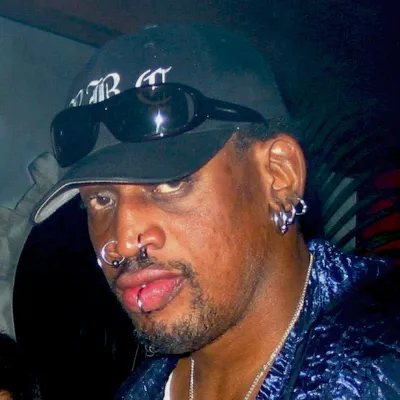
Dennis Rodman
Human Design Chart
Biography
By 1993 he had two championship rings on his way to a second straight rebounding title. He had played in two All-Star games and was the NBA Defensive Player of the Year twice. He was wildly popular in Detroit, loved what he did and the adulation that went with it. He had it all, a Ferrari, name recognition, money, fame and glory.
Yet, on an April night in 1993, he debated killing himself with a shotgun. It was his seventh and last season with the Pistons and the team was going downhill fast. He was making $2.5 million a year and looking at the guys who were making ten times that, feeling out in the cold and sorry for himself. Always flamboyant, always an exhibitionist, always driven, he decided in that conversation with his shotgun that he was going to be whoever and whatever he wanted to be. From bottoming out, he emerged with a fuller identity.
The first thing he did was bleach his hair blond. The fans went nuts. When he was in college he had stuck quarters in his ears to get attention. Now he went over the top. He moved on to pink hair, a ring in his nose, multiple earrings, painted fingernails. Sometimes he wore women's clothing, "exploring his feminine side." He said that a sequined halter top and tight leather shorts "made him feel like a whole person, not just one-dimensional." Rodman's second book, released in 1997, Walk on the Wild Side, was full of sex and obscenities, so much so that Oprah Winfrey cancelled an appearance that Rodman was scheduled to do on her show. Included in the work were details of his affair with a transsexual and the reasons for which he dates white women versus black women, as well as other information about his "identity.
Dennis Rodman as a Projector 4/6 in Human Design
Projector 4/6 — Design at a Glance
Dennis Rodman appeared as someone who instantly understood the system and precisely identified the weaknesses of others. His Projector design gave him an intense, focused aura, comparable to a bright flashlight shining into dark corners. This trait allowed him to recognize errors in structures or relationships of others immediately. However, this direct perception, when communicated without invitation, could trigger resistance in others, similar to light shining directly into someone's face. His most effective form of expression did not lie in active correction but in shining through his own harmony. By living his own lifestyle, he became attractive to his environment; others then sought his advice on their own. His strategy was to wait for an honest invitation before sharing his knowledge. Since Projectors do not have a constant energy source, they are subject to natural phases of high activity followed by necessary rest phases for regeneration. Ignoring this rhythm need led to burnout. Living according to this pattern, however, was rewarded with success. Deviations from it tended to lead to bitterness, the typical non-self-experience of this type, when recognition was lacking or energy was not conserved.
Emotional Authority
Dennis Rodman's design laid a tendency to emotional wave movements that significantly shaped his perception of the world. He appeared as someone whose view of situations was strongly colored by the current mood: one moment totally enthusiastic, the next moment the same matter negatively evaluated. This shift was linked to his emotional authority, carried by the defined Solar Plexus Center. In Human Design mechanics, this authority is always prioritized, regardless of other defined centers in the chart. This means that his inner truth did not lie in the immediate reaction but in the depth of the emotional wave. Quick, spontaneous decisions based on current feelings risked being based on a mere snapshot that had not yet reflected his true clarity. Instead, his system required patience and the conscious drawing of time. By reconsidering decisions multiple times and creating space for emotional distance, intense feelings could subside. Only then, when calmness set in and the initial intensity subsided, did the deep, comprehensive insight set in, necessary for long-term life decisions. This process of waiting and letting things mature was not an obstacle but the essential mechanism to uncover his inner truth.
The 4/6 Profile — Opportunist / Role Model
Dennis Rodman's design inclined towards intense experimentation in relationships and friendships, especially in the first three decades of life. During this phase, his Profile Line 6 still appeared like a Line 3, which encouraged him to try various things and move through the social network. Over time, as Line 6 becomes active, an internal conflict between the desire to belong to the community and the urge to withdraw to think about the meaning of life became apparent. This contradiction between heart and head could be confusing.
The fourth line of his profile, referred to as 'Splitting', describes an expansion without synthesis. It attempts to gain influence through the network, which often leads to isolation or exclusion if this does not succeed. This dynamic can lead to paranoia and atheism, as the network does not always understand the individual expression.
The sixth line considers a begun revolution and carefully decides on support. It poses important questions about principles and their impact on justice. Engagement can bring surprising results, but it takes a long time for the decision to be made. The Neptune elevation allows the potential for transformation through personal example. In the Saturn case, it is often rejected and future changes are pointed out. The decision is based on emotional clarity and the question of whether principles are positively influenced. Dennis Rodman was expected in his later years to meet the high standards of a wise role model and stand out through cooperation with other people. His big heart was always cautious about opening up to the wrong people and getting hurt.
Split Definition — Defined & Open Centers
Dennis Rodman's Human Design profile suggests a tendency towards consistent, self-determined expression of will, coupled with continuous mental and emotional processing. His defined Heart Center provided a steady source of willpower and ego strength; he could keep promises and assert his own value without being dependent on external expectations. This energy flowed directly into his defined Throat Center, allowing him to communicate his intentions and concepts clearly and reliably. Simultaneously, his defined Ajna Center was always active: he thought continuously, developed his own concepts, and was difficult to distract by external mental influences. His inner authority lay in his defined Solar Plexus Center, meaning he did not make decisions immediately but waited for emotional clarity before acting.
This stable inner life contrasted with his open centers. His open Head Center made him vulnerable to mental pressure and the temptation to seek answers to questions that were not his own problem. His open G Center led to his identity and direction being strongly shaped by the environment; he adapted rather than embodying a fixed, unchanging personality. His open Sacral Center meant he did not have a constant generative energy but absorbed the vitality of others, which could lead to exhaustion if he ignored his boundaries. Additionally, his open Spleen Center was sensitive to well-being and fear, while his open Root Center took in and amplified external stress and adrenaline from the environment rather than generating it.
Channels for clear insight and organic community.
Dennis Rodman's Human Design profile suggests a tendency towards innovative, often anticipatory thinking, which could be expressed through clear, efficient communication. This was influenced by the Channel of Structuring 43-23, which combined spontaneous insights (Gate 43) with the ability to assimilate and explain (Gate 23). His mind sought unique perspectives that could change collective understanding, but required the right timing to be accepted. Without this patience, he risked being perceived as an outsider, as his knowledge was not always immediately understood.
At the same time, there was a deep emotional dynamic regarding belonging and exchange. The Channel of Community 37-40 connected the desire for recognition and a place in the whole (Gate 37) with the need to take breaks and receive reward for work done (Gate 40). This configuration emphasized that true connections and 'business' – in the broad sense of mutual benefit – needed emotional clarity and time to become sustainable. Spontaneous decisions were less effective here than carefully negotiated agreements based on mutual respect and the feeling of being part of a larger whole.
Additional influences came from Gates emphasizing transformation and principled loyalty (Gate 49) as well as logical formulation for future security (Gate 4). Gate 55 added extreme emotional swings, while Gate 20 promoted awareness of the present moment. Gate 31 brought an energy of transmission and leadership, and Gate 21 stood for the control of material resources in service of the community. Together, these elements created a profile that swung between radical innovation and the need for stable, emotional anchoring within the group.
Individual Circuitry — Circuit Signature
Dennis Rodman's Human Design profile suggests a tendency towards structured individual expression strength, which paralleled a strong but separate ability for mutual support. These two energetic poles were not directly connected but existed as independent, side-by-side fields of power.
The Knowledge Circuit connected his Ajna Center (intellect, thought processes) with his Throat Center (expression, communication) through the Channel of Structuring (Gates 43-23). This configuration promoted the ability to bring his own thoughts and ideas into a clear, tangible form. It was not about spontaneous inspiration or creative flashes, as described by other parts of this circuit, but about organizing and giving form. Dennis Rodman was someone who emphasized his unique identity through structured expression and holding to his own boundaries.
At the same time, he possessed the Ego Circuit, which connected his Heart Center (will, identity) with his Solar Plexus Center (emotions, intuition) through the Channel of Community (Gates 40-37). This channel represents the principle of give and take and mutual support within a group. Since this circuit did not connect to his Sacral Center (constant life energy), the energy here was wave-like and required pauses for regeneration. Dennis Rodman was able to connect emotional waves with intentional action to create resources collectively and nurture relationships through reciprocal exchange.
Both circuits were isolated from each other due to shared definition. The structured individuality in the Head-Throat area did not flow directly into the emotional, community-oriented dynamics of Heart and Solar Plexus. Instead, they operated as separate but coexisting aspects of his personality: once the structured loner who asserts his form, and once the emotional partner who relies on reciprocity.
Right Angle Cross of Explanation 2
Dennis Rodman's Human Design profile suggests a tendency towards radical, often provocative self-revelation. He presented himself as someone who, through his mere presence and unconventional appearance, inevitably drew the attention of others, not through subtle charm but through a nearly aggressive directness. This attitude stems from the right cross of Explanation 2 in his chart. This configuration describes an energy designed to reveal truths or aspects of one's personality so clearly and unambiguously that they cannot be ignored. It's not about diplomatic concealment but about breaking conventions to make one's essence visible. Dennis Rodman used this mechanical drive to question societal norms and to act as a mirror reflecting the projections of his environment. His way of showing himself was a direct expression of this inner logic: what was inside him had to come out to be understood or at least noticed. This dynamic shaped his entire demeanor, as the right cross of Explanation 2 possesses a specific quality of revelation that aims less at approval and more at pure perception. For him, this open, sometimes shocking transparency was not a conscious act of rebellion but the natural result of his energetic structure, programmed to bring hidden aspects to light.
Saturn Return · Uranus Opposition · Chiron Return · 2nd Saturn Return — Life Cycles
Dennis Rodman's Human Design profile suggests a tendency towards cyclical turning points where inner development translates into external recognition. This was evident in 1989, at the age of 28, when he won the NBA championship with the Detroit Pistons. This success fell during his first Saturn Return, a phase where years of groundwork and structural maturation often culminate in a solid, visible result. The design supports the consolidation of achievements.
Later, in 2000 at the age of 39, he ended his career with the Dallas Mavericks. This step corresponded with the Uranus Opposition, an astronomical event often associated with fundamental structural breaks, detachment from old roles, and the necessity of new alignment. It marked the end of a long chapter.
The peak of this development line occurred in 2011 when he was inducted into the Naismith Memorial Basketball Hall of Fame at the age of 50. This fell during his Chiron Return, a fulfillment cycle of about two years. During this phase, one's incarnation cross increasingly unfolds in life, provided the person has lived according to their strategy and authority. Meaning and purpose become experiential, and the life task reaches its bloom. His induction into the Hall of Fame is a testament to this late but clear confirmation of his individual path.
Projector · Emotional Authority — Synthesis
A central red thread runs through the design: the ability to recognize and highlight patterns where things do not work (defined Ajna Center, Channel of Structuring). This gift comes with a Projector Essence aimed at bringing 'light into the darkness' for others and illuminating the path. The profile as a Networker/Role Model indicates that this ability to understand and explain connections plays a special role in later life – connected with the expectation to function as a wise advisor and to stand out through cooperation. Emotional authority strengthens this process by allowing a deeper, though delayed, understanding beyond the first impression.
The central paradox lies in the interplay between Heart and Head (Line 4/6 in the profile). The desire to belong to the community and connect with others stands in contrast to the need for isolation and introspective reflection. This creates a tension between engaging in existing systems and striving for independent thought and individual affirmation – a conflict that shapes life and both facilitates and complicates the ability to transform (Knowledge Circuit).
2 Defined Channels
Incarnation Cross - Right Angle Cross of Explanation 2
Solar Return
The Solar Return shows the moment when the sun returns to its exact birth position - your personal solar year.
Life Cycles
Discover the life cycles with a detailed triple view (birth chart, cycle chart, composite).
Human Design Profile
- Type
- Projector
- Strategy
- Wait for the respectful invitation
- Authority
- Emotional Authority
- Profile
- 4/6 - Opportunist / Role Model
- Definition
- Split Definition
- Incarnation Cross
- Right Angle Cross of Explanation 2
- Date of Birth
- 13.05.1961 00:10
- Place of Birth
- Trenton, NJ, United States
Frequently Asked Questions
What is Dennis Rodman's Human Design type?
What Profile does Dennis Rodman have in Human Design?
What Authority guides Dennis Rodman?
What is Dennis Rodman's incarnation cross?
When was Dennis Rodman born?
Discover your own Human Design
Are you also a Projector? Find out in a personal reading how to unfold your leadership qualities and recognize the right invitations.
More Personalities
Back to overviewSissy Spacek
Alain-Fournier
Aldair

Anémone
Ann-Margret
Bourvil