
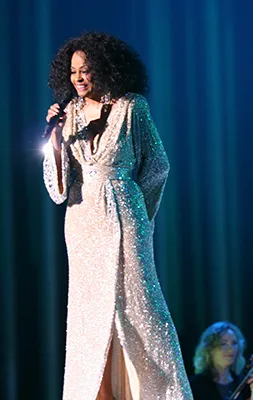
Diana Ross
Human Design Chart
Biography
Born the second of six children to Fred and Ernestine in the Brewster-Douglass housing projects of Detroit, Michigan, she had a poor but happy childhood in a musically-inclined family. During her early teens, she began singing more formally with several girls from her neighborhood. Their group became the Primettes, created by a local manager who wanted them to appear with his local male singing group, the Primes, later the Temptations. Motown's Berry Gordy saw them in 1961, and signed the group which included Mary Wilson, Florence Ballard and Ross, and they became the Supremes. The trio scored No. 1 hits in 1964 with "Where Did Our Love Go" and "Baby Love." In total, the group's nine-year career achieved 14 number-one hits.
In the late '60s, Ross' drawing power was such that Motown changed the group's name to Diana Ross and the Supremes. Ross made her final appearance with the Supremes before doing solo in 1970. Her first solo album, "Diana Ross," and first solo single "Reach Out and Touch" made the top 20. She won a Grammy in 1970.
She was nominated for an Academy Award for her starring role as Billie Holiday in "Lady Sings the Blues," in 1972. The album for the movie topped the charts the following year. In 1975, she starred in "Mahogany" which got mixed reviews. In 1978, she starred as Dorothy in the movie version of the Broadway musical, "The Wiz," a black version of "The Wizard of Oz." The project was a disaster, and helped derail her movie career.
Ross left Motown for RCA and EMI/Capital Records, immediately producing hits such as "Why Do Fools Fall in Love" and "Muscles," which was written by Michael Jackson. Her last Top 10 hit was in 1985, "Missing You.
What does Manifesting Generator 3/5 mean for Diana Ross?
Manifesting Generator 3/5 — Design at a Glance
Diana Ross displayed a hybrid energy configuration: the lightning-fast impact of a Manifestor paired with the constant power of a Generator. Her design allowed her to skip steps and quickly draw results into reality. This speed, however, was a double-edged sword. Often skipping necessary phases led her back later to fill in gaps – a source of strong frustration as it went against her inner rhythm.
Moreover, her system tended to react simultaneously to numerous impulses and tackle multiple projects at once. Without internal confirmation, the initial creative enthusiasm quickly turned into exhaustion. The key lay in the strategy 'React instead of Initiate'. Diana Ross had to wait for a clear internal impulse before acting. Only when her sacral center – her power source – responded with a clear 'Yes', was action effective and satisfying.
This principle also applied to ongoing projects: Regular checks ensured that the inner approval remained consistent. By following this strategy, she could leverage her versatility without getting distracted. In this state of playful engagement, she drew deep satisfaction from her work and wasn't limited by the necessity to tackle things one after another. Her energy flourished through variety and authentic resonance.
Emotional Authority
Diana Ross exhibited an internal decision-making structure that required inevitable time delays. Her design compelled her to suppress spontaneous judgments and instead practice patience to distinguish between momentary mood and deeper truth. This stance stems from her emotional authority: The defined Solar Plexus Center carries this inner authority, regardless of which other centers are also defined in the chart. This mechanism subjects Diana Ross to a constant wave of ups and downs of feelings. She saw the world always colored by her current mood; something could be totally inspiring one moment and appear negative the next. Her feeling at any given moment was merely a snapshot, not a secured truth. Quick decisions made purely out of emotion would often have negative consequences. Instead, she needed to let decisions mature. This process required repeatedly 'sleeping on' important questions. Only as intense initial feelings subsided and emotional distance was gained did clarity emerge. Through this waiting period, Diana Ross underwent a necessary filtering process that ensured her long-term life decisions were based on calmness rather than transient intensity.
The 3/5 Profile — Martyr / Heretic
Diana Ross displayed an attitude of the skeptical experimenter: She believed little at first sight and had to try things herself to truly understand them. This urgent need for direct experience (Line 3) drove her to accumulate practical knowledge through trial and error. In doing so, she learned from every failure and devoted herself to detailed work without shortcuts, as these would have diminished the value of her insights.
From this rich treasure trove of personal experiences developed her role as a Hero (Line 5). She used her self-acquired knowledge to offer solutions for others or address problems in the collective. This combination of adventurous spirit and practical wisdom naturally attracted people; they gathered around her to benefit from her stories and insights. Yet, this heroic role harbored tension: While Line 3 demanded adaptability, Line 5 required strategic deliberation and self-protection. Diana Ross had to learn not to be swayed by external expectations but to stay true to what was right for her. Failing in public could be painful but was an integral part of her learning process to later emerge as a competent figure with useful advice.
Triple Split Definition — Defined & Open Centers
Diana Ross revealed herself as someone with a continuous and constant presence in nearly all areas of life. Her design indicated a tendency towards authoritative self-assurance that did not stem from willpower. She had defined Head, Ajna, and Throat Centers, creating an unbroken stream of mental inspiration and expressive ability: she thought constantly and communicated her concepts directly. Additionally, her G Center (Identity/Direction), Sacral Center (vital energy) as well as Solar Plexus (emotions) were defined. This gave her a firm identity, massive energy that waited for reaction, and emotional depth that required time to clarify. Also, Spleen (spontaneous intuition) and Root (stress management/stress) were defined, allowing spontaneous action in the present moment and consistent inner drive.
The only open area was the Heart Center (willpower/ego). Mechanically this means: Diana Ross had no constant energy for acts of will or promises. She tended to question whether she needed to prove her worth or if she could keep up – typical pitfalls of an open heart. Yet, her design did not require her to prove herself through willpower or make promises she couldn’t keep. Instead, her strength came from reacting to life (Sacral) and waiting for emotional clarity (Solar Plexus). She could take on others' promises and reflect them without having to bear the pressure of maintaining that energy constantly herself. Her authority lay in her ability to ask inspiring questions (Head/Ajna), clearly show her direction (G), and intuitively act in the moment (Spleen), while she was free from the necessity to prove her worth through competition or promises.
Channels for logical leadership, judgment, awareness, discovery and recognition.
Diana Ross revealed herself as a leadership figure who established her authority not through coercion but through logical pattern recognition and gaining the trust of the community. This attitude is rooted in the Alpha Animal Channel 31-7, which defines collective leadership: one earns the group's trust before leading. The voice (Gate 31) only becomes effective when supported by the logical role of self (Gate 7), understanding and guiding existing social patterns.
This style of leadership was reinforced by an insatiable drive for perfection. The Judgment Channel 58-18 connects the vitality of the Root with the correcting intuition of the Spleen. Here, every structure is checked to see if it is in balance; what does not work is precisely corrected to create a perfect pattern for the collective.
At the same time, Diana Ross inspired through spontaneous insights that came out of nowhere. The Awareness Channel 61-24 describes this process: sudden inspiration (Gate 61) meets rational processing (Gate 24), leading to a "satori" moment – an understanding that simply is there without being forced.
Her path was marked by persistent discovery. The Discovery Channel 29-46 demands letting go of all expectations and fully committing to an experience. Through saying "yes" (Gate 29) and connecting with the direction of Higher Self (Gate 46), one stays on course until the meaning of the journey is revealed at the end.
Additionally, individual gates played a role: Gate 17 brought logical teaching and service to others, while Gate 52 stood for silent concentration and pattern correction. In the background, Gate 63 (doubt as the engine of understanding) and Gate 15 (adapting to natural rhythms) fostered the ability to move confidently within collective structures.
Collective Circuitry — Circuit Signature
Diana Ross did not use her energetic circuits as constant inner driving forces but situatively in resonance with the environment. Her design showed three separate, parallel existing energy groups that she activated depending on context.
The Knowledge Circuit connected her Head and Ajna Centers via the Awareness Channel (Gates 24-61). This allowed for innovative flashes of insight and creative impulses, which only became effective through external inspiration. It was about the potential for new expression and transformation, not a permanent source.
The Understanding Circuit consisted of two unconnected parts: Throat with Identity Center (Alpha Animal Channel, Gates 31-7) as well as Spleen with Root Center (Judgment Channel, Gates 18-58). This configuration allowed the sharing of logical structures and strategic focus on the future, separate from an instinctive security orientation. The energy was focused and rational, free from emotional coloring.
The Meaning Circuit also included two separate groups: Identity with Sacral Center (Discovery Channel, Gates 46-29) and Solar Plexus with Root Center (Recognition Channel, Gates 30-41). Here lay the ability to process emotional waves of the past and share these experiences cyclically with others. Emotional processing occurred in wave form – with a beginning, middle, and end – serving the shared learning from past events.
As a Triple Defined individual, Diana Ross did not have an uninterrupted connection between these areas. She functioned as a mirror for the collective: she absorbed knowledge, logic, or emotions when the environment resonated with them and passed them on. Her strength lay in this flexibility to use different energetic tools as needed rather than being committed to a single dominant expression form.
Right Angle Cross of Service 1
Diana Ross demonstrated a fundamental orientation rooted deeply in service and devotion to others. It wasn't superficial helpfulness but rather a core orientation of her being that found its purpose through support and care for others. This alignment stemmed from her configuration, the 'Right Service Cross 1'.
This structure described a paradoxical power: by consciously letting go of ego in favor of others, she created a deep connection and a strong sense of purpose. It was not weakness but the core of her identity. The mechanics of this design suggested that her existential motivation lay in serving others. By putting herself aside, she could build an authentic relationship with the world. The focus wasn't on personal fame or individual recognition but rather how she could enrich others through her presence and actions. This dedication was the engine of her actions and defined her inner direction. She found fulfillment in being part of something greater and working for the well-being of others, which created a stable foundation for her self-understanding independent of external circumstances. The energy flowed where it was needed, giving her a clear sense of place in life.
Saturn Return · Uranus Opposition · Chiron Return · 2nd Saturn Return — Life Cycles
Diana Ross was marked by three distinct astrological cycles that structured phases of her career and public presence. Her design showed a tendency towards clear developmental leaps correlated with these planetary events. The first Saturn Return often marks the transition from preparation to established reality. This was reflected in 1972 when, at age 28, she made her film debut in 'Lady Sings the Blues' – a moment where years of groundwork condensed into a solid public achievement.
The Uranus Opposition around the age of 39 often brings sudden changes or expansive breakthroughs from existing structures. This cycle was active in 1983 when she gave an open-air concert at New York's Central Park to an estimated audience of 350,000 to 400,000 people. This event underscores the expansive power of this phase where her influence became massively visible and old boundaries were broken.
The Chiron Return between ages 49 and 51 is a fulfillment cycle in which one's incarnation cross unfolds and purpose becomes experiential – provided that strategy was observed. It isn't about healing past wounds but rather blooming and affirming the purpose. This showed in 1993 when her compilation 'One Woman - The Ultimate Collection' reached number one on the British album charts. This success marked a phase of full development and recognition of her long-term life task at its highest level.
Manifesting Generator · Emotional Authority — Synthesis
A central red thread in this design is the dynamic interaction between initiation and reaction. As an Manifesting Generator (with defined sacral center), this person has a constant energy source, but it should not be used for self-initiated action. Instead, they need to react to external impulses – yet the connection to the Throat Center allows skipping steps and quickly seizing opportunities (Design View). The ability to set things in motion is reinforced by the defined Mental Center, which provides continuous inspiration and a drive to understand and share new knowledge (Centers, Channels/Gates). Line 3 in the Profile of the Explorer underscores this process: Experimenting, Learning, Sharing – a cycle of experience and influence.
The central paradox lies in the tension between emotional depth and the need for quick implementation. Emotional authority requires time for decision-making, maturation within the emotional wave (Authority). At the same time, the Manifesting Generator design urges swift action and immediate use of opportunities. This tension between inner necessity for reflection and outer impulse to act is further intensified by the Knowledge Circuit – the desire for innovation and transformation collides with the need for emotional clarity (Circuit). The documented events show that both career peaks and successes often occur in phases of rapid development (Cycles), emphasizing the need to navigate this internal contradiction.
5 Defined Channels
Incarnation Cross - Right Angle Cross of Service 1
Solar Return
The Solar Return shows the moment when the sun returns to its exact birth position - your personal solar year.
Life Cycles
Discover the life cycles with a detailed triple view (birth chart, cycle chart, composite).
Human Design Profile
- Strategy
- To respond - wait for something to respond to
- Authority
- Emotional Authority
- Profile
- 3/5 - Martyr / Heretic
- Definition
- Triple Split
- Incarnation Cross
- Right Angle Cross of Service 1
- Date of Birth
- 26.03.1944 23:46
- Place of Birth
- Detroit, MI, United States
Frequently Asked Questions
What is Diana Ross's Human Design type?
What are Diana Ross's Profiles in Human Design?
What authority does Diana Ross have?
What is Diana Ross's incarnation cross?
When was Diana Ross born?
Discover your own Human Design
Are you also a Manifesting Generator? Find out in a personal reading how to unfold your multi-talents and direct your energy wisely.
More Personalities
Back to overviewSissy Spacek

Aldair

Alizée

Anémone

Angeli

Ann-Margret
