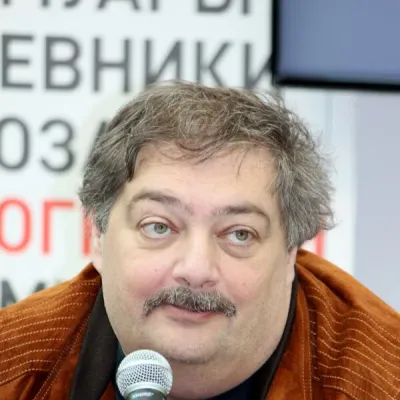
Dmitry Bykov
Human Design Chart
Biography
Bykov graduated from the Faculty of Journalism of the elite Moscow State University. Dmitry Bykov taught literature and the history of Soviet literature in Moscow's secondary schools. He was a professor at the Department of World Literature and Culture of Moscow State Institute of International Relations (MGIMO), often considered the most elite university of the USSR. As a journalist and critic, Bykov has been writing for the magazine Ogoniok since 1993. He has also periodically hosted a show on the radio station Echo of Moscow, which ran until 2008. Earlier, he was one of the hosts of an influential TV show Vremechko.
In 2022 Bykov, who has criticized the Russian invasion of Ukraine, was declared by Russian government to be a "foreign agent". Subsequently, many booksellers started withdrawing sales of his books in Russia. Since being declared a "foreign agent", Bykov has been fined for not declaring his status as such, and is subject to a criminal case. On 14 July 2025, it was reported that Dmitry Bykov was added to Russia's federal wanted list for spreading false information about the Armed Forces of the Russian Federation (Article 207.3), as well as for evading duties required by foreign agents (Article 330.1).
Human Design Analysis: Dmitry Bykov as Manifesting Generator 6/3
Manifesting Generator 6/3 — Design at a Glance
Dmitry Bykov's design shows a tendency towards hybrid energy: he had the constant power of a Generator but also the ability to skip steps and quickly draw results into his life. This configuration as a Manifesting Generator means that while he had to react to impulses rather than initiate them, unlike pure Generators, he had the speed to push projects forward rapidly.
However, this speed carried specific risks. Often, he would skip necessary intermediate steps, leading to the need to backtrack and fill gaps later, causing frustration as it affected his inner self-worth. Additionally, he tended to pursue multiple things simultaneously, driven by various impulses. Without clear inner consent, this multitasking joy could quickly turn into exhaustion.
The solution lay in a conscious strategy: Dmitry Bykov should respond to life and only act when his Sacral Center gave a clear
Sacral Authority
Dmitry Bykov's design shows a tendency towards direct, body-based decision-making. As a Generator, he had the sacral authority that also served as his strategy. This configuration simplified his process: he didn't need external analysis but reacted to external stimuli with an inner response. This manifested as a gut feeling, a surge of energy, or loud signals like grunting or humming. Such reactions signaled that his sacral motor had kicked in. In these moments, he felt vital and energized, with inexhaustible power for his tasks. His design promoted a life filled with joy and enthusiasm, driven by the immersion in the work itself, not external goals. It was crucial that his Emotional Center was open, which enabled this sacral clarity. Additionally, his activated Spleen Center acted as a supportive authority. This gave him the ability for quick, spontaneous reactions and immediate access to instinctive perception. He could thus reliably orient himself by his physical well-being. This mechanism described a person who acted through inner resonance rather than mental planning. The combination of sacral energy and spleen-based intuition shaped his way of moving through life: spontaneously, powerfully, and attuned to what truly gave him joy.
The 6/3 Profile — Role Model / Martyr
Dmitry Bykov's design shows a tendency towards continuous experimentation paired with a drive for an extraordinary life away from conventional standards. As a 6/3 Profile, he lived primarily as an experimenter in the first three decades, learning through numerous self-experiments. Although this phase slowed down after his first Saturn Return at around 30 years, it never ended completely, as the line of the Adventurer is permanently anchored in the profile.
This configuration describes an old soul who often feels inner restlessness because they seek something unique rather than ordinary perfection. The line 6, represented by Gate 11, taught adaptability and the acceptance of transitions as part of a cyclical process. Ideas were understood as transient, allowing a broad overview of the entire circuit. At the same time, Gate 46 on line 3 introduced a trial-and-error process that threw him out of balance and required adaptation.
While adventure dominated in youth, responsibility and wisdom became natural after age 30. The unusual experiences of the first half of life served to become a far-sighted and humorous role model. The challenge was not to project a possible future as the present – which can lead to egoism and loss of support – but to learn from mistakes and consciously postpone decisions to tomorrow if necessary. Thus, the initial restlessness transformed into a profound, experience-based wisdom.
Single Definition — Defined & Open Centers
Dmitry Bykov's Human Design profile was characterized by a consistent and reliable way of expression and a clear inner direction. His defined Throat Center served as a focal point, transforming messages from the body into communication and action. This voice spoke not from arbitrary thoughts, but from a deep well. His defined G Center gave him a firm sense of self-identity and the feeling of being lovable, which helped him love others without becoming dependent. He had a natural sense of his life mission and could show others new directions without needing to control their paths.
This endurance was fueled by his defined Sacral Center, a source of immense vital energy. This power generated a daily constant supply of energy that was only correctly released in response to external stimuli. His truth lay in the spontaneous yes or no responses of this center; any decision not based on this inner resonance led to frustration and exhaustion. His energy was persistent as long as it was correctly initiated, allowing him to master tasks with deep satisfaction.
At the same time, Dmitry Bykov was exposed to several open fields, making him vulnerable to external conditioning. His open Head Center lacked a consistent way to process mental information. He tended to engage with doubts and questions that were not his own, often seeking inspiration to relieve mental pressure rather than relying on his inner authority. His open Ajna Center amplified this by absorbing concepts and opinions from the environment without identifying them as personal truth. This could lead him to pretend to be certain to be accepted, even though his mind was flexible and open to new insights.
His open Heart Center lacked consistent willpower. He easily fell into the cycle of making promises to prove his worth, only to fail later because he lacked the energy to fulfill these commitments. The challenge was not to try to prove himself or others, but to recognize that he did not need to prove anything. His open Solar Plexus absorbed the emotions of his environment, leading him to personalize the moods of others and avoid confrontation to prevent emotional waves. This required a conscious distancing to avoid sinking into the emotional confusion of others.
Additionally, his open Spleen Center was marked by a fundamental fear of not being equipped for survival on Earth. This led him to cling to people or situations with defined Spleen centers to feel a sense of security and well-being, even if these were not healthy for him. Spontaneous decisions were risky for him, as they often stemmed from this conditioned fear. His open Root Center also absorbed the stress and adrenalized pressure from the environment. He tended to intensify this pressure and try to release it through hyperactivity, which could lead to an endless cycle of exhaustion if he did not recognize that this pressure did not originate from him. The wisdom of his design lay in using these open fields as mirrors of the environment without identifying with them, and instead relying on his defined centers – his voice, his direction, and his energy.
Channels for reflection, inspiring presence and persistent discovery.
Dmitry Bykov's design tended towards a double form of perception: on the one hand, the need to act through authentic presence, on the other, the patience to digest experiences fully before sharing them. This tension between immediate radiance and reflective distance shaped his inner dynamics.
The Channel of Inspiration 1-8 connected his G Center with his Throat Center. Through Gate 1, the individual entrance to the creative perspective, and Gate 8, the Gate of Contribution, he was designed to inspire through example. His impact did not come from mere explanation, but by living his unique identity and thereby drawing the attention of others. However, this channel required an inner, authentic authority, as it did not bring automatic social adaptability.
Simultaneously, the Channel of the Lost Son 13-33 was active. It also connected G and Throat Centers, but through Gate 13, the Listener, and Gate 33, the Gate of Withdrawal. This was about reflection and remembrance. Dmitry Bykov collected life stories and secrets, then withdrew to sort these experiences and uncover deeper truths. This process required patience, as he only fully recognized the significance of his experiences at the end of a cycle and then shared them as wisdom.
The Channel of Discovery 29-46 connected his Sacral Center with his G Center. Gate 29, the Gate of Saying Yes, provided access to deep endurance, while Gate 46, the Self's Resolve, anchored him at the right time and place. His path involved letting go of expectations and fully immersing in the experience. Only through clear commitment and persistence could he make discoveries that changed his and the collective's perspective.
Additionally, prioritized gates contributed to the structure: Gate 11 promoted visual memory and collective ideas, Gate 12 brought mutative creativity and emotional mood into expression, while Gate 25 supported an attitude of innocence and mystical individualization. Gate 42 in the Sacral Center emphasized the need to complete processes to take on new commitments. Gate 14 handled power and direction finding with skill, while Gate 3 drove mutation and adaptation to global changes. Finally, Gate 9 enabled detailed work and perfection through repeated pattern correction.
Collective Circuitry — Circuit Signature
Dmitry Bykov's design tended towards emotional authenticity and the desire to share inner experiences with others. As a simply defined system, he showed himself as someone whose energy flowed in a connected stream between Throat, Identity, and Sacral Centers. This connection formed the foundation of his expression: impulses from the Sacral Center, the motor of life energy, flowed directly into identity and culminated in the throat.
The Knowledge Circuit activated the Channel of Inspiration (Gates 1 and 8) in him. This connected his Throat with his Identity Center. It was about the unique path to gain new insights and express them through his own, unique personality. The energy of this channel supported the courage to express innovations and initiate change through the authentic expression of individuality.
Parallel to this, the Meaning Circuit was active. In Dmitry Bykov, two channels were active here: the Channel of the 'Lost Son' (Gates 33 and 13) as well as the Channel of 'Discovery' (Gates 46 and 29). These also connected the Throat with the Identity and Sacral Centers. The energies of this circuit revolved around emotions and experiences from the past. It was about finding the meaning behind past events and sharing these felt insights with the collective. The emotional wave of this configuration followed a cyclical pattern that promoted reflection and learning from the past. Both circuits worked together to carry emotional and authentic inner truths outward.
Left Angle Cross of Education 2
Dmitry Bykov's Human Design suggests a tendency towards a deep, often quiet transformation through the process of learning and teaching. He is someone who does not isolate his own development but is closely connected to the responsibility for the growth of others. This configuration, the left cross of Education 2, describes a life task that unfolds over long periods. It is not about quick, external successes but about inner maturity that is shaped through interaction with students, mentors, or society as a whole.
The mechanics of this cross indicate that Dmitry Bykov's true authority and sense of direction only develop through the experience of leadership and giving. His energy is geared towards not just accumulating knowledge and wisdom but condensing it into a form that is accessible and applicable to others. This requires patience and the willingness to go through personal uncertainties to lead authentically. The focus is on the quality of connection and the depth of insight that arises from exchange. It is a path of continuous adaptation and learning from practice, where one's own progress is inseparable from that of others.
Saturn Return · Uranus Opposition · Chiron Return · 2nd Saturn Return — Life Cycles
Dmitry Bykov's Human Design shows a dynamic where external recognition and inner life task converge in specific cycles. In 2006, at the age of 39, he received the prize 'National Bestseller' for his biography of Boris Pasternak. This success occurred during the Uranus opposition, a phase often bringing sudden changes or public visibility when long-held ideas encounter resistance or new structures.
Later, in 2015, he started the program 'Hundred Lectures' on the TV channel Doschd at the age of 48. This falls into the Chiron Return, a fulfillment cycle in which one's incarnation cross unfolds. Here, meaning and purpose become tangible if one follows their own strategy and authority. It is not a healing phase in a psychological sense but a blooming period in which the life task becomes concrete and shared.
The second Saturn Return marks another deepening of structure. In 2025, at 58 years old, Bykov was placed on Russia's nationwide wanted list. This crisis point correlates with the second Saturn round, often signifying a review of responsibilities and boundaries. The mechanics show how external events—from success to creative unfolding to existential tests—are intertwined with the astrological cycles of his design. Each step illustrates how inner configurations become visible through external circumstances, not as fate but as an expression of individual design logic.
Manifesting Generator · Sacral Authority — Synthesis
A central thread in this design is the dynamic connection between inner authority and the drive for creative unfolding. The sacral authority (Sacral Center defined) provides a constant energy source that, through the manifesting generator configuration (sacral center connected to throat center), can be implemented in rapid, impulsive action steps. This interplay, reinforced by the channel of inspiration (Gate 1-8), creates the ability to powerfully carry ideas and perspectives outward, thus initiating transformative processes—a pattern evident in recognized successes and the launch of new initiatives. The profile as a role model (6/3) underscores this tendency to act as an example through experimentation and living an unconventional lifestyle.
Simultaneously, a central paradox reveals itself between the need for deep, authentic self-discovery and the inclination to skip important steps. The sacral authority demands a response to current impulses, while the profile of the experimenter and the energy of the knowledge circuit fuel a constant search for the new and extraordinary. This creates a tension between the need for thorough engagement and the tendency to move quickly, leading to phases of return and correction (as suggested in the design).
3 Defined Channels
Incarnation Cross - Left Angle Cross of Education 2
Solar Return
The Solar Return shows the moment when the sun returns to its exact birth position - your personal solar year.
Life Cycles
Discover the life cycles with a detailed triple view (birth chart, cycle chart, composite).
Human Design Profile
- Strategy
- To respond - wait for something to respond to
- Authority
- Sacral Authority
- Profile
- 6/3 - Role Model / Martyr
- Definition
- Single Definition
- Incarnation Cross
- Left Angle Cross of Education 2
- Date of Birth
- 20.12.1967 22:00
- Place of Birth
- Moscow, Russia
Frequently Asked Questions
What is Dmitry Bykov's Human Design type?
What Profile does Dmitry Bykov have in Human Design?
What Authority guides Dmitry Bykov?
Which incarnation cross is active for Dmitry Bykov?
When was Dmitry Bykov born?
Discover your own Human Design
Are you also a Manifesting Generator? Find out in a personal reading how to unfold your multi-talents and direct your energy wisely.
More Personalities
Back to overviewAlain-Fournier

Aldair

Alizée

Angeli

Arletty

Artus