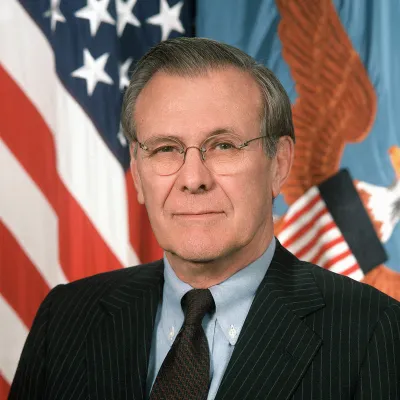
Donald Rumsfeld
Human Design Chart
Biography
Donald Rumsfeld was born to George and Jeannette (Husted) Rumsfeld who resided in Evanston, Illinois. Five years later, the family moved to nearby Winnetka where he and his sister, Joan, enjoyed the suburban lifestyle of children of a successful realtor. He attended New Trier High School in Winnetka, graduating in 1950 with an academic scholarship to Princeton. At Princeton, he distinguished himself in sports as captain of the wrestling team.
Upon graduation in 1954, Rumsfeld joined the U.S. Navy as an ensign and served until 1957, eventually earning the rank of lieutenant.
After his discharge from the Navy in 1957, he joined the administrative staff of Congressman David Dennison of Ohio. Later that year, he entered a banking and investment firm in Chicago. He won a seat in the House in 1962, and served three more terms.
President Nixon named Rumsfeld Chief of the Office of Economic Opportunity on 21 April 1969, only months after becoming president. He resigned from Congress and was confirmed by the Senate and sworn in on 26 May 1969.
In January 1973 he was posted to Brussels, Belgium as NATO ambassador. In August 1974 he was called back to Washington to serve as Chief of Staff of the White House for President Ford. He served as a cabinet member from 1974 to 1975, and as the 13th U.S.
What does Manifesting Generator 3/5 mean for Donald Rumsfeld?
Manifesting Generator 3/5 — Design at a Glance
Donald Rumsfeld's Human Design shows a tendency towards quick, hybrid action capability. As an Manifesting Generator, he had constant sacral energy at his disposal, providing him with a steady foundation for his actions. At the same time, he possessed the ability to skip steps in the process of taking action and thus quickly draw results into his environment. This configuration worked like a combination of endurance and explosive speed.
However, this type's mechanics require not initiating oneself but responding to external impulses. Only when the sacral center answered with a clear 'yes' was an action energetically covered. Without this reaction, frustration threatened, especially if Rumsfeld pursued several projects simultaneously or skipped important steps due to haste. In such cases, he often had to backtrack and make up for missed steps.
His design proved most effective when he fell into a 'play mode'. Then he drew deep satisfaction from his work, even with parallel tasks. The challenge lay in including inner authority and regularly checking whether the started work still resonated with his own energy. Only then could his natural speed be helpful rather than frustrating.
Emotional Authority
Donald Rumsfeld's Human Design shows a tendency towards emotional wave movements that shaped his perception and decision-making significantly. His inner authority was emotional, carried by the defined Emotions Center. In Human Design mechanics, this authority always takes precedence over all other defined centers; it is the primary instance for navigating life.
This center was subject to constant ups and downs of feelings. The world appeared colored by his current mood: At one moment he could be enthusiastic about something, in the next negatively evaluate the same situation. His immediate feeling was only a snapshot, an initial impression that did not necessarily correspond with his deepest truth yet. Quick, spontaneous decisions made directly from this emotional heat often proved problematic or negative.
Therefore, his design's mechanics required patience and time. The longer he let a decision ripen, the deeper and more comprehensive could he perceive the situation. Practically, this meant that he should sleep on decisions multiple times to properly consider them and ask himself repeatedly. Over time, intense feelings subsided, emotional distance was gained, clarity and calmness set in. Only then was the process complete. This strategy was especially important for long-term decisions with a significant impact on his life path.
The 3/5 Profile — Martyr / Heretic
Donald Rumsfeld's Human Design is characterized by the configuration of an Explorer with the Hero Line. He learned primarily through personal experimentation and had to practically test his convictions rather than accept them. The process of trial and error served to gather thorough knowledge that he later provided others. The line 3 in his profile emphasized this necessity for direct experience; initially, he believed nothing until it was personally verified.
The connection to the fifth line gave him a certain attractiveness and the ability to handle high expectations. Other people sought his advice because they wanted to benefit from his wealth of practical life experiences. This role as hero or savior flattered his ego but also carried the risk of public failure if experiments did not succeed.
His design's mechanics showed that development for him was only possible in a conflict-free space, while unconscious provocations could endanger conflicts. His Sun position allowed sudden insights and quick adjustments to shocks. However, an uncontrolled ego stance led to negligence and overextension through subsequent crises. Donald Rumsfeld lived this dynamic: He presented solutions derived from his own mistakes and became a focal point for those seeking proven paths.
Single Definition — Defined & Open Centers
Donald Rumsfeld's Human Design profile revealed a tendency towards consequent, conceptual clarity. His defined Ajna Center ensured consistent mental function; he processed data and concepts in the same way, unaffected by external influences. This intellectual structure flowed directly into his defined Throat Center: He spoke what the mind thought, linking communication and action closely with his mental logic.
As a Generator, he also had a defined Sacral Center, a source of immense vitality. However, this energy was only available for correct reactions – not for initiated actions from the Head. His defined Solar Plexus Center acted as an inner authority; decisions required emotional waves and time to gain clarity. The defined Spleen Center provided spontaneous, intuitive judgments in the moment, while the defined Root Center supplied the necessary pressure for material survival and progress.
At the same time, his design revealed specific vulnerabilities. His open Head Center tended to get entangled in foreign questions or mental confusion if he did not trust his authority. The open G Center meant a lack of fixed identity; he adapted to environments and sought direction through external initiation rather than inner certainty. Particularly, his open Heart Center shaped him: It drove him to prove his worth and make promises that his mechanical energy could not keep. This created a cycle of self-doubt and the need to legitimize himself through willpower – a trap since he lacked the constant energy for such competitions.
Channels for intimacy, clarity, change and maturation.
Donald Rumsfeld's Human Design profile indicated a tendency towards intense, often complex interaction. The Channel of Union 59-6 connected sacral sexuality with emotional friction, making intimacy the core of his relationships. This connection required patience and waiting for the emotional wave to gain clarity; ignoring this inner authority led to confusion in social dynamics. His ability to merge allowed him to quickly build trust but risked misunderstandings due to his intensity.
Parallel to this, his mind organized information strictly logically. The Channel of Acceptance 17-62 connected Gate of Opinions with Gate of Details. This drove him to translate visual patterns into precise language and continuously adjust his worldview through new data. Anything that did not integrate into this logical system remained incomprehensible for him. This channel created a constant pressure to present his structured views in detail, enabling effective information transmission if the timing was right and resistance avoided.
Another impulse came from the Channel of Transience 36-35, linking emotional crises with a drive for change. Here, Donald Rumsfeld actively sought new experiences to gain emotional depth. The fear of stagnation pushed him to bring movement into things even through provoked conflicts, learning that feelings are transient and wisdom only arises through the full experience of cycles.
The Channel of Maturation 42-53 emphasized this cycle: He had to carry experiences to completion to draw reflective wisdom from them. Premature termination led to repetition. Additionally, the Channel of Insight 57-20 brought intuitive insights into the present that he spontaneously expressed to strengthen others in their survival intelligence.
On an individual level, Gates like Gate 54 (Ambition and spiritual worldliness) and Gate 51 (Willpower and adaptation to shocks) shaped his attitude. Gate 22 promoted calm listening for mutation, while Gate 47 challenged him to find meaning in collective confusion. Gate 4 developed formulas for future security, and Gate 8 urged individual contribution towards group goals. Gate 33 required reflective withdrawal to process experiences before new cycles began.
Collective Circuitry — Circuit Signature
Donald Rumsfeld's Human Design profile showed a unified, coherent energetic structure. As a simply defined person, he had an unbroken flow between Solar Plexus, Sacral, Root, Throat, Ajna, and Spleen Centers. This marked him as someone whose emotional waves were directly linked to his life force, instinct, and expression ability.
In the Knowledge Circuit, Channel 20–57 (Insight) connected the Throat Center with the Spleen. This allowed him to express innovative ideas impulsively and creatively driven by inner intuition. In the Understanding Circuit, Gates 17 and 62 activated the
Right Angle Cross of Penetration 2
Donald Rumsfeld's Human Design profile is characterized by a specific energetic configuration known as "The Right Cross of Authority 2." This structure influenced his approach to handling information and making decisions. In Human Design, this cross describes a connection between logical intellect and emotional intuition, with a strong focus on personal judgment. Donald Rumsfeld was someone who did not just intellectually analyze complex situations but also sought deep, often unconscious certainty in his conclusions.
The mechanics of this cross enhanced the ability to integrate seemingly contradictory information and derive clear courses of action from it. It was not about quick reactions but rather a penetrating analysis that took into account both rational facts and inner truths. Donald Rumsfeld used this energy to bring order to uncertain or chaotic environments. His decisions were based on a blend of strategic thinking and a strong belief in his own perspective, which often led him to act with great self-assurance. This was because his design gave him the tools to overcome uncertainties through deep insights. The challenge lay in aligning this inner certainty with external reality without disregarding other perspectives.
Saturn Return · Uranus Opposition · Chiron Return · 2nd Saturn Return — Life Cycles
Donald Rumsfeld's Human Design profile indicated a tendency towards sudden, disruptive changes that often came with a sense of inevitability. This configuration describes an internal pressure to break existing structures and take unexpected paths – independent of external expectations or social norms.
In 1975, at the age of 43, he was appointed as the youngest Secretary of Defense in the USA. This event marked the peak of an Uranus aspect in his chart: A cycle often associated with radical upheavals, unexpected career leaps, or breaking through established hierarchies. For his design, this was no coincidence but rather a logical outcome of a mechanism that predisposed him to become active during moments of great uncertainty or systemic instability and create new orders.
The Uranus influences in his system promoted an attitude of detachment from conventional paths. Instead of gradually growing into roles, he stood out as someone who made sharp decisions and innovative – though often controversial – approaches. This energy demands freedom from traditions and supports the implementation of new visions, even if they go against the grain. During this phase of life, this inner dynamic condensed into a visible position of power that precisely mirrored this characteristic trait: The ability to influence in turbulent times through unconventional means and replace old structures.
Manifesting Generator · Emotional Authority — Synthesis
He was a Generator who carried a Manifestor component through his connection to the Throat Center. This hybrid nature shaped his life: he had constant sacral energy and reacted to impulses (Sacral Center), but could also skip steps and push things forward quickly (Manifesting Generator). This interplay manifested in a tendency to take initiatives, which were accompanied by an emotional wave pattern (Emotional Authority) that required maturation and waiting. The Line 3/5 in his Profile amplified this trait: a continuous experimenting and testing, followed by generating knowledge and bringing it into the world – often as a perceived savior or problem solver.
A central paradox lay in the tension between the drive for quick implementation (manifesting aspect) and the inner need for emotional clarity (emotional authority). He acted impulsively but could not make decisions without allowing time to mature. His defined Mental Center provided constant concepts, while his Profile's experimenting led him repeatedly into new situations, creating an internal dynamic between adhering to principles and adapting to changing circumstances – a give-and-take that played out throughout his life.
5 Defined Channels
Incarnation Cross - Right Angle Cross of Penetration 2
Solar Return
The Solar Return shows the moment when the sun returns to its exact birth position - your personal solar year.
Life Cycles
Discover the life cycles with a detailed triple view (birth chart, cycle chart, composite).
Human Design Profile
- Strategy
- To respond - wait for something to respond to
- Authority
- Emotional Authority
- Profile
- 3/5 - Martyr / Heretic
- Definition
- Single Definition
- Incarnation Cross
- Right Angle Cross of Penetration 2
- Date of Birth
- 09.07.1932 17:40
- Place of Birth
- Chicago, IL, United States
Frequently Asked Questions
What was Donald Rumsfeld's Human Design type?
What profile did Donald Rumsfeld have in Human Design?
What authority did Donald Rumsfeld have?
What incarnation cross did Donald Rumsfeld have?
When was Donald Rumsfeld born?
Discover your own Human Design
Are you also a Manifesting Generator? Find out in a personal reading how to unfold your multi-talents and direct your energy wisely.
More Personalities
Back to overviewAldair

Alizée

Angeli

Arletty

Artus

Balthus