
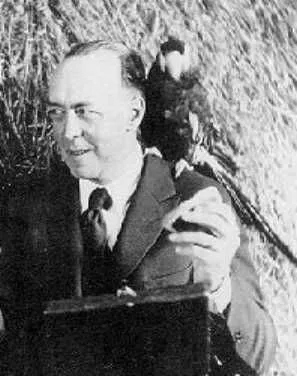
Edgar Rice Burroughs
Human Design Chart
Biography
The son of a wealthy businessman, Burroughs was educated at private schools. He spent the years 1897 to 1911 near poverty in a series of unsuccessful jobs and business ventures. Eventually settling in Chicago with a wife and three children, he began writing advertising copy and then turned to fiction. His first published piece, "Under the Moons of Mars," appeared in 1911 and was so successful that Burroughs became a full-time writer.
The first Tarzan story appeared in 1912, followed in 1914 by "Tarzan of the Apes." Eventually there were 25 Tarzan books about the son of an English nobleman abandoned in the African jungle during infancy and brought up by apes. The Tarzan stories sold by the millions and were translated into more than 56 languages as well as being popular in comic strip, motion picture, television, and radio versions.
In 1919, Burroughs bought an estate near Hollywood (at a site later named Tarzana) in order to be near the filming of his Tarzan movies. He continued to write other novels, ultimately publishing some 68 titles in all. During World War II he became a correspondent for the Los Angeles Times and, at age 66, was the oldest war correspondent covering the South Pacific theatre.
In 1900 Burroughs married Emma Centennia Hulbert; they had two sons and one daughter and divorced in 1934. In 1933 he was elected mayor of California Beach. He married Florence Dearholt in 1935 and they divorced in 1942. Burroughs died of a heart ailment on 19 March 1950 in Encino, California.
In the 1960s, after his death, the Edgar Rice Burroughs Corporation began to successfully coordinate the commercial publication of previously issued and newly released works. "Tarzan" became a Disney animated film in 1999.
Human Design Analysis: Edgar Rice Burroughs as Generator 4/6
Generator 4/6 — Design at a Glance
Edgar Rice Burroughs revealed himself as someone with immense inner endurance, comparable to a powerful workhorse. His Human Design type was Generator, meaning he had abundant sacral energy and could use it most effectively when responding to impulses from his environment rather than initiating independently. This configuration suggested that his greatest strength lay in waiting for signals from life and then acting upon them. When his inner center gave a clear 'yes', he could push projects forward with great force.
However, this design also carried specific risks. One danger was expending energy on tasks that did not interest him or inspire enthusiasm within; this led to long-term exhaustion and frustration over time. The other pitfall was being prevented from working on his heart projects when he still had plenty of energy and wanted to continue. If Edgar Rice Burroughs lived in harmony with the strategy of responding, his design rewarded him with a deep sense of fulfillment. If he initiated too often independently without waiting for inner signals, he likely faced persistent frustration and a lack of energy. His path was thus marked by waiting for occasions to then respond powerfully.
Emotional Authority
Edgar Rice Burroughs displayed an internal decision-making structure that did not rely on the first reaction but rather on deep emotional maturity. His inner authority was Emotional Authority, carried by the defined Solar Plexus Center. This mechanism meant his perception was always influenced by a wave of emotions that showed constant ups and downs. What seemed absolutely right to him at one moment could be completely different in the next. However, this emotional coloring was not an ultimate truth but merely a temporary mood.
Therefore, for Edgar Rice Burroughs, there was a central rule: every decision needed time to mature. Quick, spontaneous judgments based on current feelings were risky and often misleading for his design. Instead, his inner guidance required patience and conscious hesitation. He had to go over decisions several times in his mind and ideally let them rest overnight so that intense emotions could subside. Only when this emotional wave subsided and he gained inner distance did clarity set in. This process of emotional condensation was indispensable for making long-term life decisions that would shape his path sustainably. Without this waiting period, his internal compass needle would have been unreliable; with it, he found calmness and the direction right for him.
The 4/6 Profile — Opportunist / Role Model
Edgar Rice Burroughs revealed himself as someone whose early life was marked by experimental networking. As a 4/6 profile, his Profile Line 6 in the first thirty years acted similarly to a Line 3: he actively sought opportunities and tested various social roles. This phase served the collection of experiences before the deeper wisdom of Line 6 awakened.
Later, an inner conflict emerged characteristic for the 4/6 profile. The desire for belonging and connection (Line 4) stood in tension with the need for distance and reflective consideration about life's meaning (Line 6). This field of tension between heart and head shaped his development. Line 4 emphasized the importance of correct opportunities within a network but also required pauses to avoid exhaustion. Simultaneously, Line 6 brought initial naivety that developed over time into the ability to assess others' expressive power and make judgments.
In later years, Edgar Rice Burroughs was expected to serve as a role model through cooperation rather than isolation. His craftsmanship aimed at achieving immortality in the form of his works. The large heart of Line 4 remained cautious: it opened only to those who proved trustworthy to prevent injury. Balancing willpower and necessary rest phases was crucial so that this role did not lead to overloading.
Split Definition — Defined & Open Centers
Edgar Rice Burroughs revealed himself through a firmly anchored self-understanding and clear internal direction, shaped by his defined G Center. He had a natural sense of his mission and could provide guidance to others without being dependent on their approval. His actions were also driven by a strong willpower in the defined Heart Center; he preferred to keep control over his resources and work rhythm himself, with keeping his promises central to his self-esteem. As a Generator, he possessed immense vital energy from the Sacral Center, which he used through reactions to external stimuli to find satisfaction. His decisions, however, were subject to the emotional authority of the Solar Plexus: He needed time to wait out the waves of his feelings before gaining clarity. Simultaneously, the intuitive Spleen Center guided him in the here and now, trusting spontaneous warning signals from his body.
This stable inner core stood in contrast to his open centers, which made him vulnerable to external influences. His open Head and Ajna Centers lacked a constant mental structure; he tended to take on the pressure of others' questions or ideas, leading to internal confusion if he did not consult his inner authority. Also, his Throat Center was open, so he did not have his own consistent communication frequency and relied on being invited from outside to speak effectively. Furthermore, his open Root Center absorbed stress from the environment, making him vulnerable to external pressure that he did not generate himself. This mechanism described a person who had a powerful emotional and intuitive foundation but was mentally and communicatively strongly influenced by their surroundings.
Channels for care, community and intuitive elegance.
Edgar Rice Burroughs exhibited a fundamental attitude characterized by deep, intuitive adaptability. His design inclined towards momentary and spontaneous behavior control from inner wisdom rather than being determined by future fears or external expectations. This ability stemmed from Channel Perfect Form 57-10, connecting the Spleen Center with the G Center. Through Gate 57, he perceived the acoustic quality of his environment and acted with clear, life-preserving intuition, while Gate 10 shaped this behavior as an expression of self-assured dignity. He lived in the present moment, which gave him a rare lightness to move existentially through the world.
Parallel to this, he had a strong inclination towards care and preservation for his tribe. Channel Preservation 27-50 linked his Sacral Center with the Spleen. Here, Gate 27 worked with its selfless nourishing power together with Gate 50, representing traditional values and laws. Edgar Rice Burroughs naturally drew trust and felt called to take responsibility – whether through defending common principles or supporting the weak. His energy served to maintain structures and ensure that his tribe survived and thrived.
In interpersonal relationships, he sought authentic connections based on mutual benefit. Channel Community 37-40 connected his Solar Plexus with his Ego Center. Gate 37 aimed for affection and recognition in the collective, while Gate 40 represented a desire for independence and fair agreements. He waited for genuine invitations to become part of a community and entered into contracts that bound both his willpower and emotional clarity. This enabled him to build bridges between individuals and shape harmonious, loyal relationships where everyone found their place.
Tribal Circuitry — Circuit Signature
Edgar Rice Burroughs' design was characterized by separate, parallel energetic streams. The Split Definition meant that no single energy flowed through all centers; instead, two independent power fields existed side by side. One stream connected the Heart with the Solar Plexus Center via the Community Channel (37-40). This created a dynamic of give and take within the tribal group based on mutual support and traditional cooperation. The second stream united Sacral and Spleen Centers through the Preservation Channel (27-50) in the Protector Circuit. Here, life force flowed directly into the instinctive knowledge of the Spleen, driven by the primordial need to protect family and genetics, nourish, and preserve them. A third, isolated aspect lay within the Integration Circuit: The Perfect Form Channel (10-57) connected the Identity Center with the Spleen. This allowed directing energy from life reactions through intuitive knowledge and realizing it in the present moment, promoting individual self-reinforcement. This configuration shaped Edgar Rice Burroughs as someone who sought exchange within collective structures on one hand but was deeply rooted in the instinctive drive to protect his own and use intuitive wisdom for personal survival. The separation of these systems prevented a merging experience; instead, these forces acted as distinct, alternating focal points of his inner structure.
Right Angle Cross of Planning 3
Edgar Rice Burroughs’ Design inclined towards careful and strategic preparation. His inner nature was marked by the right cross of Planning 3, a configuration that did not call for impulsive action but rather a need for clear structures and well-thought-out processes. This mechanism acted as an internal compass urging him to gain an overview before acting or speaking, weighing potential consequences. It wasn’t about hesitation in terms of uncertainty but a deep necessity to identify the correct steps in the right order. Without this phase of planning, his energy flow felt blocked; with it, he could pursue his intentions precisely and effectively. The right cross of Planning 3 thus described someone who did not release their strength in wild outbursts but channeled and directed it purposefully. This structure influenced how he approached challenges: through analysis, organization, and the creation of systems that gave him security and control. It was a stance of discipline emerging from his chart and influencing his entire being by teaching him that true efficiency rests on thorough preparation.
Saturn Return · Uranus Opposition · Chiron Return · 2nd Saturn Return — Life Cycles
Edgar Rice Burroughs exhibited a life structure characterized by cyclical phases of consolidation and sudden breakthroughs. His design suggested that his identity condensed or realigned in specific astronomical cycles. In 1904, at the age of 29, he left Chicago with his wife and moved to Idaho. This marked his first Saturn return, a phase during which long-term commitments and structures are often fundamentally reviewed and redefined; the move signaled a clear break from earlier life circumstances.
Ten years later, in 1914 at the age of 39, "Tarzan of the Apes" was published. This coincided with his Uranus opposition, a period marked by unexpected turns and breaking old patterns. Here, a creative explosion emerged that radically changed his previous work and brought him breakthrough success.
In 1924, at the age of 49, "Tarzan and the Ant Men" appeared. This corresponded to his Chiron return, a fulfillment cycle lasting about two years. During this phase, one's personal cross emerges more fully; if one has followed their strategy, personal meaning becomes experiential. For Burroughs, this did not mean healing but rather the flowering and confirmation of his creative purpose.
His second Saturn return around 1932 (age 57) with "Tarzan and the City of Gold" completed this arc. It represented another phase of maturation and structuring in which previous achievements were transferred into a stable, long-term foundation. Thus, his career followed a clear pattern of building up, disruption, and integration.
Generator · Emotional Authority — Synthesis
Edgar Rice Burroughs lived a life path characterized by a deep inner drive to create and bring something into the world (sacral energy of the Generator). This creative force did not manifest as impulsive forward movement but developed through weighing emotional impressions (Emotional Authority), requiring time for decisions to mature. Through the connection of intuitive insight and self-behavior (Channel 57-10), he projected a quality based on love for his own being – behavior that was essential for him and manifested in creating new worlds. Repeated successes later in life (Uranus Opposition, Chiron Return, Saturn Return) confirmed this path, which was always guided by an inner direction (defined G Center).
A central tension field in Burroughs’ design lay between the desire for community and the need for isolation and reflection (Profile 4/6). On one hand, he was inclined to create resources through cooperation and connect with others (Ego Circuit), while on the other hand, he sought withdrawal to think about larger contexts. This interplay between heart and head led to an internal conflict that constantly spurred him to find a unique path in both relationships and his creative works – a path marked by deep self-love and a desire for authenticity.
3 Defined Channels
Incarnation Cross - Right Angle Cross of Planning 3
Solar Return
The Solar Return shows the moment when the sun returns to its exact birth position - your personal solar year.
Life Cycles
Discover the life cycles with a detailed triple view (birth chart, cycle chart, composite).
Human Design Profile
- Type
- Generator
- Strategy
- To respond - wait for something to respond to
- Authority
- Emotional Authority
- Profile
- 4/6 - Opportunist / Role Model
- Definition
- Split Definition
- Incarnation Cross
- Right Angle Cross of Planning 3
- Date of Birth
- 01.09.1875 21:00
- Place of Birth
- Chicago, IL, United States
Frequently Asked Questions
What was Edgar Rice Burroughs' Human Design type?
Which Profile did Edgar Rice Burroughs have?
What Authority guided Edgar Rice Burroughs?
What incarnation cross did Edgar Rice Burroughs have?
When was Edgar Rice Burroughs born?
Discover your own Human Design
Are you also a Generator? Find out in a personal reading how to use your sacral energy correctly and discover deep satisfaction.
More Personalities
Back to overviewAaliyah

Alain-Fournier

Alexia

Angèle

Angeli
Anne-Marie
