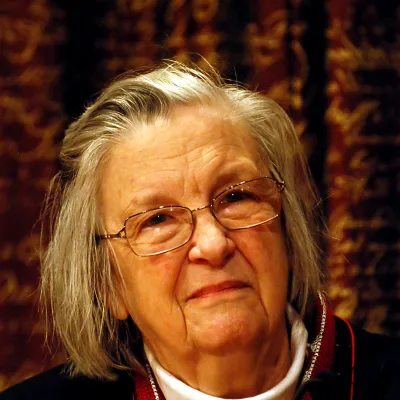
Elinor Ostrom
Human Design Chart
Biography
After graduating with a B.A. and Ph.D. from UCLA, Ostrom lived in Bloomington, Indiana, and served on the faculty of Indiana University, with a late-career affiliation with Arizona State University. She was Distinguished Professor at Indiana University and the Arthur F. Bentley Professor of Political Science and co-director of the Workshop in Political Theory and Policy Analysis at Indiana University, as well as research professor and the founding director of the Center for the Study of Institutional Diversity at Arizona State University in Tempe. She was a lead researcher for the Sustainable Agriculture and Natural Resource Management Collaborative Research Support Program (SANREM CRSP), managed by Virginia Tech and funded by USAID. Beginning in 2008, she and her husband Vincent Ostrom advised the journal Transnational Corporations Review.
She died 12 June 2012.
Elinor Ostrom as a Generator 2/4 in Human Design
Generator 2/4 — Design at a Glance
Elinor Ostrom's design inclined towards great endurance when reacting to impulses. As a Generator, she had abundant sacral energy which she used like a workhorse – strong and steady as long as she felt inner approval for her tasks. Her strategy did not lie in initiating but rather in responding: She waited for signals from life until her gut feeling gave a clear 'yes', then acted accordingly.
This mechanism protected against two specific pitfalls. First, it prevented the wastage of energy on tasks without inner desire, which otherwise quickly leads to burnout for Generators. Second, she resisted the pressure to prematurely abandon her heart project when others thought it was time to stop. As long as she followed this rhythm – wait, react, act – her system rewarded itself with deep satisfaction and fulfillment.
However, if Elinor Ostrom lived against this design, constantly initiating instead of waiting for impulses, she would sooner or later encounter persistent frustration along with a noticeable lack of energy. Her success thus depended largely on whether she channeled her great strength through the principle of gut reaction rather than fighting against the natural flow of her sacral energy.
Emotional Authority
Elinor Ostrom's decision-making followed the rhythm of her emotional waves. As someone with Emotional Authority, she was subject to a constant up and down of feelings that colored her perception of the world according to current mood. What appeared exciting in one moment could be perceived negatively in another. Her design indicated that this first emotional impression did not represent an ultimate truth but merely a snapshot.
The mechanics of her inner authority resided in the defined Emotional Center. A central aspect of this design is absolute priority: Whenever the Emotional Center is activated, it functions as internal authority regardless of other defined centers. This meant for Elinor Ostrom that spontaneous decisions made directly from strong emotions often led to negative outcomes due to incomplete information.
Instead, her strength lay in patience. She allowed decisions to mature, took time, and slept on them multiple times. This process enabled intense feelings to flatten out and emotional distance to be gained. Only when the waves had ebbed and clarity along with calmness set in was the decision-making process complete. This method proved especially crucial for long-term questions with significant influence on her life course for well-founded judgments.
The 2/4 Profile — Hermit / Opportunist
Elinor Ostrom's design inclined towards oscillating between a deep need for withdrawal and the desire for close community. As a 2/4 Profile 'Natural Talent / Networker', she existed in tension: Line 2 demanded solitude for inner clarity, while Line 4 sought connection with familiar people. This dynamic required clear communication of her boundaries – when she needed company and when silence was necessary. In alone time, she reflected on the knowledge of her network to develop new insights.
Her leadership abilities were closely tied to the concept of democracy. The second line had to be teased out by others for its full potential; thus, leadership depended on society choosing and supporting this energy. At the same time, she was aware that repeated elections without change could lead to corruption.
The fourth line brought discretion and single-minded actions with it. Higher goals stood above personal recognition (Venus elevated). Timing and silence were crucial for spiritual insight and conflict avoidance. A 'loose mouth' could cause problems; therefore, the right moment for direction changes was essential. Through this balance of introspective depth and strategic network use, she laid a foundation to understand complex social dynamics effectively without being overwhelmed by external expectations.
Split Definition — Defined & Open Centers
Elinor Ostrom's design inclined her towards clear, resolute communication that emanated from a firm inner direction. Her defined G Center endowed her with reliable self-confidence and an intuitive sense of her life mission; she knew intuitively where she belonged. This center was linked to the also defined Heart Center, which represents willpower and ego. Therefore, her voice carried the energy of 'I want' and 'I can', allowing her to keep promises and assert her positions with authority. As a Generator, she also had a defined Sacral Center, a constant source of vital energy that was activated by responding to external stimuli. Her strength did not lie in impulsive initiative but rather in the ability to sustain involvement in matters to which her body responded with an inner 'yes'.
At the same time, her emotional authority was anchored in her defined Solar Plexus Center. This meant that she did not make decisions immediately but patiently waited for the waves of her emotions to subside until emotional clarity emerged. This mechanism protected her from impulsive misjudgments and allowed deep, well-considered judgments after the emotional wave had run its course.
In contrast, her open Head and Ajna Centers revealed a vulnerability to mental pressure and confusion. She tended to engage with questions that were not hers or be inspired – or overwhelmed – by intellectual currents of others. Her open Spleen Center made her sensitive to the well-being of her environment; she could pick up intuitive signals but was vulnerable to absorbing fears or health conditions of others rather than trusting her own spontaneous intuition. Finally, her open Root Center absorbed external stress. She needed to retreat from excessive pressure as she did not have the inner capacity to process ongoing adrenalized frenzy from the environment without burning out.
Channels for logical leadership, intimacy and community.
Elinor Ostrom's design inclined her towards deep, time-intensive connections that only unfolded through patience and emotional clarity. This was most evident in the Channel of Union 59-6, which linked sacral sexuality with the emotional wave of the Solar Plexus Center. This configuration required waiting until the emotional tide subsided to determine if a relationship – whether personal or professional – would be fruitful. Spontaneous decisions often led to confusion here; instead, this channel promoted intimacy through slow approach and building trust.
Parallel to this was her ability for logical, collective leadership through the Alpha Animal Channel 7-31. This channel connected the G Center's role with the voice of leadership in the Throat Center. Elinor Ostrom could recognize patterns and translate them into understandable strategies to guide communities. Crucial here was that she did not rule alone but was invited by a majority to take on her role. Her authority rested on an understanding of existing structures and the ability to show others the way without taking it away from them.
The foundation for this was the Community Channel 37-40, which linked the Solar Plexus Center with the Heart Center. This was about fair agreements and mutual support. Gate 40 sought reward for effort while Gate 37 aimed at recognition as a whole. This created an environment in which individuals contributed not out of duty but from a sense of belonging and respected place within a larger group.
Additionally, Gates like that of Receptivity (2) and Unique Mutation (1), offered high sensitivity to new directions and individual perspectives. Gate 13 promoted reflection on past experiences to maintain continuity. In the background, gates like 62 with their love for detail work and pattern recognition supported these processes by logically organizing complex connections. Thus, a profile emerged that united emotional depth, structural clarity, and communal fairness.
Tribal Circuitry — Circuit Signature
Elinor Ostrom's design inclined her towards structured, rational communication. The Understanding Circuit in her connected the Throat Center with the Identity Center (Channel 'The Alpha Animal'). This allowed for clear and focused expression of logical insights and strategies to improve society – free from emotional conditioning.
Parallel to this, the Ego Circuit was influenced by the energy of the Community Channel, which linked the Heart and Solar Plexus Centers. This promoted a balance between giving and taking as well as mutual support within a group. Since this circuit did not connect with the Sacral Center, rest periods were necessary to regenerate resources for the community.
A third aspect came from the Protector Circuit: The Union Channel connected the Sacral with the Solar Plexus Centers. This brought instinctive energies of protection and preservation – themes like care, nutrition, and defense of one's genetics or family.
As a person with Split Definition, Elinor Ostrom had two separate energetic groups: One linked Solar Plexus, Sacral, and Heart Centers; the other Identity with Throat Center. These centers were not directly connected to each other but existed as parallel, independent forces in her system.
Right Angle Cross of the Sphinx 3
Elinor Ostrom's design indicated a tendency towards deep and often painful confrontations with her own internal conflicts. She was someone who did not simply resolve the tension between the desire for individual autonomy and social responsibility, but rather accepted this as a constant companion.
This attitude stems from the configuration of the right cross of the Sphinx 3 in Human Design mechanics. This pattern describes a specific life task: integrating opposites that appear irreconcilable at first glance. It is not about finding a perfect compromise but recognizing the fertility in the ongoing friction between 'I' and 'We'.
For Elinor Ostrom, this meant that her intellectual and emotional work was often marked by this internal dialectic. She did not seek simple solutions but understood the complexity of human systems as something that can only be grasped through the acknowledgment of these fundamental tensions. The right cross of the Sphinx 3 challenged her to neither deny her own incompleteness nor the resulting necessity for collaboration with others, but rather to use it as a driving force in her development. This mechanism created someone who did not waver in ambiguity but found their true strength within it, enabling them to penetrate and understand complex social dynamics.
Saturn Return · Uranus Opposition · Chiron Return · 2nd Saturn Return — Life Cycles
Elinor Ostrom was someone who wanted to drive structural changes through collective intelligence. Her founding of the Workshop in Political Theory and Policy Analysis at Indiana University in 1973, at age 40, together with her husband Vincent Ostrom, marked a decisive turning point. This coincided precisely with her Uranus opposition period. In Human Design mechanics, this astronomical configuration often signals a phase of deep restructuring and breaking free from old patterns. For Elinor Ostrom, this cycle became effective as she not only thought theoretically but also created institutional frameworks that enabled new ways of thinking. The workshop served as a platform to reconnect political theory with practice, which is typical for the transformative energy of the Uranus opposition: old boundaries are broken down to make way for innovative structures. Elinor Ostrom used this energetic shift to establish a space where interdisciplinary collaboration was promoted. It was not just a career step but the concrete realization of her inner need to question and redesign systems. The oppositional energy pushed her to break away from isolated approaches and instead form networks of exchange. Through this founding, she anchored her vision in a sustainable institution that extended beyond her own work. Thus, the abstract power of the Uranus opposition was translated into a tangible, socially relevant project that promoted dialogue between theory and application.
Generator · Emotional Authority — Synthesis
Elinor Ostrom's life was marked by a deep connection to her sacral energy (Generator type, Channel of Union) and the need to use this purposefully. The ability to work persistently on tasks as long as they resonated internally formed the foundation of her creativity. However, this potential was always modulated by the emotional wave (Emotional Authority), which required a careful weighing and maturation of decisions to avoid unproductive action or overlooking important impulses. The profile as a natural talent/networker reinforced the shift between retreating into the inner world (Line 2) for clarification and the need for exchange and community (Line 4).
A central paradox lay in the tension between the mind circuit, which created logical structures and future perspectives (Channel 31/7), and emotional processes that allowed clear perception only over time. While the mind tended to share insights and push forward, emotional authority required patience and allowing an internal maturation process. This was evident, for example, in the founding of the workshop (Uranus opposition in 1973), a rationally planned step whose lasting success depended on an emotionally grounded orientation towards long-term goals.
3 Defined Channels
Incarnation Cross - Right Angle Cross of the Sphinx 3
Solar Return
The Solar Return shows the moment when the sun returns to its exact birth position - your personal solar year.
Life Cycles
Discover the life cycles with a detailed triple view (birth chart, cycle chart, composite).
Human Design Profile
- Type
- Generator
- Strategy
- To respond - wait for something to respond to
- Authority
- Emotional Authority
- Profile
- 2/4 - Hermit / Opportunist
- Definition
- Split Definition
- Incarnation Cross
- Right Angle Cross of the Sphinx 3
- Date of Birth
- 07.08.1933 02:30
- Place of Birth
- Los Angeles, CA, United States
Frequently Asked Questions
What was Elinor Ostrom's Human Design type?
Which Profile did Elinor Ostrom have?
What Authority did Elinor Ostrom have?
What incarnation cross was active for Elinor Ostrom?
When was Elinor Ostrom born?
Discover your own Human Design
Are you also a Generator? Find out in a personal reading how to use your sacral energy correctly and discover deep satisfaction.
More Personalities
Back to overviewAaliyah

Alexia

Angèle

Anne-Marie

Arcángel

Arno