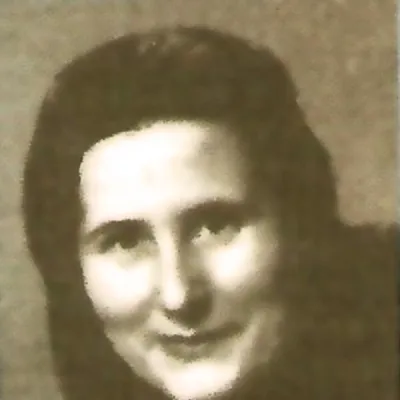
Elisabeth Barbier
Human Design Chart
Biography
Barbier was published from 1946 to 1967. She was a member of the literary panel of the Fémina award from 1958-84.
She married on 17 December 1935.
Died on 19 February 1997, Avignon, France.
Human Design Analysis: Elisabeth Barbier as Generator 3/5
Generator 3/5 — Design at a Glance
Elisabeth Barbier revealed herself as someone with immense inner endurance and strength, comparable to a workhorse. Her Human Design type is the Generator, characterized by a defined Sacral Center. This center serves as her energy source, which is activated exclusively in response to external impulses rather than through self-initiation. Her life strategy involved waiting until an internal signal – the 'yes' from the gut – was received before taking action.
By following this rhythm and reacting to offers or situations that engaged her sacral energy, Elisabeth Barbier experienced deep satisfaction and a sustained abundance of strength. She could then work with great consistency on her heart projects. Conversely, ignoring this inner compass or attempting to force things without waiting for a signal inevitably led to frustration and energy depletion. Two main risks shaped her design: first, the wastage of valuable resources on tasks that did not fulfill her, leading to long-term exhaustion over time. Second, being interrupted when she was full of energy and wanted to continue. Her success depended on whether she managed to use her great capacity only where her inner center agreed.
Sacral Authority
Elisabeth Barbier relied on immediate physical signals rather than cognitive analysis for her decisions. Her design designated the sacral authority as the primary instance, which meant a simplified decision-making structure for her as a Generator: strategy and internal guidance merged here. This mechanism required an open emotional center to prevent gut intuition from being overridden by emotional waves.
In practice, this authority manifested in a specific 'gut voice'. In response to external stimuli, Elisabeth Barbier felt physical responses like grunting, humming or a soft hmm. These sounds served as clear yes-or-no signals. When her sacral motor engaged with a situation, she experienced an energy surge. She then felt vital and alive, with an almost inexhaustible energy source that enabled her to perform tasks with great enthusiasm. This state defined her quality of life: she could fully immerse herself in her tasks, driven by joy and satisfaction rather than duty.
Conversely, ignoring this resonance led to energy loss. It was necessary to recognize these physical responses as decisive. Only through trust in the immediate physiological reaction could she act authentically and maintain her natural strength. This was not an intellectual process but a direct, tangible connection between external stimuli and internal confirmation that stabilized her actions.
The 3/5 Profile — Martyr / Heretic
Elisabeth Barbier demonstrated someone who gained knowledge not from books but through direct, often painful experimentation. Her design as Profile 3/5 established that she initially doubted everything and had to test it herself – the Line 3 of the experimenter – before later solving others' problems with this practical treasure, leading to the Hero role of Line 5. This configuration created a specific tension: while her practical knowledge attracted others and projected her as a rescuer, the necessary failure in the learning process in public was often distressing.
Line 3 (Gate 27) emphasized adaptation through trial and error and dealing with attachments. It involved secret information needed to care for others, coupled with an urge to have more than necessary – a second-generation energy source. Simultaneously, Line 5 (Gate 41) brought empowerment and imagination into play. Others projected expectations onto her, yet this projection could also be limiting. Venus in fall in this line pointed to persistent frustration over limitations; the necessity of focusing on one fantasy conflicted with the broad spectrum of her experiments. Elisabeth Barbier thus lived between the freedom of an adventurer and the burden of public expectation, where her appeal lay precisely in this authentic experience gained through mistakes.
Split Definition — Defined & Open Centers
Elisabeth Barbier revealed herself through constant inner vitality and intuitive clarity, which was however accompanied by a permanent mental pressure. Her Generator design suggested that her strength lay in the ability to focus energy on the right „Yes“ (Sacral Center) and act in the moment (Spleen Center), while identity and emotional waves were taken from outside.
This conflict between the constant thought process – characterized by the defined Head and Ajna Centers, which constantly generated questions – and the need to wait for a sacral response instead of mentally initiating action shaped her mechanics. The defined Root provided the necessary pressure to maintain the life impulse.
At the same time, her G Center (Identity), Heart Center (Willpower) and Solar Plexus Center (Emotions) remained open. This did not mean deficits but rather high adaptability: Elisabeth Barbier tended to blend with her environment and reflect other people's emotions instead of generating stable emotional waves herself. She was prone to the Non-Self Monologue, which questioned who she was or how she could prove her worth, rather than trusting in her inner authority. The open Throat Center also showed situational communication; she spoke spontaneously when invited, rather than actively seeking attention. Her challenge lay in not misunderstanding mental pressure as a directive for action and learning that her open heart did not need to prove anything. By waiting for stimuli, she could effectively use her sacral energy without falling into frustration or exhaustion through false initiatives.
Channel 3-60: Mutation — Channels & Gates
Elisabeth Barbier showed a basic attitude of pulsating change: She lived in a rhythm of inner tension and explosive renewal, carried by the acceptance of limitation. This dynamic came from Channel Mutation 60-3, which connected the Root Center with the Sacral. Gate 60 brought evolutionary possibilities pressure while Gate 3 tried to bring order into the confusion of new beginnings. Elisabeth Barbier had to learn not to fight against the accompanying melancholy but patiently wait for the next impulse from the sacral that worked as a sudden innovation.
Her thought process did not follow linear logic, but rather acoustic inspiration. Channel Awareness 61-24 connected Head and Ajna Centers. Here her mind did not seek answers through deduction but waited for the moment of „Satori“ – a sudden insight coming from Gate 61 (Secrets) and rationalized in Ajna (Gate 24). Elisabeth Barbier could not control her thinking; she had to submit to the happy coincidence that knowledge appeared at its own pace, often supported by silence or music calming mental „white noise“.
At the same time, she possessed a stubborn determination to defend her individual integrity. Channel Life Struggle 38-28 connected Root and Spleen. Gate 38 generated pressure to resist external forces that diverted her from her true nature while Gate 28 created awareness of which struggles had value. Elisabeth Barbier found meaning in fighting for her values, even if this was uncomfortable or risked security. This adrenalized resistance served individualization and forced her into fights deepening her life rather than adapting to others' expectations.
Individual Circuitry — Circuit Signature
Elisabeth Barbier's design was characterized by a split energetic structure forming two independent power fields. One field connected Head and Ajna Centers, the other Sacral, Root and Spleen Centers. Between these blocks there was no direct flow; they acted as parallel, independent systems.
The active Knowledge Circuit ran through both areas separately. In the upper part, Channel 24-61 (Awareness) connected Head and Ajna. This promoted innovative flashes of insight and the development of a unique identity through new knowledge. In the lower, pulsating area, two channels worked: Channel 3-60 (Mutation) drove deviations from the existing, while Channel 28-38 (Life Struggle) in the Sacral Center created a powerful acoustic expression base. This energy flowed over Throat supported by emotional waves from Solar Plexus – although this was not directly connected to other centers, it served as an emotional impulse generator for expression.
The mechanics described a process of transformation: New insights emerged in the mind (Head/Ajna) while vital power and mutation ability (Sacral/Root/Spleen) prepared the ground. Elisabeth Barbier showed herself through this configuration as someone whose individual path was marked by creative deviation and authentic, emotionally carried expression. The pulsating format energy demanded confirmation of her individuality not just through logical planning but through trust in inner rhythm and mutation power bringing change into the world.
Right Angle Cross of the Unexpected 1
Elisabeth Barbier's design was characterized by a fundamental architecture that did not view life as a linear and planned path but rather as a space of surprise. Her inner nature was attuned to the idea that turns would be sudden and unpredictable. This configuration, known as the right cross of the Unexpected 1, suggested that stability for her could not be found in rigid future plans. Instead, her strength lay in embracing the unknown with flexibility.
The mechanics of this design emphasized the integration of the unforeseen as a central life dynamic. It was an archetypal framework where unexpected events were not seen as disruptions but rather as structuring elements. Elisabeth Barbier lived with the tendency to discover new possibilities and insights precisely where the unexpected occurred. The ability to accept these sudden changes significantly shaped her existence. Rather than trying to control the flow of events, she focused on maintaining inner balance while external circumstances rapidly changed. This principle of surprise thus formed the foundation of her experiential world and determined how she approached the challenges of life.
Saturn Return · Uranus Opposition · Chiron Return · 2nd Saturn Return — Life Cycles
Elisabeth Barbier's design marked a phase of personal development and finding meaning that unfolded during the Chiron Return cycle. This period, typically between the ages of 49 and 51, does not signify healing from injuries in Human Design mechanics but rather a bloom: The individual's Inkarnation Cross unfolds increasingly in life if they have lived according to their strategy and authority beforehand. Meaning and purpose become experiential, leading to a profound integration of earlier experiences.
In 1958, at the age of 47, Elisabeth Barbier was elected into the jury for France's literary prize Prix Femina. This event occurred shortly before her actual Chiron Return and can be understood as a harbinger of this fulfillment phase. Being chosen for such a position reflects increasing visibility and recognition that comes with approaching the cycle. It is a moment when inner clarity manifests outwardly. For her design, this meant that years of work on aligning herself was now bearing fruit. The mechanics of the Chiron Return describe precisely this process: Not repairing damage but ripening one's essence to full expression. Elisabeth Barbier showed during this time as someone whose life path increasingly aligned with her inner compass. Her recognition by the jury was no coincidence, but an expression of a development that was heading towards the peak of the Chiron cycle. During this phase, life often becomes clearer and more purposeful, as individual gifts now come fully into play.
Generator · Sacral Authority — Synthesis
Elisabeth Barbier lived a life marked by a deep inner dynamic: the constant interplay between reaction and inspiration. As a Generator, she primarily reacted to impulses from her environment (Sacral Authority), with the connection to the Root Center signaling immediate readiness for action – an energetic drive that, however, did not receive a fixed direction through her open Heart Center. Instead, she relied on adapting to circumstances and learning from experiences (Profile 3/5) to gather knowledge and creatively pass it on. This ability to adapt and experiment, coupled with defined Head and Ajna Centers, created a unique combination of mental sharpness and intuitive perception.
A central tension in her design lay between the need for authentic expression and the lack of inner determination (open G-, Heart- and Solar Plexus Centers). While she was driven to act through her sacral energy, the direction of this energy was not predetermined. This led to a constant search for meaning and significance in life's struggle (Channel 38-28), a mutation of experiences that enriched her knowledge but also brought about a certain melancholy. This process of inner transformation, characterized by the channel of awareness, allowed her to receive inspiration and transform it into creative energy.
3 Defined Channels
Incarnation Cross - Right Angle Cross of the Unexpected 1
Solar Return
The Solar Return shows the moment when the sun returns to its exact birth position - your personal solar year.
Life Cycles
Discover the life cycles with a detailed triple view (birth chart, cycle chart, composite).
Human Design Profile
- Type
- Generator
- Strategy
- To respond - wait for something to respond to
- Authority
- Sacral Authority
- Profile
- 3/5 - Martyr / Heretic
- Definition
- Split Definition
- Incarnation Cross
- Right Angle Cross of the Unexpected 1
- Date of Birth
- 25.04.1911 23:00
- Place of Birth
- Nîmes, France
Frequently Asked Questions
What is Elisabeth Barbier's Human Design type?
What Profile did Elisabeth Barbier have in her Human Design?
What Authority did Elisabeth Barbier have?
What incarnation cross did Elisabeth Barbier have?
When was Elisabeth Barbier born?
Discover your own Human Design
Are you also a Generator? Find out in a personal reading how to use your sacral energy correctly and discover deep satisfaction.
More Personalities
Back to overviewAaliyah

Alain-Fournier

Alexia

Angèle

Angeli

Anne-Marie