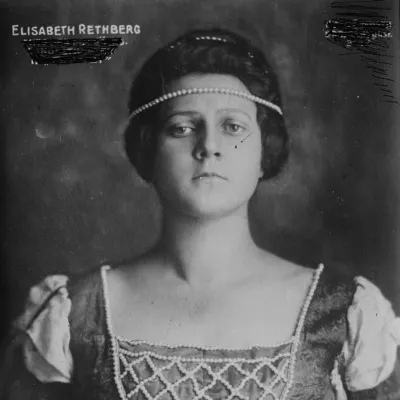
Photo: Wikimedia Commons
Elisabeth Rethberg
Human Design Chart
Biography
She died on 6 June 1976 in Yorktown Heights, NY.
What does Projector 2/4 mean for Elisabeth Rethberg?
Projector 2/4 — Design at a Glance
Elisabeth Rethberg revealed herself as an individual with a focusing aura that shone like a bright flashlight. Her Human Design type was Projector, meaning she did not have constant intrinsic life energy. Instead, she projected her energy onto the environment and immediately saw where other systems had errors or things remained in the dark. This ability to illuminate the path could be perceived as unpleasant if addressed directly.
Elisabeth Rethberg's strategy involved waiting for a respectful and sincerely meant invitation from others. Rather than actively pushing or addressing problems right away, it was more elegant to attract through her own harmony. Others would then come to her on their own seeking advice. Since Projectors must alternate between phases of high energy and necessary rest periods to avoid burnout, the conventional school and work model often did not fit her rhythm.
If Elisabeth Rethberg lived according to this design, she was rewarded with success. Ignoring this structure and the necessity of invitations as well as rest led sooner or later to the non-self theme of bitterness. Her design thus pointed towards a tendency for leadership through visibility and patience, not constant active action.
Splenic Authority
Elisabeth Rethberg showed a basic attitude based on immediate intuitive reaction. Her design indicated that she did not make decisions through long contemplation or emotional weighing but trusted in a fine inner signal. This inner authority was defined by her Spleen Center – the center for health and survival intelligence.
For this authority to be effective, both her Emotional Center as well as her Sacral Center were open. This configuration is characteristic of Projectors or Manifestors. The Spleen Center functioned as a highly sensitive alarm system; it provided spontaneous knowledge about whether a situation, person, or environment was healthy and energetically fitting. The first impulse was considered the right path since it immediately served well-being. Elisabeth Rethberg thus had the ability to rigorously distance herself from harmful influences and take good care of herself.
This impulse was however very subtle and only appeared in each moment. It could easily be drowned out by external expectations or other thoughts, requiring high vigilance. Since knowledge about what is right only arose in concrete situations, long-term commitments were often difficult. Plans could change at short notice, necessitating much freedom and flexibility. She lived according to the principle of letting herself be as little as possible committed in advance but reacting spontaneously to the immediate present.
The 2/4 Profile — Hermit / Opportunist
Elisabeth Rethberg showed a pronounced tension between the need for deep solitude and the urge towards community. Her design, Profile 2/4, marked her as someone constantly swinging between these poles: Line 2 required retreat and 'Me-Time' to create inner clarity, while Line 4 awakened the desire for time with familiar people. For Elisabeth Rethberg, it was essential to establish a secure environment where she could clearly communicate these needs – when she sought company and when she wanted solitude. Only when her need for alone-time was satisfied did she emerge from her 'cave' to tend to her network.
This dynamic was reinforced by additional character traits. The Primadonna Line endowed her with natural talent and determination towards success, but also drew attention and could arouse unrealistic expectations. Simultaneously, the fourth line acted as a wallflower using modesty as protection against perceived inadequacies. This outsider status contrasted with the public visibility of her primadonna traits. Elisabeth Rethberg had to learn to integrate these contradictions: she reflected the knowledge of her network in her withdrawal and developed new ideas from it while also dealing with the pressure to meet expectations and recognize her own boundaries.
Single Definition — Defined & Open Centers
Elisabeth Rethberg revealed herself through a firmly anchored self-understanding and a clear inner direction supported by her defined G Center. This gave her the ability to feel love and include others in her own mission without being dependent on their expectations. Her communication was characterized by her also defined Throat Center; she spoke with consistent clarity from this reliable source, which allowed for direct and honest expression. This was complemented by her defined Spleen Center, which gave her spontaneous, intuitive judgment in the here and now. She acted based on instincts and body intelligence that protected her survival and ensured her well-being rather than preferring rational analysis.
At the same time, Elisabeth Rethberg was vulnerable to external conditioning through several open centers. Her open Head Center made her susceptible to mental pressure and questions from others, which could lead to confusion when she tried to find answers to problems that were not hers. Similarly, her open Ajna Center made her mind flexible but unstable; she tended to reflect concepts and opinions of the environment rather than holding firm beliefs of her own. Her open Heart Center lacked consistent willpower, which could drive her into a cycle of promises and disappointment when she tried to prove her worth through performance. Additionally, her open Solar Plexus absorbed emotions from others, causing her to fluctuate between joy and sorrow without always recognizing these feelings as foreign. The open Sacral Center meant an unstable energy flow; she took in the vital energy of her environment but risked overloading and exhaustion if she did not pause. Finally, her open Root Center amplified environmental stress, which could lead to a feeling of chaos that did not reflect her own rhythm.
Channels for intuitive elegance and masterful experiments.
Elisabeth Rethberg revealed herself as someone whose actions were guided by deep, momentary intuition. Her design was marked by an uncommon clarity in letting go of unfounded future fears and instead reacting spontaneously and appropriately. This occurred through the Channel of Perfect Form 57-10, which connected her Spleen Center with her G Center. Gate 57 offered acute sensitivity to the quality of tones in the environment; she listened more to tonal inflections than words. This connection to innate wisdom beyond thought allowed her to move existentially and unburdened through the world. Her behavior served not for recognition but for perfect survival in the present through self-love and appreciation of her essence.
Parallel to this, Elisabeth Rethberg sought hidden truth to share insights with others. The Channel of Wavelength 48-16 connected her Spleen Center with her Throat Center. Gate 48 looked out for life-critical information from an inner intelligence that could not be grasped by the mind. Through combining this depth with the dexterity of Gate 16, she perfected skills through repeated experimentation and practice. This transformed pure technique into talent. Her process required dedication and engagement to achieve mastery. She communicated her insights not only as inspiration but also as results from work and precision.
Additionally, further gates influenced her essence. Gate 46 promoted full participation in the process and love for the body as a temple. Gate 15 established logical flow through adaptation to natural rhythms. Gate 25 brought spiritual innocence and centeredness. Gate 32 ensured continuity and evaluated situations for significance while implementing radical changes when necessary. Gate 18 discriminated between required corrections in the collective process. Gate 56 enabled abstraction of mental processes into figurative narratives. Gate 23 translated inner sound into speech and promoted assimilation. Gate 45 summed up tribal energy and expressed willpower. Gate 44 managed resources through vigilance and transformation in relationships. Gate 35 sought change and progress through new experiences and interaction, where satisfaction only came from the meaning of experience.
Individual Circuitry — Circuit Signature
Elisabeth Rethberg's design showed a clear, coherent structure. As a simply defined person, she possessed an unbroken energetic flow between Throat, Spleen, and Identity Centers. This connection shaped her way of working: She could translate intuitive knowledge from the Spleen directly into concrete actions in the here and now and then articulate these through the Throat Center.
This cohesion resulted from two active circuits. The Understanding Circuit connected her Throat with her Spleen via the 'Wavelength'. This allowed sharing rational insights and visual strategies for improving the future free of emotional conditioning. Parallel to this, the Integration Circuit worked through the Channel 'Perfect Form', linking Identity and Spleen Centers. Here it was about securing survival: Intuitive knowledge (Gate 57) was combined with correct behavior (Gate 10) to draw strength from reacting to life and realizing in the present.
Since all defined centers – Throat, Spleen, and Identity – lay within a single group, these energies formed a closed system. There were no separate or isolated energy fields; instead, energy flowed seamlessly from intuitive perception through strategic formulation to personal identity. Elisabeth Rethberg thus lived from an integrated source where logical understanding and intuitive self-affirmation always stood in harmony and reinforced each other without being interrupted by undefined gaps.
Right Angle Cross of the Vessel of Love 3
Elisabeth Rethberg showed a fundamental disposition marked by a profound, almost fateful dedication to the principle of love. This design characteristic, known as 'The Right Cross of the Vessel of Love 3', did not describe superficial romance but rather a structural need to understand oneself as a container for intense emotional connections. For Elisabeth Rethberg, this meant that her identity was strongly dependent on how she stood in relationships and whether these met the love standards she defined.
The mechanics of this cross suggested that she did not simply love but measured the quality of her own existence by the depth of these bonds. It was a configuration demanding to continually test one's 'vessel'—the emotional capacity and integrity. Elisabeth Rethberg lived in a dynamic where she was either perceived as the person embodying love or in the state of waiting for this love to manifest through a fitting connection. This was not passive waiting but an active alignment of her entire being towards finding the right resonance. Her design dictated that she sought validation not primarily through external achievements, but through the confirmation of her inner emotional truth in encounters with others. This structure created a life tension between the ideal of perfect connection and the reality of human imperfection, constantly driving Elisabeth Rethberg to define and defend her own boundaries of love.
Saturn Return · Uranus Opposition · Chiron Return · 2nd Saturn Return — Life Cycles
Elisabeth Rethberg was a person whose professional career was marked by clear, structural milestones. In 1922, at age 28, she debuted in one of the first opera performances at the Salzburg Festival and shortly thereafter received a five-year contract with the Metropolitan Opera in New York. For her design, this point marked the first Saturn Return. This cycle functions as a phase of consolidation where years of groundwork condense into a solid result. The connection between artistic debut and secure contract illustrates this mechanism: long-term development led to a stable foundation for further career advancement. The Saturn Return acts like a filter separating the essential from the superfluous, enabling an individual to operate on a new level. Elisabeth Rethberg's rise at this point was no coincidence but the result of inner maturity made visible through the planetary cycle. She used this phase to solidify her position and establish her artistic identity in an international context. The structure of her design supported her in taking responsibility and entering long-term commitments that shaped her career sustainably.
Projector · Splenic Authority — Synthesis
Elisabeth Rethberg lived a life marked by deep inner knowledge and a need for authentic expression. Her Projector Design indicates she possessed the talent to recognize potential in others and illuminate their darkness (Throat Center). This ability was strengthened by Spleen Authority, providing an instinctive compass for her own well-being and the right environment. The Profile as a natural talent and networker revealed an inner dynamic between the desire for withdrawal and the longing for connection—a give-and-take where she gained clarity to then reconnect with chosen individuals.
A central paradox in her design lay in the combination of intuitive insight (Channel 57-10) and focus on personal well-being. On one hand, she effortlessly projected qualities that could foster others' survival; on the other, her Spleen required strict boundaries and protection of her energy. This led to a tension between the need to engage and act versus simultaneous desires for self-protection and inner peace—a field of tension evident in an event where professional success (Saturn Return) brought about a new environment.
2 Defined Channels
Incarnation Cross - Right Angle Cross of the Vessel of Love 3
Solar Return
The Solar Return shows the moment when the sun returns to its exact birth position - your personal solar year.
Life Cycles
Discover the life cycles with a detailed triple view (birth chart, cycle chart, composite).
Human Design Profile
- Type
- Projector
- Strategy
- Wait for the respectful invitation
- Authority
- Splenic Authority
- Profile
- 2/4 - Hermit / Opportunist
- Definition
- Single Definition
- Incarnation Cross
- Right Angle Cross of the Vessel of Love 3
- Date of Birth
- 22.09.1894 23:45
- Place of Birth
- Schwarzenberg (Sachsen), GER
Frequently Asked Questions
What is Elisabeth Rethberg's Human Design type?
What were Elisabeth Rethberg's Profiles?
Which authority did Elisabeth Rethberg have?
What incarnation cross did Elisabeth Rethberg have?
When was Elisabeth Rethberg born?
Discover your own Human Design
Are you also a Projector? Find out in a personal reading how to unfold your leadership qualities and recognize the right invitations.
More Personalities
Back to overviewSissy Spacek

Aaliyah

Alain-Fournier
Alexia

Alizée

Anémone