
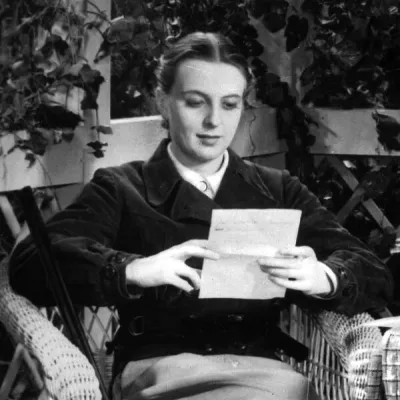
Elzbieta Barszczewska
Human Design Chart
Biography
After graduating Państwowy Instytut Sztuki Teatralnej, she debuted in Polish Theatre in Warsaw in 1934. She also starred in several movie roles, including 13 major ones. In occupied Poland, she took part in the activities of the underground theater. After the war she resumed work with the Polish Theater and the National Theatre. She was a mother of Juliusz Wyrzykowski.
She died 14 October 1987.
Human Design Analysis: Elzbieta Barszczewska as Manifestor 2/4
Manifestor 2/4 — Design at a Glance
Elzbieta Barszczewska acted as a pioneer with visions that inevitably polarized: she was loved and followed by some but rejected or even hated by others due to her grand plans. This design shaped a role similar to that of a Roman emperor who saw the strategic future but did not fight himself, instead using others for his goals. Since her thoughts often reached further than those around her, misunderstandings were a constant companion in her existence.
The key to navigating this dynamic lay in her strategy: she had to inform her environment precisely and timely about her intentions. Only through clear communication could she find the right followers who were willing to follow her. If Elzbieta Barszczewska adhered to this need for informing and held onto her inner authority, she was rewarded with a deep sense of inner peace. Living against this design and acting without prior information led to persistent, deep anger. This emotional reaction served as direct feedback on whether she aligned with her nature as a Manifestor or resisted the natural flow of her design.
Emotional Authority
Elzbieta Barszczewska's decisions were guided by an emotional rhythm that revealed spontaneous impulses as deceptive snapshots. Her inner authority was Emotional Authority carried by the defined Emotional Center. This mechanism operated independently of other configurations in her design: whenever this center activated, it determined her decision-making.
Her perception of the world was always colored by her current mood state. In one moment she could be completely enthusiastic about something, and in the next, view the same situation negatively. However, this up-and-down did not mean that her immediate feeling represented the truth; rather, it was a first impression that had yet to mature. Therefore, quick decisions made from such an emotional state risked negative consequences.
For Elzbieta Barszczewska, patience was the crucial tool for gaining clarity. She needed time for intense feelings to subside and emotional distance to set in. This process of 'sleeping on a decision' allowed her to gain deeper insight and find calmness. Only after the emotional wave had subsided did true clarity emerge. The necessity of this delay particularly shaped long-term life decisions, as only then could comprehensive understanding be achieved that went beyond transient affect.
The 2/4 Profile — Hermit / Opportunist
Elzbieta Barszczewska oscillated between a deep need for solitude for internal reflection and the urge to socialize. Her design tended to live these two poles not as contradictions but as necessary rhythms. Line 2 of her profile prompted her to withdraw to create clarity and process internal processes. During this alone time, she could evaluate knowledge from her network and develop brilliant ideas. Once this inner need was satisfied, she actively sought contact with her favorite people, driven by Line 4, which aimed at relationships and exchange in the social fabric.
This interplay required clear communication of her needs: she had to make it clear when she wanted company and when she needed solitude. Only in a safe environment could this mechanism function smoothly. The danger lay in overloading through the network (Line 4), leading to burnout, or in softening focus during withdrawal phases, which could foster depressive states. Elzbieta Barszczewska used her solitary time strategically to solve problems and delve into details before reintegrating these insights back into her social environment. This cycle of isolation and integration shaped her way of absorbing, processing, and ultimately sharing knowledge.
Single Definition — Defined & Open Centers
Elzbieta Barszczewskas Design is characterized by a stable triangular dynamics of Ajna, Heart and Throat Center. These defined centers ensured consistent conceptual thinking, reliable communication as well as personal willpower and responsibility. She had the ability to create concepts and express her intentions clearly, supported by a permanent source of ego strength. However, this constant expression structure was in tension with her inner authority: the defined Solar Plexus Center. As an emotional authority, this required waiting for the emotional wave for clarity; impulsive action led instead to chaos and confusion.
At the same time, she was strongly influenced by her environment due to several open centers. The open Head Center made her vulnerable to mental pressure, doubts, and the temptation to solve other people's questions rather than trusting in her own emotional clarity. The open G Center meant a lack of fixed identity or direction; she tended to lose herself in relationships or environments instead of radiating her own constant personality. Additionally, the absence of constant generative energy in the open Sacral Center made her vulnerable to exhaustion from "borrowed" energy from others. The open Spleen Center predisposed her for fears and unhealthy dependencies on people with defined well-being, while the open Root Center tended to absorb external stress and adrenal impact, leading to overload if ignored.
Her challenge was not trying to fill these open centers or relieve their pressure. Instead, it was about trusting in the emotional clarity of her Solar Plexus and using the environment as a mirror for her own development without identifying with adopted energies.
Channels for curiosity, emotional transformation and community.
Elzbieta Barszczewskas Design fosters a tendency towards narrative storytelling characterized by emotional curiosity and the desire for community bonding. She is someone who collects ideas to transform them into stories that inspire or teach others.
Channel 11-56 connects her Thinking Center with her Projector Center. This Gate of Ideas and the Gate of Inspiration drives her to constantly seek new perspectives. She acts as a storyteller, translating abstract information into captivating parables. Her motivation lies less in pure factual knowledge and more in stimulating imagination and emotions in her listeners through storytelling.
Channel 36-35 links her Emotional Center with her Projector Center. Through the Gate of Crisis and the Gate of Change, she actively seeks new experiences to gain emotional depth. This restless desire sometimes leads her to provoke crises just to set things in motion. She learns wisdom from these intense emotions and later offers it as advice.
Channel 37-40 connects her Emotional Center with her Willingness Center. The Gate of Friendship and the Gate of Solitude enable her to build bridges between individuals. She seeks recognition within groups and enters into agreements based on mutual benefit. This mechanism helps her find her place in social structures and achieve progress alongside others.
Her energy from Gate 9 in her Sacral Center supports these processes with detail-oriented endurance. She can focus purposefully on the nuances of her stories and experiences, sharpening her narrative power. Together, these channels form a Profile of a seeker who gains knowledge through emotional experience and anchors it within social contexts.
Collective Circuitry — Circuit Signature
Elzbieta Barszczewskas Design shows a tendency towards cyclical emotional reflection paired with a clear need for mutual support in social contexts. This configuration appeared as tension between individual past resolution and collective resource care.
The Meaning-Making Circuit connected her Ajna, Throat, and Solar Plexus Centers directly. This created an energy focused on understanding past experiences. Emotions from the Solar Plexus flowed wave-like – with a beginning, middle, and end – into creative formulation in the Throat Center, guided by the intuitive perception of the Ajna Center. Curiosity (Channel 11-56) drove exploration, while the awareness of impermanence (Channel 35-36) helped draw meaning from the past. The goal was to share these felt insights with the collective to learn together.
Parallel to this, the Ego Circuit worked, connecting Heart and Solar Plexus Centers. Here cooperation took precedence. Channel 37-40 (Community) established a balanced relationship of give and take: "Today I give you, tomorrow you give me." Since this circuit did not connect to the Sacral Center – the source of constant life force – it relied on traditional rest periods. Only through recovery could the necessary energy for the tribe and collective resource creation be maintained.
Both systems coexisted: On one hand, wave-like emotional processing of personal history for others' benefit, on the other hand, a conservative need to conserve energy in exchange with others to sustainably support each other.
Right Angle Cross of Planning 4
Elzbieta Barszczewskas Human Design shows a tendency towards strategic planning and careful preparation as a central life principle. She was someone who prepared paths and created structures before taking action. Her focus lay on long-term visions and methodical approaches, rather than impulsive actions.
This attitude stemmed from the influence of the right cross of Planning 4 in her chart. This configuration emphasized the need to prepare the ground so that ideas could take root. It was not about spontaneous impulses but about deliberately creating conditions that enabled sustainable action. Elzbieta Barszczewska intuitively understood that successful implementation rested on thorough preparation. She used this energy to think through complex connections and develop clear strategies.
Her approach was characterized by patience and foresight. She recognized that hasty actions often led to instability, while thorough planning offered security. This allowed her to pursue long-term goals with a clear head. The mechanics of her design promoted a sense of responsibility towards her own path and the resulting structures. Thus, the theoretical possibility of planning became a practical way of life that brought stability and clarity into her decisions.
Saturn Return · Uranus Opposition · Chiron Return · 2nd Saturn Return — Life Cycles
Elzbieta Barszczewskas Human Design shows a tendency to transition from active creation to integration and sharing wisdom during the Chiron Return phase (around 49-51 years). This cycle did not mark a retreat into private life but rather a shift towards a deeper, mentor-like role where her life experience became the foundation for guiding others.
In Human Design, the Chiron Return describes a fulfillment cycle: If a person has lived according to their strategy and authority, their incarnation cross increasingly unfolds in life. Meaning and purpose become experiential; it is a period of bloom when one's essence shows its full impact.
In 1962, at age 49, Elzbieta Barszczewska entered the playing season at the National Theater, which lasted until 1965. This event exemplified this mechanism: She took on a position that built upon her established expertise and enabled her to exert her artistic authority not only through personal performance but also through presence and leadership in the ensemble. The years at the National Theater were thus more than just a career step; they were the concrete expression of her inner development towards becoming a wisdom transmitter. Her design showed itself as a stabilizing force during this time, structuring what had been learned and passing it on to subsequent generations. The mechanics of the Chiron Return acted here as a catalyst for a role based on depth and authenticity rather than mere visibility.
Manifestor · Emotional Authority — Synthesis
Elzbieta Barszczewskas Human Design reveals a thread of deep inner processing fueled by a combination of emotional authority (Solar Plexus), an open G Center, and the Channel of Transience (35/36). This constellation points to someone who intensely collected experiences, emotionally lived through them, and creatively transformed them – not primarily for herself but to pass them on as stories. The ability to gain clarity from the ups and downs of her emotional world (Solar Plexus), paired with the openness of the G Center to external influences, created a personality that continually redefined itself while accumulating a broad spectrum of experiences. The Channel of Transience amplified this dynamic by fueling a constant need for change and exploration of new possibilities.
A central paradox in Elzbieta Barszczewskas design lies in the tension between emotional depth and an open G Center. While the defined Solar Plexus signals intense, wave-like experiences of emotions, the lack of fixed identity in the G Center suggests someone who felt deeply but whose self-image was malleable – a mirror for the emotions and expectations of others. This dynamic carried the risk of losing oneself in relationships or being overwhelmed by external influences, yet it also offered the flexibility to continually reinvent oneself and view the world from different perspectives.
3 Defined Channels
Incarnation Cross - Right Angle Cross of Planning 4
Solar Return
The Solar Return shows the moment when the sun returns to its exact birth position - your personal solar year.
Life Cycles
Discover the life cycles with a detailed triple view (birth chart, cycle chart, composite).
Human Design Profile
- Type
- Manifestor
- Strategy
- To inform others before acting
- Authority
- Emotional Authority
- Profile
- 2/4 - Hermit / Opportunist
- Definition
- Single Definition
- Incarnation Cross
- Right Angle Cross of Planning 4
- Date of Birth
- 29.11.1913 15:00
- Place of Birth
- Warszawa, Poland
Frequently Asked Questions
What was Elzbieta Barszczewska's Human Design type?
What Profile did Elzbieta Barszczewska have?
What Authority did Elzbieta Barszczewska have?
What incarnation cross was active for Elzbieta Barszczewska?
When was Elzbieta Barszczewska born?
Discover your own Human Design
Are you also a Manifestor? Find out in a personal reading how to use your initiation power peacefully and dissolve resistance.
More Personalities
Back to overviewSissy Spacek
Anémone

Ann-Margret

Arletty

Arno

Artus
