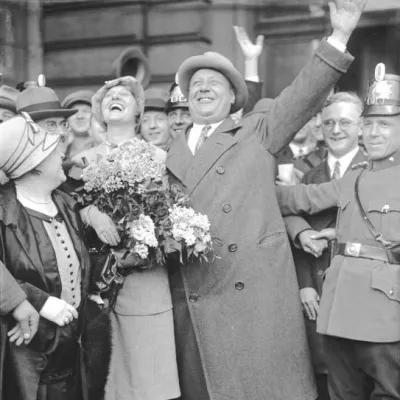
Emil Jannings
Human Design Chart
Biography
A supporter of Nazi ideology, he was blacklisted by Allied authorities and prevented from performing his profession after 1945. Jannings released an autobiography in 1928, "How I Got Into Movies." He died of cancer, a lonely, bitter man on 2 January 1950, aged 65, in Strobl, Austria.
Emil Jannings as a Projector 5/1 in Human Design
Projector 5/1 — Design at a Glance
Emil Jannings showed himself as someone who focused his energy on his environment. As a Projector, he had a dense aura that acted like a bright flashlight: it shone light exactly where the other person's problems lay or where things remained "in the dark." This ability allowed him to immediately recognize flaws in others' systems.
However, this direct perception of his surroundings could be perceived as unpleasant when he openly addressed deficits – comparable to shining a light directly into someone’s face and criticizing their rough circumstances. A more elegant expression of his design was simply to glow pleasantly, for example by embodying harmony himself. This made him attractive; other people came to him on their own initiative to seek advice. Therefore, his strategy was to wait for an honest invitation from his environment before sharing his knowledge.
Since Projectors do not have a defined Sacral Center, Emil Jannings lacked a constant, intrinsic source of life energy. He experienced phases of high activity and rapid workability, but he then needed mandatory rest periods to avoid burning out. The traditional school system and most jobs often did not take this need for breaks into account. When he lived in accordance with this design, he was rewarded with success; when he deviated from it, it led sooner or later to his non-self theme: bitterness.
Splenic Authority
Emil Jannings revealed himself as someone who did not find his orientation through rational analysis or emotional waves but rather through an immediate, physical impulse. His design indicated a tendency towards spontaneous decision-making based on deep survival intelligence. This inner authority was embodied by his defined Spleen Center – the body's health and alarm system. Since both his Emotional and Sacral Centers were open, this Spleen authority served as his primary guidance information; it took precedence over all other defined centers regardless of what else was activated in his chart.
This center functioned as a fine sensor for safety and danger. It provided spontaneous inner knowledge about whether a situation or environment was right for him. This initial impulse directly served his health, enabling him to rigorously isolate himself from harmful influences. However, it was a very subtle signal that appeared only once at the moment; it could easily be ignored or drowned out by external expectations, requiring high vigilance. Since Emil Jannings only knew what was right for him in the concrete moment, his plans often changed at short notice. Long-term commitments complicated this process; instead, he needed a lot of space and flexibility to follow this spontaneous intuition. A retreat for decision-making supported this fine perception as it became clearer without constant external stimuli.
The 5/1 Profile — Heretic / Investigator
Emil Jannings revealed himself as someone whose design was predisposed to accumulating deep knowledge to offer solutions to others for problem-solving. As a 5/1 – Hero/Researcher – he had almost magnetic charisma: Others instinctively sought him out for solutions and answers. This dynamic came from the combination of Line 1 (Research, Foundation) and Line 5 (Hero, Projection). The world projected expectations on him to be inspiring and have answers, which was amplified by Gate 56 (Captivating Attention through Storytelling, Unusualness). His mind scrutinised the nature of life without rigid rules, offering novel perspectives. At the same time, Line 1 from Gate 27 emphasised his fundamental need for self-care and a stable foundation. Without clear boundaries, he risked feeling drained after hours of answering questions – similar to how a scientist might feel exhausted at the end of the day because their inbox is overflowing. Jealousy or misfortune could serve as signals that self-nourishment had been neglected. The challenge lay in balancing his research process for himself and providing solutions for others. By learning to also say no, he could maintain this beneficial balance and optimally utilise his gifts without falling into the trap of overloading due to others' expectations.
Single Definition — Defined & Open Centers
Emil Jannings showed a defined Throat Center connected to the Spleen Center. This configuration gave him a voice that did not come from intellectual concepts or emotional waves but spoke directly from the intuitive intelligence of the body in the present moment. His communication was spontaneous and instinctive; he acted based on a deep, bodily perception of what felt right in the current situation. The Spleen Center ensured that his expression had an existential authenticity – he expressed what his survival instinct and taste in "now" deemed correct without having to rationalize it beforehand.
At the same time, Jannings was marked by several open centers, making him vulnerable to external conditioning. His open Head Center meant he did not have a constant internal mental pressure; instead, he tended to engage with the questions and confusion of others or seek inspiration from outside to focus his mind. The open Ajna Center amplified this: He was a mirror for the concepts in his environment but could easily fall into interpreting foreign ideas as his own truth or feeling uncertain when he did not have a logical answer ready.
Especially defining was his open G Center. Jannings had no fixed inner identity or direction; instead, he assimilated the energy and personality of those around him. This allowed him to "fall in love" with various roles and embody them deeply as he could take on the identity of others. The risk lay in losing himself or taking false directions because he oriented himself by the energy of his environment rather than an inner compass. His open Heart Center led to a lack of constant willpower; he tended to make promises to prove his worth, which often ended in a spiral of disappointment as he lacked the consistent energy to uphold these self-imposed commitments long-term.
Channels for intuitive insight with a clear voice.
Emil Jannings revealed himself as someone who possessed profound self-awareness and used this ability to encourage others to awaken their own inner survival intelligence. This fundamental attitude was rooted in his design: The Channel Flash of Genius 57-20 connected the Spleen Center with the Throat Center. Here, intuitive insight from Gate 57 flowed directly as a clear voice in the present through Gate 20. This allowed him to express spontaneous verbal outbursts of pure intuition that reached the core of things faster than deliberate thought could. His knowledge was based on ancient primal instincts and an immediate awareness of well-being, which he did not implement alone but made effective by speaking it aloud.
In addition to this intuitive power, a complex web of further energies came into play. Gate 56 contributed to abstracting mental processes by translating them into visual representations and stories – important for collective narratives. At the same time, he was under the pressure of Gate 60, which demanded acceptance of limitations as a prerequisite for transcendence and allowed overcoming melancholy through creativity. Care and self-preservation shaped his character through Gate 27, while Gate 28 presented him with the decision to take risks in the here and now or not, to recognize his personal purpose.
In the background, Gate 32 worked with its drive for continuity and material success for the tribe, often paired with the fear of losing stability. Gate 62 demanded patience and logical pattern recognition to clearly name facts. A love of experimentation and mastery through Gate 16 as well as the need for an individual contribution to the group through Gate 8 rounded out his profile. Reflection and withdrawal (Gate 33) served the processing of experiences, while Gate 45 expressed energetic tribal connection and willpower. Finally, Gate 23 enabled the translation of inner sounds into language to explain difference and bring multifaceted mutations into the world.
Individual Circuitry — Circuit Signature
Emil Jannings revealed himself as someone whose inner impulses directly translated into concrete expression. His design connected the Throat Center with the Spleen Center through Channel 20-57 of the Knowledge Circuit. This connection created an immediate flow from intuitive perception to verbal or visible representation. The energy of this channel, often referred as a "flash of insight," promoted innovative and creative insights that did not linger long in thought but were spontaneously expressed. Emil Jannings lived this ability to recognize new connections and express them immediately. It was about the expression of a unique identity through deviation from the known. The pulsating energy of this circuit drove him to initiate changes by transforming his acquired knowledge and bringing it outward. Since his definition was simple, these connected centers formed a coherent unit without internal tensions or separate fields of power. His focus lay on the acoustic and creative communication of his inner images. The melancholy that can accompany this energy served as a deep emotional wave coloring his expressive ability. Emil Jannings used this configuration to walk his own path by not only keeping new insights for himself but bringing them into the world through his voice or actions. This process was natural and direct for him, without an extended reflective phase in between.
Left Angle Cross of Distraction 1
Emil Jannings revealed himself through a configuration that made him vulnerable to inner conflict. His design carried the Left Cross of Distraction, a pattern indicating a deep need for meaning and spiritual understanding, often overshadowed by strong self-criticism or feelings of failure. This energy created an internal struggle between the drive to grasp higher truths and the tendency to hinder himself from consistently pursuing this path. Instead of a clear line, there was often a cycle of intense searching followed by sudden withdrawal or despair. The power of this cross lay not in linear consistency but in its ability to generate deep emotional resonance through these inner tensions. Emil Jannings lived with this dynamic: the quest for transcendence was always accompanied by the fear of having missed the true path or failing to do justice to himself. This shaped his essence as someone who felt profound spiritual or creative impulses, yet often blocked them through self-doubt or diverted them into distracting directions. The energy of the cross demanded a constant confrontation with his shadow, where distraction was less a mistake than a protective mechanism against the overwhelming intensity of his own longing for significance.
Saturn Return · Uranus Opposition · Chiron Return · 2nd Saturn Return — Life Cycles
Emil Jannings showed himself as someone whose life rhythm was marked by profound relational shifts. This dynamic crystallized in 1913 at age 29 with the end of his marriage – a typical expression of the first Saturn Return. During this phase, it often became clear which connections were structurally sound and which were not; the focus lay on defining personal boundaries within interpersonal relationships.
Ten years later, in 1923 at age 39, another turning point occurred: his fourth marriage to Gussy Holl. This fell during the time of Uranus Opposition, a period often characterized by sudden upheavals and a need for individual freedom. While Saturn Returns typically lead to stabilization or letting go of burdens, the Uranus Opposition demands a redefinition of self-understanding, often in the tension field between attachment and autonomy. For Emil Jannings, this meant that his relationships were not static but served as catalysts for inner development. The events show how astrological cycles accompanied concrete life decisions: first clarification through separation, later realignment in a new partnership. Both moments underscored that his design required constant adaptation to changing internal and external realities without losing the core of his identity.
Projector · Splenic Authority — Synthesis
He was a projector who built a deep knowledge base (Line 5) by recognizing errors and potentials in others (Gate 57). He shared this knowledge gladly, becoming a go-to person for problem-solving. His energy flowed through the Channel of Lightning directly into the Throat Center, communicating intuitive insights immediately – an expression of his inner survival intelligence from Spleen Authority. Thus, he lived a process of continuous learning and sharing, always searching for the 'right' path in the present moment.
A central paradox shaped his design: the combination of projection ability to bring light into others' darkness and an internal need for boundary setting, conditioned by Spleen Authority. While he intuitively sensed what was wrong with others, his health required recognizing limits and carefully choosing his environment. This led to tensions in relationships, evidenced by repeated turning points (relationship ends/marriages), forcing him to realign and redefine his path as a knowledge disseminator again and again.
1 Defined Channel
Incarnation Cross - Left Angle Cross of Distraction 1
Solar Return
The Solar Return shows the moment when the sun returns to its exact birth position - your personal solar year.
Life Cycles
Discover the life cycles with a detailed triple view (birth chart, cycle chart, composite).
Human Design Profile
- Type
- Projector
- Strategy
- Wait for the respectful invitation
- Authority
- Splenic Authority
- Profile
- 5/1 - Heretic / Investigator
- Definition
- Single Definition
- Incarnation Cross
- Left Angle Cross of Distraction 1
- Date of Birth
- 23.07.1884 04:00
- Place of Birth
- Rorschach, Switzerland
Frequently Asked Questions
What is Emil Jannings' Human Design type?
Which profile did Emil Jannings have?
What authority did Emil Jannings possess?
What incarnation cross did Emil Jannings have?
When was Emil Jannings born?
Discover your own Human Design
Are you also a Projector? Find out in a personal reading how to unfold your leadership qualities and recognize the right invitations.
More Personalities
Back to overviewSissy Spacek

Alain-Fournier

Anémone

Ann-Margret

Arletty
Arno