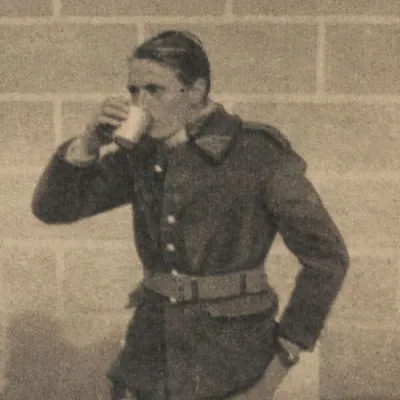
Émile Allais
Human Design Chart
Biography
He died on 17 October 2012, aged 100, in Sallanches, France.
The Human Design of Émile Allais: Generator 6/2
Generator 6/2 — Design at a Glance
Émile Allais revealed himself as someone with remarkable endurance and the ability to generate energy over long periods. His design laid out a foundational structure that inclined him more towards consistent work based on internal confirmation rather than impulsive project initiation from the head. The mechanics of his Generator type described this quality as comparable to a working horse: strong and durable, yet efficient only when the actual energy for the task at hand was present.
Central to Émile Allais was the principle of reaction rather than initiation. His energy unfolded primarily through responses to external impulses, accompanied by an internal confirmation from his sacral center. When he acted in harmony with this signal – if the inner “yes” came – it led to deep satisfaction and a sense of fulfillment. Conversely, proceeding against this nature, such as through forced initiatives without an internal impulse or suppressing action desires, resulted in frustration and energy deficiency. The risk of burnout for him primarily arose when he focused on tasks that did not resonate truly with his inner resonance or when he was prevented from advancing his heart projects, even though the power to do so still existed. His path to effectiveness thus lay in the discipline of waiting for the right signal and then consistently acting upon it.
Sacral Authority
Émile Allais demonstrated decision-making rooted firmly in the body. His design foresaw that the defined sacral center functioned as the primary instance – the sole authority that simultaneously shaped his strategy, thereby simplifying the process. Instead of planning or analyzing, he reacted to external stimuli through immediate physical signals: a gut feeling, grunting, humming, or a palpable surge of energy. These loud or soft sounds were not arbitrary noises but precise yes-or-no answers from his system.
The underlying mechanics required waiting for this impulse. Once the sacral motor engaged, vital energy emerged, granting him inexhaustible strength and great enthusiasm. Émile Allais lived this dynamic by immersing himself fully in activities driven by joy and satisfaction rather than purposefulness. His life mission consisted of working with this enthusiasm without having to pre-determine the outcome.
Additionally, his activated spleen center supported this sacral authority. This configuration allowed him quick, spontaneous reactions and direct access to instinctive perception. He could rely on this physical well-being reliably, making his decisions not only intuitive but also lightning-fast. The combination of deep sacral resonance and spleen-supported speed shaped his way of acting: reactive, energy-charged, and instinctively secure.
The 6/2 Profile — Role Model / Hermit
Émile Allais revealed himself through his design as someone whose life path went through two clearly distinct phases: an early period of active experimentation and a later era of reflective wisdom. As a natural talent in his youth, he was driven by the principle of trial and error. In this phase before the age of 30, he gathered numerous personal experiences, learned from mistakes, and withdrew after failures to start anew. This process was marked by the necessity of securing individual needs and material foundations before deeper spiritual development became possible.
With Saturn’s return cycle, roughly around 30 years old, a fundamental shift occurred. The sixth line of his design became active, prompting him to distance himself. He metaphorically retreated into a “cave” to re-examine his past experiments from a new perspective. This period of intense introspection served for healing and gaining deeper self-awareness. His early focus on problem-solving and detail work now transformed into wise insight.
When Émile Allais finally emerged from this phase of reflection, he did so as a role model. His previous experiences had turned into life wisdom that attracted others. People sought him out to learn from his ability for deep self-reflection and share in the insights arising from his long journey of individual development.
Single Definition — Defined & Open Centers
Émile Allais was characterized by a stable identity and clear life direction, paired with constant vitality and existential survival pressure. His defined G Center gave him reliable self-worth and an inner compass for his mission; he knew where he belonged without having to direct others. This inner security allowed him to offer guidance to others as long as he did not prioritize their expectations over his own path.
His energy source was in the defined Sacral Center. Allais had a tremendous reserve of power, which could only be activated through reaction. Initiatives without prior invitation cut him off from this source and led to frustration or exhaustion. His strategy involved waiting until life posed questions that his Sacral Center could answer with a clear yes or no. Only then did he have the endurance needed to master tasks sustainably and endure stagnation phases.
Additionally, a defined Root Center propelled him forward. It provided a steady, adrenalized pressure necessary for material prosperity and survival. This existential motor helped him establish himself in the world and correct problems as long as he did not become obsessive or project stress onto others.
In contrast, Head, Ajna, and Throat Centers were open. Allais tended to relieve mental pressure by trying to find answers to questions that weren't his own. He could easily get entangled in the confusion of others or feel the need to demand attention through spontaneous speech, which often produced unpredictable results. His open Heart Center led him to want to prove his worth through promises and competition – a mechanism destined to fail due to his lack of necessary willpower. Furthermore, his open Solar Plexus absorbed foreign emotions, making him vulnerable to emotional waves not originating from him. His open Spleen Center generated deep fear about well-being and survival, leading him to cling to uncertain situations or make spontaneous decisions to temporarily alleviate these fears rather than trusting his inner authority.
Channels for resources, change and inner rhythms.
Émile Allais was marked by a pulsating dynamic between tension and generative power. His design was characterized by the Channel of Mutation 60-3, a format energy that enables evolutionary change through accepting limitation (Gate 60) and organizing new beginnings (Gate 3). This connection between Root and Sacral Centers created a characteristic on/off dynamics: moments of high intensity were often followed by phases of melancholy or silence in which something new matured underground. Attempting to control these pauses rationally led him to frustration; instead, patience during the wait for the sacral reaction was crucial for new directions.
Parallel to this, the Channel of Beat 14-2 connected his Sacral Center with his G Center. Through Gate 14, he had the competence to use material resources to drive mutations, while Gate 2 served as a driver for higher knowledge and direction. This tantric channel endowed him with the ability to translate innovative impulses into concrete life directions by trusting the answer from his sacral center – even if the goal was initially unclear. His presence could help others find their own direction simply through the emanation of his authentic reaction to life.
Additionally, the Channel of Rhythm 5-15 stabilized his inner flow. Gate 5 held onto fixed habits while Gate 15 integrated the diversity and extremes of experience into the stream of life. This connected him closely with the natural pulse of existence, independent of intellectual or emotional fluctuations. Through this configuration, Émile Allais was enabled to be carried by the flow of life, his timing guided by the sacral reaction. When he followed this rhythm, his energy flowed effortlessly and drew others into a continuous, flexible stream that propelled both himself and his environment forward.
Individual Circuitry — Circuit Signature
Émile Allais exhibited an energy that pulsed and was rooted in the present moment. His identity expressed itself acoustically: emotional waves from the Solar Plexus Center flowed through the Throat Center into the world. This connected creativity with melancholy to effectively make individual mutations – deviations from the existing – happen.
This dynamic came from the Knowledge Circuit. For Émile Allais, here the Identity, Sacral, and Root Centers were directly linked. The Channel 3-60 (Mutation) promoted his unique path while the Channel 2-14 (The Beat) provided rhythmic impulses. Together they created a force to transform new knowledge and express it through emotional resonance.
Parallel to this, the Understanding Circuit was at work. Here, the Channel 5-15 (Rhythm) connected Identity with Sacral Centers. This connection stood for the transmission of logical, rational insights free from conditioning. The energy was focused and visually oriented towards future structures.
Although both circuits utilized the Identity and Sacral Centers, they formed separate segments. The Knowledge Circuit brought in emotional, acoustic transformation; the Understanding Circuit delivered strategic, rational structure. Émile Allais’ design integrated these forces not as a single stream but as coexisting potentials: on one hand, the pulsating individual voice, on the other, the clear dividing mind. Both aspects shaped his way of initiating change and conveying insights, with the emotional wave always in dialogue with the rational strategy without fully merging.
Left Angle Cross of Spirit 1
Émile Allais revealed himself through the left cross of Spirit, a configuration that aims at spiritual development and inner transformation. His design inclined him to engage with higher levels of consciousness and integrate these experiences into his everyday life. This orientation fostered a deep understanding of the connections between the material and the immaterial.
The left cross of Spirit is known in Human Design as a special energetic structure often associated with a strong connection to the spiritual dimension. It supports the process of self-discovery and helps see personal challenges as opportunities for growth. For Émile Allais, this likely meant that he gained important insights during moments of reflection or meditation, which shaped his life path.
Although no specific events are mentioned in the raw content, it can be assumed that this spiritual orientation influenced his decisions and reactions to various situations. His ability to look beyond the obvious may have helped him consider complex problems from a different perspective and find innovative solutions. Overall, the left cross of Spirit shaped Émile Allais' approach to life and his interactions with the world around him.
Saturn Return · Uranus Opposition · Chiron Return · 2nd Saturn Return — Life Cycles
Émile Allais affirmed his life direction with clear consistency in 1938 at the age of 26. His success in the alpine combination during the World Championships in Engelberg marked a moment of structural consolidation for his design. This period fell into the phase of the first Saturn return – a cycle that, in Human Design mechanics, is not merely an age but a phase of maturation and affirmation. While the first Saturn return often begins with uncertainty, years of groundwork condense into a solid result here. Émile Allais did not use this energy for realignment but to consolidate what had already proven effective. The repetition of success in Engelberg was no coincidence but a visible sign that his inner compass system functioned stably and he was on the path prescribed by his strategy and authority. The Saturn return acts like a litmus test: it shows whether the chosen direction is sustainable. For Émile Allais, this cycle demonstrated that his decisions were based on solid ground. The alpine combination required precision and endurance – qualities strengthened by the Saturn influence. This success was thus not an isolated event but an integral part of his personal development, underscoring his ability to pursue long-term goals consistently and turn them into concrete results.
Generator · Sacral Authority — Synthesis
Émile Allais' life was marked by a deep inner rhythm fueled by strong sacral energy (Sacral Center defined) and the need to discharge this energy in response to external stimuli. This responsiveness, combined with the ability to convert pressure through the Root Center into movement (defined centers G, Sacral, Root), created dynamic power that constantly realigned him and gave him an intuitive understanding of life's flow. The connection between creativity and practical implementation, manifested in the Channel of Beats and Mutation, points to a person who was both innovative and capable of realizing these innovations – a skill evident in repeated successes (documented event 1938).
A central tension lay in Émile Allais' open centers – particularly the Heart, Ajna, and Solar Plexus Centers – making him vulnerable to external influences. While this openness allowed him to deeply understand others' needs, there was also a risk of getting lost in conditioning or making decisions out of fear and uncertainty. The constant oscillation between the need for authenticity and adaptation to external expectations created an inner dynamic that was both the source of his creativity and a challenge to maintain his own direction.
3 Defined Channels
Incarnation Cross - Left Angle Cross of Spirit 1
Solar Return
The Solar Return shows the moment when the sun returns to its exact birth position - your personal solar year.
Life Cycles
Discover the life cycles with a detailed triple view (birth chart, cycle chart, composite).
Human Design Profile
- Type
- Generator
- Strategy
- To respond - wait for something to respond to
- Authority
- Sacral Authority
- Profile
- 6/2 - Role Model / Hermit
- Definition
- Single Definition
- Incarnation Cross
- Left Angle Cross of Spirit 1
- Date of Birth
- 25.02.1912 11:00
- Place of Birth
- Megève, France
Frequently Asked Questions
What Human Design type was Émile Allais?
Which Profile did Émile Allais have?
What Authority did Émile Allais have?
What incarnation cross was assigned to Émile Allais?
When was Émile Allais born?
Discover your own Human Design
Are you also a Generator? Find out in a personal reading how to use your sacral energy correctly and discover deep satisfaction.
More Personalities
Back to overviewAaliyah

Aldair

Alexia

Angèle

Anne-Marie

Arcángel