
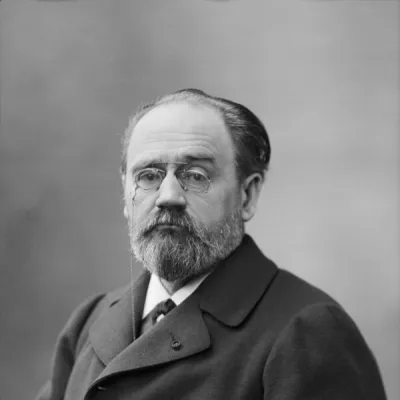
Émile Zola
Human Design Chart
Biography
Émile Zola as a Generator 5/1 in Human Design
Generator 5/1 — Design at a Glance
Émile Zola's design placed a power source that did not release on its own but only became effective when it could respond to something from the environment - an impulse, a question, a task brought to him. This is the basic mechanics of the Generator type: A Generator has very enduring working strength, comparable to a workhorse that can accomplish enormous tasks as soon as there's a reason to pull. So this power in Zola's design did not unfold through self-initiation but through reacting - first an external impulse, then the response through action.
From this disposition emerged two typical pitfalls. The first: exhausting oneself with tasks for which there was actually no real desire - this drained his strength and could lead to exhaustion despite high creative potential. The second: being held back from working on a self-chosen project pursued with passion when energy was still abundant.
If this power aligned with his own responsiveness, it resulted in a deep feeling of fulfillment as a reward. If instead it got stuck on unwanted duties or was slowed down, ongoing frustration or a noticeable lack of energy threatened.
Emotional Authority
Émile Zola's design showed a pronounced binding of decisions to a temporal ripening process: What appeared within him at the moment did not immediately follow an impulse for action but went through a perceptible emotional movement before something substantial emerged. The basis for this was emotional authority, carried by the defined Solar Plexus Center. In Émile Zola's case, this center was activated, and according to Human Design mechanics: If the Emotional Center is defined, it is always inner authority - regardless of what else is defined in the chart. This rule took precedence over all other defined centers.
Practically, this meant for him a continuous wave of ups and downs in mood. The same thing could inspire enthusiasm at one moment and appear completely negative shortly after - the first impression was not yet reliable truth. Quick decisions made directly from an immediate emotion carried corresponding risk for him. Only when he gave a decision time, when he mulled it over multiple times and resisted the urge for instant clarity, did the initial emotional intensity subside. At the end of this process stood then a calmness from which a more substantial assessment was possible - especially in decisions with greater reach for his further path.
The 5/1 Profile — Heretic / Investigator
Émile Zola's design carried the profile 5/1, the 'Hero/Researcher': an orientation to build one's own knowledge quietly and offer it as a solution to others. This profile combination describes people who love the process of learning, new projects, and challenges; the fifth line gives almost magnetic effect - others want to know desperately what insights someone with this profile has to offer and seek solutions for their problems there. For Zola, this could become a burden if no clear boundaries were set: The balance between his own research (first line) and meeting other's expectations (fifth line) had to be learned, among other things through the ability to also say 'no'.
Two further activations shaped this picture. Gate 21 in the fifth line stood for an objective, impartial stance when guiding and leading during crises - the ability to remain clear without being led by emotions; this impartiality was considered crucial for success on a material level. Gate 54 in the first line described also an ascent through support from hidden, not openly revealed relationships - influence that lost power once these ties were exposed. In Zola's case, it showed a chart combining strategic, impartial action during crises with quietly building influence through relationships behind the scenes.
Split Definition — Defined & Open Centers
Émile Zola's design set a tendency to prove himself through constant willpower while simultaneously reacting sensitively to the need to be noticed. This tension arose from the interplay of a defined Heart Center with several open centers.
The Heart Center, responsible for willpower, ego, and handling material resources, was defined in him - a firm, consistently available theme. People with this configuration like to control their lives and resources themselves, recognize their own value, and strengthen themselves by giving promises they keep. They work out of self-motivation but prefer to be their own boss and want recognition for their contribution.
Similarly defined was his Sacral Center, the source of vital, productive energy: a daily hum that requires engagement and finds deep satisfaction once this energy flows into perceived appropriate activities. Added to this was a defined Solar Plexus Center as inner authority - decisions needed time with this configuration because clarity only set in after an emotional wave ran from peak to depth, not immediately.
These permanently available themes stood opposite several open centers. The Throat Center, responsible for expression and communication, was open - a disposition that is prone to act out of the concern of being overlooked rather than waiting until the invitation to speak comes naturally. Also open was the G Center, the seat of identity and direction: without firm self-definition this configuration tends to repeatedly ask where one's path leads and easily adopts orientation from the environment. The Spleen Center was also open, thereby typically amplifying fears about one's well-being rather than filtering them - a vulnerability that should be countered by conscious waiting.
Channels for community feeling and the process of becoming.
Émile Zola's design combined a strong need to commit oneself to something or a community through clear agreements with an impulse to continually embrace new experiences, complete them, and then draw lessons from them. Behind this stood the Community Channel 37-40 connecting the Solar Plexus Center with the Heart Center: Gate 40 was ready to devote itself to what it loved but required payment and rest periods, while Gate 37 sought recognition and a secure place in the whole through its gift of affection. Together they formed the pattern of a business negotiated over time rather than spontaneous - on the principle "I do this for you if you do that for me". Added was the Ripe-ness Channel 42-53 between Root and Sacral Centers: Gate 53 initiated a new cycle, Gate 42 drove its growth to completion. Each experience had to be brought to a satisfying conclusion before starting anew - only then did hindsight make insight useful. In addition, his design featured Gates 21, 48, and 54: the need to control material things oneself and receive respect for it, the ability to recognize patterns deeply and bundle them, as well as ambition that aligned worldly success with higher development. This was complemented by Gate 22 showing openness and the ability to listen to a conversation through its end, along with Gates 41, 14, 19, and 5 expressing desire for new experience, skillful handling of power, need for secure resources, and one's own work rhythm. Gating 51 and Gate 26 rounded out the picture, with willpower in dealing with shocks and the ability to convince others of something new.
Collective Circuitry — Circuit Signature
198 words under the limit. Here is the final text:
Émile Zola's design showed a tendency to bring experienced events to an inner conclusion before producing results he shared with others. This characteristic traced back to a channel between Root and Sacral Centers, which Human Design calls "Ripeness": a cyclical energy that did not run linearly but in phases - an impulse from the Root Center drove the life force of the Sacral Center until a started matter was actually completed before a new cycle began. This belonged to a group of themes revolving around past experience and drawing insights from it - typically connected with the need to pass on what was understood afterward.
Separate from this, there existed in Zola's design a second independent area: a channel between Heart and Solar Plexus Centers that Human Design calls "Community" and describes as a relationship of mutual support - giving help expecting to receive it back at some point. This pattern belonged to a group of channels oriented toward cooperation and the joint creation of resources, not individual strength.
Zola's overall definition was 'divided': The two areas - Root/Sacral on one side, Heart/Solar Plexus on the other - did not merge in him but existed as two parallel, self-contained forces alongside each other without a direct bridge between them.
Left Angle Cross of Endeavour 1
132 words, well below the upper limit. Here is the chapter text:
Émile Zola's design established a fundamental orientation towards sustained, goal-directed effort – a force that did not exhaust itself in a single act of strength but rather showed itself as consistent endeavor over longer periods of time, sticking to one thing. This orientation stemmed from his Incarnation Cross, which in the Human Design system is called 'The left cross of effort 1': that thematic field that outlines the larger life framework of a person and indicates the direction in which their energy would be focused over the years. The addition of 'left' in the designation pointed to a transpersonal orientation – the effort was embedded in a network of relationships and effects on others, rather than being solely about oneself. For Zola, this pattern shaped a way of life where effort and perseverance only fully unfolded through exchange with another environment.
Saturn Return · Uranus Opposition · Chiron Return · 2nd Saturn Return — Life Cycles
Émile Zola's design showed a recurring movement: phases in which commitment, departure, fulfillment, and public responsibility took turns appearing. In 1870, at the age of 30, he married Alexandrine – the first Saturn Return occurred, a cycle that shows how effective the structures built up until then actually are, often answered by a binding decision. Ten years later, in 1880, at the age of 40, he acquired a country house in Médan: the Uranus opposition became active, a time when one's gaze detaches from expectations and seeks an independent path. In 1888, at the age of 48, he published the novel 'The Dream' – the Chiron Return marked this phase: no break but a fulfillment cycle in which his own Incarnation Cross unfolded more and more if lived according to strategy and authority until then, making sense experienced. Finally, in 1898, at the age of 58, he published the open letter 'I Accuse...!' to President Félix Faure and was subsequently sued and sentenced to a fine and imprisonment – the second Saturn Return occurred: this cycle tests the lived attitude with full consequences.
Generator · Emotional Authority — Synthesis
Through Émile Zola's design ran a red thread: depth that was put into service of something greater. As a 5/1, he attracted others who sought solutions from him, drawing on his quiet knowledge base – yet being sought after forced him to set boundaries and say no. His defined Sacral Center carried an energy that unfolded most strongly when responding to external signals rather than initiating itself. Through the Channel of Community, he waited to be invited into a collective and find recognition – a need that manifested in Gate 21 as a desire for control over the material world in service of the community. His defined Heart Center reinforced this pull: being one's own boss, recognized for one's contribution.
At the same time, his design carried a tension field between two wired forces. Solar Plexus and Heart formed a group: a strong-willed drive towards controlling one's resources and recognition from others. Sacral and Root formed a second, independent group: a force that could only react and lost reliability when initiating. These engines ran parallel without being interconnected – an 'I' wanting to steer and be recognized alongside a life force that could only respond. Over both lay the same delay of inner authority: every reaction had to go through an emotional wave before becoming a decision.
2 Defined Channels
Incarnation Cross - Left Angle Cross of Endeavour 1
Solar Return
The Solar Return shows the moment when the sun returns to its exact birth position - your personal solar year.
Life Cycles
Discover the life cycles with a detailed triple view (birth chart, cycle chart, composite).
Human Design Profile
- Type
- Generator
- Strategy
- To respond - wait for something to respond to
- Authority
- Emotional Authority
- Profile
- 5/1 - Heretic / Investigator
- Definition
- Split Definition
- Incarnation Cross
- Left Angle Cross of Endeavour 1
- Date of Birth
- 02.04.1840 23:00
- Place of Birth
- Paris, France
Frequently Asked Questions
What was Émile Zola's Human Design type?
What profile did Émile Zola have?
What authority did Émile Zola have?
What incarnation cross did Émile Zola have?
When was Émile Zola born?
Discover your own Human Design
Are you also a Generator? Find out in a personal reading how to use your sacral energy correctly and discover deep satisfaction.
More Personalities
Back to overviewAaliyah

Alain-Fournier

Alexia

Angèle

Angeli

Anne-Marie
