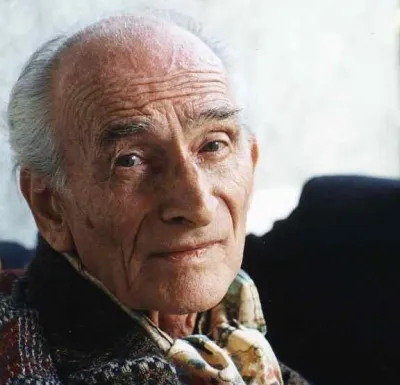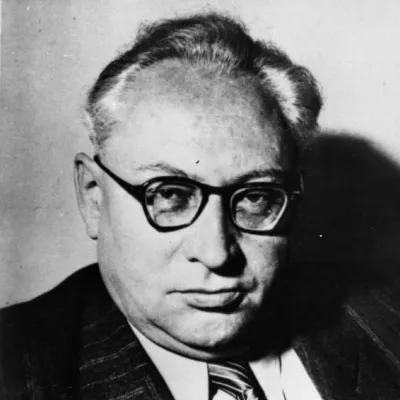
Erich Ollenhauer
Human Design Chart
Biography
Died on 14 February 1963, Bonne, Germany.
Erich Ollenhauer as a Manifesting Generator 3/5 in Human Design
Manifesting Generator 3/5 — Design at a Glance
Erich Ollenhauer's design marked him as a Manifesting Generator, a configuration that combined constant sacral energy with the ability to skip steps and produce results quickly. This structure created a hybrid character trait: He possessed the endurance of a generator but also had the speed of a manifestor. His inner drive required responding to impulses; only when his sacral center said a clear "yes" could he effectively channel his energy and derive deep satisfaction from his work.
At the same time, this design carried a tendency to pursue multiple projects in parallel. The speed with which Ollenhauer could bring things into his life carried the risk of overlooking important intermediate steps. When this happens, the need to backtrack and fill gaps often leads to frustration – the specific non-self theme of this type. As long as he listened to his inner authority and maintained the "play mode" in which variety served as a source of power, however, handling multiple tasks simultaneously was not a burden but a wellspring of creative energy. His design thus did not show up as linear progression but rather as dynamic, impulse-driven action that allowed both acceleration and the risk of rushing.
Emotional Authority
Erich Ollenhauers design inclines towards emotional depth and necessary delays in decision-making. His inner authority was emotional authority, carried by the defined Solar Plexus Center. This mechanism was subject to constant waves of ups and downs in feelings; the world always appeared colored by his current mood. What seemed inspiring at one moment could appear negative in the next. In such moments, his immediate feeling was only a snapshot, not yet necessarily his truth. Therefore, quick, spontaneous decisions based on such emotions often had negative consequences.
The mechanics required patience: The more time he took to let a decision mature, the deeper and more comprehensive his understanding became. This meant reconsidering and sleeping on decisions multiple times. Through this hesitation, intense feelings subsided, emotional distance was regained, leading to clarity and calmness. Only then was the process complete. This strategy primarily applied to long-term decisions with significant influence on life's course. Since the Solar Plexus Center was defined, this emotional authority always took precedence over other defined centers in his design, regardless of what else was activated. Thus, he lived in a rhythm that established waiting and rethinking as necessary filters for true insight, rather than relying on initial impulses.
The 3/5 Profile — Martyr / Heretic
Erich Ollenhauer's Design is characterized by the dynamism of the 3/5 Profile: the Experimental and Heroic type. He embodied the attitude of a heroic adventurer who gathered practical life experiences and later passed them on as valuable knowledge to others. His Line 3 drove him not to believe anything simply; instead, he tested everything himself through trial and error. This process of detailed work and adaptability formed the foundation of his understanding of complex relationships. He consciously avoided abbreviations because they would have limited the value of his judgments.
Line 5 transformed this acquired experience into a role as a helper. He was someone who solved other people's problems with his self-earned knowledge. This competence attracted those around him; people sought his proximity to learn from both his successes and setbacks. However, this public role also brought risks: failing in front of others could be painful because the heroic role was highly flattering.
Additionally, the energy of 58.5 shaped his way of acting. It stood for counterattack and defense. He used his strength only for practical solutions and carefully weighed each experiment. His protective instinct remained active to avoid being misled by false paths. By using attacks as an opportunity for defense, he preserved his own orientation. Thus, a personality emerged that learned through personal experience and then applied this secure knowledge for the benefit of the collective, always mindful of self-protection and practical effectiveness.
Single Definition — Defined & Open Centers
Erich Ollenhauer's design inclined towards consequent willpower and mental clarity. His defined Heart Center provided a constant source of inner strength, predisposing him to take responsibility for his resources and promises. This energy drove him to strive for success and actively prove his worth without relying on external validation. Simultaneously, the defined Ajna Center ensured reliable mental function: he processed data and creativity always according to a specific pattern, allowing him to develop concepts independently of external influences.
This internal structure culminated in his defined Throat Center, serving as a pivot point to translate these mental and willful impulses into clear communication and action. His voice was thus a reliable expression of what his mind conceptualized or his heart desired. The combination of the defined Sacral and Solar Plexus Centers complemented this profile: while the Sacral Center provided immense vital energy activated through reaction, the defined Solar Plexus acted as an emotional authority. This meant that he did not make decisions impulsively but patiently waited until his emotional wave had clarified to gain deep insights.
In contrast, his open Head Center showed a vulnerability to mental pressure and confusion when trying to find answers to questions that were not his own. He tended to identify with the inspiration or doubts of others rather than recognizing them as foreign. Similarly, his G Center was open, meaning he did not have a fixed, unchangeable identity. Instead, he reflected the direction and self-understanding of his environment. This made him vulnerable to losing himself in relationships or environments that were not correct for him, since he did not draw from an inner definition but learned through interaction with others.
Channels for clear structure, focus, logic, power, change and community.
Erich Ollenhauer's design inclined towards precise analysis and corrective action. The Channel of Concentration 52-9 connected Root Center with Sacral Center, allowing him to focus on evaluating details and collecting energy through calm stillness before reacting. This formative energy drove him to perfect patterns. Parallelly, the Channel of Judgment 58-18 between Root Center and Spleen Center; here he checked what was healthy in a lively manner and corrected imbalances to keep the collective in balance.
His ability to act showed through the Channel of Charisma 34-20 connecting Sacral Center with Throat Center. This energy allowed him to quickly and powerfully impact the world when resonating internally, without having to wait long. In interpersonal relations, the Channel of Community 37-40 between Solar Plexus and Heart promoted fair agreements; he sought recognition through service to others and built bridges for cohesion.
Simultaneously, he carried the tension of the Channel of Transience 36-35 connecting Solar Plexus with Throat Center. This channel urged him to collect new experiences and bring about changes often driven by emotional waves or even artificially created crises to break stagnation.
On the personality side, Gate 17 complemented his pursuit of succession and logical teaching for the future, where doubts served as a healthy process. Gate 4 formulated clear rules for future security. Gate 38 set boundaries and defended individual integrity against harmful pressure. Gate 54 connected worldly ambition with spiritual insight. Additional design elements like Gate 42 (closing processes), Gate 11 (visual assessment) as well as Gates 5 (rhythm) and 12 (creative restraint) rounded off his profile by bringing structure into his energy flow patterns.
Collective Circuitry — Circuit Signature
Erich Ollenhauer's design inclined towards structured, emotional communication. The Knowledge Circuit connected Ajna Center with Throat Center via the Channel of Structuring (Gates 43-23). This allowed him to articulate mental concepts in clear words. Parallelly, the Understanding Circuit worked through Channels for Concentration (9-52) and Judgment (18-58), connecting Sacral, Root, and Spleen Centers. Here lay a focused rational energy developing logical strategies. The Meaning-Finding Circuit linked Throat Center with Solar Plexus Center via the Channel of Transience (35-36). This brought emotional wave movements into expression, reflecting past experiences. In the Ego Circuit, the Community Channel (40-37) connected Heart and Solar Plexus Centers. This promoted cooperative relationships based on mutual support and resource exchange. Finally, the Integration Circuit through the Charisma Channel (20-34) linked Throat Center with Sacral Center. This gave his presence an immediate, now-exerting power from life energy. As a simple definition, all these centers formed a cohesive flow. The various energies - from rational strategy over emotional reflection to cooperative support - did not work in isolation but supported each other in a unified expression system.
Right Angle Cross of Service 1
Erich Ollenhauer's Human Design showed a tendency towards deep, often unspoken dedication to the welfare of others. He was someone who did not channel his strength through loud assertion or personal ambition but rather through quiet support and readiness to serve. This attitude stemmed from what is known as the 'Right Service Cross 1'. In this constellation type, the energy lies in taking responsibility for one's environment without having to stand in the spotlight. It involved an inner discipline that allowed him to tackle difficult tasks with patience and perseverance as long as they served a common good. Erich Ollenhauer lived this mechanism by proving himself as a reliable pillar who worked behind the scenes to keep structures stable. His authority did not arise from dominating will but from his ability to clear paths for others and prioritize their needs over personal preferences. This created an atmosphere of trust, as his actions were always perceived as selfless and in everyone's best interest. However, this cross also demanded a willingness to step back to make room for others – an aspect that shaped his entire work and enabled him to take on a connecting role in collective processes without losing sight of his own identity.
Saturn Return · Uranus Opposition · Chiron Return · 2nd Saturn Return — Life Cycles
Erich Ollenhauer's Human Design pointed towards strategic succession and the assumption of responsibility within established structures. This orientation was evident in 1952, at age 51: he took over Kurt Schumacher’s roles as party chairman, parliamentary group leader, and opposition leader. This marked his Chiron Return, a fulfillment cycle between ages 49 and 51. During this phase, the individual's incarnation cross increasingly unfolds in life; if one has lived according to their strategy and authority up until then, personal meaning becomes tangible and inner destiny turns into external reality. Ollenhauer’s assumption of leadership positions was thus not mere coincidence but a concrete manifestation of this bloom cycle, where his life task reached full effectiveness.
Later, in 1960 at age 59, Willy Brandt was nominated as the new chancellor candidate. This fell into the second Saturn Return, often marking a phase of consolidation and passing on responsibility. While the first Saturn Return (around ages 27-30) signifies establishing one's own base, the second return frequently calls for reviewing achieved positions and preparing for the next generational step. Ollenhauer’s design showed a clear developmental line: from personal establishment in the Chiron Return to structural further development and succession planning in the second Saturn cycle. Thus, his design shaped both the peak phase of his own leadership as well as the transition to the next generation without losing sight of his role but embedding it into a larger context.
Manifesting Generator · Emotional Authority — Synthesis
Erich Ollenhauer was a person marked by the connection between sacral energy (defined Sacral Center) and mental concentration (Channel of Concentration). This combination led to a profound ability to focus on details and apply knowledge – a format energy that enabled him to recognize patterns and make them accessible for others. His profile as an experimenter/hero and savior indicates that he learned through personal experiences and willingly shared this knowledge to help others. However, emotional authority required time for decision-making, a maturation process contrasting with the quick action of the Manifesting Generator.
This interplay of fast, sacral-driven energy and emotional depth created an inner tension. He tended to act quickly but also could not avoid filtering decisions through the emotional wave – a process that slowed him down yet enabled him to make well-founded judgments. The documented events showed how he took responsibility (1952) and set strategic directions (1960), where both seizing opportunities swiftly and careful deliberation played roles.
6 Defined Channels
Incarnation Cross - Right Angle Cross of Service 1
Solar Return
The Solar Return shows the moment when the sun returns to its exact birth position - your personal solar year.
Life Cycles
Discover the life cycles with a detailed triple view (birth chart, cycle chart, composite).
Human Design Profile
- Strategy
- To respond - wait for something to respond to
- Authority
- Emotional Authority
- Profile
- 3/5 - Martyr / Heretic
- Definition
- Single Definition
- Incarnation Cross
- Right Angle Cross of Service 1
- Date of Birth
- 27.03.1901 10:00
- Place of Birth
- Bonn, GER
Frequently Asked Questions
What was Erich Ollenhauer's Human Design type?
What Profile did Erich Ollenhauer have in Human Design?
Which Authority guided Erich Ollenhauer's decisions?
What incarnation cross was decisive for Erich Ollenhauer?
When was Erich Ollenhauer born?
Discover your own Human Design
Are you also a Manifesting Generator? Find out in a personal reading how to unfold your multi-talents and direct your energy wisely.
More Personalities
Back to overviewAldair

Alizée

Angeli

Arletty

Artus

Balthus