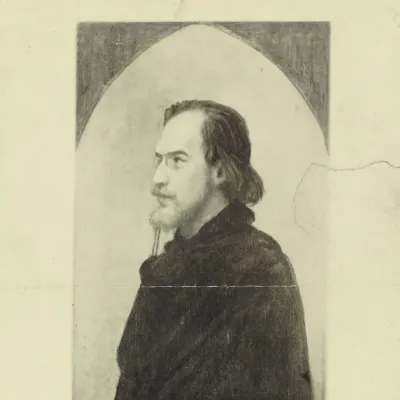
Photo: Wikimedia Commons
Erik Satie
Human Design Chart
Biography
He studied only one year at the Paris Conservatoire, then started his café pianist work and returned to serious study in 1905 at the Schola Cantorum. Satie, along with Jean Cocteau and Picasso, produced a shocking ballet, "Parade," in 1917. Among his other works are two ballets, the piano suite, "Gymnopedies" in 1888, four sopranos, chamber orchestra and numerous piano pieces.
Satie died of liver failure due to alcohol abuse on 1 July 1925, Paris, France.
What does Generator 2/4 mean for Erik Satie?
Generator 2/4 — Design at a Glance
Erik Satie's design established a tendency for great endurance and inner strength, comparable to a workhorse that uses its energy efficiently. As a Generator, he had a lot of sacral energy, which was released not through self-initiated action but by responding to impulses from the environment. His life strategy involved waiting for signals and then acting when his inner self gave a clear "yes."
This mechanism was crucial for his well-being. When he responded to this inner resonance, he could push projects forward with deep satisfaction and a sense of fulfillment. The energy then flowed naturally and sustainably. Conversely, ignoring this principle—such as by forcing actions without inner consent or interrupting his heart projects—led to frustration and energy loss.
His greatest challenge lay in not investing in things he had no interest in, as this wasted his limited life force. Equally harmful was being prevented from pursuing his true passion, even though he was still full of power. Thus, Erik Satie showed himself to be someone whose effectiveness and satisfaction directly depended on following the rhythm of his sacral energy: responding rather than initiating, and acting when his gut confirmed it. Only in this way did he avoid burnout and find his deepest fulfillment.
Emotional Authority
Erik Satie was influenced by an emotional wave that colored his perception of the world through his current mood. His design showed a tendency towards strong mood swings: in one moment he could be enthusiastic about something, and in the next moment view the same thing negatively. These fluctuations were not mere mood swings, but an expression of his inner authority, which lay in his defined Emotional Center. In Human Design mechanics, every defined Emotional Center automatically carries inner authority, regardless of other definitions in the chart. This meant for Satie that spontaneous decisions based on current emotions were often misleading, as they only represented a snapshot and not his deeper truth. His strategy was to take his time. He had to let decisions mature, often through multiple nights of sleep, to allow the intense feelings to subside. Only when emotional distance was gained did clarity and calmness set in. This process of patience was crucial for long-term life decisions that shaped his path. By enduring through the emotional wave, he could arrive at a well-founded, calm understanding, rather than being led by fleeting impulses.
The 2/4 Profile — Hermit / Opportunist
Erik Satie revealed himself as someone who lived in a constant oscillation between the need for withdrawal and the desire for community. His design, marked by Profile 2/4, created an internal tension: On one hand, he retreated into his "cave" to find peace and clarity (Line 2), while on the other hand, he sought contact with his favorite people to share these insights (Line 4). This dynamic required clear communication of his needs – when he wanted company and when he needed to be left alone. During his solitary times, he reflected on the knowledge of his network and developed brilliant ideas from it. Line 2 emphasized his contribution as a natural talent, often unusual and as a role model, where selflessness in service to the collective preserved his integrity. At the same time, Line 4, known as the "burnout" line, carried the risk of an emotional breakdown if the longing for intense feelings in the network became too strong. Analytical thinking could deliver positive results here, yet the fixation on opportunities and influence in the social circle was a constant challenge. Erik Satie's life was thus an ongoing process of integrating these two poles: deep, solitary reflection and active, often risky participation in the community.
Split Definition — Defined & Open Centers
Erik Satie's Human Design profile indicated a tendency towards constant mental pressure, coupled with a profound emotional authority. His defined Head and Ajna Centers created a perpetual state of inspiration, but lacked the direct energy to implement ideas. This often led to confusion and doubt, as thoughts could not be immediately translated into action. Instead, this mental process served to formulate questions and inspire others to think deeply.
At the same time, Satie had a defined G Center, which gave him a firm sense of self-identity and a clear sense of direction. This inner security allowed him to love without dependency on others and to follow his own path. His defined Sacral Center generated a constant vital energy that waited for reactions to find satisfaction. Initiations from the mind led to frustration and exhaustion, as the sacral energy was only available through affirming responses.
His defined Solar Plexus Center acted as an emotional authority. Here, truth was revealed only with time. Impulsive decisions at the highs or lows of the emotional wave were error-prone. Patience and waiting for emotional clarity were essential to make correct judgments.
In contrast, his open centers showed areas of conditioning. His open Throat Center tended to feel pressured, to seek attention, or to speak inappropriately if not waiting for the right invitation. His open Heart Center was prone to trying to prove its worth through promises or competitive thinking, often ending in a cycle of self-doubt. Additionally, his open Spleen Center was sensitive to environmental fears and tended to cling to uncertain situations to simulate a false sense of well-being rather than making spontaneous, risky decisions.
Channels for power, change, clarity and emotional intuition.
Erik Satie's Human Design profile indicated a tendency towards sudden, deep directional shifts, driven by an inner generative force. This dynamic was shaped by the Beat Channel 14-2, connecting the Sacral with the G Center. Gate 14 made material resources available for mutation, while Gate 2 as the driver directed movement through space and time. This allowed him to bring innovative, reinforcing new directions by trusting his sacral reactions, even without knowing where it would lead.
Simultaneously, the Mutation Channel 60-3, connecting the Root with the Sacral Center, combined the acceptance of limitation (Gate 60) with the urge for order (Gate 3). This channel brought a mechanical moodiness and melancholy that could not be argued against but had to be endured patiently. The pulse of this energy was unpredictable; it created space for evolutionary change that suddenly arrived like music, followed by phases of inner tension and silence.
Mentally, Erik Satie was shown through the Awareness Channel 61-24, connecting the Head with the Ajna Center. Gate 61 provided inspiration from the unknown, which Gate 24 rationalized. This led to sudden moments of knowing, a Satori that broke old cycles. His mind sought silence, as music or listening offered relief from constant mental pressure.
Additionally, the Recognition Channel 30-41, connecting the Root with the Solar Plexus Center, drove a strong desire for new experiences. The restlessness (Gate 41) was fueled by emotional waves (Gate 30), creating a strong need for the leap from unfamiliarity to experience.
Individual Gates like Gate 8 (Contribution), Gate 29 (Saying Yes), and Gate 52 (Concentration) supported this structure. Gate 8 promoted the activation of uniqueness, Gate 29 required persistence in dealing with challenges, and Gate 52 offered a self-imposed pause for pattern correction. Gate 22 allowed calm listening, Gate 13 collected experiences for collective memory, Gate 17 organized for the future through logical teaching, and Gate 15 adapted to natural rhythms.
Individual Circuitry — Circuit Signature
Erik Satie's Human Design profile indicated a tendency towards pulsating, acoustic creativity, manifesting in separate energetic strands. As a person with split definition, he did not have a continuous connection between all defined areas; instead, two parallel, non-connected energy fields existed.
The Knowledge Circuit formed two isolated segments. One stream connected the Head with the Ajna Center, triggering intuitive flashes and innovative ideas. The second, independent segment linked the Identity, Sacral, and Root Centers. Here, the energy of mutation and awareness, paired with a rhythmic 'beat', fostered the expression of a unique individuality, yet without direct feedback to the thought impulses from the Head-Ajna part.
Parallel to this, the Meaning Circuit operated as an independent system. It connected the Solar Plexus with the Root Center. This configuration generated cyclical emotional waves that focused on the past. Erik Satie reflected on past experiences to understand their meaning and share these felt insights with others. The emotional wave here was descending and distinct from the pulsating energy of the Knowledge Circuit.
Overall, these separate circuits shaped his essence: on one hand, the creative, identity-forming power of mutation and rhythm, on the other, the deep, cyclical emotional processing of the past. Both systems ran alongside each other without forming a common, continuous flow, dividing his experiential world into distinct, non-overlapping areas.
Right Angle Cross of Contagion 2
Erik Satie's Design carried the structure of the right cross of infection. This configuration laid out a specific dynamics characterized by a close, often fateful connection with the environment. In Human Design, this cross describes an energy that does not act in isolation but unfolds through contact, encounters, and being "infected." It was a life task to take in impulses from the outside world, process them, and pass them on.
The mechanics of this cross are based on the interaction between one's own essence and the influences of others. Erik Satie was programmed through this structure to become dynamic in relationships and groups. His energy was activated through the exchange with others; he was not an isolated actor but someone whose potential was fully realized only in the context of community or partnership. This did not necessarily mean harmony, but rather an intense, sometimes challenging connection that forced growth.
The "infection" here is to be understood neutrally: it refers to the process by which ideas, moods, or energies pass from one person to another. For Erik Satie, this was a central life motor. His development took place through this constant interaction. He learned to yield to these streams rather than fight against them. This ability to open up and be influenced by the environment shaped his way of experiencing and shaping the world. It was a path of integration where the boundaries between I and We became fluid.
Saturn Return · Uranus Opposition · Chiron Return · 2nd Saturn Return — Life Cycles
Erik Satie's design indicated a tendency towards radical direction changes when internal tensions reached a critical point. This dynamic was evident in 1905, at the age of 39, when he resumed his music studies. This step occurred during the phase of the Uranus opposition, a cycle that often triggers abrupt breaks and new beginnings to dissolve old structures and make way for more authentic paths.
Later, in 1914 at the age of 48, Erik Satie joined the socialist party. This marked the beginning of the Chiron return, a fulfillment cycle in which one's incarnation cross unfolds. Here, meaning and purpose became experiential, not through healing, but through a concrete alignment with what gives life depth and significance.
The second Saturn return, which occurred in 1925 at the age of 59, brought final consolidation. In this year, Erik Satie died from the effects of alcohol abuse. This cycle often demands ultimate responsibility and integration; his death concluded this long-term process, which had condensed years of groundwork and structuring. Thus, Erik Satie's life phases followed the rhythmic patterns of his planetary cycles, each marking specific turning points in career, relationships, and existence.
Generator · Emotional Authority — Synthesis
Erik Satie lived as a Generator, whose energy flowed through the Sacral Center and empowered him with sustained creative power. However, his ability to generate energy was always tied to the emotional wave that shaped his decisions and required careful maturation to gain inner clarity. The Profile as a natural talent and networker amplified this inner rhythm by oscillating between the need for withdrawal and the desire for exchange – a dynamic that allowed him to find clarity in isolation and then share it with others.
A central paradox in his design lay in the connection between creative inspiration (defined Head Center) and the drive to create something new (Knowledge Circuit) with the melancholic energy of the Beat Channel. He was able to develop innovative ideas, yet they were always marked by a certain melancholy and a quest for something unique. The cycles, particularly the Saturn Return, pointed to a confrontation with the limits of his own energy and ultimately toward death, which was influenced by how he dealt with this energy.
4 Defined Channels
Incarnation Cross - Right Angle Cross of Contagion 2
Solar Return
The Solar Return shows the moment when the sun returns to its exact birth position - your personal solar year.
Life Cycles
Discover the life cycles with a detailed triple view (birth chart, cycle chart, composite).
Human Design Profile
- Type
- Generator
- Strategy
- To respond - wait for something to respond to
- Authority
- Emotional Authority
- Profile
- 2/4 - Hermit / Opportunist
- Definition
- Split Definition
- Incarnation Cross
- Right Angle Cross of Contagion 2
- Date of Birth
- 17.05.1866 09:00
- Place of Birth
- Honfleur, France
Frequently Asked Questions
What was Erik Satie's Human Design type?
What Profile did Erik Satie have?
What Authority did Erik Satie have?
What incarnation cross did Erik Satie have?
When was Erik Satie born?
Discover your own Human Design
Are you also a Generator? Find out in a personal reading how to use your sacral energy correctly and discover deep satisfaction.
More Personalities
Back to overviewAaliyah

Alexia

Alizée

Angèle

Anne-Marie

Arcángel