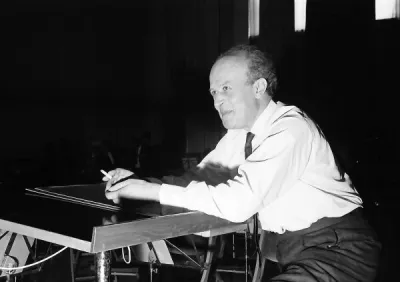
Ernest Bour
Human Design Chart
Biography
He died om 20 June 2001 in Strasbourg.
Ernest Bour as a Generator 5/1 in Human Design
Generator 5/1 — Design at a Glance
Ernest Bours design showed a tendency towards immense endurance. As a Generator, he had plenty of sacral energy that made him like a strong workhorse – provided he had the energy for his task. This configuration described someone who could materialize things into their life but in a specific way: not through initiation but through reaction.
The central mechanics of his design was waiting for impulses from life. Successful action required him to react to a signal and then, when his Sacral Center sent an inner “yes,” to act upon it. Deviations from this reactive principle led to problems for him. If he did things that he didn’t feel like doing, wasted energy, or was prevented from working on his heart project, he tended towards burnout and frustration.
In harmony with his strategy of reacting from the gut, Ernest Bour experienced deep satisfaction. Living not according to this design, especially if he constantly initiated instead of reacted, led him to a feeling of persistent frustration or energy loss. His path to fulfillment consisted in freeing up his great power through patient waiting for the right life question and then acting with full force.
Sacral Authority
Ernest Bours design showed a tendency towards direct, body-based decision-making. As a Generator, his strategy was identical to his inner authority: sacral authority. This configuration simplified his process as he didn’t have to distinguish between strategic approach and intuitive direction. His inner truth manifested through physical signals in the gut area as a reaction to external stimuli. This materialized into a specific “gut feeling” – audible as grunts, hums or affirming mhm – that signaled whether an issue engaged his energy.
With correct resonance, Ernest Bour felt vital and alive; he had inexhaustible power and tackled tasks with great enthusiasm, entirely without aimlessness. His design also foresaw the supporting role of the Spleen Center. This allowed him quick, spontaneous reactions and immediate access to instinctive perception as well as physical wellbeing. He could reliably be guided by these impulses, which underlined his ability for rapid decision-making. His life energy was geared towards engaging in tasks with joy, driven by this direct connection between external trigger and inner, sacral confirmation.
The 5/1 Profile — Heretic / Investigator
Ernest Bours design showed a tendency towards magnetic presence paired with a deep need for private knowledge acquisition. As a Hero/Researcher (Profile 5/1), he appeared as someone who wanted to create practical solutions from confusion while simultaneously protecting the depth of his own research. The mechanics here describe a tension field: Others projected expectations onto him as an expert or problem solver. Without clear boundaries, this quickly led to overload and exhaustion, comparable to a scientist drained after long conferences.
Line 5 demanded that he bring order out of chaos, yet Mutation has its own timing; immediate solutions often proved counterproductive. At the same time, Line 1 required inner reflection and examining the right feelings for self-restraint. It was important for him to deeply explore fantasies and delegate responsibility in the proper measure. Neptune enhanced a certain mysticism and obscured his true feelings while Mercury in Fall showed a tendency towards overexertion. The urge to evoke many emotions simultaneously stood in conflict with the necessity of focusing on one central feeling. The solution lay in balancing private research and public service, supported by the courage of his own conviction despite external projections. Only through learning to say “no” could he maintain the beneficial balance and optimally utilize his gifts without burning himself out.
Split Definition — Defined & Open Centers
Ernest Bours Human-Design profile indicated a tendency towards persistent mental structure and reliable expression. His defined Ajna Center ensured continuous conceptualization, while the connection to his defined Throat Center enabled him to communicate these thoughts clearly. This mental presence was not easily shaken by external influences.
His energy base came from his defined Sacral Center, which acted as a constant source of vital power. Here lay his reactive strength: He had the ability to respond with a clear yes or no to requests, thereby protecting himself from overloading and only pursuing activities for which he actually had energy. This was supported by his defined Spleen Center, which gave him an intuitive moment-to-moment awareness. He could spontaneously recognize what was healthy or correct without having to rationalize it. Additionally, a defined Root Drive propelled him forward with a set stress towards movement, anchoring him in the material world.
In contrast to this stable base, sensitive areas were revealed through open centers. His open Head Center meant that he did not have a persistent mental focus; instead, he tended to be influenced by doubts or confusion from others rather than having his own inspiring questions. The open G Center led to him lacking a fixed identity or life direction and often aligning himself with the environment in search of the 'right place' where he felt belonging.
Especially pronounced was the vulnerability of his open Heart Center: He lacked persistent willpower, which drove him to make promises to prove his worth – a pattern that often ended in frustration as he could not muster the energy. Finally, his open Solar Plexus absorbed foreign emotions; he had no own emotional rhythm and instead amplified the moods of his environment, making him vulnerable to emotional overload when these were not identified as non-self.
Channels for care, clear logic and critical judgment.
Ernest Bour showed a constant presence in logical analysis and critical evaluation, leading to an internal pressure to organize and correct things. His design was marked by the Acceptance Channel 17-62, which created a continuous mental system for organizing details. Anything he could not integrate into this logical pattern remained incomprehensible; therefore, he sought relief in verbally clarifying his opinions and what he understood or did not understand. However, this ability to translate visual patterns into language was only effective when waiting for an invitation to speak to avoid resistance.
At the same time, the Judgment Channel 58-18 propelled him forward. This channel connected a drive for vitality with an instinct for correcting and perfecting patterns. Ernest Bour constantly questioned what existed in order to improve it; yet this energy was only effective when invited. Uninvited, it could appear as an endless stream of criticism; however, upon invitation, it enabled precise solutions for societal or personal problems.
In his personality, the Preservation Channel 27-50 was at work. This channel carried the weight of care duties and responsibility towards the tribe as well as the defense of traditional values. While his design logically analyzed, his personality ensured that communities were supplied and protected. The challenge lay in timing: The correcting impulses of the design had to wait while the caring energy clearly distinguished between one's own needs and those of others. In the background, themes of mutation (Gate 3), transmission leadership (Gate 31), and evolutionary development (Gate 41) were at play, underlining his adaptability to changes without dominating the channel mechanics.
Collective Circuitry — Circuit Signature
Ernest Bours design indicated a tendency towards rational structuring and instinctive protection. This configuration was shown as tension between seeking logical clarity for the future and the primal urge to preserve what exists. The Understanding Circuit in him connected Ajna with Throat Center, as well as Spleen with Root Center. This promoted sharing insights free from emotional conditioning – an 'emotionless ratio' aimed at initiating improvements through focus and logic. Parallel, the Protector Circuit was active, connecting Sacral with Spleen Center in Ernest Bour. This channel emphasized preservation: instinctive care and safeguarding of family and genetics as a condition for survival. Both circuits shaped his essence; yet through shared definition, these energies did not remain closed within themselves. The connection between the rational head part (Ajna/Throat) and the instinctual body part (Sacral/Spleen/Root) existed only as separate energy fields. A full activation of these mechanisms occurred only when Ernest Bour encountered resonance in his environment that mirrored or triggered these specific energies.
Left Angle Cross of Wishes 1
Ernest Bours design carried the signature of the left cross of desires. This configuration set a profound inner dynamic characterized by the drive to pursue personal aspirations and goals. It was not about superficial cravings but rather a structural impulse to actively shape life according to one's own vision, thereby defining his identity through these desires.
In Human Design, this cross marks a specific energetic alignment where fulfilling internal desires functions as a central life motor. The energy flowed towards the realization of what Ernest Bour wished for himself, often with considerable intensity and focus. This mechanism created tension between the inner world – deep-seated wishes – and the external world that either supported or hindered these wishes.
The structure promoted an attitude of active design. Ernest Bour emerged as someone whose life path was strongly influenced by this internal direction. The energy of this cross helped gain clarity about what truly mattered, driving him to make his priorities visible in everyday life. It was about integrating desire and action, with the focus always on personal satisfaction and achieving individual goals. This configuration shaped how he approached challenges: filtering them through the lens of his own desires and seeking ways to translate these into reality.
Saturn Return · Uranus Opposition · Chiron Return · 2nd Saturn Return — Life Cycles
Ernest Bours professional career followed a clear structure reflecting his inner maturation and growing authority. In 1941, at age 28, he took up the position of First Kapellmeister at the City Theater Mulhouse. This marked his first Saturn Return: a life stage where years of hard work and discipline often crystallize into a stable official status. The role firmly anchored him in his position.
This cycle repeated again in 1972 when, at age 59, he participated as a conductor at the ISCM World Music Days. His second Saturn Return confirmed and stabilized his established expertise on an international level; it was the culmination of a long career phase where responsibility and recognition went hand in hand.
Between these two structural points lay a decisive turning point in 1964: Ernest Bour became Chief Conductor of the Südwestfunk Symphony Orchestra Baden-Baden. At age 51, he experienced his Chiron Return, a fulfillment cycle. Here, the bloom of his life purpose was evident. If he had lived according to his strategy and authority up until then, this phase saw an increasing manifestation of his incarnation cross in everyday life. His appointment as Chief Conductor was no coincidence but rather the visible expression that his inner compass and external reality now fully aligned. Meaning and purpose became tangible, not as a healing of old wounds but as the realization of his full potential.
Generator · Sacral Authority — Synthesis
Ernest Bour lived a life deeply marked by an internal dynamic: the drive to recognize patterns and make them accessible through logical organization (Channel 17-62), coupled with a strong instinct for survival and preservation (Channel 27-50). This combination led to a capacity to absorb complex information, evaluate it, and present it in a comprehensible form – a talent evident throughout his professional career. His design suggests that he was most satisfied when focusing his energy on correcting patterns and supporting others, always guided by deep body awareness (defined Sacral Center) and the need for authenticity.
A central tension field in Ernest Bours' design lay between his logical mind (defined Ajna Center) and his open emotional side (undefined Solar Plexus Center). While the mind sought to order and understand the world, he was also vulnerable to others' emotions. This dynamic likely led to a constant search for clarity and confirmation but also to a deep ability to perceive others' needs and respond with care. The repeated professional peaks (Kapellmeister, Chief Conductor) attest to a life where these two forces – logic and intuition – harmoniously interacted.
3 Defined Channels
Incarnation Cross - Left Angle Cross of Wishes 1
Solar Return
The Solar Return shows the moment when the sun returns to its exact birth position - your personal solar year.
Life Cycles
Discover the life cycles with a detailed triple view (birth chart, cycle chart, composite).
Human Design Profile
- Type
- Generator
- Strategy
- To respond - wait for something to respond to
- Authority
- Sacral Authority
- Profile
- 5/1 - Heretic / Investigator
- Definition
- Split Definition
- Incarnation Cross
- Left Angle Cross of Wishes 1
- Date of Birth
- 20.04.1913 22:00
- Place of Birth
- Thionville, France
Frequently Asked Questions
What was Ernest Bour's Human Design type?
What Profile did Ernest Bour have?
What authority did Ernest Bour have?
What incarnation cross did Ernest Bour have?
When was Ernest Bour born?
Discover your own Human Design
Are you also a Generator? Find out in a personal reading how to use your sacral energy correctly and discover deep satisfaction.
More Personalities
Back to overviewAaliyah

Alexia

Alizée

Angèle

Anne-Marie

Arcángel