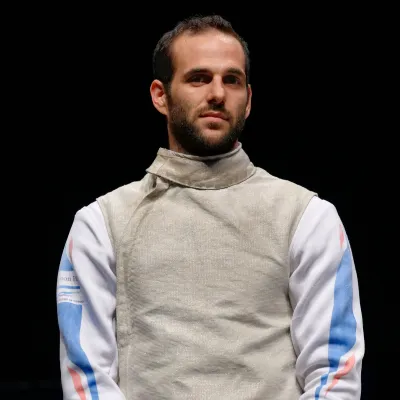
Erwann Le Péchoux
Human Design Chart
Biography
Le Péchoux competed in the 2004 Athens Olympic Games, the 2008 Beijing Olympic Games, and 2012 London Olympic Games, the 2016 Rio de Janeiro Olympic Games, and the 2021 Tokyo Olympic Games.
Le Péchoux is married to Tunisian foil fencer Inès Boubakri. Since Muslim women are forbidden to marry non-Muslim men in Tunisia, he converted to Islam to marry her.
Erwann Le Péchoux — Generator with Profile 3/5
Generator 3/5 — Design at a Glance
Erwann Le Péchoux revealed himself as someone who does not propel his strength through constant pushing, but rather through quick reactions to external impulses. As a Generator, he possessed considerable sacral energy, making him enduring and resilient – comparable to a workhorse that can carry immense loads as long as it is driven by the task. Crucial to his design was the strategy of reacting rather than initiating. His energy only became effective when he responded to signals from his environment and gave a clear inner “yes”.
This principle protected him from two specific dangers: exhaustion from activities without inner resonance and frustration when he was distracted from his heart project. If Erwann Le Péchoux lived in harmony with this mechanism, acting from his gut, his design rewarded him with a deep sense of fulfillment. If he initiated independently without an external trigger, this inevitably led to frustration and energy loss. His strength lay not in pre-empting, but in the powerful, contented response to what life offered him.
Sacral Authority
Erwann Le Péchoux revealed himself as someone who did not make decisions through long contemplation, but through an immediate physical reaction to external stimuli. His design tended to wait for stimuli and then act once an inner confirmation was felt.
This structure corresponds to the sacral authority, which is only possible for the Generator type. Here, the decision-making process simplifies, as strategy and inner authority are identical: listening to the body’s response. A prerequisite for this is an open emotional center, meaning that emotional clarity is not immediately given but requires time. Sacral authority expresses itself in a “gut feeling” – often as a grunt, hum, or a soft “Mhm” – as well as a sudden surge of energy. When this reaction occurs, Erwann Le Péchoux feels vital and energized, with an almost inexhaustible power at his disposal. He then works with great enthusiasm and immerses himself in his tasks without the need for a specific goal or purpose. The joy of doing stands in the foreground.
Additionally, the active spleen center acts as a supporting authority. It enables quick, spontaneous reactions and grants direct access to instinctive perception. Erwann Le Péchoux could thus reliably guide himself from this physical well-being and his intuition, further strengthening his ability to make quick decisions. This mechanism ensured him a reliable orientation in everyday life, based on what gave him energy at the moment.
The 3/5 Profile — Martyr / Heretic
Erwann Le Péchoux’s design tended towards heroic experimentation: he learned through his own trial and error and then offered this practical knowledge to others as a solution. This Profile 3/5 combines the adventurous spirit of Line 3 with the heroic role of Line 5. Erwann Le Péchoux showed himself to be someone who initially assumed little, but had to test everything himself. Through trial and error, he gathered a rich trove of life experiences, which he was happy to present. The attractiveness of his knowledge drew others who wanted to learn from his experiences. Line 3 thematizes mutual dependence and the search for support to rationally explain inner truths. Erwann Le Péchoux learned which relationships were helpful and which were not, often through instability. Line 5 from Gate 32 demanded flexibility and effortless adaptation to changes. This showed as an instinct to adapt in times of change. However, the immature urge for direct defiance of conformity, driven by Mars on the fall side, could lead to conflicts. When Erwann Le Péchoux failed in front of others while trying things out, this heroic role became painful. His nature was marked by the need to solve others’ problems with self-learned knowledge, making him a cool storyteller and humorous rebel. The mechanism describes a life task of uncovering hidden connections through personal experience and passing them on to others, with the balance between individual expression and adaptation being crucial.
Split Definition — Defined & Open Centers
Erwann Le Péchoux revealed himself through a constant, specific mental function: his defined Ajna Center generated a trustworthy way of forming concepts and theories that he did not easily allow to be influenced from the outside. This mind served as an external authority that conditioned the mental field of his environment. His communication and manifestation were guided by his defined Throat Center, which acted as a pivot point for transforming messages from various body parts and radiating them into the world as clear action or speech.
The driving force behind this expression was his defined Sacral Center, a source of immense vital energy. This sacral energy required reaction rather than initiation; it was only reliably available when Erwann Le Péchoux responded to a question or opportunity, which allowed him to find satisfaction through his personal expression. Additionally, his defined Root Center established a set way of dealing with stress and provided the physical pressure that moved him forward in the material world and nourished existential awareness.
At the same time, Erwann Le Péchoux was vulnerable to conditioning through several open centers. His open Head Center lacked a constant way of processing inspiration, which could lead him to get lost in mental monologues about questions not his own or to be overwhelmed by doubts that belonged to others. His open G Center meant he had no fixed identity but blended with his environment and collected directions from the outside world, making him vulnerable to "borrowed" identities.
His open Heart Center lacked a constant willpower, which encouraged the temptation to prove himself through promises or competition rather than trusting his inner authority. Furthermore, his open Solar Plexus absorbed the emotions of his environment, putting him at risk of personalizing foreign feelings and feeling emotionally unstable, even though these waves did not originate from him. Finally, his open Spleen Center was exposed to a fundamental fear of not being equipped for survival, which led him to cling to things or people that gave a false sense of security rather than making spontaneous decisions.
Channels for focus, details and insatiable curiosity.
Erwann Le Péchoux revealed himself through a deep, almost meditative ability to focus, coupled with an insatiable drive to explore new perspectives and convey these as stories. His design carried the format energy of the Concentration Channel 52-9. This connection between Root and Sacral Center created a calm, passive pressure to remain still. He possessed the innate ability to screen out distractions to focus completely on details and facts. This energy helped him to recognize, correct, and perfect patterns by investing the time needed to truly understand or refute something logically and step by step.
At the same time, the Channel of Curiosity 11-56, connecting the Ajna Center with the Throat, propelled him in the search for new ideas and viewpoints. He was less interested in mere discovery than in the process of discovery itself. His creativity showed in weaving compelling stories from individual ideas and experiences. These narratives served to entertain, teach, and stimulate others' imagination by filling gaps in information and making abstract concepts tangible.
Additionally, Gates like 61 (inner truth), 62 (logic and pattern recognition), and 42 (experience and conclusion) influenced his design. They supported his ability to focus on the essential and complete processes through experience. Gates like 32 (continuity) and 19 (resources) gave him an awareness of stability and community, while 41 (evolutionary development) and 34 (integration) shaped his individual strength and adaptability. Also, 60 (acceptance of limitations), 29 (perseverance), and 14 (skillful handling of power) contributed to his complex inner dynamics by teaching him to deal with pressure, change, and influence.
Collective Circuitry — Circuit Signature
Erwann Le Péchoux's design shows a tendency towards separate, parallel forces. As a person with a split definition, he did not have a continuous energetic connection between his various centers, but rather two isolated functional blocks that existed side by side.
The Understanding Circuit connected his Sacral with his Root Center through the Channel of Concentration. This connection allowed a focused, logical approach to tasks, free from emotional influence. It was an "emotionless ratio" aimed at improving things and guiding society towards a better future. The energy was future-oriented and visually structured.
At the same time, but energetically separate from the first block, the Meaning Circuit was active. This connected his Ajna with his Throat Center through the Channel of Curiosity. Here, it was not about cool logic, but about sharing emotional experiences and insights from the past. The energy followed a cyclical, wave-like structure aimed at giving meaning to the past and sharing these learning experiences with the collective.
Thus, Erwann Le Péchoux appears as someone who, on one hand, looks strategically and rationally into the future, while on the other hand, processes the past emotionally and reflectively. These two aspects – the future-oriented improvement and the past-oriented meaning-making – were not directly linked in his design, but formed two independent, equally important areas of his personality.
Right Angle Cross of Maya 4
Erwann Le Péchoux was marked by the right cross of Maya 4, a configuration that establishes a deep connection to collective wisdom and spiritual heritage. His design inclined him towards engaging with the roots of traditions and translating them into a modern context. This orientation fostered a strong interest in uncovering hidden patterns and making them accessible to others.
The right cross of Maya 4 represents the ability to preserve ancient knowledge while simultaneously integrating new perspectives. It supports a stance of humility towards what lies ahead, while also stimulating creativity to further develop this legacy. For Erwann Le Péchoux, this meant that he often acted as a bridge between past and future, linking traditional values with innovative approaches.
His life's task was to explore the depth and complexity of knowledge and convey it in a way that remains both respectful and relevant. This required a balance between respect for history and the willingness to take risks. Through this configuration, he became someone who not only collected knowledge but brought it to life and helped others find their own connection to the whole.
Saturn Return · Uranus Opposition — Life Cycles
Erwann Le Péchoux showed a development characterized by alternating phases of internal structuring and external validation. His design suggested that he focused particularly on stability and long-term anchoring in certain life stages, while other periods were marked by a need for change and release.
In 2011, at the age of 29, he reached silver at the World Championships and European Championships in team competition. This coincided with his first Saturn return. In this cycle, years of groundwork often condense into a solid result; the structure previously built receives its first major confirmation. It was a moment of consolidation, in which his previous path was proven to be solid.
Later, in 2020 at the age of 38, the peak followed: the Olympic victory in team competition. This corresponded to the Uranus opposition, a cycle often associated with sudden breakthroughs, liberation from old patterns, and a new sense of self. Here, it was evident how the previously acquired stability formed the basis for an explosive, liberating success. Thus, the mechanics of his design described a path from structural anchoring to a liberating, triumphant unfolding, with each step building on the previous one.
Generator · Sacral Authority — Synthesis
A central red thread in this design is the deep connection to sacral energy and the resulting drive to learn and shape through action. The sacral authority, paired with the Generator type, implies a constant reaction to the environment and a natural inclination to immerse oneself in activities that actually give energy (Sacral Center). The profile of the experimenter and helper (3/5) reinforces this aspect by emphasizing the desire to collect personal experiences to then serve others – a cycle of personal exploration and sharing of insights, further fueled by the defined mental structure (Ajna Center) and the channel of concentration (52/9). Successes in competitive situations (2011, 2020) seem to be tied to activities that release this energy.
The central paradox lies in the tension between the need for continuous activity and the potential burnout that threatens the Generator when immersed in unsatisfying activities. Although sacral energy is tireless, it requires the right alignment to avoid being 'wasted.' This is further emphasized by the combination of the adventurous spirit of the profile (Line 3) and the role of the hero (Line 5), as the urge to try new things and help others can easily lead to overextension if not regulated by inner authority and the ability to focus (Channel 52/9).
2 Defined Channels
Incarnation Cross - Right Angle Cross of Maya 4
Solar Return
The Solar Return shows the moment when the sun returns to its exact birth position - your personal solar year.
Life Cycles
Discover the life cycles with a detailed triple view (birth chart, cycle chart, composite).
Human Design Profile
- Type
- Generator
- Strategy
- To respond - wait for something to respond to
- Authority
- Sacral Authority
- Profile
- 3/5 - Martyr / Heretic
- Definition
- Split Definition
- Incarnation Cross
- Right Angle Cross of Maya 4
- Date of Birth
- 13.01.1982 16:10
- Place of Birth
- Pertuis, France
Frequently Asked Questions
What is Erwann Le Péchoux's Human Design type?
What Profile does Erwann Le Péchoux have?
What Authority does Erwann Le Péchoux have?
What is Erwann Le Péchoux's incarnation cross?
When was Erwann Le Péchoux born?
Discover your own Human Design
Are you also a Generator? Find out in a personal reading how to use your sacral energy correctly and discover deep satisfaction.
More Personalities
Back to overviewAaliyah

Aldair

Alexia

Angèle

Anne-Marie

Arcángel