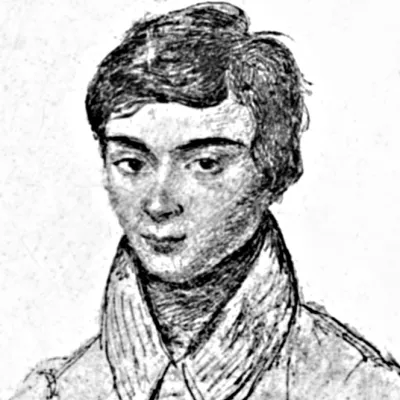
Evariste Galois
Human Design Chart
Biography
Galois’ father was a politician who headed up his town’s liberal party and was elected mayor of Bourg-la-Reine in 1815 during the Hundred Days, Napoleon’s first return from exile. From his mother, Galois received a solid background in Greek and Latin and a skepticism toward established religion. He did not receive much more than routine math instruction, and there is no record of previous mathematical talent on either side of his family. His formal education began in 1823 when he enrolled in a Paris preparatory school and began to develop his political sensibilities. He won several prizes in Greek and Latin, but had to repeat a year due to inadequate work in rhetoric. At age 15, he enrolled in his first mathematical class, and arrived at his niche. His genius was recognized and he published his first paper in March 1829 while still a student, entitled, "Proof of a Theorem on Periodic Continued Fractions." By that time, however, Galois had turned to equations, and at age 17 he was taking on the problem of solving equations which had eluded mathematicians for more than a century.
Galois submitted his first papers on group theory to the French Academy of Sciences on 25 May 1829 and 1 June 1829 near the end of his final year at school.
Evariste Galois — Manifesting Generator with Profile 5/1
Manifesting Generator 5/1 — Design at a Glance
Evariste Galois revealed himself as someone who combined unique dynamics of constant energy and lightning-fast implementation. His design as an Manifesting Generator merged the powerful endurance of a Generator with the direct action of a Manifestor, allowing him to skip steps in his work and quickly pull ideas into reality.
This ability to accelerate carried a specific risk: The tendency to overlook important intermediate steps or pursue multiple impulses simultaneously. If he did not respond to the inner signal of his sacral center – that constant energy hub confirmed by a clear “yes” – this speed often led to frustration. This frustration arose from having to catch up on missing foundations or abandon projects unsupported by his inner authority.
The deepest satisfaction Evariste Galois found came when he used this rapid pace in the „Play Mode“. This happened when he reacted to external life impulses and was sure that his inner center continued to enjoy the activity. In this state, he could work on various tasks simultaneously without burning out. His creative power did not ignite through rigid planning but through this playful yet strategically correct response to life, making his hybrid nature of energy and direction harmonize.
Emotional Authority
Evariste Galois displayed a decision-making structure that required time delay due to spontaneous judgments being skewed by passing emotional waves. His inner authority lay in the defined Solar Plexus Center, meaning his perception of the world was always marked by a permanent up-and-down of emotions. In moments of intense enthusiasm, something appeared absolutely right; shortly after, the same situation could flip into total distrust. This fluctuation was not unreliability but a mechanical process: The current mood offered only a momentary coloring, not the final truth.
Quick decisions made out of emotion proved error-prone and often negative for his design. Clarity only set in once intense feelings subsided and emotional distance was gained. This process required patience and conscious “sleeping on” choices. Only when the emotional wave had died down did calmness arise, making deeper, more comprehensive insight accessible. This need to wait was especially crucial for long-term decisions with significant influence on his life course. By waiting out the emotional flow, Evariste Galois could ensure that his actions were guided by a mature inner truth rather than a fleeting moment.
The 5/1 Profile — Heretic / Investigator
Evariste Galois showed a fundamental stance oscillating between the drive for universal solutions and a deep need for isolated research. His design as Profile 5/1 shaped this dynamic: Line 5 gave him almost magnetic appeal, drawing people irresistibly to him for answers to their problems. This stood in tension with Line 1, demanding intense knowledge gathering and diving into complex interconnections.
This configuration meant that his environment often sought his expertise, which without clear boundaries quickly led to exhaustion. The challenge lay in protecting his own energy through disciplined setting of limits. Only by learning to say “No” could he maintain the balance between serving others and the necessary time for his own mental development. Without this discipline, constant demands as a problem solver threatened to deplete his resources while leaving potential for deepening knowledge untapped.
Triple Split Definition — Defined & Open Centers
Evariste Galois was marked by a design characterized by massive, constant mental and emotional pressure. His defined Head and Ajna centers created an incessant urge to question, justify, and conceptualize. However, this mental process was not directly linked with the energy required for implementation; his also defined Throat center primarily served as a transmutator for these concepts. The actual driving force and inner authority lay in his defined Solar Plexus: Decisions were only revealed through waiting for an emotional wave. His defined Sacral center provided vital energy but did not act proactively, reacting solely to external impulses.
At the same time, he lacked firm reference points for identity and willpower. The open G Center meant no stable inner direction; he was dependent on the right environment to find orientation. Similarly, his open Heart Center indicated no consistent reserve of willpower, bringing with it the risk of simulated strength. Also, his open Spleen Center made him vulnerable to external influences regarding security and well-being.
The central dynamic consisted in the interplay between constant mental pressure (Head/Ajna) and the necessity to wait for emotional clarity (Solar Plexus), before the Throat center could speak or the Sacral react. The danger lay in being mentally overwhelmed by his own mind as well as attempting to simulate willpower from an open Heart. Instead of fighting this pressure, his design required accepting the mental state without hasty action. By waiting for the emotional wave, he could prevent mental concepts from turning into inappropriate decisions. His energy was only fully available when he waited for stimuli and allowed responses from the Sacral center rather than forcing them through the mind. This mechanism protected him from exhaustion and frustration that arise when one tries to bring mental ideas into the world without emotional confirmation and sacral resonance.
Channels for change, focus, emotional depth and abstraction.
Evariste Galois appeared as someone suffering under an intense internal field of tension: the urge for sudden, revolutionary change on one side and the simultaneous, compelling need for absolute calm and logical precision on the other. This dynamic was determined by two dominant format channels in his Personality Circuit, both connecting the Root with the Sacral center to create a massive, constant energy presence.
The Channel of Mutation 60-3 drove him to bring about evolutionary change based on Gate 60 as the fulcrum of all possibilities and Gate 3, which wanted to realize new values. However, this channel also created mechanical moodiness and melancholy when the mutative pulse ceased; Evariste Galois had to learn to accept this limitation rather than rationalizing away his moods. Parallel to this, the Channel of Concentration 52-9 promoted a drive for non-action and stillness through Gate 52 while focusing on details and facts via Gate 9. This channel required logical silence to perfect patterns – a process directly conflicting with the impulsive mutative urge.
In his design, the Channel of Openness 22-12 complemented this structure by allowing emotional wave movement. It connected the Solar Plexus with the Throat center and enabled Evariste Galois to express passion and melancholy only when he waited for the ebb and flow of his own mood. Gate 12 provided necessary caution that regulated his openness. Additional influences came from the Channel of Abstraction 64-47, which filled his mind with mental images and the search for meaning, as well as prioritized gates like Gate 50 (Reflex/Tradition) and Gate 31 (Transmission of Power), shaping his identity and values. His design thus showed a complex interaction between the pressure to innovate and the need to find clarity in silent concentration.
Individual Circuitry — Circuit Signature
Evariste Galois appeared as an interface for three separate, parallel energetic streams. His triple definition meant he did not have a continuous energy flow but carried three isolated groups of forces that were not connected.
Firstly, the Knowledge Circuit was active. Here his Throat center was linked with his Solar Plexus center and separately, his Sacral center with his Root center. This configuration generated pulsating, acoustic energy representing individual identity expression through emotional waves and the power of mutation – deviation from the known – as well as openness. Galois could transform and express new knowledge only situationally, inspired by resonance with his environment, since he did not drive these channels himself.
Secondly, the Understanding Circuit existed as an independent block. Here the Sacral center was directly connected to the Root center forming a focused, visual energy aimed at rational structure and future-oriented logic. It allowed sharing insights free from emotion and developing strategies for societal improvement. This part of his design was strictly separated from the emotional and expressive forces of the Knowledge Circuit.
Thirdly, the Meaning-Finding Circuit operated isolated. Here his Head center was directly linked with his Ajna center creating a cyclical, abstracting energy focused on the past. It served to reflect on emotional experiences and inexplicable patterns from history and derive meaning from them.
Galois navigated not in a dominant flow but as an interface where these three systems – emotional transformation, rational future-building, and cyclic past-resolution – could meet without himself being the driving force in any specific channel.
Left Angle Cross of Wishes 2
Evariste Galois was characterized by the structural alignment in what is known as the "left desire cross 2". This configuration formed the fundamental motif of his design, representing a specific archetypal energy and life dynamics that shaped his essence. Since the underlying details of this structure are not further specified in the available data, the precise content expression of this dynamic remains undetermined. It was a basic shaping characteristic that served as a framework for his experiential world without allowing concrete behavioral patterns or psychological nuances to be derived from it. The presence of this cross was thus a factual element of his Human Design chart, whose specific effect could not be detailed explained due to the lack of descriptions. Evariste Galois lived with this structural givenness that functioned as a neutral basis for his individual mechanics without requiring additional interpretative layers or biographical associations. The analysis therefore limits itself to the identification of this archetypal pattern as a central but content-wise open element of his design.
Manifesting Generator · Emotional Authority — Synthesis
He was a Generator, marked by constant sacral energy (sacral center) and the ability to spark things quickly – a Manifesting Generator. However, this potential was modulated by his emotional authority; decisions matured in waves of feelings that required time and patience. His profile as Hero and Researcher (5/1) reinforced this inner drive to gather deep knowledge and make it available to others, while the channel of Mutation (3-60) continually led him to new unconventional paths. He thus lived in a tension field between the impulsive action of his type and the need for emotional clarity, always searching for deeper understanding.
A central paradox shaped his existence: the combination of pulsating creativity (Knowledge Circuit) and acceptance of limitation (Gate 60). He drew from an inner wellspring of inspiration (Head Center), yet this was channeled through a need to explore and transform new possibilities. This process carried the risk of skipping important steps (Manifesting Generator) – a constant oscillation between the urge for innovation and the necessity to embrace his own inner truth.
4 Defined Channels
Incarnation Cross - Left Angle Cross of Wishes 2
Solar Return
The Solar Return shows the moment when the sun returns to its exact birth position - your personal solar year.
Life Cycles
Discover the life cycles with a detailed triple view (birth chart, cycle chart, composite).
Human Design Profile
- Strategy
- To respond - wait for something to respond to
- Authority
- Emotional Authority
- Profile
- 5/1 - Heretic / Investigator
- Definition
- Triple Split
- Incarnation Cross
- Left Angle Cross of Wishes 2
- Date of Birth
- 25.10.1811 01:00
- Place of Birth
- Bourg la Reine, France
Frequently Asked Questions
What Human Design type was Evariste Galois?
What was Evariste Galois' Human Design Profile?
Which Authority guided Evariste Galois?
What Incarnation Cross did Evariste Galois have?
When was Evariste Galois born?
Discover your own Human Design
Are you also a Manifesting Generator? Find out in a personal reading how to unfold your multi-talents and direct your energy wisely.
More Personalities
Back to overviewAldair

Alizée

Angeli

Arletty

Artus

Balthus