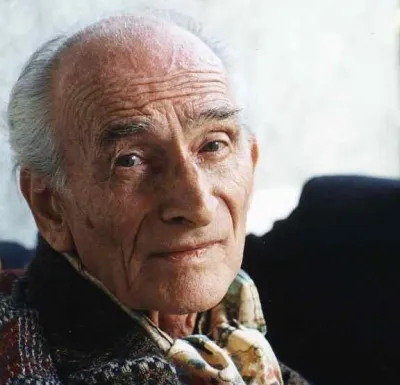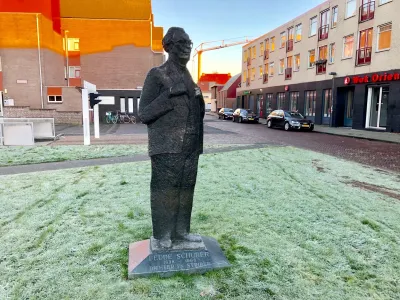
Fedde Schurer
Human Design Chart
Biography
Schurer was born in a Frisian speaking working family: his father Bouke was a shipyard labourer and his mother a maidservant. After visiting the elementary school Schurer worked as a junior carpenter, but in the evening hours he studied to become a school teacher (1917-1919). His first job as a teacher was at the reformed school in Lemmer (1919-1930), the same school he visited as a boy. Here he also met the school teacher Willy de Vries, whom he married 1 July 1924. They got no children, but they adopted a son.
In 1919 Schurer became member of the Kristlik Frysk Selskip (Christian Frisian Club), that strived to translate Christian liturgy and the bible into the Frisian language to enable Frisians to worship services in their mother language. Here he published his first poems. His first bundle "Fersen" (songs) came out in 1925.
In the twenties Schurer developed a more pacifistic and liberal view on Christianity, which brought him in conflict with the board of his "Gereformeerde" Calvinistic school (1929). He changed his religion to the less dogmatic and more socialistic "hersteld verband" under the influence of Karl Barth and the socialistic theologian Jan Buskes (b.16 Sept 1899).
In 1930 he was dismissed as a teacher and went to Amsterdam. He taught on secular schools and went in 1935 into provincial politics with the slogan "No Führer, but Schurer". He translated the poetry of Heinrich Heine into the Frisian language and also wrote illegal anti Nazi poetry during the war. For this he was awarded in 1945 with a state prize for resistance poetry.
After the WW2 he became editor in chief of the Heerenveense Koerier, later renamed to De Friesche Koerier, a local newspaper. He was a promotor of the use of the Frisian language in public arena and edited and published in cultural periodicals in the Frisian language .
Human Design Analysis: Fedde Schurer as Manifesting Generator 1/3
Manifesting Generator 1/3 — Design at a Glance
Fedde Schurer's Human Design suggested a tendency towards hybrid dynamics: He combined the constant energy source of a Generator with the lightning-fast execution power of a Manifestor. As a Manifesting Generator, he had a defined Sacral Center, which provided him with a steady life force. The key advice for him was not to initiate himself but to respond to external impulses. Only when the Sacral Center gave a clear 'yes' should he act.
This configuration allowed him to skip steps and pull things into his life extremely quickly. However, this speed carried risks. Often, he tended to overlook important stages, which inevitably led to him having to return later and make up for lost time. This could quickly turn into frustration as he then had to face the necessity of taking the slow route.
Another characteristic was his tendency to pursue multiple projects simultaneously. He reacted to many different impulses at once. If strategy and inner authority were not in harmony, his creative enthusiasm quickly turned into dissatisfaction. When the resonance was in tune, however, he drew deep satisfaction from his work. For him, the advice to focus on only one thing was counterproductive. His true strength unfolded in 'play mode,' where variety and parallel work fed his energy rather than depleting it.
Emotional Authority
Fedde Schurer's inner compass was the defined Solar Plexus Center, which made him an emotional authority. This configuration was considered the highest instance for decisions, independent of all other defined centers in his design. He moved in a permanent wave of emotional highs and lows, coloring his perception of the world through the current mood. What appeared inspiring in one moment could be perceived as negative in the next. His immediate feeling was only a snapshot, not yet the final truth. Quick, spontaneous judgments from this emotional heat often risked negative consequences, as they were based on transient impulses.
The mechanics of his authority required patience and time. To gain clarity, Fedde Schurer had to let decisions mature, ideally overnight. Only when the initial emotional intensity subsided and distance was established did calmness set in. This process of 'sleeping on it' was essential to recognize the true essence of a situation, especially in long-term steps with significant influence on his life course. It was best demonstrated when he hesitated and took time to find inner security through the emotional process, rather than trusting the first impulse.
The 1/3 Profile — Investigator / Martyr
Fedde Schurer's design was characterized by the Profile 1/3, which marked him as a researcher and experimenter. His life followed the principle of trial and error: Line 1 drove him towards theoretical preparation, while Line 3 forced him into practical experimentation. Often, an inner conflict arose when the fear of insufficient knowledge (Line 1) blocked the urge to act (Line 3). Yet, it was only through these practical mistakes that his judgment matured. When he made a decision, he had previously examined it both intellectually and empirically.
This dynamic was fueled by Gate 31 (Line 1) in the Throat Center, which controlled logical leadership and communication. It was about the interplay of light and darkness and the responsibility towards succession. Simultaneously, Gate 27 (Line 3) worked, which addressed adaptation through bonds and their dissolution. This gate was associated with themes like greed and the compulsion to possess more than necessary to care for others—often based on secret information. For Fedde Schurer, this meant that his authority did not stem from mere theory but from tested, often chaotic practice. His judgment was trustworthy because it had passed the harsh test of reality. He not only learned but refined his knowledge through direct experience, which significantly shaped his ability to lead and communicate.
Split Definition — Defined & Open Centers
Fedde Schurer revealed himself as someone with a clear, reliable identity and a deep inner direction, driven by an enormous daily vitality. His defined G Center gave him a firm sense of self-worth and the ability to show others new perspectives without being dependent on their approval. This inner stability was fueled by his defined Sacral Center, which provided him with a constant energy source. His life strategy involved not initiating but waiting for life to unfold and then reacting to the sacral response – a spontaneous yes or no – to avoid frustration.
His communication was characterized by his defined Throat Center, which served as a pivot point for his messages and allowed him to express his truth with clarity and honesty. This was supported by his defined Spleen Center, which gave him an intuitive, momentary perception of health and well-being, as well as his defined Root Center, which provided him with the necessary pressure and endurance to move forward in the material world. However, he did not make emotional decisions impulsively; his defined Solar Plexus Center required patience to wait out the emotional wave before acting, as only then could emotional clarity be achieved.
In contrast, his Head, Ajna, and Heart Centers were open. This meant that he did not have a constant mental inspiration or conceptual structure but was open to the ideas and opinions of his environment. He tended to absorb mental questions and confusion of others without identifying them as his own truth. The open Heart Center meant that he was not designed to prove willpower or make promises. Instead, he learned not to be guided by competition or the pressure to prove his worth, but to focus his energy on areas where he naturally had competence through reaction and intuition.
Channels for powerful, emotional transformation and discovery.
Fedde Schurer's design tended towards rhythmic innovation and persistent discovery. The Beat channel 14-2 connected his Sacral Center, the source of generative energy, with the G Center for identity and direction. Through Gate 14, which cleverly handled material resources to drive mutation, and Gate 2, which offered higher knowledge to guide movement through space and time, he showed himself to be someone who took on new directions. This configuration provided a powerful resource for creative life force, reinforcing a shift in orientation by trusting the reaction from the Sacral.
Parallel to this, the Discovery channel 29-46 was at work. It connected the Gate of Saying Yes (29), the well of endurance, with the Gate of Self-Determination (46), which wanted to be in the right place at the right time. This required letting go of expectations and a deep immersion in experiences whose meaning only became clear at the end. His persistence allowed him to get lost in processes to eventually gain insights that could change collective understanding.
Additionally, the Transformation channel 54-32 shaped his drive for recognition and progress. It connected the Gate of Ambition (54) with the Gate of Continuity (32). Driven by the fear of tribal failure and the desire to be seen, he used his talents to rise up. This ambition was rewarded by tribal support, fostering a healthy, mutual dependency.
The Ephemeral channel 36-35 connected the Gate of Crisis (36) with the Gate of Change (35). As an emotional channel, he sought new experiences, often by creating crises to set things in motion. This drove him to explore the depth of his feelings and gain wisdom through experience.
The Charisma channel 34-20 connected the Gate of Power (34) with the Gate of Now (20). This gave him the ability to act through sacral reaction and manifest in the moment. His energy was geared towards maintaining activity over longer periods, provided it was used for things that truly brought him joy.
Further Gates like 31 (Transmission), 41 (evolutionary development), 27 (care), 28 (risks in the moment), and 18 (correction) complemented this picture through aspects of leadership, evolutionary change, altruistic care, risk-taking decisions, and political correction.
Individual Circuitry — Circuit Signature
Fedde Schurer's design tended towards rhythmic, pulsating creativity, characterized by separate, parallel acting energetic strands. As a person with split definition, his energy consisted of two independent blocks that did not flow directly into each other.
The first block connected Identity and Sacral Centers through the Knowledge Circuit (Channel 2-14, 'The Beat'). This gave him a pulsating, acoustic format energy, allowing him to express his unique individuality in the now and transform new knowledge. Parallel to this, the Integration Circuit (Channel 20-34, 'Charisma') also connected Identity and Sacral. Here, it was about drawing power from reacting to life and anchoring it through intuitive knowledge in the now. Both channels supported his ability to be present and creative in the here and now.
The second, completely separate block included Spleen and Root Centers in the Ego Circuit (Channel 32-54, 'Transformation'). This promoted a traditional, conservative attitude with a focus on mutual support and finding security through transformation. Since this block was not connected to the first, these needs for security and tradition existed alongside the pulsating creativity without directly mixing.
Additionally, the Meaning Circuit worked in Fedde Schurer in two separate segments: one between Throat and Solar Plexus Centers (Channel 35-36, 'Ephemeral') and one between Identity and Sacral (Channel 46-29, 'Discovery'). This allowed him to reflect on emotional waves of the past and share visual insights, with the connection between feeling and expression, as well as between identity and life force, each functioning independently.
Right Angle Cross of the Unexpected 2
Fedde Schurer's Human Design profile carried the signature of the right cross of the Unexpected. This configuration shaped a fundamental attitude characterized by spontaneous and often unpredictable turns. His inner nature was designed to integrate the unexpected not as a disturbance, but as an essential part of his experience.
In Human Design, this cross describes a specific energy that uses the unexpected as a source of insight. It is not about controlled planning, but about the ability to embrace the unknown and gain new perspectives from it. Fedde Schurer exemplified this dynamic: His paths were not linear, but marked by sudden insights or external events that disrupted the previous course.
This mechanism means that stability for him did not lie in predictability, but in familiarity with the unexpected. The right cross of the Unexpected requires openness to what cannot be controlled. Fedde Schurer used this energy to move through situations where others might have sought fixed structures. His strength lay in taking the unexpected as an impulse rather than resisting it. This shaped his life as a sequence of moments where the new and unexpected guided the way, rather than following a rigid plan. The energy of this cross fostered a kind of flexibility that allowed him to remain effective in chaotic or rapidly changing environments by accepting the unexpected as a natural part of his reality.
Saturn Return · Uranus Opposition · Chiron Return · 2nd Saturn Return — Life Cycles
Fedde Schurer's design showed a clear tendency towards structural anchoring and public responsibility. This orientation was visible in his life phases where he institutionalized himself. In 1924, at the age of 26, he married Willemke de Vries. This step marked his first Saturn Return, a cycle often initiating the crystallization of years of groundwork into durable, long-term commitments.
The search for broader societal impact characterized his middle life phase. In 1935, at 37, he joined the Christian-Democratic Union and became a member of the North Holland Assembly. This fell during the Uranus Opposition, a phase often leading to sudden changes or breaking with old structures to follow new, often collective, tasks.
His deepest fulfillment came during his Chiron Return. In 1945, at 47, he received the Verzetsprijs voor letterkundigen. This fulfillment cycle is not a healing process but the bloom of one's purpose: Here it was evident that his life path found meaning and recognition. His second Saturn Return in 1956, when he entered the national parliament for the Labour Party at 58, confirmed this development. He built on previous foundations and established his authority on a national level, underscoring the maturation of his design strategy.
Manifesting Generator · Emotional Authority — Synthesis
Fedde Schurer lived a life path marked by a profound inner dynamism. The combination of manifesting generator energy and emotional authority points to a person who, while constantly following sacral drive (Sacral Center defined), always filtered this through intense emotional processing. The profile as a researcher and experimenter (1/3) reinforced this process, with an unceasing drive for self-discovery and practical testing of ideas – a constant testing and validating to arrive at a grounded, personal truth. The connection between G Center and Throat Center (Channel 14-2) underscored the ability to carry a transformative message into the world through one's identity and direction.
A central paradox in Fedde Schurer's design lay in the tension between the impulsive, rapid action enabled by the manifesting generator aspect and the necessity of emotional maturation required by emotional authority. The energy wanted to push forward and initiate things, while inner wisdom demanded patience and reflection on decisions. This discrepancy led to an inner rhythm marked by quick starts followed by a need for deep emotional processing – a dance between the urge for mutation and the desire for inner clarity.
5 Defined Channels
Incarnation Cross - Right Angle Cross of the Unexpected 2
Solar Return
The Solar Return shows the moment when the sun returns to its exact birth position - your personal solar year.
Life Cycles
Discover the life cycles with a detailed triple view (birth chart, cycle chart, composite).
Human Design Profile
- Strategy
- To respond - wait for something to respond to
- Authority
- Emotional Authority
- Profile
- 1/3 - Investigator / Martyr
- Definition
- Split Definition
- Incarnation Cross
- Right Angle Cross of the Unexpected 2
- Date of Birth
- 25.07.1898 17:00
- Place of Birth
- Drachten, NETH
Frequently Asked Questions
What is Fedde Schurer's Human Design type?
What profile did Fedde Schurer have in his Human Design?
What authority guided Fedde Schurer's decisions?
Which incarnation cross determined the life path of Fedde Schurer?
When was Fedde Schurer born?
Discover your own Human Design
Are you also a Manifesting Generator? Find out in a personal reading how to unfold your multi-talents and direct your energy wisely.
More Personalities
Back to overviewAldair

Alizée

Angeli

Arletty
Artus
Balthus