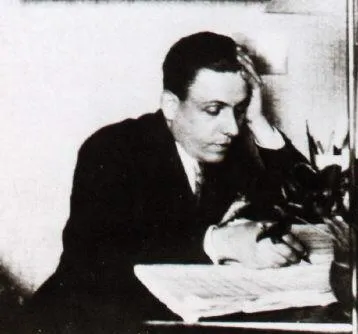
Photo: Wikimedia Commons
Francis Poulenc
Human Design Chart
Biography
Francis Poulenc had several male lovers in his life. He died from a heart attack on 30 January 1963 at age 64 in Paris, France.
Francis Poulenc as a Generator 3/5 in Human Design
Generator 3/5 — Design at a Glance
Francis Poulenc's design shows a tendency towards great endurance and inner drive, provided he reacts to impulses from his environment. As a Generator, he had a lot of sacral energy, which made him extremely strong and resilient like a workhorse when he had energy for his task. His motto was not initiating but reacting. The energy of his sacral center was mainly released when he responded to signals from life and answered with an inner 'Yes! Let's get started!' to these impulses.
However, this design contained two specific pitfalls. One was doing things persistently that he actually didn't want to do, which wasted his energy and could lead to burnout due to a lack of intrinsic motivation. The other danger was being prevented from working on his heart project, even though he still wanted to continue with full power. If Francis Poulenc lived in harmony with this pattern by reacting to signals and acting from the gut, he was rewarded with a feeling of deep fulfillment. If he, on the other hand, continuously initiated independently without waiting for inner confirmation, he would sooner or later encounter a feeling of persistent frustration and a lack of energy. His success therefore depended on whether he followed this reactive strategy or worked against his natural flow.
Sacral Authority
Francis Poulenc showed himself to be someone who did not seek his decisions in his head but waited for a direct physical response. His design tended towards spontaneous, lively reactions, driven by sacral authority. As a Generator, this inner voice was also his strategy: he reacted to stimuli from the environment rather than initiating himself. This mechanism greatly simplified his decision-making process, as he only had to respond to what energetically appealed to him.
A prerequisite for this clear leadership was his open emotional center, which ensured that he was not misled by passing moods. His sacral authority communicated to him through a 'gut feeling' or perceptible surges of energy. If his body expressed interest through sounds like grunts or a confirming 'Hmm', he felt vital and energetic. In these moments, he approached his tasks with great enthusiasm, without the need for an external goal. The joy of the work itself was the motivation.
Additionally, his activated spleen center served as a supportive instance. It gave him a quick, instinctive access to his physical well-being. This connection allowed him to act particularly spontaneously and reliably, guided by a deep, bodily perception that reliably guided him through life.
The 3/5 Profile — Martyr / Heretic
Francis Poulenc's design shows a tendency towards heroic experimentation. As a 3/5 'Explorer/Hero', he learned through his own experimentation, as he initially accepted nothing as given. This Line 3 of the Explorer forced him to gain knowledge practically, often through failures. The experience gained was presented to others, who were attracted by his charm as a storyteller. This heroic role flattered him, but became painful when public attempts failed. His mechanism included secret interactions and hidden means when official routes were blocked – an influence of Pluto and the falling Venus. This strengthened his ambition through concealment. At the same time, he developed new forms in crisis situations to increase survivability. Gate 57, Line 5, showed how he further developed intuition and survivability. Individual mutations were made available to the collective to protect against threats. The establishment of these new structures should be generalizable. In later phases, intuition could be overwhelmed, leading to independent development. Francis Poulenc used this dynamic to generate solutions for others from his own experiments, while balancing the tension between public failure and private success.
Single Definition — Defined & Open Centers
Francis Poulenc's Human Design profile indicated a tendency towards vital, physical presence, driven by his defined Sacral Center. This provided a constant energy source that required activity and expression to find satisfaction. His strategy involved waiting for stimuli and then responding with a spontaneous yes or no, rather than initiating actions. The also defined Spleen Center supported this through intuition and an awareness of the present moment, helping him make health-promoting decisions. Additionally, the defined Root Center generated a physical pressure that propelled him forward and helped him deal with stress.
In contrast, his open centers shaped his vulnerabilities. The open Head Center made him receptive to mental inspiration and confusion from the environment; he tended to engage with questions that were not his own, rather than listening to his inner authority. The open Ajna Center meant that his conceptual thinking was flexible but also that he could adopt other people's concepts without identifying them as his own truth. His open Throat Center showed in the uncertainty about the timing of communication; he had to wait for an invitation to speak, rather than forcing attention. The open G Center conveyed no fixed identity, so he mirrored in relationships and environments and waited for external initiation to find the right direction. The open Heart Center lacked consistent willpower, making him prone to giving promises to prove value rather than acting from inner security. Finally, the open Solar Plexus Center absorbed the emotions of his environment, making him vulnerable to foreign moods and making it difficult to distinguish between his own and absorbed feelings.
Channels for focus, life purpose and intuitive power.
Francis Poulenc was someone whose energy was characterized by intense, almost physical concentration. This attitude resulted from the Channel of Concentration 52-9, connecting the Root and Sacral Centers. This channel created a calm inner pressure to stay still and avoid distractions, allowing for precise capture of details and facts. It was a formative energy that influenced the entire design by promoting logic and perfectionism once Poulenc's Sacral Center reacted.
Parallel to this, the Channel of Life Struggle 38-28 propelled him. It connected the Root and Spleen Centers, giving him the stubborn determination to forge his own path and find meaning in struggles. Gate 28 helped him recognize which struggles had value, while Gate 38 maintained the pressure to defend individual integrity against external forces. This channel made him the driving force that challenged the status quo to enforce individualization.
Furthermore, Poulenc possessed the Channel of Power 34-57, linking the Spleen and Sacral Centers. This gave him a protective, intuitive intelligence based on mammalian memories. He was permanently acoustically and physically attentive, reacting spontaneously to dangers or opportunities. This combination of intuition and sacral energy helped him navigate daily life selectively responding to verbal inputs to maintain his vitality.
Individual Gates rounded out this picture: Gate 54 connected worldly success with mystical insight, Gate 53 allowed him to pioneer new cycles as a trailblazer, and Gate 51 gave him a strong will. Gate 58 in the Root Center promoted experiments and correction of patterns, while Gate 39 induced mutations through provocation and analysis. Gate 48 enabled the recognition of deeper connections, although this sometimes led to frustration in the collective.
Individual Circuitry — Circuit Signature
Francis Poulenc's design showed a coherent, simple definition that allowed for a clear, focused life energy. His defined centers – Sacral, Root, and Spleen – formed a single group, suggesting an integrated, unfragmented energy flow.
The Knowledge Circuit worked through him via the Channel of Life Struggle (Gates 28-38), connecting the Spleen and Root Centers. This gave him a pulsating, acoustic creativity and the ability to generate immediate reactions through intuitive perception (Spleen) to express his unique identity.
In the Understanding Circuit, the Channel of Concentration (Gates 9-52) connecting the Sacral and Root Centers was active. Here, a rational, emotionless logic was evident, allowing him to think strategically and focus to improve structures and share insights free from conditioning.
The Integration Circuit closed through the Channel of Power (Gates 34-57) between Sacral and Spleen Centers. This helped him draw strength from reacting to life and realize it through intuitive knowledge in the present moment. Together, these channels formed a system that united creativity, rational structure, and intuitive self-preservation in a single, coherent stream, without separate, unconnected energy islands.
Right Angle Cross of Penetration 4
Francis Poulenc's Human Design profile carried the signature of the right cross of the penetration 4. This configuration shaped a specific, often ambivalent life stance. It combined a deep, almost mystical yearning for inner truth and spiritual understanding with a strong, sometimes contradictory urge to anchor and live these insights in the material world.
In Human Design, this cross describes a tension between the search for the invisible and the necessity to act in the visible world. Francis Poulenc therefore did not present himself as someone who either fully turned to the world or completely withdrew from it. Instead, a dynamic movement emerged: the effort to translate abstract, spiritual truths into concrete, tangible forms. This could lead to internal conflicts, as pure spiritual experience often seemed incompatible with the harsh realities of everyday life.
The mechanics of this cross suggested that Francis Poulenc's path lay in accepting these two poles not as opposites, but as complementary forces. The challenge was to not keep spiritual intuition solely in the head but to carry it into the world through actual action and creation. This required a constant balance between withdrawal for reflection and engagement in social or creative fields. His design indicated that true fulfillment could only be achieved through the integration of both aspects – the spiritual and the material – without neglecting or idealizing either.
Saturn Return · Uranus Opposition · Chiron Return · 2nd Saturn Return — Life Cycles
Francis Poulenc's Human Design profile was characterized by phases of intense inner upheavals and creative maturity that manifested in clear life turning points. In 1936, at the age of 37, he underwent a profound spiritual transformation after the accidental death of his friend Pierre Octave Ferroud, turning to the Catholic faith. This moment fell during a Uranus opposition, a cycle that often brings sudden interruptions and the necessity of new orientation. The crisis acted as a catalyst for a fundamental realignment of his inner compass.
Later, in 1947 at the age of 48, Poulenc reached a peak phase of his creative expression with the premiere of his first opera, whose texts were by Apollinaire. This occurred during his Chiron return, a fulfillment cycle in which one's life mission increasingly unfolds and personal meaning becomes tangible. The success of this opera marked the pinnacle of this inner maturity.
Another milestone followed in 1957, at the age of 58, with the composition of 'Dialogues des Carmélites,' his most famous opera. This work was created during his second Saturn return, a phase of consolidation and mastery, in which years of experience are condensed into a solid, mature result. Poulenc's journey showed how he transformed external shocks and inner cycles into concrete, meaningful artistic achievements.
Generator · Sacral Authority — Synthesis
Francis Poulenc was a Generator whose life was marked by a deep, sacral energy. This power source, combined with a profile of the experimenter and hero (3/5), drove him to collect experiences and transform them into creative work. The channel of concentration (52/9) indicates a capacity to focus intensely on details when free from distractions – a state that allowed him to use his energy effectively and give it form. The repeated successes, evidenced by opera premieres and compositions (1947, 1957), attest to the ability to generate knowledge and express it through the Throat Center into the world.
Simultaneously, a central paradox was revealed: although he possessed immense endurance and creative power, he was vulnerable to wasting energy on tasks that did not truly fulfill him. This corresponds with the right cross of the penetration 4, which points to a tendency to get lost in unsatisfying situations. The crises, such as the loss of a friend (1936), showed that he was influenced by external circumstances and sought meaning, while the inner drive, the sacral authority, constantly urged him to follow his own path and listen to his inner voice.
3 Defined Channels
Incarnation Cross - Right Angle Cross of Penetration 4
Solar Return
The Solar Return shows the moment when the sun returns to its exact birth position - your personal solar year.
Life Cycles
Discover the life cycles with a detailed triple view (birth chart, cycle chart, composite).
Human Design Profile
- Type
- Generator
- Strategy
- To respond - wait for something to respond to
- Authority
- Sacral Authority
- Profile
- 3/5 - Martyr / Heretic
- Definition
- Single Definition
- Incarnation Cross
- Right Angle Cross of Penetration 4
- Date of Birth
- 07.01.1899 16:00
- Place of Birth
- Paris Arrondissement 8, France
Frequently Asked Questions
What was Francis Poulenc's Human Design type?
What Profile did Francis Poulenc have in Human Design?
Which Authority guided Francis Poulenc's decisions?
Which incarnation cross determined Francis Poulenc's life path?
When was Francis Poulenc born?
Discover your own Human Design
Are you also a Generator? Find out in a personal reading how to use your sacral energy correctly and discover deep satisfaction.
More Personalities
Back to overviewAaliyah

Alexia

Alizée

Angèle

Anne-Marie

Arcángel