
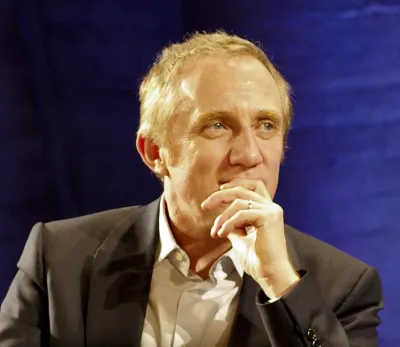
François Henri Pinault
Human Design Chart
Biography
Married to American actress Salma Hayek (14 February 2009).
The Human Design of François Henri Pinault: Generator 2/4
Generator 2/4 — Design at a Glance
François Henri Pinault's design points to a tendency towards great endurance and the ability to generate energy for his tasks. As a Generator, he had a lot of sacral energy, which made him similar to a strong workhorse – provided he had energy for the task at hand. However, his design had two specific pitfalls: on the one hand, the risk of wasting energy on things that didn't interest him, which could lead to burnout; on the other hand, the risk of being held back from his heart project, even though he was still full of power.
The successful use of this energy depended on not initiating but responding to impulses. The strategy was to wait for a signal from life and then, when the sacral center gave a clear 'yes', to respond with action. If François Henri Pinault lived in harmony with this design, he was rewarded with deep satisfaction and a sense of fulfillment. If he constantly initiated himself or acted against his inner signal, he likely faced ongoing frustration and a lack of energy. His path was therefore characterized by reacting from the gut, not by pushing forward against inner resistance.
Emotional Authority
François Henri Pinault's design points to an emotional wave movement that significantly shaped his perception and decision-making. He was someone who always filtered the world through the lens of his current mood. His inner authority resided in his defined Solar Plexus Center. In Human Design mechanics, this center carries emotional authority, which always takes precedence regardless of other defined centers.
This configuration means that Pinault was under permanent emotional waves. His feelings swung between enthusiasm and negative evaluation of the same matter. However, the first emotional impression was not the final truth but only a snapshot. Quick, spontaneous decisions based on this immediate emotion carried the risk of negative repercussions.
The mechanics of his authority required patience and time. By letting decisions mature and reviewing them multiple times, he gained emotional distance. Over time, the intense feelings subsided, leading to clarity and calmness. This process was crucial for long-term orientation, influencing his life course. Pinault's design thus showed that true insight did not lie in the first impulse but in the calm that followed the subsiding of the emotional wave.
The 2/4 Profile — Hermit / Opportunist
François Henri Pinault's design is characterized by a fundamental tension between the deep need for withdrawal and the urge for social connection. As a 2/4-profile, he oscillates between Line 2, which requires solitude and selective distance, and Line 4, which seeks life in the close circle of 'favorite people'. This configuration shapes a lifestyle based on the creation of secure, clearly communicated boundaries: he must clearly indicate when he wants company and when he wants to be undisturbed.
In his withdrawal phase, driven by Gate 16 in Line 2, he uses the time for internal processes. Here, his selective nature and sharp eye for the realizability of ideas are evident. Without sufficient energy, this line can appear cynical, but with self-confidence, it enables objective judgment and skillfulness. Once this inner clarity is achieved, he returns to his social sphere.
There, he takes on the role of a role model as described by Gate 37 in Line 4. His leadership is not based on coercion but on providing resources and setting an example. This creates a traditional hierarchy based on respect and principles. The challenge lies in balancing: the knowledge and impulses from his network are reflected upon during his alone time to develop brilliant, well-thought-out strategies. His success depends on consistently living and communicating this rhythm of isolation and community, thereby protecting his own energy while fulfilling his social responsibility as a role model.
Split Definition — Defined & Open Centers
François Henri Pinault's Human Design profile is characterized by a clear, consistent expression and a firm inner direction. His defined Throat Center gave him the ability to translate messages from various inner sources—such as intellect, emotion, or will—into concrete communication and action. This worked in conjunction with his defined G Center, which created a reliable self-identity and a clear sense of his personal mission. He had the inner security to love and lead others without being dependent on them, and showed others natural directions.
Additionally, he had a defined Heart Center, which gave him access to willpower and the ability to keep promises and determine his own resources. His defined Sacral Center generated a constant vital energy that he used by reacting to life rather than initiating. His defined Solar Plexus Center functioned as an emotional authority; he needed time to go through his emotional wave before gaining clarity in decisions. The defined Root Center provided the necessary pressure to advance in the material world and process stress.
In contrast, his Head, Ajna, and Spleen Centers were open. The open Head Center made him vulnerable to mental confusion and the pressure to find answers to questions that were not his own. He tended to be influenced by others' doubts rather than trusting his inner authority. The open Ajna Center meant that he took in concepts and ideas flexibly, but should not consider them his own unchangeable truth. The open Spleen Center led to a fundamental fear of survival and health. He was prone to clinging to people or situations that gave him a false sense of security, rather than preserving his own needs. This openness required him to avoid spontaneous decisions and be aware of his own fears to avoid falling into conditioned patterns of dependence or insecurity.
Channels for focus, reflection, principles and community.
François Henri Pinault's design showed a tendency towards extreme, almost meditative focus. The Channel of Concentration 52-9 connected the Root Center with the Sacral Center, creating a strong, passive pressure to remain still and avoid distractions. This energy was used to logically assess details and facts before the Sacral Center reacted. It was a formative energy that influenced the entire design by challenging and perfecting patterns. Pinault was someone who used this focused attention to immerse himself in one thing while ignoring others.
Parallel to this, the Channel of the Lost Son 13-33, which connected the G Center with the Throat Center, was at work. Here he gathered information and secrets (Gate 13), but then withdrew (Gate 33) to reflect and sort these experiences before passing them on. This created an attitude of the patient observer, drawing lessons from the past to convey wisdom later, rather than acting immediately.
In interpersonal relations, the Channel of Synthesis 19-49 and the Channel of Community 37-40 shaped his behavior. The Channel of Synthesis 19-49 connected the Root Center with the Solar Plexus Center, generating an emotional sensitivity for belonging and tribal connection. Pinault sought a balance between feasibility and fairness, with loyalty and the protection of resources being central. The Channel of Community 37-40 connected the Solar Plexus Center with the Heart Center, emphasizing the need for carefully calibrated contracts and partnerships. He waited for the right invitation to become part of an organization and sought recognition for his contribution to the group.
Additionally, individual Gates were at work: Gate 16 promoted experimenting to improve new things, Gate 25 brought a spiritual stance of innocence, Gate 45 expressed willpower and possession, Gate 3 enabled adaptation through mutation, Gate 7 projected leadership patterns, Gate 41 advanced emotional development, Gate 1 emphasized individual creativity in the here and now, and Gate 29 demanded a persistent yes to challenges.
Collective Circuitry — Circuit Signature
François Henri Pinault's design showed a tendency towards strategic concentration and resource-oriented cooperation. His Understanding Circuit was active through the Channel of Concentration (Gates 9-52), which connected the Sacral with the Root Center. This created the ability to follow logical structures and future-oriented strategies with focused endurance, free from emotional disturbance. Parallel to this, his Purpose Circuit worked through the Channel of the Lost Son (Gates 33-13), which connected the Throat with the Identity Center. Here a cyclical, emotional wave was evident, aimed at reflecting past experiences and making their meaning understandable for the collective. His Ego Circuit connected his Heart, Solar Plexus, and Root Centers through the Channels of Community (37-40) and Synthesis (49-19). This promoted a sense of mutual support, giving and taking, and the joint creation of resources, with the emotional scale of the Solar Plexus influencing decisions. As a Shared Definition, his design consisted of two separate groups: a powerful connection of Sacral, Root, Solar Plexus, and Heart, as well as a separate connection of G and Throat Centers. This separation meant that the strategic, resource-oriented energy did not directly flow with the identity-forming communication, but rather worked as parallel existing forces, each setting its own focus.
Right Angle Cross of Planning 2
François Henri Pinault's design suggests a tendency towards strategic foresight, paired with the ability to translate complex visions into concrete, structured plans. This configuration, the right cross of Planning 2, describes a life task aimed at meticulous preparation and clear goal setting. It is not about impulsive action, but about considering consequences and creating blueprints that stand the test of time.
This energy manifests by fostering an inner discipline that allows one to maintain a clear overview even in uncertain times. François Henri Pinault is shown to value precision and logical sequences. The mechanics of this cross support the ability to break down abstract ideas into concrete steps that others can follow and implement. It is an energy of organization and resource management, whether in terms of time, finance, or personnel.
The challenge often lies in not rigidifying the plan too much, but rather leaving room for necessary adjustments. Nevertheless, the core of this expression remains the search for the optimal structure to achieve a specific goal efficiently and sustainably. François Henri Pinault used this quality to create clarity in his environment and reduce uncertainties through thorough planning.
Saturn Return · Uranus Opposition · Chiron Return · 2nd Saturn Return — Life Cycles
François Henri Pinault's design points towards strategic positioning, which condensed into clear career steps. In 1989, at the age of 27, he became the General Director of France Bois Industries. This marks the first Saturn Return, a cycle where years of groundwork often condense into a solid result and create structure.
His design also showed a dynamic of sudden change and repositioning. In 2005, at the age of 43, he followed Serge Weinberg as CEO of Kering. This corresponds to the Uranus Opposition, a time when old structures are often broken through and new, unexpected roles or responsibilities arise.
The Chiron Return, a fulfillment cycle of blooming, marked his personal sphere. In 2009, at the age of 47, he married Salma Hayek. During this period, his incarnation cross increasingly unfolds in life, provided the person has lived according to their strategy and authority. Meaning and purpose become tangible, not as a healing of old wounds, but as the realization of their design in both private and public spaces.
Generator · Emotional Authority — Synthesis
A central red thread in this design is the deep connection between energy and inner authenticity. The sacral energy of the Generator (Design View) is channeled through emotional authority (Authority), which requires a powerful but time-bound decision-making process. This combination demands that energy is not wasted (Design View), but focused on what truly aligns with inner feelings. The Channel of Concentration (Channels/Gates) emphasizes the ability to shape and strengthen energy through silent focus, while the Profile as a Natural Talent/Networker (Profile Role) highlights the need for both solitude and community – both necessary to find the inner clarity that directs sacral energy correctly.
The central paradox lies in the tension between the need for emotional maturity and the drive to shape something through concentrated energy. Emotional authority (Authority) requires time and reflection on decisions, while the Channel of Concentration (Channels/Gates) provides immediate, focused energy. This field of tension between the inner, rippling feeling and the need for formative energy (Circuit) requires balance to effectively utilize the power of sacral energy and avoid inaction or unsatisfying work. The documented events (Cycles) show how this dynamic plays out in career and relationships.
4 Defined Channels
Incarnation Cross - Right Angle Cross of Planning 2
Solar Return
The Solar Return shows the moment when the sun returns to its exact birth position - your personal solar year.
Life Cycles
Discover the life cycles with a detailed triple view (birth chart, cycle chart, composite).
Human Design Profile
- Type
- Generator
- Strategy
- To respond - wait for something to respond to
- Authority
- Emotional Authority
- Profile
- 2/4 - Hermit / Opportunist
- Definition
- Split Definition
- Incarnation Cross
- Right Angle Cross of Planning 2
- Date of Birth
- 28.05.1962 15:00
- Place of Birth
- Rennes, France
Frequently Asked Questions
What is François Henri Pinault's Human Design type?
What Profile does François Henri Pinault have in Human Design?
What Authority governs François Henri Pinault?
What incarnation cross does François Henri Pinault have?
When was François Henri Pinault born?
Discover your own Human Design
Are you also a Generator? Find out in a personal reading how to use your sacral energy correctly and discover deep satisfaction.
More Personalities
Back to overviewAaliyah

Alexia

Angèle

Anne-Marie

Arcángel

Arno
