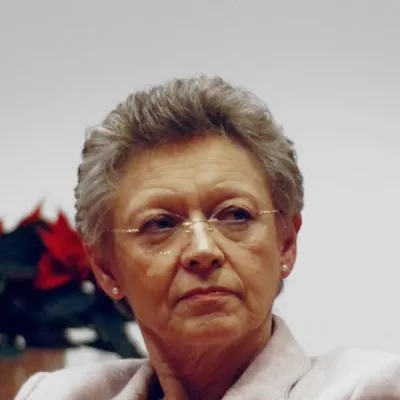
Françoise Barré-Sinoussi
Human Design Chart
Biography
When Montagnier led efforts at the Pasteur Institute in 1982 to determine a cause for AIDS, Barré-Sinoussi was a member of his team. Through dissection of an infected patient’s lymph node, they determined that AIDS was caused by a retrovirus, which came to be known as HIV. Their work led to the development of new antiviral drugs and diagnostic methods.
The Human Design of Françoise Barré-Sinoussi: Manifesting Generator 5/1
Manifesting Generator 5/1 — Design at a Glance
Françoise Barré-Sinoussi had a hybrid energy configuration: the constant power of a Generator paired with the lightning-fast executive force of a Manifestor. This design allowed her to skip steps and quickly pull things into her life. However, this speed carried risks. If she omitted important phases or pursued multiple impulses simultaneously without inner consent, it led swiftly to frustration – the specific suffering pressure of her type.
The mechanics of the Manifesting Generator require strict reaction rather than initiation. Only when the sacral center gives a clear 'yes' can action be taken. She was successful when she consistently followed this inner authority. Then potential friction turned into deep satisfaction. Instead of tackling tasks linearly, one after another, her creative power flourished in 'play mode'. Parallel projects were not distractions but necessary for maintaining her energy. The demand to focus on a single thing would have stifled her nature. Instead, she found fulfillment in variety and the ability to act swiftly – provided each step was secured by inner resonance. Thus, her speed became a tool rather than a source of conflict.
Sacral Authority
Françoise Barré-Sinoussi had an internal decision-making process that wasn't in her head but deeply rooted within her body. Her design required her to wait for external stimuli and then react based on physical signals – often spontaneous sounds like grunts or soft 'hmms'. This sacral authority is specific to the Generator type, simplifying the choice process as strategy and inner guidance are one and the same. A prerequisite was an open emotional center ensuring that this gut feeling wasn't distorted by passing moods.
When her sacral motor was engaged, a palpable vitality entered: inexhaustible energy and great enthusiasm accompanied her activities. She was inclined to go into what she did with joy without always needing an external goal in the foreground. This instinctiveness was supported by her activated spleen center. This center allowed for quick, spontaneous reactions and direct access to physical perception. Françoise Barré-Sinoussi could thus rely on her immediate, instinctive impulses rather than pre-empting or analyzing intellectually. The waiting period for a clear 'yes' or 'no' from her body was the key mechanism for her inner clarity and endurance.
The 5/1 Profile — Heretic / Investigator
Françoise Barré-Sinoussis design set up a fundamental tension between magnetic outward projection and deep, private research process. Others projected leadership qualities onto her and expected solutions to complex problems – an effect of Line 5, often perceived as self-righteousness or natural authority without personal ambition. The environment sought answers from her, which carried the risk of energetic depletion if clear boundaries weren't set.
Simultaneously, her inner work focused on Line 1: testing inspiration and mutating concepts into new contexts. Here it was about individuality and whether an idea is truly novel or merely repeating the known. The challenge lay in maintaining this necessary distinction from the collective to avoid devaluing her own new thoughts under external pressure.
The dynamics required learning to say 'no' to maintain balance between her role as a problem-solver for others and deep research for herself. Only then could she optimally utilize her gifts without falling into the trap of service to the collective, which would have endangered her innovative power. It was an ongoing equilibrium between external call and the need for inner clarity.
Single Definition — Defined & Open Centers
Françoise Barré-Sinoussi was characterized by a consistent ability to express herself and a clear identity. Her defined Throat Center ensured reliable communication, while the G Center provided a firm sense of direction. The willpower of her Heart Center drove her to keep promises and determine her own resources. As a motor, her Sacral Center supplied constant vital energy that was activated by reaction, supported by the stable pressure of the Root Center for stress management.
These defined centers created a foundation of inner stability and action-oriented strength. In contrast, her open centers – Head, Ajna, Solar Plexus, and Spleen – revealed situational receptivity. The open Head Center made her vulnerable to mental confusion or the pressure to find answers to others' questions rather than being guided by her own authority. Her open Ajna Center allowed intellectual flexibility but tended to adopt other people's concepts as her own truth or pretend uncertainty.
The open Solar Plexus Center acted like an emotional sponge; Françoise Barré-Sinoussi absorbed the emotions of those around her and amplified them, which could lead to identifying with others' moods rather than recognizing them as not her own. Finally, the open Spleen Center revealed a fundamental fear of survival or lack of well-being, leading her to cling to unhealthy situations for false security or make spontaneous decisions that she later regretted. The challenge was to not personalize these open fields as personal deficits but use them as mirrors for the environment while the defined centers formed the stable core.
Channels for authentic action, magnetic presence and mature growth.
Françoise Barré-Sinoussi's design established a structural presence of self-love and individual leadership. Her authenticity did not influence directly, but rather served as an example of authentic being that inspired others. This attitude stems from Channel Awakening 10-20, which connects the G Center with the Throat Center. It transforms personal knowledge (Gate 10) into proper action in the present moment (Gate 20), ensuring survival through self-acceptance.
This was complemented by Channel Exploration 34-10, linking the Sacral Center to the G Center. Here, Gate 76 provides inner strength to hold onto personal convictions while Gate 10 initiates behavior. This combination promoted the refinement of personal conduct towards self-acceptance independent of external validation.
Additionally, Channel Charisma 34-20 connected the Sacral and Throat Centers. The generative power of Gate 76 was channeled through expression in the moment (Gate 20), generating a charismatic presence based on reaction.
Individual Gates such as Gate 56 (mental stimulation), Gate 1 (creative uniqueness), and Gate 29 (sacral persistence) supported this dynamic through reflexive processes and saying yes to challenges. The mechanics show someone whose resilience is rooted in an unconditional commitment to inner authority.
Individual Circuitry — Circuit Signature
Françoise Barré-Sinoussi exhibited a centered, individualistic orientation. Her design connected the Sacral Center (life force) directly with the Identity Center via Channel Exploration within the Focusing Circuit. This created internal strength and courage that did not rely on external affirmation but flowed from her own existence. Since this circuit does not include the Throat Center, these deep convictions often remained hard to verbalize; the energy worked inward as a quiet certainty of 'I am so'.
Parallel to this, energy flowed in the Meaning Circuit between Sacral and Root Centers (Channel Maturation). This connected her life force with processing past experiences. Emotional waves from the Solar Plexus were not immediately expressed here but served for internal reflection and learning from history before being shared.
In the Ego Circuit, Françoise Barré-Sinoussi linked the Heart Center (self-worth) to the Throat Center via the Money Line. This allowed her to create resources through cooperation and make her value visible in concrete actions or words within the collective – a counterpoint to the inner stillness of the Focusing Circuit.
Finally, the Integration Circuit integrated Throat, Sacral, and Identity Centers via Channels Awakening and Charisma. Here intuition, life force, and expression in the present moment were united. This allowed spontaneous, authentic reactions to life, drawing strength from immediate experience and communicating it directly. Despite these connections, individual circuits remained energetically separate: inner identity (Focusing), emotional past (Meaning), resource-oriented cooperation (Ego), and spontaneous integration worked as parallel, non-fusing streams.
Left Angle Cross of the Alpha 1
Françoise Barré-Sinoussi's Human Design shows a profound, often unconscious motivation: to take on the role of an initiator who sets new cycles in motion. She was driven by the urge not just to keep ideas in her head but to actively bring them into the world and inspire others through her own initiative. This is the core energy of what is known as the 'left cross of Alpha 1'. In this Human Design context, the Alpha symbol represents the spark of creation – the moment when something new comes into being. It's not about power in a traditional sense but rather the pure force of initiation. Those who carry this configuration are archetypally connected to the Big Bang: the point where nothing becomes something. This energy often works below consciousness as a strong impulse to take that first step, even if the outcome is still unclear. It's the power that starts processes and moves others through this pioneering role. For Françoise Barré-Sinoussi, it meant an inner alignment towards creating new things less out of a desire for control than from the necessity to start something. This energy shaped how she dealt with changes: not as a reaction to external circumstances but as an active trigger. Identifying with this archetype created a fundamental stance where beginning itself was already a central expression of her inner dynamics.
Saturn Return · Uranus Opposition · Chiron Return · 2nd Saturn Return — Life Cycles
In her late youth, Françoise Barré-Sinoussi showed herself to gain clarity through outer structuring. Her design points towards a tendency not to seek identity in flow but to anchor it through concrete, measurable achievements. This became visible in 1974 at the age of 27 when she defended her doctoral thesis. This step marked for her the transition from an explorative phase to adult responsibility.
The first Saturn return represents a period of significant maturation in Human Design. It acts like a test stone, showing whether previous development is sustainable. For Françoise Barré-Sinoussi, this cycle was not just a mere age limit but the moment of identity consolidation. The mechanics describe here a process where inner convictions are confirmed through structural achievement. Her doctoral thesis was not only an academic conclusion but also the concrete manifestation of her ability to organize knowledge and establish herself as a competent personality. This experience shaped her further actions: she learned that security and self-worth arise from overcoming clearly defined challenges. Saturn energy demanded from her to realize her potentials within a stable framework, which gave her the necessary foundation for future responsibilities.
Manifesting Generator · Sacral Authority — Synthesis
Françoise Barré-Sinoussi's life seems marked by a deep inner dynamic arising from the connection between action and reaction. As an Manifesting Generator, she has the ability to quickly respond to impulses and set things in motion, yet this speed is inseparable from the need to always engage with life and heed sacral signals. This combination of initiative and responsiveness, reinforced by a defined G-Center authority, points towards someone who is both goal-oriented and adaptable – an inner compass guiding her through the world while remaining open for new possibilities. The profile as Hero/Researcher underscores this tendency: a deep thirst for knowledge and the ability to process complex information, paired with the desire to make this knowledge accessible to others.
A central paradox in her design lies in the interplay of independence and connectedness. A defined G-Center gives her a strong identity and direction while simultaneously open centers – particularly Ajna and Solar Plexus – make her receptive to external influences. This openness carries the risk of emotional conditioning and uncertainty but also allows for deep understanding of others and empathy. It's a field of tension between the need for autonomy and the natural inclination to connect with the world and learn from it.
5 Defined Channels
Incarnation Cross - Left Angle Cross of the Alpha 1
Solar Return
The Solar Return shows the moment when the sun returns to its exact birth position - your personal solar year.
Life Cycles
Discover the life cycles with a detailed triple view (birth chart, cycle chart, composite).
Human Design Profile
- Strategy
- To respond - wait for something to respond to
- Authority
- Sacral Authority
- Profile
- 5/1 - Heretic / Investigator
- Definition
- Single Definition
- Incarnation Cross
- Left Angle Cross of the Alpha 1
- Date of Birth
- 30.07.1947 03:25
- Place of Birth
- Paris, France
Frequently Asked Questions
What is Françoise Barré-Sinoussi's Human Design type?
What profile does Françoise Barré-Sinoussi have in Human Design?
What authority determines Françoise Barré-Sinoussi's decision-making?
What incarnation cross is assigned to Françoise Barré-Sinoussi?
When was Françoise Barré-Sinoussi born?
Discover your own Human Design
Are you also a Manifesting Generator? Find out in a personal reading how to unfold your multi-talents and direct your energy wisely.
More Personalities
Back to overviewAldair

Alizée

Angeli

Arletty
Artus

Balthus