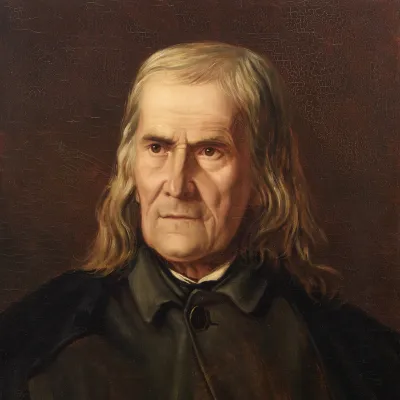
Friedrich Rückert
Human Design Chart
Biography
A gifted linguist, Rückert was master of 44 languages and made his mark chiefly as a translator of Oriental poetry and as a writer of poems conceived in the spirit of Oriental masters. He was self-educated in Oriental languages and, through translations and imitations of Eastern literature, introduced his German readers to Arabic, Persian, Indian, and Chinese mythology and verse. He taught Oriental philology from 1826 at Erlangen and Berlin universities before moving in 1848 to Neuses to devote his life to scholarship and writing. He published several epic poems and historical plays but achieved greater success and repute with his lyric verse, particularly "Liebesfrühling" (1844; “Dawn of Love”), poems written during his courtship of Luise Wiethaus, whom he married in 1821.
Rückert's poetry was a powerful inspiration to composers and there are about 121 settings of his work. Among the composers who set his poetry to music are Schubert, Robert and Clara Schumann, Brahms, Mahler (song cycles Kindertotenlieder,“Songs on the Deaths of Children” written in 1834 on the death of his two children), Max Reger, Richard Strauss, Zemlinsky, Hindemith, Bartók, Berg, Hugo Wolf and Heinrich aspar Schmid.
Rückert had a splendour of imagination which made Oriental poetry congenial to him, and he has seldom been surpassed in rhythmic skill and metrical ingenuity. There are hardly any lyrical forms which are not represented among his vast works, and in all of them he wrote with equal ease and grace.
He died on 31 January 1866 at age 77 in Neuses, near Coburg.
Human Design Analysis: Friedrich Rückert as Manifestor 2/4
Manifestor 2/4 — Design at a Glance
Friedrich Rückert revealed himself as a pioneer and visionary who was meant to lead the world into a new future. His design corresponds to that of an Manifestor, a configuration which compared him to an emperor in ancient Rome: He had the great vision but did not wage the necessary wars himself; instead, he sent others out to conquer foreign lands for him. This structure significantly shaped his interaction with the environment. Since his plans and dreams often exceeded the understanding of his contemporaries, he polarized strongly. Some people loved him because of these huge visions and followed him, while others rejected or even hated him precisely because of this. The central pain point of this design was being misunderstood, as his thinking frequently transcended common perception. To find the right followership and minimize resistance, it was essential for him to inform others about his intentions in a timely and precise manner. This strategy of informing formed the core of his life task. If he lived according to this principle and his inner authority, his system rewarded him with a sense of internal peace. Acting against this design, however, led to persistent, deep-seated anger within him. Therefore, his path was to clearly communicate his vision in order to attract the right people and avoid conflicts due to lack of information.
Emotional Authority
Friedrich Rückert showed a basic attitude where inner clarity did not immediately present itself but rather emerged over time through emotional calming. His design carried Emotional Authority, meaning that his defined Emotional Center alone determined decisions – regardless of which other centers were also defined in his chart. This priority rule was central: The emotional wave set the rhythm of his internal compass.
His feelings underwent constant ups and downs; the world appeared colored by his current mood. What excited him for a moment could appear negative the next. Since this initial impression often only reflected a snapshot rather than deeper truth, spontaneous decisions based on emotion were risky and potentially harmful.
Instead of acting when emotions ran high, Friedrich Rückert used the strategy of waiting. He let decisions mature, slept on them multiple times, and consciously sought distance. Through this patience, intense waves subsided, calmness set in, and only then did true clarity emerge. This process of emotional cooling was indispensable for him, especially regarding long-term steps that significantly shaped his life path.
The 2/4 Profile — Hermit / Opportunist
Friedrich Rückert exhibited a characteristic oscillation between the deep need for withdrawal and the urge to connect with his closest circle. His design as Profile 2/4, known as 'Natural Talent' or 'Networker', established an inner tension: Line 2 demanded isolation for reflection, while Line 4 sought community. Rückert therefore needed clear signals externally to manage his availability – when he wanted company and when he needed solitude. During his 'Me-Time', he immersed himself in internal processes, gathered calmness, and achieved clarity. Only after satisfying the need of Line 2 did he leave his 'cave' to meet with his favorite people. This rhythm allowed him to reflect on the knowledge of his network in solitude and develop brilliant ideas from it. Additionally, Line 4 brought analytical thinking as well as a search for influence within the network but also carried the risk of emotional burnout through excessive fixation on opportunities. Rückert's contribution as a role model emerged from this synthesis: He used alone time for processing and group time for exchange, always ensuring to communicate his boundaries clearly to prevent burnout.
Single Definition — Defined & Open Centers
Friedrich Rückerts Human Design shows a tendency towards constant mental activity and clear communication. His defined Ajna Center provided continuous conceptual thinking, while his also defined Throat Center reliably translated these concepts into language. This connection allowed him to express thoughts directly without interrupting the mental process.
Additionally, Friedrich Rückert had a defined G Center, which gave him a firm self-identity and a clear sense of personal direction. He knew where he belonged and could convey this inner security to others. His defined Solar Plexus served as an emotional authority; he needed to wait out the waves of his feelings to gain clarity before acting. The defined Root Center provided constant pressure, driving him forward in the material world and helping him cope with stress.
In contrast, Friedrich Rückert was vulnerable through his open centers to specific conditioning. His open Head Center lacked consistent inspiration; he tended to be distracted by doubts or questions from others rather than trusting his own inner answers. The open Heart Center made him sensitive to the pressure of proving his worth through willpower, often ending in a cycle of promises and disappointment. His open Sacral Center meant no constant energy flow; he was prone to being overwhelmed by the energy of others and neglecting boundaries. Finally, his open Spleen Center carried a fundamental fear of survival, leading him to make spontaneous decisions or cling to unhealthy situations to create a sense of security that did not come from within.
Channels for seeking, reflection, change and emotional release.
Friedrich Rückert showed as a person whose expression was marked by an insatiable curiosity and the ability to transform experiences into enlightening stories. His design featured Channel of Curiosity 11-56, connecting Ajna Center with Throat Center. This configuration drove him to constantly seek new ideas and inspirations, not for definitive answers but to further convey discoveries as narrative parables. He acted as a storyteller who transformed abstract information into forms that spoke to the imagination and feelings of others.
Parallel to this, Channel of the Lost Son 13-33 between G Center and Throat Center was at work. Here he gathered life stories and secrets (Gate 13) as a listener before withdrawing (Gate 33) to reflect on these experiences before sharing them. This process of patient integration lent his expressions deep wisdom from the past, even if he could not predict the future.
Emotionally, Friedrich Rückert was driven by the wave of Channel of Transience 36-35 between Solar Plexus and Throat Center. The connection prompted him to seek new emotionally charged experiences to break stagnation. Often, he consciously sought change or even created crisis situations just to set things in motion and explore his emotional depth. This restless longing served maturation through direct experience.
The underlying mood was modulated by Channel of Emotion Release 39-55 between Root and Solar Plexus Centers. Here moods pulse between joy and melancholy, prompting him to authentically listen to his emotional wave and only interact when the inner mood matched.
Additionally, Gates like 8 (Contribution), 14 (Power Handling) and 29 (Persistence in Sacral Center) shaped his work through a drive for individual contribution and directional endurance, while Gates of Personality such as 45 (Tribe Level) and 37 (Community) underlined his social appeal.
Collective Circuitry — Circuit Signature
Friedrich Rückerts design featured an unbroken, integrated energy since he was simply defined. His centers – Ajna, Throat, Identity, Solar Plexus, and Root Center – formed a single continuous flow without internal division. This allowed him a consistent expression where thinking, feeling, and acting seamlessly interwove.
In the Knowledge Circuit, he connected his Solar Plexus with his Root Center. The link between emotional wave and instinct generated pulsing impulses. It drove him to forge his own paths and unlock new knowledge through intuitive mutations rather than adhering to existing patterns.
The Meaning Finding Circuit linked Ajna, Throat, Solar Plexus, and Identity Centers in a single group. Here cognitive structuring merged with emotional depth and self-determined expression. Friedrich Rückert reflected on past experiences to grasp their meaning. Through curiosity, the recognition of transience, and willingness to learn from detours, he shared these insights. The energy flowed wave-like: emotions were not only felt but articulated through Throat Center and anchored in Identity Center as personal truth. Thus, he transformed private emotional cycles into shared collective learning by verbally formulating past events and making them accessible to others.
Right Angle Cross of Contagion 2
Friedrich Rückerts Design carried the imprint of the right cross of infection. This configuration described a specific life dynamics where external influences and environmental stimuli were not simply rejected but deeply absorbed into his personal system. For him, this meant that he shaped himself through the intensive uptake of foreign impulses. What hit him from outside—whether culturally, emotionally, or intellectually—was not experienced as disruptive noise but as an essential nutrient for his own development.
This mechanism worked like a filtering process: Friedrich Rückert took in the energy of his environment, processed it internally, and thus made it part of his own substance. It was not passive imitation but active integration. The boundaries between "I" and "environment" were more permeable with this configuration than with other types. This allowed him to immerse himself authentically into various roles, moods, or fields of knowledge.
This ability for deep absorption shaped the way he was. He depended on being touched by the world to sharpen his own identity. Without this exchange with the outside, his inner structure would have been less defined. The right cross of infection thus appeared as a mechanism of transformation: foreign elements were channeled through him and transformed into something of his own that he then passed on or lived.
Saturn Return · Uranus Opposition · Chiron Return · 2nd Saturn Return — Life Cycles
Friedrich Rückert's design laid a tendency towards structured, cyclical development that condensed into clear life phases. This mechanics became evident in 1816, at the age of 28: With his first Saturn return, he began publishing "Napoleon, a Political Comedy in Two Acts." This planetary position often marked the point where years of groundwork led to a solid, public result.
The search for new orientation and expansion characterized his mid-thirties. In 1826, at age 38, his Uranus opposition became active: Rückert was appointed as Professor of Oriental Languages and Literature at the University of Erlangen. This cycle often promoted a desire for change and a broader platform for one's knowledge.
He reached the bloom phase of his life purpose around his 49th birthday. The Chiron return is an achievement cycle in which one's inner destiny increasingly unfolds, provided one follows their own strategy. In 1837, the second, completed edition of "The Transformations of Ebu Seid von Serûg or the Makâmen of Hariri" was published. This was not merely a reprint but rather a sign that his work had now reached full maturity and recognition.
Even his second Saturn return in 1844 (age 56) underscored this structuring: The publication of "The Transformations of Abu Seid von Serug" further solidified his work. Rückert's design thus showed a clear line: from initial structured steps to professional establishment, and then to the full realization of his specific purpose in translation and mediation of Oriental intellectual property.
Manifestor · Emotional Authority — Synthesis
Friedrich Rückert lived an inner dynamism characterized by the interplay of initiation and emotional depth. As a Manifestor (Design), he possessed the ability to initiate processes and develop visions – a pioneer who pointed out new paths (Channel of Curiosity). These impulses were, however, always filtered through his emotional authority; decisions matured over time to allow for deeper insight. The profile as a natural talent and networker suggests that Rückert oscillated between the need for inner retreat (Line 2) and connection with others (Line 4), a give-and-take that fueled his creative energy and provided clarity. The repeated career events in the cycles underscore this process of withdrawing to gather oneself and then expressing.
A central paradox lay in the tension between the drive to initiate something new (Knowledge Circuit) and the necessity to filter it through an emotional wave. While the defined Mental Center created concepts and inspired, his emotional authority required patience and a thorough engagement with one's feelings. Thus, Rückert was both a thinker and creator whose visions only took full shape through emotional maturation – a dance between impulsive creativity and profound reflection.
4 Defined Channels
Incarnation Cross - Right Angle Cross of Contagion 2
Solar Return
The Solar Return shows the moment when the sun returns to its exact birth position - your personal solar year.
Life Cycles
Discover the life cycles with a detailed triple view (birth chart, cycle chart, composite).
Human Design Profile
- Type
- Manifestor
- Strategy
- To inform others before acting
- Authority
- Emotional Authority
- Profile
- 2/4 - Hermit / Opportunist
- Definition
- Single Definition
- Incarnation Cross
- Right Angle Cross of Contagion 2
- Date of Birth
- 16.05.1788 06:00
- Place of Birth
- Schweinfurt, GER
Frequently Asked Questions
What was Friedrich Rükert's Human Design type?
What Profile did Friedrich Rükert have?
What Authority did Friedrich Rükert have?
What incarnation cross was assigned to Friedrich Ruckert?
When was Friedrich Ruckert born?
Discover your own Human Design
Are you also a Manifestor? Find out in a personal reading how to use your initiation power peacefully and dissolve resistance.
More Personalities
Back to overviewAlain-Fournier
Angeli

Christian-Jaque

Juninho

Kesha

Lucebert