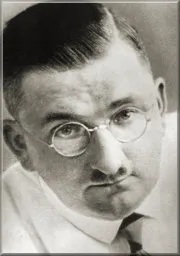
Fritz Gerlich
Human Design Chart
Biography
In 1919, he published the book Communism as the Theory of the Thousand Year Reich (Der Kommunismus als Lehre vom Tausendjährigen Reich), comparing communism with the phenomenon of redemption religion. A whole chapter in the work is devoted to denouncing antisemitism.
From 1920 to 1928 he was editor in chief of the Münchner Neueste Nachrichten (MNN), a predecessor to today’s Süddeutsche Zeitung in that its circulation was one of the largest in southern Germany. As editor, Dr. Gerlich opposed Nazism and Hitler's Nazi Party as "murderous". In the early 1920s, he had seen proof of Nazi tyranny already in Munich. Once a conservative nationalist, after the 1923 Beer Hall Putsch Gerlich decisively turned against Hitler and became one of his fiercest critics.
By 1927, he had befriended Therese Neumann, a Catholic mystic from Konnersreuth, Bavaria, who supported Gerlich's resistance activities. Initially, he wanted to expose her stigmatism as a fraud, but Gerlich came back a changed man and later converted from Calvinism to Catholicism in 1931. From that year until his death, his resistance became inspired by the social teachings of the Catholic Church.
Supported by a wealthy patron, Prince Waldburg-Zeil, Gerlich was able to take over the weekly newspaper Sunday Illustrated (Der Illustrierte Sonntag), which was renamed The Straight Path (Der Gerade Weg) in 1932. In this newspaper, Dr. Gerlich opposed Communism, National Socialism and antisemitism. The dispute with the growing Nazi movement became the central focus of Gerlich and his later writing. At the end of 1932 the circulation of the weekly was over 40,000 readers.
After the Nazis seized power on 30 January 1933, Gerlich was arrested on 9 March 1933 and held at the Dachau concentration camp, where he died on 30 June 1934 during the Night of the Long Knives.
Fritz Gerlich — Manifesting Generator with Profile 3/5
Manifesting Generator 3/5 — Design at a Glance
Fritz Gerlich revealed himself as someone who possessed hybrid energy: the constant power of a Generator paired with the lightning-fast effect of a Manifestor. His design tended to draw things quickly into his life and skip steps. This speed was, however, a double-edged sword. Often he acted too hastily, skipped necessary intermediate stages, and had to return later to catch up on missing foundations. This compulsion for correction quickly led to frustration, the specific non-self theme of his type.
Furthermore, Fritz Gerlich tended to pursue multiple projects simultaneously, driven by different impulses. Without strict adherence to his strategy – reacting to life impulses rather than initiating himself – his creative enthusiasm tipped into overextension. His inner authority and Sacral Center had to clearly agree; only then did the energy remain stable. Given this resonance, he found deep satisfaction in parallel work. The advice to focus on one thing stood against his nature. Instead, his creativity flourished in a playful mode with constant variety. His success depended on channeling this speed through conscious reactions to inner signals rather than blindly following it.
Sacral Authority
Fritz Gerlich was a Generator whose decision-making was shaped by Sacral Authority. This inner guidance is unique to this type and simplifies the process because strategy and authority are identical: reacting to life. The prerequisite for this was his open Emotional Center, meaning he did not have to wait for emotional clarity but could immediately use physical signals.
His responses were expressed as gut feelings or bursts of energy – audible as grunts, hums, or a confirming "Mhm". As long as his sacral motor responded to external stimuli, he felt vital and had inexhaustible energy. He lived with great enthusiasm in his activities, free from purposefulness, which brought him joy and satisfaction.
Additionally, his activated Spleen Center acted as supporting authority. This connection allowed for quick, spontaneous reactions and decisions. Fritz Gerlich had direct access to his physical well-being and instinctive perception. He reliably followed these deep impulses, emphasizing his ability to quickly orient himself in the world. This configuration marked him as someone who acted through direct physical resonance and possessed a natural, instinctive security that helped him move with the flow of life without having to think long.
The 3/5 Profile — Martyr / Heretic
Fritz Gerlich revealed himself as someone who learned through personal experimentation and later used these practical experiences to solve other people's problems. His Human-Design Profile 3/5 marked him as an experimenter and a hero: The Line of the Adventurer challenged him to test everything himself before believing it; the Hero Line conveyed this knowledge to others. This configuration created a natural attraction, as people wanted to use his acquired insights. However, this design also carried the risk that public failures during experimentation could deeply hurt him, as the role of the competent helper would be shaken.
Additionally, Gate 30 on Line 3 dealt with themes of resignation and fate acceptance. This did not mean passive surrender but rather learning through life as a wave – accompanied by temporary relief and mystical potentials, associated with the Goddess Kali. On the other hand, Line 5 stood for power and dignity. This innate authority was often perceived externally as arrogance or overconfidence, yet it primarily functioned as a protective mechanism to maintain his projection and respect. Fritz Gerlich lived in the tension between the humorous rebel who learned from mistakes and the figure of the savior whose dignity he had to preserve to not lose his impact on others.
Single Definition — Defined & Open Centers
Fritz Gerlich was characterized by a design that combined constant mental activity with a deep inner direction. His defined Ajna Center ensured a steady, trustworthy form of conceptual thinking; he created concepts in the same way every time and was hardly mentally influenced from the outside. These thoughts flowed directly into his defined Throat Center, allowing him to express what he thought, making his communication a manifestation of his inner world. Simultaneously, his defined G Center provided a firm self-identity and clear sense of life direction without being dependent on others.
These stable pillars contrasted with the sensitivity of his open centers. His open Head Center made him vulnerable to mental pressure and confusion from others; he tended to get entangled in questions that were not his own instead of using them as mere inspiration. The lack of consistent willpower in his open Heart Center led him into a cycle of proving his worth through promises and commitments, resulting in self-disapproval when failing. Additionally, his open Solar Plexus absorbed the emotions of his surroundings, leading to emotional instability if he personalized these foreign feelings or avoided confrontation out of fear of rejection.
His open Spleen Center carried a fundamental survival anxiety and made him vulnerable to unhealthy dependencies on people with defined Spleens who provided false security. Spontaneous decisions here were risky as they often relied on conditioned fears. Finally, his open Root Center took in external stress, leading to cycles of avoiding behavior or excessive tension if he did not recognize and release this non-own pressure.
Channels for inspiration, rhythmic power and structured insight.
Fritz Gerlich inspired others through his mere existence and individual expression. This effect stems from the Channel of Inspiration 1-8, which connects the G Center with the Throat Center. He lived out his unique identity rather than just explaining it; this exemplary leadership required courage to stand out from the crowd and drew public attention by serving as a role model.
At the same time, Fritz Gerlich possessed a profound generative power that enabled new directions. The Channel of Beats 14-2 connected his Sacral Center with the G Center, giving him the ability to translate mutative impulses into material reality. Through Gate 14, he had resources for innovation while Gate 2 directed higher knowledge. He trusted in his inner reaction to bring innovative perspectives that changed the status quo.
His way of thinking and communicating was marked by spontaneous insights. The Channel of Structuring 43-23 connected the Ajna Center with the Throat Center. Fritz Gerlich received inspired knowledge as sudden breakthroughs (Gate 43) and processed it to clearly express it (Gate 23). This required patience in timing; his innovative thinking was only recognized when communicated at the right moment, otherwise misunderstandings were likely.
Furthermore, other Gates shaped his attitude: Gate 30 steered the recognition of feelings and acceptance of limitations as fate. Gate 29 demanded a consistent yes to challenges, where persistence was crucial. Gate 35 sought change through interaction while Gate 45 expressed energetic tribal connection and willpower. Gate 47 helped him recognize collective meaning from past experiences. In his design, Gates 17 worked with logical teaching for the future, Gate 34 as a powerful source of individual energy, and Gate 15 promoted adaptation to natural rhythms and collective behavior.
Individual Circuitry — Circuit Signature
Fritz Gerlich was someone who walked his own path and transformed new knowledge. His design was simply defined; all energetic streams flowed together in one coherent system. The Knowledge Circuit significantly shaped him. It connected his Ajna Center with the Throat Center, Identity Center, and Sacral Center into a unity. This allowed him to clearly structure his own ideas (Channel 43-23) and express them through inspiration (Channel 8-1) as well as an inner rhythm (Channel 2-14). The energy flowed from mental conception over emotional affirmation to verbal articulation. Thus, he could express his unique identity and initiate change. His creativity worked pulsatingly and acoustically, driven by emotional waves. Since all centers were directly connected, there were no internal breaks or divided forces; his thinking, feeling, and acting aligned. This created a consistent aura aimed at bringing new knowledge into the world. The mechanics promoted the expression of individuality through the interplay of mind, emotion, and voice. Fritz Gerlich used this connection to not only think innovative thoughts but also make them audible and tangible, thereby initiating transformation for others.
Right Angle Cross of Contagion 1
Fritz Gerlichs design featured the configuration of the right cross of infection. This structure defined a fundamental attitude characterized by intense emotional dedication and a deep yearning for hidden truth. In Human Design, this cross describes a specific energy: it connects the need to grasp the essence of things (Gate 10) with the ability to bring these insights into clear, tangible forms (Gate 28). Fritz Gerlich thus appeared as someone who did not merely collect superficial information but sought the core, the "infection" with an idea or feeling.
This mechanism acted like a filter: only what emotionally and intellectually truly touched him entered his consciousness. The connection between the center of emotions (Solar Plexus) and mental understanding (Ajna) created a dynamic where feelings formed the basis for clear judgments. It was not about arbitrary mood swings but rather a penetrating intuition that proved valid after maturing in the emotional center. Fritz Gerlich lived this strategy of waiting for emotional clarity. His design challenged him to observe the world not just passively, but with almost missionary dedication, and to convey the truths he found in such a way as to inspire others—"infect" them—to act. This configuration created a person whose influence rested less on logical argumentation than on the persuasive power of deeply felt insights.
Saturn Return · Uranus Opposition · Chiron Return — Life Cycles
Fritz Gerlich revealed himself as someone whose life path was marked by clear turning points where inner maturity met outer structures. His design suggested a tendency towards such phases of reorientation, in which personal commitments or professional responsibilities dictated new directions.
In 1920, at the age of 37, he married Sophie Botzenhart. This coincided with his Uranus opposition period. In this mechanical configuration, there is often a breaking away from old patterns or expectations to make room for a more independent form of relationship. The marriage here was not just an event but an expression of this necessary distancing from the familiar towards a more conscious partnership that respected personal space.
Later, in 1932 at the age of 49, he took over the weekly newspaper "Die Illustrierte Sonntag" and renamed it to "Der Gerade Weg". This marked his Chiron return. This cycle does not represent healing in a therapeutic sense but rather the blossoming of one's own purpose. If one has lived according to their strategy up until this point, here the life work condenses into a coherent whole. The renaming of the newspaper was a visible sign of this fulfillment phase: Gerlich gave his medium a name that directly reflected his inner conviction and life sense. His Chiron return allowed him not only to carry his message but also to publicly present it as the central expression of his existence.
Manifesting Generator · Sacral Authority — Synthesis
Fritz Gerlich lived a life path marked by a strong urge for experience and the desire to share these experiences with others. As an Manifesting Generator with sacral authority, he primarily responded to his environment but also possessed the ability to quickly initiate things (the Manifestor aspect). The defined Mental Center indicates a constant flow of ideas that found expression through the Channel of Inspiration (Gate 1/8), making him a creative impulse giver. His Profile as an Experimenter and Hero embodied this dynamic: he tried many things himself to gain knowledge, which he then made accessible to others – a process highlighted particularly by his Uranus opposition at age 37 (Relationship) and Chiron return at age 49 (Career).
Central to Fritz Gerlich was the tension between the need for quick action and the necessity not to skip steps. While sacral energy provided the power for rapid initiatives, the defined Ajna Center demanded a thorough consideration of consequences. This led to an internal interplay between impulsive forward momentum and reflection on his own experiences – a paradox that manifested in how he generated and transformed knowledge to then publicly express it (Knowledge Web).
3 Defined Channels
Incarnation Cross - Right Angle Cross of Contagion 1
Solar Return
The Solar Return shows the moment when the sun returns to its exact birth position - your personal solar year.
Life Cycles
Discover the life cycles with a detailed triple view (birth chart, cycle chart, composite).
Human Design Profile
- Strategy
- To respond - wait for something to respond to
- Authority
- Sacral Authority
- Profile
- 3/5 - Martyr / Heretic
- Definition
- Single Definition
- Incarnation Cross
- Right Angle Cross of Contagion 1
- Date of Birth
- 15.02.1883 22:15
- Place of Birth
- Stettin, Germany
Frequently Asked Questions
What was Fritz Gerlich's Human Design type?
What Profile did Fritz Gerlich have in Human Design?
What Authority did Fritz Gerlich have?
Which incarnation cross was active for Fritz Gerlich?
When was Fritz Gerlich born?
Discover your own Human Design
Are you also a Manifesting Generator? Find out in a personal reading how to unfold your multi-talents and direct your energy wisely.
More Personalities
Back to overviewAldair

Alizée

Angeli

Arletty

Artus

Balthus