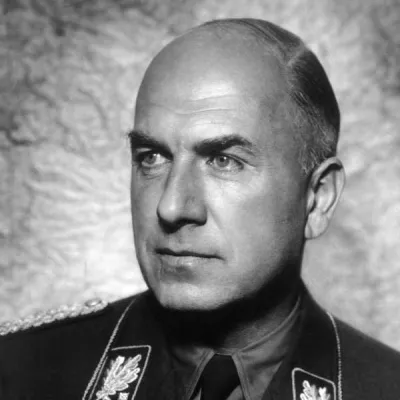
Fritz Todt
Human Design Chart
Biography
After he left a meeting with Hitler in Rastenburg, Germany on February 8, 1942 he boarded a plane. He died when it exploded and crashed.
What does Manifesting Generator 1/3 mean for Fritz Todt?
Manifesting Generator 1/3 — Design at a Glance
Fritz Todt revealed himself as someone with a hybrid energy structure: As an Manifesting Generator, he possessed the constant power of the sacral center combined with the ability to skip steps and quickly produce results. This design inclined him towards handling multiple projects simultaneously and advancing rapidly when inner impulses responded. However, his type's mechanics required not initiating on his own but responding to life impulses. Only when the sacral center gave a clear 'yes' could his creative power be effective without turning into frustration. When this strategy was adhered to, a play mode emerged that brought him deep satisfaction and allowed him to enjoy variety rather than fixating on one task alone. The danger lay in skipping important steps through excessive speed or taking too many threads at once, which quickly led to exhaustion without the consent of his inner authority. Thus, his design marked him as someone who, when correctly responding to impulses, created efficiently and contentedly; however, with a wrong approach, he could stumble due to his own speed.
Sacral Authority
Fritz Todt lived as a Generator whose decision-making was shaped by sacral authority. This internal leadership manifested not in the head but in the body: In response to external stimuli, a noticeable gut feeling or surge of energy arose. His design required listening to these physical signals – often expressed as grunts, hums, or simple 'hmms' – to recognize the right direction.
A prerequisite for this clear guidance was his open emotional center. This prevented emotional confusion from clouding his sacral response; he had to wait until inner clarity set in before acting. When his sacral motor engaged with a task, he felt vital and alive. He then possessed seemingly inexhaustible energy and tackled his work with great enthusiasm. His design enabled him to immerse himself fully in activities without pursuing strict purposefulness towards an external goal; the joy of the activity itself was the driving force.
Furthermore, his activated spleen center acted as a supportive authority. This gave him the ability to react particularly quickly and spontaneously. He had immediate access to his instinctive perception and physical well-being. This combination of sacral confirmation and spleen-supported intuition allowed him to make decisive decisions without hesitant deliberation as long as the inner impulse was correct.
The 1/3 Profile — Investigator / Martyr
Fritz Todt revealed himself as someone whose life path was strongly influenced by the principle of learning through direct experience. His design as a 1/3 Profile – the Researcher and Experimenter – established an approach that always linked theoretical knowledge with practical application. For him, self-earned insights were of central importance; only what he had mentally penetrated and tested in real life on his heart and guts was deemed trustworthy.
This dynamic resulted from the interaction of his lines. The first line formed the foundation of abstract mental processes, aiming to find the pivotal point amidst complex confusion. Without this clear mental structure, no progress was possible. Simultaneously, the third line required trial and error in the context of boredom and necessary crises. This was not an individual development process but one that needed other people and enabled forward-looking changes through practical tests.
The pressure often leading to rash actions was channeled by this mechanism: Instead of just planning, he acted to learn from the results – even mistakes. When Fritz Todt made a decision or judgment, it was based on this double test. He avoided getting lost in pure theory as his energy pushed him towards action and testing consequences. His path thus became an ongoing balance between the desire for comprehensive knowledge and the necessity of gaining security through concrete experience.
Split Definition — Defined & Open Centers
Fritz Todt's Human Design reveals a tendency towards constant mental tension and clear but often isolated inner orientation. His defined Head and Ajna Centers created a permanent pressure to ask questions and form concepts; this was not a choice, but rather a mechanical state of continuous thinking. This mental energy flowed into his defined Throat Center, allowing him to communicate his thoughts and theories directly with the world. Complementing this structure were his defined G Center, which gave him a firm sense of self-identity and clear direction, as well as his defined Sacral Center, acting as an engine providing a continuous source of vitality and industriousness.
At the same time, his design revealed specific vulnerabilities through his open centers. His open Heart Center lacked the consistent energy for willpower and promises; he tended to get lost in spirals of self-doubt when trying to prove his worth through performance or taking on commitments that did not align with his inner authority. His open Solar Plexus absorbed the emotions of his surroundings, making him vulnerable to foreign moods and emotional overload instead of standing on his own emotional wave. Furthermore, his open Spleen Center created a fundamental insecurity in matters of health and well-being; he often sought external validation for his safety and avoided spontaneous decisions to avoid unhealthy dependencies or false intuition. His open Root Center ultimately amplified the external stress pressure, causing him to suffer under the burden of externally driven hectic activity that did not originate from within.
Channels for mental clarity, rhythm and powerful presence.
Fritz Todt's Human Design points towards a powerful, mutative direction. The Beat Channel 14-2 connects material resource availability with higher knowledge, allowing him as a keyholder to transform innovative impulses into material reality and show new paths. This dynamic was complemented by the Rhythm Channel 5-15, linking habitual patterns with love for extremes; this created a magnetic flow binding him closely to natural life processes and giving him an inner timing that could draw others into his energy flow.
His capacity for action was shaped by the Charisma Channel 34-20. Here raw physiological power met the need for present expression, giving him the strength to maintain activity over longer periods and immerse himself in tasks self-reinforcingly, often making him unavailable to others as his energy flowed directly into manifestation.
Mentally, his design showed a complex processing of experience through the Abstraction Channel 64-47. This connected Head confusion with Ajna understanding, leading him to filter every life situation through kaleidoscopic mental images to recognize underlying patterns and stories, even if this temporarily led to inner uncertainty.
Additionally, Gates like 29 (Yes-Saying/Perseverance) and 8 (Contribution/Leadership) enhanced his ability to support group goals through constancy and act as a role model for mutation. Gate 35 (Change) pushed him to seek progress through interaction, while Gate 63 (Doubt) sharpened the mental process to resolve uncertainties.
Collective Circuitry — Circuit Signature
Fritz Todt's Human Design points towards a divided, bifurcated energetic structure. This 'Split Definition' meant that his powers worked in two independent blocks not directly flowing into each other. One block connected Identity, Sacral and Throat Centers; the other linked Head and Ajna Centers.
In the first block several circuits operated parallel. The Knowledge Circuit (Channel 2-14, 'The Beat') created a pulsating connection between identity and sacral center, promoting the expression of unique individuality. Parallel to this, the Understanding Circuit (Channel 15-5, 'Rhythm') linked these centers with focused rational energy for strategic future planning. The Integration Circuit (Channel 20-34, 'Charisma') connected Throat and Sacral Centers, expressing power from reacting to life in the present acoustically.
The second block consisted solely of the Meaning Finding Circuit (Channel 64-47, 'Abstraction'). This linked Head and Ajna Centers and directed energy cyclically towards reflecting past experiences. Since this block was separate from the first, these reflective processes existed independently of the active, strategic or identity-forming power in the other part of his design. Fritz Todt lived with these two coexisting but not directly connected energetic systems.
Right Angle Cross of Consciousness 3
Fritz Todts design pointed towards a tendency shaped by the right cross of consciousness 3. This configuration described a specific life task: to uncover hidden connections and convey them in such a way that others could actually take them on board. It was not just about theory but rather seeking what lies beneath the surface, combined with the need to pass on insights. For his design, this was a typical moment: the first Saturn return, often condensing years of groundwork into a solid result. This mechanism worked as an underlying attitude that determined his way of thinking and acting. It showed in how he processed and used information. The right cross of consciousness 3 demanded a clear focus on essentials without being distracted by side issues. It was about finding the truth and making it accessible to others. This task significantly shaped his decisions and actions, becoming a central part of his character and personality. Through this configuration, he became a mediator of knowledge and insights. His design supported him in presenting complex matters clearly and inspiring others with them. This was not an accidental trait but a direct result of his Human Design constellation, which largely determined how he interacted with the world and moved within it.
Saturn Return · Uranus Opposition · Chiron Return — Life Cycles
Fritz Todts design showed a tendency to take on structural responsibility during phases of upheaval. This dynamic was marked by the Uranus return, a cycle often associated with sudden changes and new authority structures. In 1933, at age 42, this effect became evident: he was appointed General Inspector for German Road Construction. This career move corresponded to the mechanical pattern of the Uranus return, where established systems often need to be redefined or radically expanded.
Later came the Chiron return, a fulfillment cycle in which a person's deeper life task and inner purpose unfolds – provided they have followed their strategy. For Fritz Todt, this moment fell in 1940 when he was appointed Reich Minister for Armaments and Munitions at age 49. This appointment was not just an administrative shift but the concrete manifestation of his personal purpose in a position of highest operational responsibility. Both events illustrate how astrological cycles in Human Design can serve as frameworks where certain character traits and life tasks become visible.
Manifesting Generator · Sacral Authority — Synthesis
Fritz Todt lived a life marked by a constant interplay between initiation and reaction. As an Manifesting Generator, he had the ability to quickly initiate things (sacral center, channel of beats), yet his profile as Researcher/Experimentor required thorough testing and validation before implementation. This combination led to a deeply rooted drive to explore new paths and gain knowledge through practical experience – a process fueled by mental pressure (defined head center) and constant seeking for understanding. His repeated professional successes in 1933 and 1940 were the result of this inner drive to change the world through innovation.
The central paradox in Fritz Todts design lay in the tension between his sacral authority and the defined head center. While his Sacral Center prompted him to react to the present moment and act impulsively, the defined Head Center exerted a constant pressure to understand, question, and plan things out. These two forces – one immediate, the other long-term oriented – created a dynamic tension field where quick initiatives were complemented by deep analysis, making him an indefatigable researcher and pioneer.
4 Defined Channels
Incarnation Cross - Right Angle Cross of Consciousness 3
Solar Return
The Solar Return shows the moment when the sun returns to its exact birth position - your personal solar year.
Life Cycles
Discover the life cycles with a detailed triple view (birth chart, cycle chart, composite).
Human Design Profile
- Strategy
- To respond - wait for something to respond to
- Authority
- Sacral Authority
- Profile
- 1/3 - Investigator / Martyr
- Definition
- Split Definition
- Incarnation Cross
- Right Angle Cross of Consciousness 3
- Date of Birth
- 04.09.1891 12:16
- Place of Birth
- Pforzheim, GER
Frequently Asked Questions
What was Fritz Todt's Human Design type?
What Profile did Fritz Todt have in Human Design?
What Authority did Fritz Todt have?
What incarnation cross did Fritz Todt have?
When was Fritz Todt born?
Discover your own Human Design
Are you also a Manifesting Generator? Find out in a personal reading how to unfold your multi-talents and direct your energy wisely.
More Personalities
Back to overviewAldair

Alizée

Angeli

Arletty

Artus

Balthus