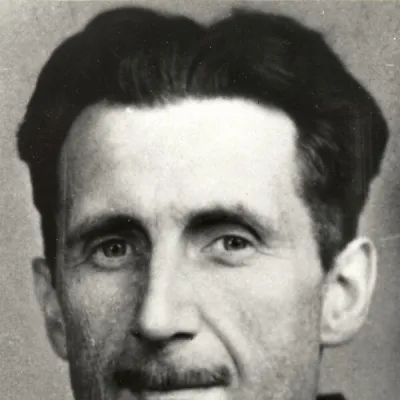
George Orwell
Human Design Chart
Biography
Orwell is best known for his allegorical novella Animal Farm (1945) and the dystopian novel Nineteen Eighty-Four (1949), although his works also encompass literary criticism, poetry, fiction and polemical journalism. His non-fiction works, including The Road to Wigan Pier (1937), documenting his experience of working-class life in industrial Northern England, and Homage to Catalonia (1938), an account of his experiences soldiering for the Republican faction of the Spanish Civil War (1936–1939), are as critically respected as his essays on politics, literature, language and culture.
Orwell's work remains influential in popular culture and in political culture, and the adjective "Orwellian"—describing totalitarian and authoritarian social practices—is part of the English language, like many of his neologisms, such as "Big Brother", "Thought Police", "Room 101", "Newspeak", "memory hole", "doublethink", and "thoughtcrime". In 2008, The Times named Orwell the second-greatest British writer since 1945.
The Human Design of George Orwell: Manifestor 5/1
Manifestor 5/1 — Design at a Glance
George Orwell proved to be a pioneer and visionary whose design predisposed him to lead the world in new directions. His character matched the metaphor of a Roman emperor: He possessed great vision but delegated concrete execution to others, much like a ruler sending his soldiers into battle rather than fighting himself. This superior way of thinking often led to misunderstandings and polarization among those around him. As he frequently thought ahead of his environment, some loved and followed him while others rejected or even hated him because of these forward-thinking plans.
To balance this dynamic, it was essential for George Orwell to apply his strategy of information dissemination. Through timely and precise communication of his intentions, he could find the right followers willing to follow him. If he followed this path of informing, his design rewarded him with a deep sense of inner peace. Living against this nature by acting without clearly stating his plans resulted in persistent, deep anger. This emotional range between peace and anger marked the central challenge of his life: balancing his leading role with the necessary adaptation to the understanding of others.
Splenic Authority
George Orwell demonstrated decision-making based on an immediate internal signal. His design assigned inner authority to the defined Spleen Center – his health and alarm system. This configuration endowed him with pronounced survival intelligence manifesting as spontaneous knowledge: he instantly recognized whether a situation or environment was right for him.
For this specific authority, both the Emotional and Sacral Centers had to be open; only Projectors or Manifestors can carry them. The first impulse was always correct and served his health directly. This allowed him to rigorously shield against harmful influences and protect himself effectively.
At the same time, it was a very subtle impulse that appeared only once in the moment and could easily be drowned out by external voices or ignored, requiring high vigilance. As what was right became known only at the moment and plans changed quickly, long-term commitment was difficult. George Orwell needed much freedom and flexibility to do justice to this spontaneous nature. A retreat often helped him clearly hear this fine impulse before acting.
The 5/1 Profile — Heretic / Investigator
George Orwell stood between a deep inner research drive and external expectations as a problem solver. His Human Design Profile 5/1 combined the magnetic radiance of the 'Hero' (Line 5) with the private knowledge deepening of the 'Researcher' (Line 1). Others instinctively sought solutions from him, which without clear boundaries quickly led to exhaustion. The mechanics describe this dynamic as tension: while Line 1 promoted openness to various opinions and recognition of connections, Line 5 attracted requests that often overburdened him. Particularly Gate 15 in the fifth line pointed to a tendency towards overcompensation, especially during crises or under extreme pressure. This could disrupt the natural flow and lead to emotional depletion similar to an expert exhausted after long consultations. The central life task was learning the art of 'saying no.' Only by setting boundaries could George Orwell maintain balance between his private research and public availability. By protecting his energy through limits, he optimally utilized his gifts rather than being drained by constant requests. This structure profoundly shaped his work.
Single Definition — Defined & Open Centers
George Orwell's Human Design profile was characterized by a consistent and reliable expression that did not stem from impulsive urges or fleeting inspiration. His defined Throat Center served as the central pivot, transmuting messages from his inner compass: It spoke the truth of his personal direction (defined G Center), supported by clear willpower (defined Heart) and intuitive body knowledge (defined Spleen). This configuration created a harmonious connection between identity, intention, and spontaneous perception in the present moment.
At the same time, he was receptive to environmental energies through open centers. His open Head and Ajna Centers made him vulnerable to mental pressure and the risk of interpreting foreign concepts as his own truth or getting stuck in endless questions. The open Sacral Center meant an inconsistent energy flow; he tended to overextend himself with external work demands rather than trusting his own rhythm. Additionally, his open Solar Plexus absorbed others' emotions, making him susceptible to emotional waves that did not belong to him. His open Root Center also took on external stress and adrenaline, putting him at risk of being driven by foreign pressure.
The challenge lay in not personalizing these absorbed energies – mental confusion, emotional fluctuations, or external time pressure. Instead of reacting to conditioned stimuli, his design showed the need to trust his inner authority. Only then could he maintain the clarity of his defined throat and ensure that his communication always flowed from his own authentic source rather than echoing surrounding uncertainties.
Channels for intuition, creative integration and bold execution.
George Orwell's Human Design profile revealed a tendency towards intuitive self-assertion paired with the drive to shape material structures through willpower. He secured his survival in the present moment through spontaneous adaptation, perfecting talents through repeated practice.
This attitude was rooted in Channel of Perfect Form 57-10. This channel connected the intuitive insight of the Spleen Center (Gate 57) with self-behavior in the G Center (Gate 10). It allowed an acute sensitivity to the environment, reacting not just to words but to tone levels. This gave him clarity to act spontaneously and appropriately to protect his physical well-being and uniqueness without being burdened by future anxieties.
Parallel to this was Channel of Wavelength 48-16. It linked the inner intelligence of the Spleen Center (Gate 48) with dexterity in the Throat Center (Gate 16). Here, he sought life-critical information and perfected skills through constant experimentation. Through this combination, pure technique transformed into talent that required recognition and resources to further develop. It was a process of mastery where repetition led to precision.
The material plane was shaped by Channel of the Money Line 21-45. This channel connected the will of the Heart Center (Gate 21) with the authoritative voice in the Throat Center (Gate 45). This created a tension field between the need for control and service. George Orwell had to take responsibility for resources to sustain his tribe, while maintaining his own independence. He worked best as his own boss since he struggled to delegate responsibility without burdening his heart.
Additionally, Gates like Gate 17 (Succession and logical teaching) and Gate 51 (strong willpower and adaptation to shocks) contributed to his ability to navigate hierarchies and respond to crises with inner strength.
Collective Circuitry — Circuit Signature
George Orwell displayed a clear distinction between rational understanding, material security, and individual survival strategy. His design presented three parallel, non-directly connected circuits. The Understanding Circuit in him linked the Throat Center with the Spleen Center through Channel of Wavelength. This created an ability for visual, future-oriented perception and sharing logical structures – an 'emotionless ratio' that acted free from conditioned emotion. Parallel to this was the Ego Circuit, which linked the Throat Center with the Heart Center via the Money Line. Here it was not about individual identity but tribal resource accumulation and material well-being. As there was no connection to the Sacral Center, this energy required rest periods for regeneration. The third area was the Integration Circle, which connected Identity with Spleen through Channel of Perfect Form. This served individual survival security through power from reacting to life guided by intuitive knowledge and correct behavior in the present moment. Although all three circuits touched either Throat or Spleen Center, energy flows remained separate: Logic (Understanding), Resources (Ego), and Survival (Integration) existed as parallel, independent forces without a common flow between groups.
Left Angle Cross of Prevention 1
George Orwell's Human Design profile revealed a tendency towards strategic prevention and risk minimization as a central life principle. He demonstrated this through the consistent application of precautionary measures to avoid potential problems or dangers before they could even arise. This approach stemmed from the configuration of his left cross of Prevention 1, which focuses on identifying latent threats and taking proactive action to prevent damage rather than merely reacting to crises that have already occurred. It was not paranoia but a structural ability to identify weaknesses in systems or situations early on and counteract them. George Orwell used this energy to shape his environment and fields of action so as to minimize sources of error. The mechanics of this cross fostered a deep understanding of the causality of events: small, overlooked details could have significant consequences. Therefore, it was essential to examine and secure things in advance. This shaped his way of dealing with uncertainties – not through ignorance or blind optimism but through careful analysis and preparatory measures. The energy of this design acted like an inner compass for safety and stability, urging him to neutralize risks before they could spread. It was a defensive strength aimed at curbing chaos through targeted planning and foresight.
Saturn Return · Uranus Opposition — Life Cycles
In 1943, when George Orwell was 40 years old, he experienced a profound break in his professional routine: due to health reasons, he left the Home Guard and ended his work at the BBC. This corresponds to the dynamic pattern of the Uranus opposition, a cyclical turning point often manifesting as a sudden crisis or unexpected interruption. Such configurations violently dissolve existing structures – whether in one's career or social roles – forcing necessary detachment from old patterns. For George Orwell, this moment marked not only an external professional change but also an internal watershed where his previous life order broke down to make way for new orientation. The mechanics here do not describe a random occurrence but a necessary process of the decay of outdated forms so that the individual does not suffocate in them. This disruption was painful and disruptive, yet it served the function of freeing George Orwell from a role that might have bound him more than it benefited him. Through this forced pause and loss of familiar positions, the path was cleared for a redefinition of his own paths, driven by the necessity to break free from what could no longer sustain him.
Manifestor · Splenic Authority — Synthesis
George Orwell lived a life marked by a profound drive towards understanding and an ensuing need to communicate. As a Manifestor with defined Throat (linked to Spleen) and the Channel of Completed Form (57/10), he intuitively recognized patterns and needs that eluded others – an instinctive knowledge about his own well-being and its connection to behavior in the world. This ability, coupled with a 5/1 Profile as Hero and Researcher, led to an unstoppable search for truth and the need to make these insights accessible to others, even when facing resistance. The focus was always on maintaining personal integrity and securing survival through authentic action.
A central paradox in his design was the conflict between the desire for separation and the urge to communicate. Spleen authority demanded spontaneous decisions aligned with one's well-being, while the defined Throat forced him to express and share these inner impulses – a process that made him vulnerable to misunderstandings (Manifestor type). This tension was evident in an event where health issues compelled him to withdraw from public activity despite his inner voice calling for expression. The left cross of prevention reinforced this tendency to recognize risks and protect himself from them, which in turn limited his ability for direct influence.
3 Defined Channels
Incarnation Cross - Left Angle Cross of Prevention 1
Solar Return
The Solar Return shows the moment when the sun returns to its exact birth position - your personal solar year.
Life Cycles
Discover the life cycles with a detailed triple view (birth chart, cycle chart, composite).
Human Design Profile
- Type
- Manifestor
- Strategy
- To inform others before acting
- Authority
- Splenic Authority
- Profile
- 5/1 - Heretic / Investigator
- Definition
- Single Definition
- Incarnation Cross
- Left Angle Cross of Prevention 1
- Date of Birth
- 25.06.1903 14:30
- Place of Birth
- Motihari, India
Frequently Asked Questions
What is George Orwell's Human Design type?
Which Profile did George Orwell have?
What inner authority did George Orwell have?
What incarnation cross did George Orwell have?
When was George Orwell born?
Discover your own Human Design
Are you also a Manifestor? Find out in a personal reading how to use your initiation power peacefully and dissolve resistance.
More Personalities
Back to overviewAlain-Fournier

Angeli

Christian-Jaque
Juninho

Kesha

Lucebert