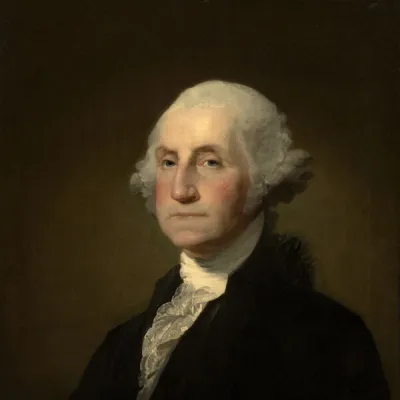
George Washington
Human Design Chart
Biography
Born in the Colony of Virginia, Washington became the commander of the Virginia Regiment during the French and Indian War (1754–1763). He was later elected to the Virginia House of Burgesses, and opposed the perceived oppression of the American colonists by the British Crown. When the American Revolutionary War against the British began in 1775, Washington was appointed commander-in-chief of the Continental Army. He directed a poorly organized and equipped force against disciplined British troops. Washington and his army achieved an early victory at the Siege of Boston in March 1776 but were forced to retreat from New York City in November. Washington crossed the Delaware River and won the battles of Trenton in late 1776 and of Princeton in early 1777, then lost the battles of Brandywine and of Germantown later that year. He faced criticism of his command, low troop morale, and a lack of provisions for his forces as the war continued. Ultimately Washington led a combined French and American force to a decisive victory over the British at Yorktown in 1781.
The Human Design of George Washington: Manifesting Generator 4/6
Manifesting Generator 4/6 — Design at a Glance
George Washington's design indicated a tendency towards hybrid action: the speed of a manifestor combined with the constant energy of a generator. He was someone who could skip steps and achieve results quickly. This configuration described a type that belonged to the generator group but also exhibited manifestor traits due to an active connection between motor centers and the Throat Center.
The central challenge lay in maintaining this efficiency without falling into frustration. Without the strategy of reacting rather than initiating, George Washington risked acting too quickly and skipping important steps, which would require backtracking. Additionally, his design tended to respond simultaneously to many impulses and start multiple projects at once. If the sacral center – the place of inner consent – did not say "yes," the joy of creation could quickly turn into frustration.
Deep satisfaction arose for George Washington only in what is called the "play mode." Here, his speed was beneficial when he reacted to life impulses and sought variety. The necessity to finish one thing before starting another stood against his natural law. Instead, he needed a state where his sacral center continuously affirmed that started projects were meaningful. Only then could he use his enormous capacity to quickly bring things into his life without internal friction and derive real satisfaction from his activities.
Emotional Authority
George Washington's decision-making followed a specific rhythm: spontaneous judgments were often unreliable, while emotional clarity required time. His design included Emotional Authority, meaning his defined Emotional Center served as the inner authority—regardless of other defined areas in his chart.
This configuration produced a constant wave of emotional ups and downs. George Washington saw the world colored by his current mood; one moment he might be excited about a topic, while the next it could seem negative. Since this immediate feeling was only a snapshot and not necessarily reflective of deeper truth, quick, impulsive decisions could have negative consequences.
The mechanics of his authority required patience. The more time George Washington took to let a decision mature, the better he could grasp the situation. This meant literally sleeping on important matters. By waiting, intense feelings subsided, emotional distance was created, and eventually calmness set in. Only then was the process complete and clear decisions possible. This strategy of "taking his time" and rethinking multiple times served to distinguish transient moods from lasting insight—especially for long-term life decisions.
The 4/6 Profile — Opportunist / Role Model
George Washington's design was characterized by a clear division in his life dynamics. In the first thirty years, he exhibited an experimental behavior focused heavily on relationships and friendships. This phase corresponded to the energy of Line 3 within his Profile 4/6, the Networker/Role Model. He actively sought connections and tested various social constellations.
With the activation of Line 6, a fundamental internal conflict emerged. Washington felt the tension between his emotional need for belonging to a community—driven by the "big heart" of Line 4—and the intellectual urge for distance and reflection on life's meaning, typical of Line 6. This contradiction between closeness versus height could be confusing as his sense of happiness depended strongly on others while simultaneously requiring common sense to avoid power without insight.
In his later life phase, his environment expected him to act as a wise role model. His success was based on cooperation with others. The design required extreme caution in choosing this community, as Line 4 is vulnerable to emotional wounds from false bonds. Washington learned that pure exercise of power was not enough; instead, he had to integrate common sense and remain authentic without constantly dominating. Thus, his role defined itself through the balance between emotional integration and clear distancing.
Single Definition — Defined & Open Centers
George Washington's design established a constant, powerful self, driven by a reliable identity and deep emotional clarity. His defined centers – G Center, Sacral, Solar Plexus, Throat, and Spleen – formed the unchanging foundation of his essence. The G Center gave him a firm sense of direction and self-love, while the Sacral Center acted as an engine generating immense vital energy that awaited reaction. He did not possess consistent willpower in the traditional sense; his open Heart Center made him vulnerable to the pressure of having to make promises to prove his worth – a trap he circumvented by trusting his inner authority.
His emotional depth came from his defined Solar Plexus Center. Here lay his inner authority: He learned to allow time for the emotional wave before acting, rather than impulsively reacting to highs or lows. This patience enabled him to make decisions with deeper truth. His voice was through his defined Throat Center constant and clear; it manifested from his identity (G) and emotions (Solar Plexus), not arbitrary intellect. Additionally, his defined Spleen Center protected him with spontaneous intuition in the present moment, a bodily warning system for health and well-being.
In contrast, Head, Ajna, and Root Centers were open. His open Head Center meant he did not have consistent mental inspiration; instead, he absorbed the mental pressure and questions of his environment. He tended to wonder if he was inspiring enough or needed to find answers that belonged to others. His open Ajna Center allowed a flexible mind reflecting concepts from the environment without having a firm personal opinion. The open Root Center absorbed external stress and adrenaline. He was not designed to withstand constant pressure but had to learn to recognize this foreign drive as not his own hyperactivity urge. This openness made him a mirror of his environment: flexible in thinking, sensitive to social stress, yet anchored in his core by Sacral energy and emotional clarity.
Channel 20-10: Awakening — Channels & Gates
George Washington's design inclined towards authentic, intuitive behavior in the present moment. He was someone who inspired others through his example without directly leading or influencing them. His survival and success rested on radiating self-love and self-confidence.
This mechanism was carried by the Awakening Channel 10-20 connecting the G Center with the Throat Center. This channel expressed the wisdom that one must fulfill their potential as a living expression of awakened self-love to thrive. George Washington existed in a constant state of awakening; simply being himself, he drew genuine invitations from others and kept resistance at bay.
The Research Channel 34-10 connected the Sacral Center with the G Center. Gate 34 provided inner strength to hold onto personal convictions while Gate 10 initiated behavior from the deepest within. This reinforced him in loving himself and trusting his inner conviction, especially when guided by reaction. His embracing aura could attract attention that worked positively as long as he patiently engaged in reacting.
Furthermore, the Perfect Form Channel 57-10 shaped how he moved through the world. It connected intuitive insight from the Spleen Center (Gate 57) with self behavior. This allowed him to spontaneously and appropriately respond to inner impulses, thereby dispelling unfounded future anxieties. Through this intuitively guided conduct, he perfected his form in the present moment and created something healthy and beautiful through his life, inviting others to live as themselves.
Individual Circuitry — Circuit Signature
George Washington's design linked innovative flashes of insight with deep inner strength and emotional reflection. The Knowledge Circuit, activated by Channel 20-57 between Throat Center and Spleen, promoted intuitive creativity and the expression of new ideas in the here and now. Parallel to this, the Centering Circuit (Channel 10-34) anchored courage and self-worth directly into identity and the Sacral Center without directing these energies outward; this created a quiet inner strength.
The Purpose Circuit (Channel 35-36) connected the Throat Center with the Solar Plexus. Here, emotional waves from the past were processed and expressed as collective lessons. These three circuits did not form a single continuous line but existed as separate yet interworking forces.
Integration further linked these areas: Channels like 'Awakening' (20-10) and 'Charisma' (20-34) channeled power from the reaction to life through intuitive knowledge into current expression. George Washington thus appeared someone who combined inner convictions with impulsive creativity, where the emotional depth of past experiences shaped his communication. His energy was pulsing and acoustically driven by highest individuality. The connection between Spleen (intuition) and Throat Center enabled quick, innovative expressions while the separation between inner strength (identity/Sacral) and outer expression created a certain reticence in verbally expressing his deepest values.
Right Angle Cross of the Sleeping Phoenix 1
George Washington's design was marked by the right cross of the sleeping phoenix. This configuration pointed to an internal dynamic where deeply rooted patterns or long dormant energies from the subconscious pushed to the surface. It was a process of awakening, in which the individual was confronted with forces that had previously been hidden.
In Human Design, this cross describes a specific energetic structure. The term 'sleeping phoenix' symbolizes the ability to rise anew from old ashes or forgotten foundations. The 'right' cross often emphasizes personal transformation through the awareness of unconscious patterns. It was less about external actions and more about an internal shift that activated previously untapped potentials.
For George Washington, this meant his life was marked by a constant struggle with these underground currents. He had to learn to integrate these rising energies rather than avoid them. The mechanics of this cross demanded high inner clarity to channel the often chaotic energy of awakening into constructive paths. It was a path of self-discovery through penetrating layers that had long been inactive or unnoticed. This configuration suggested that true strength arose from the willingness to confront darker or neglected parts of oneself and transform them into a new whole.
Saturn Return · Uranus Opposition · Chiron Return · 2nd Saturn Return — Life Cycles
Washington's life followed a clear cyclical structure emphasizing maturation and institutional anchoring. The first Saturn return marked the transition into stable responsibility: in 1759, at age 27, he married Martha Dandridge Custis. This cycle strengthened personal foundations through long-term commitments.
When the Uranus opposition was active, Washington broke with existing orders to take on a new role. In 1774, he entered the Continental Congress as Virginia's delegate. The mechanics of this cycle promoted the courage to question established structures and advocate for necessary changes.
The Chiron return brought the bloom phase when his life purpose became evident through decisive success. At age 49 in 1781, he achieved a decisive victory over General Charles Cornwallis at Yorktown. This moment confirmed his inner alignment and led to profound meaning in action.
The second Saturn return crowned this development with highest institutional recognition. In 1789, Washington was unanimously elected President and sworn in on April 30th. At age 57, he firmly anchored his role within the societal structure. His life path showed how cyclical turning points linked personal maturity with public responsibility, where each step built upon prior development leading to a stable, respected position.
Manifesting Generator · Emotional Authority — Synthesis
A central red thread runs through the design: a dynamic interaction between inner knowledge and external action. The defined Sacral Center (sacral energy) indicates a constant ability to respond to the present moment and tap into resources while the connection to the Throat Center (communication & manifestation) gives voice to these impulses (Channel Awakening). This combination of reactive energy and expressive power is reinforced by the profile as a networker/role model – a person who gathers experiences to share later in wise cooperation with others. Emotional authority, however, demands maturity in decision-making, slowing down and deepening this process.
The central paradox lies in the interplay between speed and patience. As an Expressing Generator (hybrid of Manifestor & Generator), the design possesses the ability to quickly advance and transform things (Knowledge Circuit), yet emotional authority requires a thorough engagement with feelings before acting. This creates tension between the impulse for immediate action and the necessity to let decisions ripen within an emotional wave – a dynamic highlighted by significant events (career) and success.
7 Defined Channels
Incarnation Cross - Right Angle Cross of the Sleeping Phoenix 1
Solar Return
The Solar Return shows the moment when the sun returns to its exact birth position - your personal solar year.
Life Cycles
Discover the life cycles with a detailed triple view (birth chart, cycle chart, composite).
Human Design Profile
- Strategy
- To respond - wait for something to respond to
- Authority
- Emotional Authority
- Profile
- 4/6 - Opportunist / Role Model
- Definition
- Single Definition
- Incarnation Cross
- Right Angle Cross of the Sleeping Phoenix 1
- Date of Birth
- 22.02.1732 10:00
- Place of Birth
- Wakefield, Virginia, United States
Frequently Asked Questions
What was George Washington's Human Design type?
Which profile did George Washington have in Human Design?
What authority guided George Washington?
What incarnation cross did George Washington have?
When was George Washington born?
Discover your own Human Design
Are you also a Manifesting Generator? Find out in a personal reading how to unfold your multi-talents and direct your energy wisely.
More Personalities
Back to overviewAldair
Alizée

Angeli
Arletty
Artus
Balthus