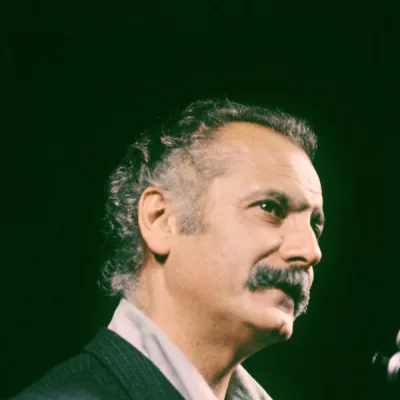
Georges Brassens
Human Design Chart
Biography
He was born to a French mason father and a mother of Italian descent. Being on bad terms with his father because he refused to succeed him as a mason, he left Southern France in his youth and lived at his aunt's home in the 14th Arrondissement of Paris, and then in the 15th (where a park named "Georges Bransens" is located near his last home).
He was born nine days after the Italian-French actor and singer Yves Montand. Brassens remained single and had no children.
He died of cancer at 11:15 PM on 29 October 1981 in Saint-Gely-du-Fesc, France.
Human Design Analysis: Georges Brassens as Generator 3/5
Generator 3/5 — Design at a Glance
Georges Brassens revealed himself as someone whose endurance and deep contentment were inseparably linked to his ability to wait for inner signals. His design indicated a tendency to generate energy not through forced initiation but by reacting to life's impulses. As a Generator, Georges Brassens had a lot of sacral energy – comparable to that of a strong workhorse – which only flowed effectively in response to stimuli. The strategy was to wait until the Sacral Center gave a clear "yes" before taking action.
This principle was crucial for his energy management. When Georges Brassens did things he didn't feel an inner resonance with, he risked frustration and a lack of power. Conversely, ignoring the internal stop signal or interrupting his heart projects led to blockages. The motto "react rather than initiate" protected him from burnout. By reacting intuitively to life's signals instead of arbitrarily pushing forward, he optimally utilized his intrinsic creative force. When Georges Brassens lived in harmony with this mechanism, his system rewarded him with a sense of deep fulfillment. Deviations from it – such as constantly pushing against inner resistance – resulted in persistent frustration. His endurance was thus not merely a trait but the result of consciously waiting for the right momentary confirmation from his Center.
Sacral Authority
Georges Brassens lived as a Generator, with his inner authority in the defined Sacral Center. This configuration fundamentally shaped his decision-making: he responded to external stimuli rather than initiating them. His strategy was to wait and then answer from the depth of his body.
His sacral authority manifested through physical signals. An internal grunting sound or a loud "Mhm" signaled agreement; a negative noise like "Hm-hm" indicated rejection. This gut feeling was his compass. When his sacral motor engaged with something, he felt an immediate surge of energy. This state gave him vitality and seemingly inexhaustible energy. He approached his tasks with great enthusiasm and immersed himself completely in them.
For Georges Brassens, it wasn't about being task-oriented but rather the sheer joy of the action itself. With his Emotional Center open, he could perceive this sacral response without distortion. This simplified his process significantly, as strategy and authority were one and the same. He followed the immediate feedback from his body, which allowed him to move through life with satisfaction, driven by an authentic, physical resonance with the world around him.
The 3/5 Profile — Martyr / Heretic
Georges Brassens revealed himself as someone who did not gain knowledge from books but through direct, often risky experimentation. His design showed a tendency to question everything initially and only believe what he had experienced firsthand. This attitude stemmed from his Line 3, which defined experiments and mistakes as a necessary learning process. He learned from these practical experiences to later solve problems for others – a characteristic of the Hero Line (Line 5).
This combination created a particular attraction: people were drawn to his lived stories because they were authentic. Brassens acted as a storyteller who captured attention through his unusualness. However, this configuration also harboured a specific source of pain. When he experimented in front of an audience and failed, it hit him deeply, as Line 5 projects high expectations for perfection. His charm thus arose from the tension between private experimentation and public presentation as a competent hero who became wiser through his own mistakes.
Split Definition — Defined & Open Centers
Georges Brassens was characterized by an inner foundation of constant mental pressure and generative vitality, supported by adrenaline-fueled endurance. His defined Head Center generated a permanent inspiration and the urge to question, while his Ajna Center translated these impulses into conceptual structures. However, this mental activity was not directly action-oriented; it required the energy from his defined Sacral Center to become effective. This center provided a reliable source of vitality that was released in response to initiations, paired with the stabilizing pressure of the Root Center, which propelled him forward in the material world.
This mechanical foundation contrasted with his open centers, making him reflective of his environment. His open Throat Center meant he did not have his own consistent communication energy and waited to be invited to speak rather than actively seeking attention. His open G Center led to his identity and life direction being situational, adapting to people and places instead of having a fixed inner direction. Similarly, lacking the energy in his open Heart Center for constant willpower or competitive behavior made him vulnerable to wanting to prove worthiness rather than simply being. His open Solar Plexus Center caused him to absorb and amplify emotions from his environment without owning them as his own, while his open Spleen Center created a tendency towards survival anxiety and clinging to unhealthy situations to simulate a sense of security. This configuration required an attitude of waiting for correct initiations since the open centers did not provide their own energies for spontaneous decisions or emotional regulation.
Channel 3-60: Mutation — Channels & Gates
Georges Brassens oscillated between impulsive change and reflective storytelling. His design inclined him towards melancholic patience, which was not passivity but rather a necessary wait time for inner clarity.
This dynamic was shaped by the Channel of Mutation 60-3. This connects the Root Center with the Sacral Center, bringing about evolutionary change that depends on accepting limitations. Gate 60 served as a pivot point for possibilities, while Gate 3 attempted to organize new things. The energy of this channel was adrenalized and pulsing; it only became effective when Georges Brassens endured the confusion of a fresh start and waited for his inner response. Melancholy accompanied these phases of silence in which something new developed beneath the surface.
Parallel to this, the Channel of Abstraction 64-47 worked. It connected the Head Center with the Ajna Center, filtering every experience through kaleidoscopic mental images. Gate 64 introduced confusion while Gate 47 sought to understand it. This channel drove him to tell stories and find meaning in life's chaos. However, this mind was not suited for fully understanding his own life; rather, it served the mediation of perspectives to others. The tension between the unpredictable energy of mutation and the searching nature of abstraction shaped his expression: patience was key to letting mental confusion evolve into an inspiring narrative.
Individual Circuitry — Circuit Signature
Georges Brassens exhibited a dynamic tension between individual mutation and collective meaning-making. His design connected two separate energetic poles: the Knowing Circuit and the Meaning-Making Circuit, which did not flow directly into each other but rather worked as parallel forces.
The Knowing Circuit propelled his unique path forward. Through the Channel of Mutation (3-60), it linked the Sacral Center with the Root Center. This connection generated a pulsing, acoustic energy that heralded transformation through the expression of his individual identity. It was about deviating from the known and creating new knowledge.
Simultaneously, the Meaning-Making Circuit worked via the Channel of Abstraction (47-64). It connected the Head Center with the Ajna Center. Here it reflected emotional waves from the past to grasp their meaning and abstractly convey them further. This energy was cyclical and visually marked, in contrast to the pulsing nature of the other pole.
The shared definition emphasized this separation: the groups Sacral/Root and Head/Ajna formed independent units. Georges Brassens lived in the interaction between these two worlds – on one hand, the driving force of individual change, on the other, the calm, abstract reflection of past experiences for the collective.
Right Angle Cross of Laws 3
Georges Brassens had a deep, often unconscious understanding of rules and structures. His orientation towards what was considered 'appropriate' was intuitive rather than based on academic legal knowledge. This manifested in his sensitive perception of social, moral, or systemic connections.
This attitude stemmed from the mechanics of the right cross of Laws 3 in Human Design. This configuration implies a natural connection to principles of order and the consequences of actions. It wasn't about consciously studying rules but rather an inner compass that automatically responded to what was structurally sound or needed to be. Georges Brassens navigated a world full of implicit laws without always verbalizing them. His design suggested he sensed the boundaries and conditions of his environment before they were explicitly stated, creating a foundation for action in harmony with these deeply rooted principles. The energy of this cross worked as a silent background factor shaping his behavior and perception by helping him recognize the invisible lines that structure social or personal coexistence. It was a form of knowledge less anchored in the mind than in a direct, almost physical resonance with what felt right or wrong.
Saturn Return · Uranus Opposition · Chiron Return · 2nd Saturn Return — Life Cycles
Georges Brassens’ design indicated a tendency towards cyclical phases of structural review and maturation. This mechanism is seen in Saturn return cycles, which act as times of consolidation where inner values must be reconciled with external realities.
In 1952, at the age of 31, Georges Brassens made his first successful public appearance at the Paris cabaret of chanteuse Patachou. This moment marked his first Saturn return: a phase in which years of groundwork and inner development condensed into a tangible, visible result. It was a point of affirmation where his artistic identity solidified.
The second major test came in 1980 when Georges Brassens, at the age of 59, underwent surgery for kidney cancer. This corresponded to his second Saturn return, a time of intense structural review. Here it wasn't about external success but confronting the limits of the body and the necessity of establishing one's foundation on a new, often painful level. Both events illustrate how these cycles mark phases of maturation: once through public affirmation, another time through physical crisis, always demanding an internal structure to be reviewed and stabilized.
Generator · Sacral Authority — Synthesis
Georges Brassens primarily lived from his sacral energy (Generator Type), which was constantly renewed by experimenting and trying out new things (Line 3). This inner exploration, fueled by a defined Head Center with the resulting mental pressure, led to a rich trove of life experience that he willingly shared (Line 5). The connection between Sacral and Root Centers through the Channel of Mutation indicated an ability to accept limitations and create something new out of confusion – often a process linked with melancholy. He drew his strength from the present moment and expressed it in a pulsing format, making him inspiring to others.
A central tension lay in Brassens being both a Generator whose energy arose through active engagement with the world and also possessing potential for evolutionary change (Channel 3-60). This led to an internal dynamic between the need for free experimentation and the drive to manifest something new and valuable. The documented events – early success as well as later crisis – showed how these forces shaped him: phases of intense creative power alternated with times of limitation and upheaval.
2 Defined Channels
Incarnation Cross - Right Angle Cross of Laws 3
Solar Return
The Solar Return shows the moment when the sun returns to its exact birth position - your personal solar year.
Life Cycles
Discover the life cycles with a detailed triple view (birth chart, cycle chart, composite).
Human Design Profile
- Type
- Generator
- Strategy
- To respond - wait for something to respond to
- Authority
- Sacral Authority
- Profile
- 3/5 - Martyr / Heretic
- Definition
- Split Definition
- Incarnation Cross
- Right Angle Cross of Laws 3
- Date of Birth
- 22.10.1921 18:00
- Place of Birth
- Sète, France
Frequently Asked Questions
What is Georges Brassens' Human Design type?
Which Profile did Georges Brassens have?
What Authority guided Georges Brassens?
What incarnation cross did Georges Brassens have?
When was Georges Brassens born?
Discover your own Human Design
Are you also a Generator? Find out in a personal reading how to use your sacral energy correctly and discover deep satisfaction.
More Personalities
Back to overviewAaliyah

Alexia

Alizée

Angèle

Anne-Marie

Arcángel