
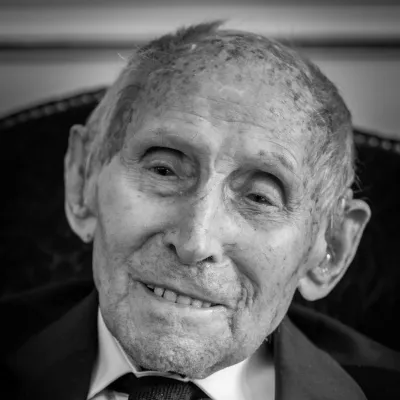
Georges Loinger
Human Design Chart
Biography
He was born in Strasbourg, then part of Imperial Germany, to Solomon Loinger (1883-1941) and Mina Werzberg (1886-1981). His cousin is Marcel Marceau and his niece is Israeli singer Yardena Arazi. In 1925 he entered the Hatikvah Zionist youth movement.
In 1935 he was a physical education teacher. As National Monitor of the Israelite Scouts of France, he created a sports club in Belleville for Jewish children. In the years before the Second World War, he took care of young Jewish refugees from Germany at château de la Guette, a property owned by Baroness Germaine de Rothschild.
He began fighting against Nazi Germany in the beginning of World War II, but he was captured in 1940. However, Loinger escaped from his camp of imprisonment later that year, with his cousin Simon Mangel, the brother of Marcel Marceau. With the support of Dr. Joseph Weill, whom he had met in 1930, one of his friends in Strasbourg and leader of the Children's Relief Work, he went on to rescue hundreds of Jewish children over the next few years before Liberation.
He was part of the Réseau Garel (Garel Network) in Lyon (1942-1944), along with his sister Fanny Loinger (1915-1992), a nurse. But it was only after the war that brother and sister discovered that they were both part of the Resistance as part of Réseau Garel.
After the war, he worked to facilitate the passage of survivors of Nazism to Mandatory Palestine and played a big role in the Exodus. He was then working as director of the French subsidiary of the Israeli shipping company Zim Integrated Shipping Services.
He turned 100 in August 2010. In March 2013, during a trip to Israel at the age of 102, he was received by Shimon Peres, the former president of Israel. He was awarded the medal of honorary citizen of the city of Strasbourg in 2014.
Human Design Analysis: Georges Loinger as Generator 6/2
Generator 6/2 — Design at a Glance
Georges Loinger revealed himself as someone with tremendous inner endurance. His design as a Generator had an abundance of sacral energy, making him seem like a strong workhorse – provided he found tasks that truly resonated with him. This power was not a free pass for arbitrary action. The mechanics of his design required reaction, not initiation. His energy only fully unleashed itself when he responded to a signal from the outside world and reacted with a clear "yes" from within.
This strategy of waiting and reacting was crucial for his well-being. When Georges Loinger followed this inner confirmation, he experienced deep satisfaction and a sense of fulfillment. Conversely, ignoring this signal or forcing himself to work on things that did not resonate quickly led to frustration and energy loss. Two main pitfalls shaped his potential: either he wasted his strength on things without internal approval, which exhausted him, or he was held back from his heart project despite still feeling driven to continue. His path to strength lay in not anticipating but patiently waiting until life posed a question that his gut instinct answered with enthusiasm. Only in this harmony between external impulse and inner confirmation could he sustainably utilize his immense endurance without depleting himself or being exposed to prolonged frustration.
Sacral Authority
Georges Loinger showed himself to be someone who did not make decisions in his Head Center but rather from the body. His design indicated a tendency to trust inner signals that were directly connected to his life energy. As a Generator, his strategy and inner authority were identical: sacral authority. This greatly simplified his decision-making process since he was not torn between different internal voices.
This authority manifested as an immediate physical reaction to external stimuli. Georges Loinger felt a gut feeling or surge of power that could express itself as grunting, humming, or a loud "Mhm." As long as his Emotional Center remained open, this sacral response stayed clear and unclouded by emotional waves. When his Sacral Motor engaged with something, he felt vital and alive. He then had seemingly inexhaustible energy and tackled his work with great enthusiasm.
Georges Loinger was born to walk through life with joy and contentment. He immersed himself completely in his activities without needing strict goal-orientedness. The activity itself was the reward. His design supported him in reliably guiding himself from this physical well-being, allowing him to act spontaneously and authentically rather than thinking or weighing options.
The 6/2 Profile — Role Model / Hermit
Georges Loinger revealed himself in his youth as someone who learned through trial and error. His Profile 6/2 shaped this phase: Before the age of thirty, the energy acted like a three-line configuration, promoting experiments and collecting personal experiences. Mistakes served not as failures but as necessary steps in the process of self-discovery.
With increasing age, this dynamic fundamentally changed. The second line of his profile, connected with Gate 16, brought a selective attitude and craftsmanship. Georges Loinger learned to judge objectively and quickly recognize whether ideas were realizable or not. Without sufficient energy, however, this ability could turn into cynicism; he withdrew when the resonance was lacking.
After the age of thirty, the sixth line fully activated. This marked the transition from external experimenting to deep introspection. Georges Loinger sought distance to view his past experiences from a new perspective. This period of reflection served for healing and the development of wisdom.
In his relationships, Gate 59 came into play, addressing the consequences of unions and long-term commitments. It was not just about temporary connections but about the depth and sustainability of partnerships. Through this combination of selective judgment from Line 2 and integrative wisdom from Line 6, Georges Loinger developed an attitude based on deep self-knowledge. He became a figure whose judgment and experiential values were significant for others, as he had learned to transform the lessons of his own life path into coherent life wisdom.
Split Definition — Defined & Open Centers
George Loinger revealed himself as someone with a consistent, trustworthy mental function. His defined Ajna Center ensured that he always formulated concepts and theories in the same way; his mind was constantly active and served as an external authority for others. This mental clarity flowed directly into his communication: The defined Throat Center allowed him to reliably express what he thought. His energy source lay in the defined Sacral Center. As a Generator, he possessed immense vital energy that could only be released through reaction. He had to wait until life asked him something before hearing his sacral answer – a yes or no – thereby avoiding frustration. His actions were also guided by a defined Spleen Center. His intuition worked in the present moment; he trusted his spontaneous judgments about health and well-being without having to rationalize them. The pressure to move forward came from his defined Root Center, which helped him deal with stress and maintain existential awareness.
In contrast, George Loinger was open in other areas regarding the environment. His open Head Center had no consistent way of inspiring; he tended to be influenced by doubts or questions from others when not listening to his inner authority. His G Center was also open. He did not have a fixed identity and often adapted himself to the people with whom he interacted. His direction in life crystallized only when he was at the right place; wrong environments led him to feel lost. The open Heart Center meant that he was not designed to consistently uphold willpower or promises. He tended to want to prove his worth, which often ended in a cycle of self-doubt if he failed. Finally, his open Solar Plexus absorbed the emotions of his environment. He could feel emotionally out of control because he amplified and personalized foreign feelings instead of letting them go as not belonging to him. These opennesses made him sensitive to the emotional climate and identities of others while his defined centers gave him a stable internal structure of thinking, communication, and energy.
Channels for structuring, experimental depth and natural maturity.
George Loinger showed a fundamental approach of intuitive depth that through repeated experimentation led to technical mastery. His design connected inner intelligence with the drive for perfectionism. The Channel of Wavelength 48-16 linked Gate of Depth (48), which seeks life-critical information, with Gate of Dexterity (16). This allowed him to refine skills step-by-step and communicate them as talents. His development followed a pattern of engagement and repetition, where recognition served as a resource to continue the process.
Parallel to this, George Loinger structured his thinking through spontaneous insights. The Channel of Structuring 43-23 connected Gate of Insight (43) in Ajna Center with Gate of Assimilation (23) in Throat Center. He received innovative perspectives as breakthroughs and expressed them to promote efficiency. His challenge was to let go of control and allow his mind to process knowledge at its own pace rather than planning it ahead. When his timing was right, this unique knowledge was accepted by the collective; otherwise, it led to rejection.
His life path was also marked by a cyclical maturation process. The Channel of Maturation 53-42 linked Gate of Beginnings (53) with Gate of Growth (42). George Loinger went into experiences to fully go through them and then reflect on them. This process served not only personal wisdom but created a collective history for future generations. He learned to act without rigid expectations to avoid frustration and integrate the lessons of each phase.
Additional energetic facets were shown in his genetic strategy for binding (Gate 59) and emotional awareness through mood swings (Gate 55). His detail work (Gate 9) required focus, while reflection (Gate 33) created calm for the abstract process. Care (Gate 27) and contribution to the group (Gate 8) shaped his social impact, supported by skillful power handling (Gate 14). The evolutionary development of meaning (Gate 41) drove him from experience to experience, while here-and-now awareness (Gate 20) and correction of collective processes (Gate 18) sharpened his authenticity. Mutations in the order (Gate 3) and creative restraint (Gate 12) rounded off his complex profile.
Collective Circuitry — Circuit Signature
George Loinger's design laid a tendency towards structured communication and logical analysis, flanked by deep, cyclical processing of past experiences. As a person with Split Definition, he had two separate, parallel existing energetic power fields: a complex network of Throat, Spleen, and Ajna Centers as well as a separate pair of Sacral and Root Centers. These fields were not directly connected to each other but worked as independent systems.
In the Knowledge Circuit, Channel 3-60 (Structuring) linked Ajna with Throat Center. This allowed George Loinger to precisely articulate and express internal thought structures and visions in words. Parallel to this, the Understanding Circuit featured Channel 16-48 (The Wavelength), which connected Throat with Spleen Center. Here it was about the ability to clearly communicate intuitive perceptions and logical insights driven by a focus on essentials and future.
The second independent field formed the Meaning-Making Circuit. Channel 42-53 (Maturation) here linked Sacral with Root Center. This connection generated rhythmic, wave-like energy aimed at learning from past experiences and emotional waves and sharing these insights in the collective. While the first field set on structured expressiveness and rational analysis, the second provided a deep, emotionally grounded anchoring in life experience and learning from the past. Both systems shaped his essence as someone who could both think and speak clearly while understanding the depth of emotional maturation processes.
Left Angle Cross of Spirit 2
Georges Loinger's Human Design profile indicated a tendency towards deep spiritual introspection combined with the ability to make these internal experiences understandable for others. This configuration is known in Human Design as 'The Left Spirit 2 Cross'. It did not describe an external mission in a societal sense, but rather an inner life task: establishing a connection between personal self and greater spiritual truth.
People with this expression were often sensitive observers of their own internal world. They sought the essence behind things, not at the surface level. Their energy was focused on deepening and clarifying spiritual insights. It was a process marked by silent reflection and inner dedication. Georges Loinger lived this dynamic by directing his attention to the invisible – values that lie beyond material measures.
The mechanics of this cross emphasized the importance of authenticity in spiritual expression. It wasn't about dogmatic teaching, but personal experience of the Holy or Transcendent. Georges Loinger used this internal clarity to build a bridge between the individual and the universal. His design promoted a deep understanding of hidden forces that shape life and conveyed it through a calm, contemplative presence. This attitude characterized his way of engaging with the world – less through active action, more through his inner being and the radiance of his spiritual convictions.
Saturn Return · Uranus Opposition · Chiron Return · 2nd Saturn Return — Life Cycles
Georges Loinger's life followed a rhythm structured by recurring planetary cycles. His design indicated that his internal development was oriented towards major astronomical turning points. The first Saturn Return marked for him the transition from youth to full responsibility; here early impulses condensed into a sustainable life structure. It was a phase of consolidation, in which he learned to use his energy sustainably.
Later, the Uranus Opposition impacted his design. This cycle often brought unexpected breaks or sudden liberations. For Georges Loinger, this meant breaking old patterns and exploring new freedoms, even if it initially destabilized him. It was a test of flexibility and trust in his own path.
The Chiron Return around age 50 served as the peak of his inner journey. During this period, he opened up to recognize and live his deepest meaning. If he had followed his strategy earlier, he now experienced a bloom time when his essence fully unfolded. It was not about repairing damage but realizing his potential.
The second Saturn Return closed this arc. In this late phase, Georges Loinger reflected on the entire journey back. He integrated experiences from previous cycles and found final deep stability. His life showed itself as a process of growth through structured phases where he continually rediscovered his inner truth.
Generator · Sacral Authority — Synthesis
Georges Loinger was a Generator whose life was marked by profound sacral energy. This power source fueled natural endurance and the ability to dissolve into activities that truly resonated with him – provided external influences did not prevent it (sacral authority). His profile as an exemplar suggests he initially gathered many experiences, experimented, and learned from mistakes. Later, he withdrew to reflect on life experiences and develop deep wisdom that attracted others. The defined Mental Center enabled consistent, conceptual thinking connected through the Channel of Wave Length (Gate 48/16) with instinctive depth and a desire for perfection.
A central paradox in his design lay in the interplay between this profound inner wisdom and the necessity of experimentation. He lived initially a life full of trial and error before withdrawing to reflect – a phase emphasized by the Left Spirit 2 Cross. This dynamic suggests he had both an urge to explore new paths as well as a longing for internal clarity and sharing his gained insights with others.
3 Defined Channels
Incarnation Cross - Left Angle Cross of Spirit 2
Solar Return
The Solar Return shows the moment when the sun returns to its exact birth position - your personal solar year.
Life Cycles
Discover the life cycles with a detailed triple view (birth chart, cycle chart, composite).
Human Design Profile
- Type
- Generator
- Strategy
- To respond - wait for something to respond to
- Authority
- Sacral Authority
- Profile
- 6/2 - Role Model / Hermit
- Definition
- Split Definition
- Incarnation Cross
- Left Angle Cross of Spirit 2
- Date of Birth
- 29.08.1910 07:00
- Place of Birth
- Strasbourg, France
Frequently Asked Questions
What was Georges Loinger's Human Design type?
What profile did Georges Loinger have in Human Design?
Which authority guided Georges Loinger?
What incarnation cross did Georges Loinger have?
When was Georges Loinger born?
Discover your own Human Design
Are you also a Generator? Find out in a personal reading how to use your sacral energy correctly and discover deep satisfaction.
More Personalities
Back to overviewAaliyah

Alexia

Angèle

Anne-Marie

Arcángel

Arno
