
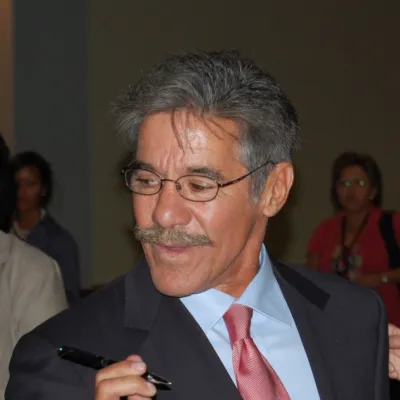
Geraldo Rivera
Human Design Chart
Biography
One of five children born to Cruz Rivera and Lilly Friedman, his heritage is Puerto Rican and his religion, although he doesn't practice, is Jewish. Raised in Brooklyn, NY, his parents were cafeteria workers who moved to Long Island when he was 12. Returning to Brooklyn after high school, he lived with an aunt and took remedial math and English to get into the NY State Merchant Marine Academy which he attended for two years. Feeling there was no excitement there, he dropped out, going to California. Rivera attended the University of Arizona graduating in 1963, later attending Brooklyn Law School at age 23. He was considered the class flirt.
After being an anti-poverty attorney for two years, he decided he was here to be a crusader. The New York City affiliate of ABC, WABC, was looking for a Puerto Rican to send to Columbia School of Journalism for New York's "Eyewitness News" in 1970. In 1971 Rivera's report, "Drug Crisis in East Harlem" won the Columbia-Dupont Award and in 1972 WABC won the George Foster Peabody Award for the report he did, "Willowbrook: The Last Disgrace," an expose of a state home for the retarded. Rivera left WABC in 1974, then worked for the entertainment division of ABC doing some specialty pieces, including 12 on various wars, on "20/20." His eight-year contract ended December 1985 and wasn't renewed.
"Geraldo," his daytime talk show, began in 1987, pioneering tabloid journalism on TV. Featuring offbeat topics and odd individuals, he had more than one scuffle with guests. This show lasted until 8 May 1998, his 2,163 episode, when NBC gave him a nightly legal-oriented news show which proved successful, making him one of their highest paid employees at $6 million per year allowing him to purchase several homes and yachts.
Geraldo Rivera — Manifesting Generator with Profile 2/5
Manifesting Generator 2/5 — Design at a Glance
Geraldo Rivera's design tends towards lightning-fast action, allowing him to skip steps and quickly bring things into his life. As a Manifesting Generator, he has constant sacral energy, giving him a hybrid nature: he has the endurance of a Generator paired with the direct impact of a Manifestor. This configuration allows him to take on multiple projects simultaneously, rather than focusing on just one thing.
However, the mechanics of his type reveal two central challenges. First, he tends to be too quick and skip important steps, forcing him to backtrack and make up for missed steps – a process that often leads to frustration. Second, his speed can lead to reacting to many different impulses at once. When he reacts to life rather than initiating himself, or when his inner authority is not on board, his enthusiasm for creation quickly turns to dissatisfaction.
For deep satisfaction, it is crucial that he waits for impulses and only acts when his sacral center gives a clear “yes”. In this state of “play mode”, his ability to seek variety and work parallel becomes the source of his fulfillment, rather than the reason for frustration. His design challenges him to regularly check whether the projects he starts still have his inner approval.
Sacral Authority
Geraldo Rivera's design tends towards direct, physical decision-making based on immediate inner feedback. As a Generator, his strategy to react is identical to his inner authority, the sacral authority. This configuration simplifies his decision-making process significantly, as he does not need to distinguish between strategic approach and inner guidance.
Sacral authority manifests through a gut feeling or a surge of energy in response to an external stimulus. Geraldo Rivera could pay attention to these physical signals, which could express as grunts, hums, or loud affirmations. When his sacral motor engages with something, he feels vital and alive. He has an inexhaustible supply of energy and tackles his work with great enthusiasm. His design sees him going through life with joy and satisfaction, fully immersed in activities without the need for a background purpose.
Additionally, his activated spleen center acts as a supportive authority. This allows him to react especially quickly and spontaneously. He has immediate access to his physical well-being and instinctive perception. Geraldo Rivera could reliably guide himself with this instinctive intuition, further strengthening his ability to make quick decisions. This combination of sacral energy and spleen-supported intuition shapes his way of acting in life and responding to challenges.
The 2/5 Profile — Hermit / Heretic
Geraldo Rivera's design tends towards a polarized existence: the urge to act as a competent problem solver for others collides with a deep, biological need for isolation. As a person with the Profile 2/5, the “Natural Talent / Hero and Saviour”, a tension between the Hermit Line (2) and the Hero Line (5) is evident. While Line 5 leads others to seek him out for solutions and expect him to be a saviour, Line 2 demands withdrawal to regenerate energy. This pattern describes the life task of setting clear boundaries: deciding when to invest his time and when to withdraw to avoid burning out.
His energetic presence is shaped by specific Gate configurations. Gate 39, Line 2, gives him the talent to provoke. This is not acting out of malice, but a mechanism of self-preservation: by purposefully nudging or creating discomfort, he creates distance and protects his space. At the same time, Gate 21, Line 5, acts as an opposite pole. It demands objectivity and impartiality, especially in crisis situations. Here, it is about acting as a guide without being led by emotions. The challenge lies in connecting this cool, material efficiency with the need for inner clarity. Geraldo Rivera had to learn to strategically use his “alone time” to define for whom he would actually deploy his saving energy without forgetting himself.
Single Definition — Defined & Open Centers
Geraldo Rivera's Human Design suggests a tendency towards clear, strong-willed communication that stems from a deep inner identity and a strong instinct for the moment. His defined Throat Center served as a focal point, translating messages from his defined G Center (personal direction and love) and his defined Heart Center (willpower and ego) into the world. This created a reliable way of expressing himself: he spoke from the "I" of what he wanted and who he was, supported by the spontaneous, intuitive perception of his defined Spleen Center. This configuration allowed him to make decisions in the "now" and articulate them with full conviction, without being swayed by external opinions.
At the same time, he was exposed to specific challenges through his open centers. His open Solar Plexus absorbed and amplified the emotions of his environment, making him vulnerable to personalizing foreign moods or retreating from emotional confrontations to maintain peace. His open Head and Ajna Centers meant he did not have a constant mental pressure but was open to inspiration; however, if he sought answers that did not belong to him, this could lead to confusion. Additionally, his open Root Center took on external stress, causing him to enter phases of high adrenal tension when he succumbed to environmental pressure rather than trusting his inner authority. The wisdom of his design lay in using his stable energy and intuition while perceiving the emotional and mental waves of the environment as information, not as his own truth.
Channels for leadership, innovation, willpower and endurance.
Geraldo Riveras Design points towards a tendency for logical, collective leadership that relies on gaining trust and recognition from the majority. This is evident through the Alpha Animal Channel 7-31, which connects the G Center with the Throat Center. Gate 7 provides the strategic role of the "power behind the throne," while Gate 31 represents the voice of the collective leader. Rivera did not act as a sole ruler but as someone who understood patterns and trends to guide others. His authority depended on being invited by the community to take on this role.
Parallel to this, the Channel of Frequency 48-16 shaped his approach to skills. This channel connects the Spleen Center with the Throat Center, uniting the intuitive depth of Gate 48 with the experimental dexterity of Gate 16. Rivera showed a need to achieve mastery through repeated experimentation and refinement of his talents. His success depended on being recognized and rewarded by others with resources to continue this process of refinement. It was about transforming mere technique into true talent through dedication and practice.
Additionally, the Channel of the Line of Money 21-45, which links the Heart Center with the Throat Center, played a role. Gate 21 brings in the will and control of the Hunter, while Gate 45 represents the authoritative voice of the Collector. Rivera had to master the material plane and take responsibility, often as his "own boss," to maintain independence. This channel underscores the need to balance will and authority so that both personal interests are protected and service to others is provided.
The Channel of Discovery 29-46 connected the Sacral Center with the G Center. Gate 29 offers the persistence of "saying yes," while Gate 46 delivers the determination to be oneself at the right place and time. Rivera had to let go of expectations and immerse himself in experiences to make discoveries that could change collective understanding. His strength lay in the endurance to see the significance of an experience through to the end.
Furthermore, prioritized Gates like Gate 39 (Provocation, Analysis) and Gate 38 (Resistance, Integrity) contributed to his dynamic way of setting boundaries and pushing through challenges.
Collective Circuitry — Circuit Signature
Geraldo Rivera's Human Design shows a tendency towards strategic communication that combines logical structures with emotional depth. As someone with a simple definition, he appeared as an integrated unit where all defined centers flow directly into one another.
The Understanding Circuit shaped him through the connection of Throat, Identity, and Spleen Centers. This allowed him to articulate rational insights and future-oriented strategies clearly, free from emotional distortion. The energy of this circuit promoted the sharing of logical insights to guide society in a better direction.
Parallel to this, the Purpose Circuit, which connects the Identity with the Sacral Center, was also at work. This involved reflecting on the past and finding meaning in past experiences. This cyclical emotional wave served to gain insights from history and share them with the collective to learn from them together.
The Ego Circuit closed the connection between Throat and Heart Centers. This supported cooperation and the joint creation of resources in the social environment. Through this channel, Geraldo Rivera could promote material well-being and mutual support, while the missing direct connection to the Sacral Center in this circuit necessitated periods of rest for resource regeneration.
Overall, Geraldo Rivera appeared as someone who linked logical future visions with emotional past analyses and implemented this through cooperative communication. His energy was geared towards structuring and sharing insights while considering both rational and felt aspects to be effective in the social context.
Right Angle Cross of Tension 2
Geraldo Rivera's design was characterized by an intense, often tension-filled energy aimed at overcoming internal conflicts or external resistance. This configuration, known as the right cross of tension, suggested an approach where the path to success was not seen as linear or effortless, but rather as a process of navigating friction and pressure.
In Human Design mechanics, this pattern represents the necessity of confronting challenges rather than circumventing them. It describes a life dynamic where tension is not seen as a negative symptom but as a driving force for transformation. Geraldo Rivera was someone whose development and effectiveness were closely tied to his ability to endure and channel these tensions into constructive actions. The design implies that true strength and clarity arise through confrontation with resistance.
This mechanism meant that calm or stagnation was often less beneficial than active confrontation with problems. The energy of this cross promoted a stance of endurance and perseverance, even when circumstances seemed difficult. Rivera's approach was marked by the realization that overcoming obstacles was an integral part of personal growth and external impact. It was not about seeking conflict but about utilizing the resulting energy for forward development.
Saturn Return · Uranus Opposition · Chiron Return · 2nd Saturn Return — Life Cycles
Geraldo Rivera's design indicated a tendency towards acute, often confrontational perception, capable of exposing societal blind spots. This structure promoted a direct, unfiltered way of observing that did not seek harmony but the naked truth, even if it was unpleasant. The mechanics of his chart supported an energy that worked through uncovering malpractices, often polarizing as it challenged established narratives.
In 1971, at the age of 28, during his first Saturn return, Rivera's report 'Drug Crisis in East Harlem' won the Columbia-Dupont Award. This moment marked a condensation in his design: years of accumulated observations and the development of his distinct journalistic voice found expression in a concrete, recognized achievement. The Saturn return functioned as a catalyst, translating his inner urgency for truth into an external, measurable impact. It was not a random success but the logical consequence of an energy geared towards revealing hidden truths and drawing attention. This success confirmed the effectiveness of his natural inclination to engage with difficult, taboo subjects rather than avoiding them.
Manifesting Generator · Sacral Authority — Synthesis
A central red thread in this design is the dynamic between initiation and reaction. The combination of a manifesting generator with sacral authority points to a person who possesses abundant potential energy (Sacral Center) but primarily reacts to external stimuli. At the same time, the connection to the Throat Center (Alpha Animal Channel) enables quick action and skipping steps, implying a tendency towards direct influence and leadership. This tension between waiting for an internal impulse and the urge to take action seems to be a constant accompaniment.
The central paradox lies in the connection between inner wisdom and the need for recognition. The profile as a natural talent and hero/savior (Profile 2/5) points to a retreat space for inner orientation, while the 5th line implies an external expectation – the role of problem solver and advisor. This tension between the desire for autonomy and the obligation to help others is reinforced by the definition in the communication and manifestation center (Throat Center), which directs inner states into the world. A documented event marking success in public reporting underscores this tendency towards a public voice and impact.
4 Defined Channels
Incarnation Cross - Right Angle Cross of Tension 2
Solar Return
The Solar Return shows the moment when the sun returns to its exact birth position - your personal solar year.
Life Cycles
Discover the life cycles with a detailed triple view (birth chart, cycle chart, composite).
Human Design Profile
- Strategy
- To respond - wait for something to respond to
- Authority
- Sacral Authority
- Profile
- 2/5 - Hermit / Heretic
- Definition
- Single Definition
- Incarnation Cross
- Right Angle Cross of Tension 2
- Date of Birth
- 04.07.1943 00:01
- Place of Birth
- New York, NY, United States
Frequently Asked Questions
What is Geraldo Rivera's Human Design type?
What Profile does Geraldo Rivera have in Human Design?
What Authority guides Geraldo Rivera?
What incarnation cross is Geraldo Rivera associated with?
When was Geraldo Rivera born?
Discover your own Human Design
Are you also a Manifesting Generator? Find out in a personal reading how to unfold your multi-talents and direct your energy wisely.
More Personalities
Back to overviewAlain-Fournier

Aldair

Alizée

Angeli

Arletty

Artus
