
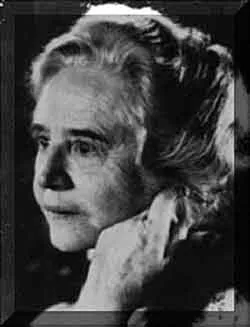
Gertrud von Le Fort
Human Design Chart
Biography
Her best-known work is the conversion novel "The Shroud of Veronica".
She died on 1 November 1971 in Obersdorf, Germany.
The Human Design of Gertrud von Le Fort: Generator 4/6
Generator 4/6 — Design at a Glance
Gertrud von Le Fort's design pointed towards great endurance and inner strength. As a Generator, she had plenty of sacral energy that only released when responding to impulses from her environment. Her strategy was not initiating but waiting for a signal that her inner self answered with a clear 'yes'. Acting on this led to efficient use of her energy and deep satisfaction.
However, this mechanism contained two specific pitfalls. One was the waste of power on tasks without internal resonance, which could lead to long-term exhaustion. The other danger was being held back from advancing her heart project when her energy was still fully present. If Gertrud von Le Fort did not live by this principle of reacting from the gut, but instead tried to initiate or act against her inner resistance, she would more likely encounter frustration and a lack of energy rather than the rewarding fulfillment that her design offered with proper use. Her strength lay in responding to life rather than anticipating it.
Sacral Authority
Gertrud von Le Fort had a simplified decision-making structure: Her strategy as a Generator was also her internal authority. This meant she did not have to think about what was right but could listen to her body. A prerequisite for this was her open Emotional Center, which prevented emotional clarity and thus enabled direct physical responses.
Her sacral authority manifested as an 'inner voice' or surge of energy in response to external stimuli. She learned to pay attention to bodily signals like grunts, hums, or a nodding 'Mhm'. When her sacral motor kicked in, she felt vital and alive. Then, almost inexhaustible energy was available to her, allowing her to work with great enthusiasm without the tasks needing a specific purpose.
Additionally, her activated Spleen Center acted as supportive authority. Likely directly connected to the Sacral Center, she could react particularly quickly and spontaneously. This gave her immediate access to her instinctive perception and physical well-being. She let herself be guided by this reliable inner compass that made decisions in the here and now before other centers came into play.
The 4/6 Profile — Opportunist / Role Model
Gertrud von Le Fort's design pointed towards a tension-filled life path oscillating between a deep need for belonging and the urge toward detached wisdom. As someone with Profile 4/6, she experimented intensively with relationships and friendships during her first thirty years, where Line 6 still felt like Line 3 – marked by trial and error as well as the search for new rewarding experiences.
With Saturn's return, her constellation fundamentally shifted. The inner conflict between Heart (Line 4) and Head (Line 6) became effective: On one hand, she sought connection to community; on the other, the high mountain of reflection over life's meaning. This dynamic shaped her entire later life as a continuous dialogue between emotional engagement and intellectual detachment.
Her fourth line anchored a transpersonal fixation on relationships towards self-interest; her survival depended significantly on social networks. Simultaneously, the design demanded in later years that she meet the high standards of a wise role model. However, this happened with typical Line 4 caution: Her large heart opened selectively to avoid injuries from 'false' people. The sixth line also required constant reflection and waiting for the right timing before starting new cycles or repeating successful processes under Pluto's pressure.
Split Definition — Defined & Open Centers
Gertrud von Le Fort was characterized by a design marked by constant internal structure and clear orientation. Her defined G Center provided her with a firm self-identity as well as a reliable sense of personal direction; she knew who she was and where she belonged, without having to impose this on others. This inner security aligned with her defined Ajna Center, which allowed for continuous, trustworthy mental work. Her mind continuously worked on concepts and theories that she could directly translate into language and action through her also defined Throat Center. What she thought, she spoke out – a direct line from the idea to communication, making her utterances precise and independent.
The energy for this was generated by her defined Sacral Center as a constant motor. As a generator, she possessed vital force that flowed correctly only in reaction to external impulses; initiatives from the mind would have blocked this energy and led to frustration. Her defined Spleen Center provided spontaneous intuition in the present moment, while the defined Root Center supplied the necessary pressure to remain materially and existentially alive and move forward.
At the same time, she was vulnerable to external influences through open centers. Her open Head Center had no source of inspiration; it tended to absorb mental questions and doubts from others or seek inspiring answers externally, leading to confusion if she did not trust her inner authority. The open Heart Center indicated a lack of consistent willpower in an egoistic sense; she was not designed to give and keep promises or prove herself through competition but had to learn that proving her worth was unnecessary. Finally, her open Solar Plexus absorbed the emotions of the environment like a sponge. Without recognizing these foreign feelings as non-self, she would have felt emotionally unstable and avoided confrontation to maintain peace. Her strength lay in using these open fields as mirrors without identifying with them.
Channels for intuitive power, leadership, insight and transformation.
Gertrud von Le Fort was characterized by a complex mix of collective leadership and individual, innovative insight. Her design included the Alpha Animal Channel 7-31, which combined logical, pattern-based leadership. She possessed the ability to gain trust and understand trends to be recognized as a leader – not through absolute authority but through representative influence within existing structures. Parallel to this was the Channel of Structuring 23-43. This channel connected spontaneous mental breakthroughs with a unique expression style. Her insights often felt light-years ahead; she had to learn to communicate this innovative thinking clearly so that it would be accepted by the collective and not seen as outlandish.
Another influence came from the Channel of Transformation 32-54. Here, the drive for constant effort to rise up propelled her development forward. She sought ways to move beyond her social class and use talents to secure prosperity and continuity for her tribe. This urge was driven by an intuitive fear that her group might not survive, motivating her to work harder than others to gain support and recognition.
Additionally, she possessed the Channel of Power 34-57. This connection between sacral life force and spleen intuition created a strong survival instinct. She reacted spontaneously to her environment, attentive to dangers and vibrations, which helped her assert herself as an individualized being. Her energy was focused on remaining vital and independent by relying on physical perception rather than mental considerations.
Individual Gates rounded out this picture: Gate 51 brought willpower and adaptability in shock situations, while Gate 53 fostered a pioneer spirit for new cycles. In the personality realm, Gates 59 (genetic binding strategy) and 46 (devotion to process) were active. The design also included logical elements like Gates 15 (collective rhythm), 62 (detail work and pattern recognition), as well as Gate 4 (formulation of future security). Mental processes were supported by Gates 56 (pictorial storytelling) and 47 (meaning-making from the past), while Gate 27 stood for nurturing warmth in the tribe.
Individual Circuitry — Circuit Signature
Gertrud von Le Fort's design inclined towards structured, emotionally colored communication. The Knowledge Circuit connected her Ajna and Throat Centers through the Channel of Structuring (Gates 43–23). This allowed for translating inner thoughts into clear, organized expressions, with emotional waves from the Solar Plexus shaping the expression. Parallel to this was a capability for strategic dissemination of rational insights. The Understanding Circuit linked the Throat Center with the Identity Center (Channel 31–7), focusing on sharing logical insights free from conditioning to guide society towards a better future.
As shared definitions, these individual powers existed alongside another group: Ego and Integration Circuits formed separate networks. The Ego Circuit connected Spleen and Root Centers (Channel 32–54), indicating cooperative resource creation that needed rest periods as there was no direct connection to the Sacral Center. Simultaneously, the Integration Circuit secured survival through connecting Sacral and Spleen Centers (Channel 34–57). This allowed drawing strength from reacting to life and applying it intuitively in the present moment. These two groups were not directly energetically connected; they existed as separate, independent systems within her character.
Right Angle Cross of Penetration 3
Gertrud von Le Fort's design indicated a tendency towards deep, often painful inner work. She was someone who reached clear understanding through personal crises and suffering paths. This attitude stemmed from the right intersection 3 in her chart.
This intersection connects the impulse for self-discovery with the necessity to bring these insights into the world. It describes a process where internal confusion or darkness is penetrated to create light and clarity. Gertrud von Le Fort did not live this path as a passive observer but as an active shaper of her experiential world. Her energy was directed towards integrating seemingly irreconcilable aspects within herself.
The mechanics of this intersection require authenticity and the willingness to acknowledge one's own shadows. For Gertrud von Le Fort, this meant that her greatest strength came from her ability to translate personal transformations into understandable messages. She used her internal conflicts as raw material for creative or spiritual expressions. The focus was always on the connection between the individual and the universal. Through this intersection, she reached a level of clarity that allowed her to guide others in their own search processes. Her design thus promoted a kind of leadership that did not rely on authority but rather on lived experience and deep empathy.
Saturn Return · Uranus Opposition · Chiron Return · 2nd Saturn Return — Life Cycles
Gertrud von Le Fort's design indicated a tendency towards deep inner work that reached visible fruition in her middle age. This process became evident in 1928 when she published "The Veil of Veronica" at the age of fifty. For her Human Design, this was not a random time but rather her Chiron Return (around ages 49–51), a fulfillment cycle. During this phase, the incarnation cross unfolds increasingly in life if one follows their strategy and authority; meaning and purpose become experiential. This was not about healing old wounds but about completing her life's task. The publication marked this peak: what had matured internally over years now entered the world. Gertrud von Le Fort’s chart suggested that her creative power only achieved its full effect through this slow, inner condensation. Her Chiron Return served as a catalyst for the external realization of her inner potential. The connection between this astrologically and Human Design-specific time period and the publication underscores how her design foresaw a late but intense unfolding of her core qualities.
Generator · Sacral Authority — Synthesis
Gertrud von Le Fort lived a lifestyle deeply influenced by her sacral authority and Generator type. Her energy flowed best when she immersed herself completely in tasks that confirmed her gut feeling – a state of intense vitality and endurance (sacral center). This ability to concentrate and the need to bind herself to tasks was reinforced by the defined mental center, which provided a consistent way of thinking. The profile as Networker/Role Model suggests that throughout her life she repeatedly faced the challenge of mediating between the desire for community and the need for inner reflection (Line 4/6).
A central paradox in her design lay in the combination of the Knowledge Circuit and the Alpha Animal Channel. While she tended to forge her own innovative paths and generate new knowledge, she simultaneously possessed the ability for logical leadership and could recognize patterns (Gate 31/7). This likely led to a tension between the desire for individual development and the responsibility to share her knowledge with others and take on a role in collective structures. A documented event illustrates this: publishing a work at age 52 (Chiron Return) points to a transformative period of creative energy.
4 Defined Channels
Incarnation Cross - Right Angle Cross of Penetration 3
Solar Return
The Solar Return shows the moment when the sun returns to its exact birth position - your personal solar year.
Life Cycles
Discover the life cycles with a detailed triple view (birth chart, cycle chart, composite).
Human Design Profile
- Type
- Generator
- Strategy
- To respond - wait for something to respond to
- Authority
- Sacral Authority
- Profile
- 4/6 - Opportunist / Role Model
- Definition
- Split Definition
- Incarnation Cross
- Right Angle Cross of Penetration 3
- Date of Birth
- 11.10.1876 12:30
- Place of Birth
- Minden, Germany
Frequently Asked Questions
What is Gertrud von Le Fort's Human Design type?
What Profile did Gertrud von Le Fort have?
Which authority guided Gertrud von Le Fort?
What incarnation cross did Gertrud von Le Fort have?
When was Gertrud von Le Fort born?
Discover your own Human Design
Are you also a Generator? Find out in a personal reading how to use your sacral energy correctly and discover deep satisfaction.
More Personalities
Back to overviewAaliyah

Alain-Fournier

Alexia

Angèle

Angeli
Anne-Marie
