
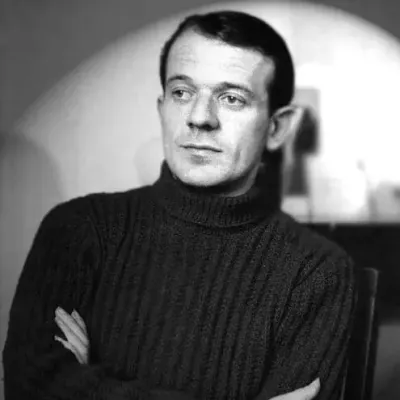
Gilles Deleuze
Human Design Chart
Biography
An important part of Deleuze's oeuvre is devoted to the reading of other philosophers: the Stoics, Leibniz, Hume, Kant, Nietzsche, Spinoza, and Bergson. A. W. Moore, citing Bernard Williams's criteria for a great thinker, ranks Deleuze among the "greatest philosophers". Although he once characterized himself as a "pure metaphysician", his work has influenced a variety of disciplines across the humanities, including philosophy, art, and literary theory, as well as movements such as post-structuralism and postmodernism.
The Human Design of Gilles Deleuze: Generator 2/4
Generator 2/4 — Design at a Glance
Gilles Deleuze revealed himself as someone who unleashed his strength not through self-willed pushing forward, but through quick reactions to external signals. As a Generator, he possessed an enormous reservoir of sacral energy that enabled him to work with almost animal-like endurance – comparable to a workhorse that carries on as long as it receives the right impulse. This energy, however, was not released through initiatives but exclusively through reactions. The strategy was to wait for a signal from the environment and only then act when his inner center clearly signaled a “yes”.
This mechanism protected him from the first major danger of his design: the waste of energy on tasks that did not resonate internally. Such initiatives without reactions led to frustration and a noticeable lack of energy in him. Conversely, it was harmful to prevent him from working on his heart projects when his inner drive was still fully running. Living in harmony with this reactive strategy rewarded him with a deep sense of fulfillment. Acting against the design and trying to initiate things instead of reacting led to persistent frustration. His effectiveness thus depended on responding from the gut as soon as the right impulse came, thereby targeting his immense endurance.
Emotional Authority
Gilles Deleuze revealed himself as someone who did not make decisions immediately but gave himself time for the emotional wave to subside. His inner authority was the Emotional Authority, carried by the defined Solar Plexus Center. In Human Design mechanics, this center is considered primary: once it is defined, it takes the lead in decision-making, regardless of other defined centers in the chart.
This design shaped a specific decision-making strategy. Deleuze was subject to an emotional dynamics that showed in constant ups and downs. The world appeared colored by the current mood; enthusiasm could quickly turn into skepticism. An initial emotional impression, however, was not the final truth but only a snapshot. Spontaneous reactions to these initial feelings often proved misleading.
The mechanics required patience. Deleuze used time to let a decision mature. By repeatedly sleeping on a question, the intense feelings gained distance. Over time, the emotional wave subsided, and clarity set in. This process of emotional condensation was essential to reach the deeper, more comprehensive insight that lay beneath the surface of the first reaction. Only when the initial intensity subsided could he act with calmness and clarity, rather than reacting to fleeting moods.
The 2/4 Profile — Hermit / Opportunist
Gilles Deleuze revealed himself through Profile 2/4 as someone who oscillated between a deep need for withdrawal and the desire to connect with a close group. His design laid a tendency to move in a secure environment to communicate clearly when he sought company and when he wanted to be left alone. This tension between Line 2, the Hermit, and Line 4, the Community, shaped his interactions. During his alone time, he immersed himself in internal processes to gain clarity. Only after this need was satisfied did he emerge from his “cave” to spend time with his favorite people.
Line 2 radiated a certain selectivity and adaptability to constraints. Deleuze was not always aware of how this emanation affected others, which could sometimes be uncomfortable. At the same time, Line 4 showed a corruptibility, as it was based on weak social laws and brought enriching values to the outside. Through this configuration, he could reflect and evaluate the knowledge of his network in isolation, developing brilliant ideas from it. The elevation of Line 2 allowed for mutations, while Line 4 showed how he succeeded despite possible value gaps by acting selfishly or offensively. This created a dynamic balance between inner processing and outer networking.
Single Definition — Defined & Open Centers
Gilles Deleuze revealed himself as someone whose life was driven by a deep, vital energy source that, however, only became effective through reactions to external impulses. His defined Sacral Center generated a constant power that he had to wait for to use correctly, rather than initiate it himself. This physical endurance was linked to his defined Solar Plexus Center, which gave him emotional authority. Deleuze learned to wait for the waves of his feelings before making decisions; his inner truth only revealed itself over time, not in impulsive moments. The defined Root Center provided the necessary pressure to maintain this process and nourish existential awareness.
At the same time, Deleuze was marked by several open centers, making him susceptible to certain conditioning. His open Head Center lacked consistent inspiration, tending to draw him into mental confusion or the search for answers that did not come from him. His open Ajna Center allowed for a flexible mind for concepts but without the danger of holding opinions as his own truths. His open G Center meant he did not have a fixed identity but defined himself through relationships and places, making him susceptible to borrowed identities. His open Heart Center lacked consistent willpower, so he might have tried to prove his worth through promises, often leading to frustration. Finally, his open Spleen Center was vulnerable to fears and spontaneous decisions not based on his inner authority. Deleuze's design challenged him to navigate these open areas through patience and trust in his defined centers, rather than being led by external expectations or internal doubts.
Channels for evolutionary change and emotional waves.
Gilles Deleuze worked deeply underground, where thoughts slowly condensed into new forms before surfacing. His design bore the burden of evolution: The Mutation Channel 60-3 connected the Root Center with the Sacral Center. This was not a steady flow but a pulsing rhythm of tension and release. Gate 60, the Gate of Limitation, required the acceptance of boundaries, while Gate 3, the Gate of Order, tried to form new structures from chaos. This mechanism generated a specific melancholy in the phases of silence when the inner pulse ceased and the pressure in the Root Center weighed down. Deleuze learned not to rationalize this waiting period as emptiness but to use it as a necessary space for mutation, where the new developed in the hidden.
Parallel to this, the Emotional Release Channel 39-55, connecting the Root Center with the Solar Plexus Center, created an emotional wave through Gate 39 of Provocation and Gate 55 of the Mind, swinging between ecstatic joy and melancholic uncertainty. This configuration allowed him to sense and provoke the moods and minds of others to test authenticity. He was not a victim of these moods but used them to find the correct resonance. If he was not in the mood, he withdrew to be with his inner muse rather than forcing himself to do something that did not fit.
Additionally, Gates like 56 (Abstraction and Storytelling) and 50 (Protective Reflex and Values) shaped his way of translating mental processes into visual representations while preserving traditional structures. Gate 58 in the Root Center drove him towards the perfection of patterns, while Gate 29 in the Sacral Center fostered the persistence needed to master challenges. Gate 22 allowed him a calm openness that enabled him to listen without intruding. Overall, Deleuze lived in the tension between the pressure for change and the necessity to wait for the right moments to make his unique insights effective.
Individual Circuitry — Circuit Signature
Gilles Deleuze revealed himself through a design based on the search for the unique path. His Knowledge Circuit connected his Sacral, Root, and Solar Plexus Centers into a single, continuous energetic flow. This configuration pushed him to acquire new knowledge and bring it into the world, with his own unique identity at the center. The Mutation Channel (Gates 3-60) supported this stance through deviations from the known, while the Emotional Release Channel (Gates 55-39) ensured that insights were transported through emotional waves from the Solar Plexus Center. Since the Throat Center was not part of the group of connected centers in this circuit, the expression did not occur directly through this channel in the context of this specific connection, but the energy remained in the realm of motivation, stress management, and emotional processing. The pulsing, acoustic quality of this field energy shaped his way of initiating change. It was a simple definition, meaning these energies worked as a unified force without being interrupted by undefined centers. Gilles Deleuze used this structure to transform creative flashes and inspirations into a transformative power guided by his inner compass in the Sacral Center.
Right Angle Cross of Laws 4
Gilles Deleuze was marked by the right cross of laws 4, a configuration that established a profound connection with the search for truth and the ability to communicate it. This design element linked the intuition of the mind with the power of manifestation, creating a unique dynamic: the ability to translate abstract concepts into tangible, transformative actions or expressions.
In Human Design, the right cross of laws 4 describes the connection between the center of the mind and the center of manifestation through specific channels. It is not just about knowledge but about applying insights in the material world. Gilles Deleuze used this structure to formulate complex ideas in a way that not only intellectually understood but also practically effective. His way of thinking and acting was characterized by a clear line between inner inspiration and outer implementation.
This mechanism fostered an attitude that was both analytical and creative. Gilles Deleuze avoided getting lost in purely theoretical spheres; instead, he aimed to bring his insights into forms that could reach and move other people. The right cross of laws 4 supported the belief that true insight must always have a component of action-orientedness. Thus, his work became a tool that not only described how the world is but how it can be changed. This integration of mind and deed shaped his entire approach and distinguished him from purely academic thinkers.
Saturn Return · Uranus Opposition · Chiron Return · 2nd Saturn Return — Life Cycles
Gilles Deleuze showed himself to be someone whose intellectual peak phases precisely corresponded with the major astrological cycles of his design. His Human Design chart indicated a tendency towards profound, structural publications that did not arise as spontaneous impulses but as the result of long maturation processes.
This mechanism became visible in 1968, at the age of 43, when he published “Difference and Repetition.” This moment fell into the Uranus opposition, a phase in which internal tensions often discharge in radical, new forms of expression. The publication marked the point at which years of theoretical groundwork could unfold its full, disruptive impact.
Two years later, in 1972, the Chiron return occurred. In Human Design mechanics, this cycle does not signal healing but the fulfillment phase of the incarnation purpose. That Deleuze released “Anti-Oedipus” at this time demonstrates how his specific life purpose – if he followed his strategy – manifested in a concrete, socially relevant form. It was the moment when his design revealed its core purpose.
The second Saturn return in 1983, with the publication of “The Movement-Image. Cinema I,” rounded out this development. Saturn stands for structure and condensation. Here, it showed how the earlier explosive phases were transformed into a stable, sustainable form. Deleuze’s career thus followed not chance but the rhythmic logic of his cyclical energy: from disruptive opening through purposeful unfolding to structural anchoring.
Generator · Emotional Authority — Synthesis
Gilles Deleuze lived as a Generator with emotional authority a process of continuous energy generation and direction. His Sacral Center (defined) provided a constant vitality, which, however, was run through by the necessity to constantly realign. The connection of line 2 and 4 in the profile points to a play between withdrawing into the inner world and the need to exchange with a selected community – a rhythm that allowed him to gain clarity in isolation to then share it through creative expression. The channel of Mutation (3-60) reinforced this tendency by constantly pushing him to new paths and deviations from convention, coupled with a melancholic basic mood.
Deleuze’s design showed a tension between the need for inner peace and the pulsating energy he needed for his work. Emotional authority required a maturing of ideas, while the knowledge circuit simultaneously drove him to constant innovation and the expression of his individuality. The documented events – publications of important works in cycles of Uranus, Chiron, and Saturn – underscore this contrast: phases of intense creative work arising from deep inner processes and the desire for transformation, followed by a need for reflection and reorientation.
2 Defined Channels
Incarnation Cross - Right Angle Cross of Laws 4
Solar Return
The Solar Return shows the moment when the sun returns to its exact birth position - your personal solar year.
Life Cycles
Discover the life cycles with a detailed triple view (birth chart, cycle chart, composite).
Human Design Profile
- Type
- Generator
- Strategy
- To respond - wait for something to respond to
- Authority
- Emotional Authority
- Profile
- 2/4 - Hermit / Opportunist
- Definition
- Single Definition
- Incarnation Cross
- Right Angle Cross of Laws 4
- Date of Birth
- 18.01.1925 02:45
- Place of Birth
- Paris, France
Frequently Asked Questions
What was Gilles Deleuze's Human Design type?
What Profile did Gilles Deleuze have in Human Design?
Which Authority guided Gilles Deleuze?
What incarnation cross did Gilles Deleuze have?
When was Gilles Deleuze born?
Discover your own Human Design
Are you also a Generator? Find out in a personal reading how to use your sacral energy correctly and discover deep satisfaction.
More Personalities
Back to overviewAaliyah

Alexia

Angèle

Anne-Marie

Arcángel

Arno
