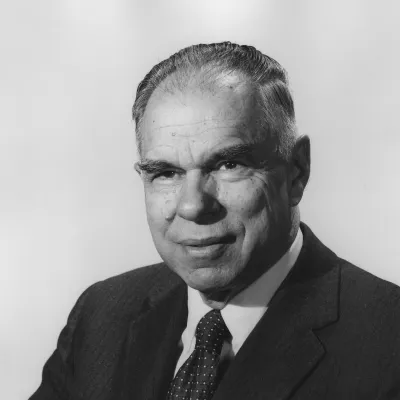
Glenn Seaborg
Human Design Chart
Biography
Born in Ishpeming, Michigan, Seaborg moved with his family to southern California in 1922 and settled in what is now part of South Gate. His childhood and adolescence were normal. He attended local public schools, played football, and delivered newspapers, and showed no real interest in science until an enthusiastic high school teacher inspired an interest in physics and chemistry. He graduated valedictorian from his high school in 1929, then worked his way through UCLA maintaining a high enough average to be elected to Phi Beta Kappa in his junior year. His teachers encouraged him to pursue a career in nuclear chemistry, and after receiving his B.A. degree in 1934, he transferred to Berkeley for graduate study where he received his Ph.D. in chemistry in 1937. He began a life-long association with Lawrence Berkeley National Laboratory in 1934 as a graduate student, going to work at the University of California (UC) Radiation Laboratory and joined the UC Berkeley faculty in 1939.
He got into nuclear chemistry, he claimed, "by accident" when asked to isolate some radioisotopes by physicist Jack Livingood. It took five years, but Seaborg and Livingood discovered or characterized iodine-131, iron-59 and cobalt-60, all of which had medical applications. Ironically, iodine-131, which was widely used for diagnosing and treating thyroid disease and other disorders, extended the life of Seaborg's mother.
Human Design Analysis: Glenn Seaborg as Generator 3/5
Generator 3/5 — Design at a Glance
Glenn Seaborg's design revealed a tendency towards great endurance and inner strength. As a Generator, he had plenty of sacral energy that made him extremely strong like a workhorse – provided this power was used for tasks he enjoyed. His character was marked by the need to react to signals from his environment rather than initiate independently. This strategy of 'reacting' was crucial: Only when his sacral center gave a clear 'yes', could he effectively use his energy and achieve things in life.
However, this mechanism harbored two specific pitfalls. If Glenn Seaborg continuously engaged in activities that did not bring him joy, he risked an energetic burnout due to wasted power. Conversely, he suffered from frustration and lack of energy when prevented from working on his heart project, despite his inner self still brimming with the urge to continue. Living in harmony with this design – by patiently waiting for impulses and then acting upon them – rewarded him with a deep sense of satisfaction. If he initiated things constantly without waiting for the internal signal, however, he faced persistent frustration. His life energy was thus not an inexhaustible reservoir for any project but a specific power that achieved its full effectiveness through correct responses to external stimuli.
Sacral Authority
Glenn Seaborg's decision-making process was characterized by direct physical resonance. As a Generator, he possessed sacral authority, meaning his strategy and inner guidance were identical: He responded to external stimuli with an immediate internal answer. This mechanism greatly simplified his actions as he did not need to think but only listen.
His open emotional center was the crucial prerequisite; it prevented impulsive action and demanded clear differentiation between short-term excitement and sustained energy. Seaborg showed himself in moments when his sacral motor kicked in – recognizable by vitality, enthusiasm or subtle physical sounds like a grunt. Then he felt alive and acted with inexhaustible strength, entirely without purposefulness but out of sheer joy in the act.
Additionally, his activated spleen center served as a supportive instance. Through connection to the sacral center, Seaborg could react especially quickly and spontaneously. He had an immediate access to his instinctive perception and physical well-being, which he reliably trusted. This configuration allowed him to make intuitive and swift decisions guided by a deep inner compass leading him through life.
The 3/5 Profile — Martyr / Heretic
Glenn Seaborg's design was characterized by a fundamental approach based on direct experimentation: initially believing nothing and having to experience everything himself. As someone with Profile 3/5, he learned from his experiments and the associated failures. This line of an adventurer drove him to experience extremes to gain knowledge.
This self-acquired knowledge later served him in solving others' problems. The Hero Line 5 endowed him with the ability to offer practical solutions and attract those who wanted to learn from his experiences. His attractiveness to his environment directly resulted from this rich treasure trove of practical life experiences he presented.
However, this role came with risks. If he experimented and failed before others, it could be painful. Additionally, his design showed a tendency towards mutation and survival through biological partner selection. He understood the destruction of old limitations as a prerequisite for new beginnings. His leadership lay in waiting for the right moment to avoid confusion and establish limits that created space for evolution. Thus, he acted as someone who became a reference figure through his own failure and learning.
Split Definition — Defined & Open Centers
Glenn Seaborg was characterized by a consistent, trustworthy mental function and an enormous source of vital energy. His defined Ajna Center ensured that he created concepts in the same way consistently; his mind was constantly active and served as an external authority for others. This mental stability combined with his defined Sacral Center, which generated constant energy. As a Generator, he had a reliable power source but it could only be correctly applied through reactions to questions or offers, not by initiatives from the mind.
His defined Throat Center allowed him to express his thoughts and concepts reliably. Since Ajna and Throat were connected, he spoke out what his mind conceptualized. Additionally, his defined Root Center provided a set pressure to move forward in the world, often in a logical or focused way, to maintain the life impulse.
At the same time, Seaborg was vulnerable through several open centers to conditioning. His open Head Center had no consistent way of processing mental information; he tended to be distracted by doubts and confusion that actually belonged to others, or sought inspiration to relieve mental pressure. His open G Center meant that he did not have a fixed identity and blended with his environment; he was dependent on the right environment to find direction rather than determining it himself.
The open Heart Center led him to not be designed to be willful or keep promises he could not fulfill. He tended to want to prove his worth, which ended in a cycle of self-disapproval if he failed. His open Solar Plexus absorbed emotions from the environment; he risked personalizing foreign feelings and feeling emotionally out of control. Finally, his open Spleen Center was marked by a fundamental fear of not being equipped to survive, making him vulnerable to unhealthy dependencies when clinging to people with defined Spleens for security.
Channels for change, focus and logical order.
Glenn Seaborg's design set a tendency towards deep transformation paired with the ability for precise logical structuring. This dynamic was primarily shaped by two format channels connecting the Root Center with the Sacral Center and thus determining his entire energy frequency.
The Channel of Mutation 60-3 brought potential for evolutionary change to the fore. It linked Gate of Limitation (60) with Gate of Order (3). This connection required accepting limits to move beyond the confusion of a new beginning and realize new possibilities. The energy of this channel was pulsating and often accompanied by melancholy; it did not work continuously but in sudden impulses. Glenn Seaborg had to remain patient until this mutation showed through him, rather than fighting against his inner moods.
Simultaneously, the Channel of Concentration 52-9 worked, connecting Gate of Non-action (52) with Gate of Focusing (9). This channel created potential for concentrated attention and logical refinement. While Gate 60 brought a drive towards change, Gate 9 helped to maintain focus on details supported by the passive calmness of Gate 52. This allowed Glenn Seaborg to examine patterns precisely and correct them step-by-step. The combination of mutative impulse and logical concentration shaped his way of dealing with complex systems: impulsive at origin but strictly structured in execution.
Additionally, the Channel of Acceptance 17-62 contributed to processing. It connected Gate of Opinions (17) in Ajna Center with Gate of Details (62) in Throat Center. This promoted the ability to mentally organize visual patterns and translate them into precise language. Glenn Seaborg could logically categorize information and communicate it in detail, enabling him to explain complex connections clearly. His energy was directed towards putting what he saw into words to enable understanding, always mindful of his audience's openness.
Collective Circuitry — Circuit Signature
Glenn Seaborg's design revealed two separate, parallel operating power fields. As a Split Definition, he did not have an uninterrupted energetic connection between these areas; they functioned as independent units.
One field connected the Sacral with the Root Center through the Knowledge Circuit. Here, Channel 3-60, the energy of Mutation, was active. This promoted a tendency to deviate from the known and created space for new knowledge. The pulsating format energy in this area supported the expression of unique individuality through emotional waves.
The second field connected Ajna with Throat Center as well as Sacral and Root Center again, this time through the Understanding Circuit. Here, Channel 17-62 (Acceptance) and Channel 9-52 (Concentration) were active. This configuration directed energies towards logic, structure, and focus. It was about sharing rational insights free from emotional coloring to lead society into a better future. The visual, focused energy of this part contrasted with the pulsating nature of the other field.
Thus, his design showed a split between seeking hidden, mutating truth and striving for clear, logical structuring. These two aspects were not directly intertwined in Glenn Seaborg but existed as separate, parallel potentials. He had to learn to integrate these different energies since his chart did not offer an automatic bridge between the emotional creativity of the Knowledge Circuit and the cool ratio of the Understanding Circuit.
Right Angle Cross of Laws 1
Glenn Seaborg's Human Design revealed a specific and profound inner structure characterized by the presence of the right cross of Laws 1. This configuration did not describe an external method of action or social role but rather a fundamental internal foundation: an unwavering belief in the existence of a higher order and divine lawfulness in the universe. For him, this truth was not merely a philosophical idea but a lived certainty that shaped his entire perception of reality.
In Human Design, the right cross of Laws 1 represents the deepest level of spiritual faith. It is an absolute assurance that everything in life is part of a greater plan and that there exists a divine intelligence guiding events. This belief is not learned or uncertain; it is anchored as a firm pillar within the energy chart. Glenn Seaborg lived with this inner confirmation, which gave him a unique internal stability independent of external circumstances. He did not need external proof for this order because it was part of his own nature. This configuration created a space of trust in life itself, a trust that did not require logical justification but simply existed as a fact of his being. It formed the basis upon which he understood his experiences – always within the context of a larger, meaningful structure.
Saturn Return · Uranus Opposition · Chiron Return · 2nd Saturn Return — Life Cycles
Glenn Seaborg's Human Design was marked by a clear structuring of his life phases where external recognition and inner development were intricately intertwined. His first Saturn Return in 1939 at age 27 marked the assumption of a professorship at UC Berkeley. This cycle condensed years of groundwork into a solid professional foundation that institutionalized and stabilized his expertise.
The Uranus Opposition acted as a catalyst for sudden, profound changes. In 1951, at age 39, Seaborg received the Nobel Prize in Chemistry. This was not a gradual ascent but a momentary breakthrough that elevated his work to a new level and made him internationally visible. The mechanics of this cycle brought innovations to light that had previously been hidden.
His second Saturn Return confirmed his status as a University Professor in 1971 at age 59. Here, the maturation of earlier achievements was evident; the foundation from the first return and the breakthrough of the Uranus cycle culminated in an established, respected position. This sequence illustrated how Seaborg's design combined long-term stability with punctual, groundbreaking moments, where each cycle reinforced previous steps and elevated them into a higher structure.
Generator · Sacral Authority — Synthesis
Glenn Seaborg was a Generator whose life was marked by deep, sacral energy. This driving force, coupled with the Profile of the Explorer and Hero (3/5), continuously led him to try new things and gain knowledge through experience – which he then shared. The defined Ajna Center enabled consistent conceptual thinking always oriented towards seeking concepts and their implementation. The interplay between sacral authority and the Knowledge Circuit suggests that he carved out a path through action and experimentation, leading him repeatedly to new insights, which he then transformed and communicated.
A central paradox in his design lay in the tension between limitation and mutation (Channel 3-60). On one hand, as a Generator, he explored new possibilities by accepting boundaries; on the other hand, his drive for change and innovation propelled him forward. This dynamic was evident in documented events such as assuming a professorship or receiving an award – moments where he both accepted established structures while also forging new paths through his work. The melancholy associated with this channel points to a deep engagement with the consequences of change.
3 Defined Channels
Incarnation Cross - Right Angle Cross of Laws 1
Solar Return
The Solar Return shows the moment when the sun returns to its exact birth position - your personal solar year.
Life Cycles
Discover the life cycles with a detailed triple view (birth chart, cycle chart, composite).
Human Design Profile
- Type
- Generator
- Strategy
- To respond - wait for something to respond to
- Authority
- Sacral Authority
- Profile
- 3/5 - Martyr / Heretic
- Definition
- Split Definition
- Incarnation Cross
- Right Angle Cross of Laws 1
- Date of Birth
- 19.04.1912 04:30
- Place of Birth
- Ishpeming, MI, United States
Frequently Asked Questions
What was Glenn Seaborg's Human Design type?
What Profiles did Glenn Seaborg have?
What Authority did Glenn Seaborg have?
What incarnation cross did Glenn Seaborg have?
When was Glenn Seaborg born?
Discover your own Human Design
Are you also a Generator? Find out in a personal reading how to use your sacral energy correctly and discover deep satisfaction.
More Personalities
Back to overviewAaliyah

Alexia

Angèle

Anne-Marie

Arcángel

Arno