
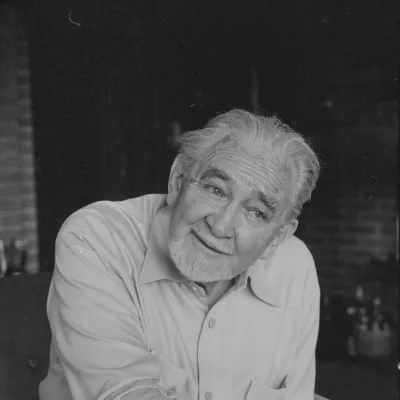
Gustav Knuth
Human Design Chart
Biography
He died 1 February 1987, Zollikon, Switzerland.
Human Design Analysis: Gustav Knuth as Manifesting Generator 6/2
Manifesting Generator 6/2 — Design at a Glance
Gustav Knuth's design featured a tendency towards hybrid energy: He had the constant power of a Generator but also the ability to skip steps and quickly draw results into his life. As an Manifesting Generator, he primarily responded to inner impulses from the sacral center; only when this center gave a clear “yes” did he effectively use his energy. This strategy protected him from the frustration of not being himself, which arose when he acted too hastily or skipped important processes that needed to be addressed later.
His nature inclined towards pursuing multiple projects simultaneously rather than focusing on one task alone. This was not a lack of endurance but an expression of his specific creative power: Gustav Knuth drew deep satisfaction from variety and a playful approach to work. As long as his inner authority and the sacral center supported the current focus, he could use this multitasking ability without becoming overwhelmed. Constantly checking whether a started undertaking still brought joy was essential for him to maintain balance between his great speed and the need to respond to life impulses. Thus, he transformed potential friction losses from acting too quickly into productive dynamics by opening up to his design’s play mode.
Emotional Authority
Gustav Knuth's inner decision-making structure was characterized by the defined Emotional Center, serving as his emotional authority. This configuration fundamentally determined how he judged situations: He was subject to a constant emotional wave that showed in an ongoing up and down of his feelings. The world appeared colored through his current mood; enthusiasm could shift into deep skepticism within moments. His immediate feeling was often only a provisional snapshot, not necessarily the final truth. Quick, spontaneous decisions from this emotional excitement frequently proved problematic or misleading.
The mechanics of his authority required patience and time. The longer he let a decision mature, the deeper and more comprehensive he could perceive the situation. This meant practically that he had to rethink important steps multiple times and sleep on them to gain clarity. Only when intense feelings subsided and emotional distance emerged did calmness set in and the real truth became visible. This process was essential for all long-term decisions that significantly influenced his life course. Gustav Knuth thus showed himself as someone who, through hesitation and conscious delay of judgments, reached a deeper, stable insight rather than trusting the first impulse.
The 6/2 Profile — Role Model / Hermit
Gustav Knuth's design featured a two-phase development: initially as an experimental Seeker, later as a reflective Mentor. In his younger years, before Saturn’s return, line 6 appeared like line 3. Gustav Knuth lived in this phase of trial and error. He gathered numerous personal experiences, withdrew after failures to learn, and started anew. This process served the acquisition of practical wisdom through direct confrontation with life.
Around age 30, the full dynamics of line 6 were activated. Gustav Knuth now showed a need for deep withdrawal, metaphorically comparable to a stay in a cave on a mountain. From this distance, he looked back at his earlier experiments. This phase was crucial for healing and intensive self-knowledge. Only after completing this inner work did Gustav Knuth reappear in public. He then appeared as a wise person whose life experience had matured into stable wisdom. Others sought him out to learn from this depth and take on the ability of introspection.
His natural gift lay in problem-solving and altruistic mutation, as described by Gate 39.6. This ability should enable others the right spirit but was often only recognized late because its effectiveness required time. At the same time, Gustav Knuth possessed the property of withdrawal (Gate 51) to protect his ego and gather willpower. He responded only to correct calls, which helped him use his energy purposefully and not be drained by false expectations.
Split Definition — Defined & Open Centers
Gustav Knuth's design inclined towards a tendency of consequent, self-determined action capability. Six defined centers – Ajna, Throat, G Center, Heart, Sacral, and Solar Plexus – created a system full of internal resources. He had consistent mental structures (Ajna) that he could directly translate into words and actions (Throat). His identity and direction were clearly anchored (G Center), supported by his own willpower (Heart) and an enormous responsive energy source (Sacral). Additionally, he possessed emotional depth that he could use as authority (Solar Plexus).
This dense network of definitions also meant a high internal burden. Gustav Knuth was constantly in a mental process and tended to make decisions from the mind, which made him feel incapable when he couldn't follow his own concepts. The connection between Heart and Sacral to Throat Center created an urge to act impulsively or talk too much to release energy. His emotional wave required patience; without this inclination, he experienced spontaneous failures.
At the same time, three open centers revealed his vulnerabilities to conditioning. The open Head Center made him susceptible to mental pressure and the illusion of finding answers to foreign questions. The open Spleen Center led him to cling to unhealthy situations driven by the fear of not surviving or being abandoned instead of trusting spontaneous intuition. Finally, his open Root Center absorbed external stress, which could plunge him into a cycle of hyperactivity and burnout if he tried to get rid of this foreign pressure rather than escape from it or use it consciously. Gustav Knuth's challenge lay in not using his immense internal power against these open spots but channeling them through waiting and reacting.
Channels for rhythm, emotional depth, leadership and structure.
Gustav Knuth was someone whose life was marked by a deep inner pulse that carried him effortlessly through time. The Rhythm Channel 5-15 connected his Sacral Center with the G Center, creating a magnetic attraction that embedded him in the natural flow of things. His reactions followed fixed habits (Gate 5) while he simultaneously integrated the diversity of society into this stream (Gate 15). This gave him unique timing; if he stayed on this path, everything felt natural and drew others into his energy flow.
His interaction with others was however determined by a clear emotional wave. The Openness Channel 22-12 connected his Solar Plexus Center with the Throat Center. Here caution (Gate 12) regulated the expression of his passion and romance (Gate 22). Gustav Knuth spoke only when he felt like it; his voice had the potential to emotionally move others and bring about change, but if forced into social situations against his will, he became abrupt or withdrew.
In the material realm, he felt the pressure to maintain control. The Money Line Channel 21-45 connected his Heart Center with the Throat Center. As a Hunter (Gate 21), he wanted to work hard and serve, but as a Collector (Gate 45), he claimed the last word over resources. His success depended on setting his own rhythm and not being dependent on others to protect his heart from overload.
Mentally, he worked with a unique perspective. The Structuring Channel 23-43 connected his Ajna Center with the Throat Center. Sudden insights (Gate 43) were processed and expressed through assimilation (Gate 23). His thinking often lay far ahead; he had to practice patience until others understood his innovative ideas, as his timing was crucial for the acceptance of his knowledge. Additional gates like Provocation (39) or Willpower (51) underscored his drive towards mutation and adaptation through shock experiences, while intuitive clarity (57) helped him navigate in the here and now.
Individual Circuitry — Circuit Signature
Gustav Knuth's design inclined towards structured communication and strategic resource building. In him existed two separate, not directly connected energetic systems: a focus on logical planning and one on emotional expression.
The Understanding Circuit linked his Identity Center with the Sacral Center (Channel 15-5). This promoted a rational, future-oriented strategy free from strong emotion. Parallel to this, the Ego Circuit worked through the channel between Heart and Throat Center (21-45). Here it was about giving and taking as well as material support in social contexts, where pauses for regeneration were necessary.
A third area, the Knowledge Circuit, connected Ajna-, Solar Plexus-, and Throat Centers (Channels 43-23 and 12-22). This allowed him to structure and express new insights through emotional intuition. The combination of strategic planning in the first system and impulsive creative expression in the second shaped his way of processing knowledge and bringing it into the world. This split definition meant that these forces existed side by side without a single continuous flow.
Left Angle Cross of Individualism 1
Gustav Knuth's design inclined towards individual autonomy and the search for independent solutions. This configuration, the left cross of individualism, shaped his inner stance: He did not primarily seek collective affirmation or attachment to existing group structures but rather paths that aligned with his personal truth.
In Human Design, this cross describes a specific energy that empowers an individual to disengage from external expectations and set their own standards. It is not about egoism or isolation in the negative sense, but about the necessity of clearly defining one's identity. Gustav Knuth exemplified someone who lived this distinction by making decisions based on his inner compass rather than environmental pressure.
This mechanism acted as a constant internal driving force: The world was not simply taken over but critically questioned and reordered according to personal criteria. Gustav Knuth embodied this dynamic through the pursuit of finding his own voice and living it authentically. This often meant choosing the path of least resistance against the norms of his time to remain true to his integrity. His design challenged him to maintain the courage of independence in a world that rewarded conformity, without dissolving into the masses.
Saturn Return · Uranus Opposition · Chiron Return · 2nd Saturn Return — Life Cycles
Gustav Knuth's life followed a clear rhythmic structure marked by recurring planetary cycles. His design indicated regular phases of consolidation and transformation. The first Saturn return signified the transition from youth to full responsibility; here early impulses solidified into a sustainable foundation for life. Later came the Uranus opposition, a phase where existing structures were questioned and often radically recalibrated – a necessary break for further development.
Around age 49 to 51, the Chiron return occurred. This cycle was not a moment of healing old wounds but a blossoming period: Gustav Knuth's inner potential increasingly unfolded outwardly if he had followed his strategy previously. The meaning and purpose of his existence became experientiable. The second Saturn return completed this process; it stood for maturation and integration of all previous life experiences into a stable, wise stance. These cycles did not appear as random events but as structural milestones that propelled Gustav Knuth's development and enabled him to gradually realize his inner architecture in life.
Manifesting Generator · Emotional Authority — Synthesis
Gustav Knuth lived a life marked by profound internal dynamics. His design as an Manifesting Generator (MG) with defined sacral energy and emotional authority points to someone who both possessed the ability to quickly initiate things and needed to let decisions mature over longer periods. The Channel of Rhythm (Gate 5/15) underscored this tendency, linking a firm inner structure with openness to the unforeseen – a steady flow between habit and embracing new experiences. His defined Mental Center enabled him to develop concepts and powerfully convey his thoughts outward.
This interplay generated a central paradox: the tension between the drive for quick initiation typical of the manifesting aspect of his design, and the emotional wave that required thorough engagement with feelings. He intensely experimented (6/2 Profile) to gather experiences, yet reflection and wisdom were equally formative. This led to an inner conflict between the desire for rapid progress and the necessity to withdraw and process gained insights.
4 Defined Channels
Incarnation Cross - Left Angle Cross of Individualism 1
Solar Return
The Solar Return shows the moment when the sun returns to its exact birth position - your personal solar year.
Life Cycles
Discover the life cycles with a detailed triple view (birth chart, cycle chart, composite).
Human Design Profile
- Strategy
- To respond - wait for something to respond to
- Authority
- Emotional Authority
- Profile
- 6/2 - Role Model / Hermit
- Definition
- Split Definition
- Incarnation Cross
- Left Angle Cross of Individualism 1
- Date of Birth
- 07.07.1901 04:00
- Place of Birth
- Braunschweig, Germany
Frequently Asked Questions
What was Gustav Knuth's Human Design type?
What Profile did Gustav Knuth have in Human Design?
Which Authority guided Gustav Knuth?
What incarnation cross did Gustav Knuth have?
When was Gustav Knuth born?
Discover your own Human Design
Are you also a Manifesting Generator? Find out in a personal reading how to unfold your multi-talents and direct your energy wisely.
More Personalities
Back to overviewSissy Spacek

Aldair

Alizée

Anémone

Angeli

Ann-Margret
