Gustav Krupp Von Bohlen
Human Design Chart
Biography
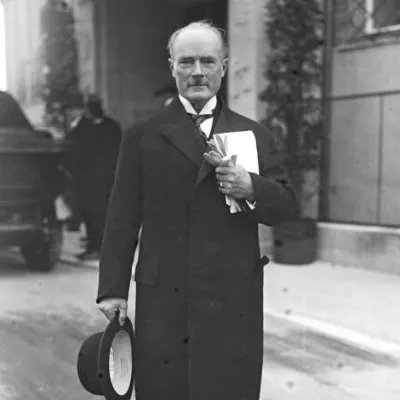
Throughout World War I, Krupp provided many of the weapons in Germany’s powerful arsenal including a huge cannon used to blast Paris and a 98-ton howitzer that was used to shell Liège and Verdun, named "Big Bertha," allegedly after his wife. Krupp profited from the war, and after Germany’s defeat, he began to work toward a secret rearming of the country, stating the company should be ready "again to work for the German armed forces at the appointed hour without loss of time or experience." In 1933, his financial aid helped tighten Hitler’s grip on the government, and as president of the Reichsverband der Deutschen Industrie, he expelled all Jewish industrialists. Through his connections to the Nazis, he used Jewish, Polish and Russian concentration camp prisoners as "employees," although it was later discovered that his son had really been the person in charge during this period.
He married the heiress of the Krupp family of industrialists, Bertha Krupp (1886-1957), after her father’s suicide in 1902. It was considered unthinkable that a woman would run the Krupp empire, so Emperor William II personally chose Gustav as an acceptable husband for Bertha, and upon their marriage on 15 October 1906, he added the Krupp name to his own. They had a son, Alfried, who took over the business in 1943.
Although the Allies proposed to indict him as a war criminal, he was in ill health from a stroke and was growing increasingly senile. He died on 16 January 1950, never having stood trial.
Gustav Krupp Von Bohlen as a Manifesting Generator 2/4 in Human Design
Manifesting Generator 2/4 — Design at a Glance
Gustav Krupp Von Bohlen was someone who combined the endurance of a Generator with the initiative-driven power of a Manifestor through a hybrid energy configuration. His design provided him with constant sacral energy, but required that he not initiate himself but rather respond to external impulses. This reaction allowed him to skip steps and quickly draw results into his life.
However, this speed carried risks: Often, he was too quick and skipped necessary intermediate steps, leading to the need to return later to make up for deficits. Such setbacks caused frustration in him as they went against his natural pace. Additionally, he tended to pursue multiple projects simultaneously rather than focusing on a single task. When his inner authority and strategy did not align, his enthusiasm for creating quickly turned into dissatisfaction.
Deep satisfaction came only when Gustav Krupp Von Bohlen strictly responded to life impulses and confirmed each undertaking with a clear 'yes' from his sacral center. Under these conditions, the simultaneous handling of various tasks was no obstacle but rather a source of contentment. He lived in a play mode that sought variety and whose energy was sustained through continuous confirmation rather than linear completion of individual projects.
Sacral Authority
Gustav Krupp Von Bohlen possessed sacral authority, which distinguished him as a Generator. This greatly simplified his decision-making process since strategy and inner guidance were identical. His reactions to external stimuli did not come from intellectual deliberation but from physical signals: a 'gut feeling' or sudden surge of energy. These internal impulses often manifested as loud sounds like grunts, hums, or affirming mhm's. Such reactions signaled that his sacral motor had engaged. In these moments, he felt vital and alive with inexhaustible energy and great enthusiasm for the activity itself, free from purpose-driven compulsion. His design promoted a life of joy and contentment by fully dedicating himself to his tasks. A crucial mechanism was the openness of his emotional center; this prerequisite enabled the function of sacral authority. Additionally, his activated spleen center supported him. Through a direct connection to the sacral center, Gustav Krupp Von Bohlen could act particularly quickly and spontaneously. He had an immediate access to his physical well-being and instinctive perception, which served as a reliable compass. This configuration allowed him to make intuitive and timely decisions based on the deep resonance of his body rather than delayed emotional clarity or rational planning.
The 2/4 Profile — Hermit / Opportunist
Gustav Krupp Von Bohlen showed a constant interplay between a deep need for withdrawal and attraction towards his close environment. His design, characterized by Profile 2/4, created an inner tension: On one hand, he retreated into his 'cave' to be alone and let internal processes settle; on the other hand, he actively sought out the company of his favorite people. This duality required clear external communication – when he offered space for exchange and when he wanted to remain undisturbed. During times of withdrawal, he reflected the knowledge from his network to develop new ideas. Once this inner clarity was achieved, he returned to the community.
This pattern was influenced by specific line energies. The second line brought themes like leadership and self-awareness; here, his potential often had to be 'drawn out' externally to fully unfold. Simultaneously, the fourth line with its tendency towards secrecy and focus on higher goals rather than mere recognition played a role. For Gustav Krupp Von Bohlen, timing was crucial, especially during direction changes or when silence was needed to avoid conflicts. The ability to harmoniously connect these two aspects – the solitary reflective process and social engagement – shaped his way of moving through the world and forming relationships.
Split Definition — Defined & Open Centers
Gustav Krupp von Bohlen revealed himself as someone with a fixed, reliable identity and a clear sense of direction. His defined G Center gave him inner security in self-love, while the also defined Heart Center provided willpower and the desire for control over resources. This combination shaped a person who enjoyed acting autonomously and keeping promises to strengthen his self-esteem. His mental function was consistently active through the defined Ajna Center; he processed data and creativity in a specific way that was hard to influence from outside. Through the defined Throat Center, he could translate these concepts as well as his willpower directly into communication and action. The vital energy of his defined Sacral Center drove him to be active and find satisfaction through the use of this power, while he had to wait for inner responses to avoid resistance. The constant pressure of his defined Root Center supported this forward drive in the material world. At the same time, Gustav Krupp von Bohlen was vulnerable to conditioning through open centers. His open Head Center made him prone to mental confusion or trying to solve others' questions, which could distract him from his own process. His open Solar Plexus absorbed the emotions of the environment, putting him at risk of personalizing foreign moods and feeling emotionally unstable if he did not clearly distinguish what was his own. Additionally, his open Spleen Center tended to take on fears about survival or health concerns, which could tempt him to cling to uncertain situations just to gain a false sense of well-being. These mechanisms worked together: a strong, willful structure that nonetheless required constant mindfulness to avoid being thrown off balance by foreign mental or emotional influences.
Channels for inspiration, curiosity, pioneering spirit and maturation.
Gustav Krupp Von Bohlen revealed himself as someone who inspired others through his blores existence and authentic presence. This effect stemmed from Channel 1-8, which connects the G Center with the Throat Center. By living out his individual identity, he became a role model; his contribution did not lie in mere explanations but in exemplifying his creative direction. This drew public attention and encouraged others to muster the courage to express their own uniqueness.
His way of communicating was marked by a deep curiosity that never rested. Channel 11-56 connected the Ajna Center with the Throat Center, driving him to constantly seek new ideas and perspectives. He acted as a storyteller, transforming abstract information into captivating narratives. Through these stories, often more about searching than finding, he stimulated the imagination of those around him and shared his philosophical reflections on life.
Another defining force was his competitive spirit aimed at individualization. Channel 51-25 connected the Heart Center with itself, giving him the ability to withstand initiations through "shocks" or challenges. He also awakened this competitiveness in others, spurring them towards growth. His focus lay in recognizing and reinforcing the potential for individualization, learning that true initiation can only occur by invitation and not be forced.
Furthermore, he underwent a continuous process of maturation. Channel 42-53 connected the Root Center with the Sacral Center, challenging him to live experiences fully and reflect upon them before beginning new cycles. This cyclical movement allowed him to gain wisdom from past events and pass it on as collective history. Each experience needed a satisfying conclusion to lay the groundwork for future growth.
Additionally, Gates like 7 (Leadership), 13 (Continuity), and 2 (Direction) influenced his development, while personality gates such as 54 (Ambition) and 26 (Innovation) shaped his inner drive.
Individual Circuitry — Circuit Signature
Gustav Krupp von Bohlen was marked by a split definition that formed two independent energetic poles. One pole connected the Throat Center with the Identity Center through the Knowledge Circuit (Channel 1-8), giving him inspired impulses to articulate his unique individuality. The second pole included the Heart and Identity Centers in the Focusing Circuit (Channel 25-51), creating firm convictions and inner self-worth, though without a direct outward expression channel. A third aspect came from the Purpose Circuit: Here two separate strands existed. One strand connected Ajna with the Throat Center (Channels 11-56 and 42-53), allowing for inquisitive reflection on past events that could be verbalized. The other strand linked Sacral with Root Centers, providing vital energy to handle pressure and past experiences. Since these groups were not interconnected, creative inspiration, inner conviction, and emotional purpose acted as parallel, non-directly flowing forces in his design.
Right Angle Cross of the Sphinx 3
Gustav Krupp von Bohlen and Halbach's Human Design featured the right cross of the Sphinx. This configuration combined a deep, often unspoken intuition with the drive to make the invisible visible. It was not mere speculation but rather a specific kind of perception: the ability to grasp connections that eluded others and to pour these insights into concrete forms.
The right cross of the Sphinx 3 describes a process of trusting one's inner knowledge, even if it wasn't immediately apparent from the outside. Gustav Krupp von Bohlen and Halbach was someone who relied on this internal certainty. He trusted that his perceptions – even when they seemed contradictory or unconventional – would ultimately lead to a clear structure.
This mechanism fostered an attitude of creating from within. It was less about external validation than it was about consistently pursuing one's vision and translating it into reality. The energy of this cross supported him in organizing complex ideas and making them accessible so that others could embrace them. His path was marked by the tension between hidden insight and the necessity to transform these insights into tangible results.
Saturn Return · Uranus Opposition · Chiron Return · 2nd Saturn Return — Life Cycles
Gustav Krupp Von Bohlen emerged as a key figure during his middle life phase, taking responsibility for large structures. This development was shaped by the Uranus opposition in his design, a cycle often associated with sudden changes or new authority structures. In 1909, at age 39, he became chairman of the board – an event typical of this configuration: The Uranus opposition marks a turning point where previous patterns are broken and new leadership roles are taken on. For Gustav Krupp Von Bohlen, it meant a clear focus on his strategic role within the company. This position enabled him to realize his visions and set long-term goals. The Uranus opposition promoted the ability to find innovative solutions and reshape existing systems. It was a moment of transformation where Gustav Krupp Von Bohlen concentrated his energy to drive change forward. This cycle also underscored the need to focus on essentials and not be distracted by external influences. Through this attitude, he could act effectively and achieve his goals.
Manifesting Generator · Sacral Authority — Synthesis
He lived a life characterized by a dynamic interplay between inner clarity and the urge for rapid implementation. The defined Mental Center (Ajna) provided him with consistent concepts and strong internal conviction, while sacral authority supplied constant energy that responded to external stimuli. This combination of strategic thinking and immediate reaction allowed him to recognize opportunities and seize them through swift initiatives (Manifesting Generator) – a process that occasionally required skipping important steps. The profile as a natural talent and networker further amplified this tendency towards activity, as he needed both phases of withdrawal into internal processes and intense social interaction to balance his energy.
A central tension lay between his need for individual expression (Channel Inspiration 1-8) and the ability to transform knowledge and initiate change (Knowledge Circuit). He was destined to express creative impulses and inspire others, yet processing these impulses also required time for reflection – a balancing act that was further emphasized by the profile between solitude and community. The Uranus opposition in his life cycle points towards a tendency to question conventions and chart new paths, which manifested in professional shifts.
4 Defined Channels
Incarnation Cross - Right Angle Cross of the Sphinx 3
Solar Return
The Solar Return shows the moment when the sun returns to its exact birth position - your personal solar year.
Life Cycles
Discover the life cycles with a detailed triple view (birth chart, cycle chart, composite).
Human Design Profile
- Strategy
- To respond - wait for something to respond to
- Authority
- Sacral Authority
- Profile
- 2/4 - Hermit / Opportunist
- Definition
- Split Definition
- Incarnation Cross
- Right Angle Cross of the Sphinx 3
- Date of Birth
- 07.08.1870 06:00
- Place of Birth
- The Hague, Netherlands
Frequently Asked Questions
What is the Human Design type of Gustav Krupp Von Bohlen?
What Profile did Gustav Krupp Von Bohlen have?
What Authority did Gustav Krupp Von Bohlen have?
What incarnation cross did Gustav Krupp von Bohlen have?
When was Gustav Krupp Von Bohlen born?
Discover your own Human Design
Are you also a Manifesting Generator? Find out in a personal reading how to unfold your multi-talents and direct your energy wisely.
More Personalities
Back to overviewAldair

Alizée

Angeli

Arletty
Artus

Balthus