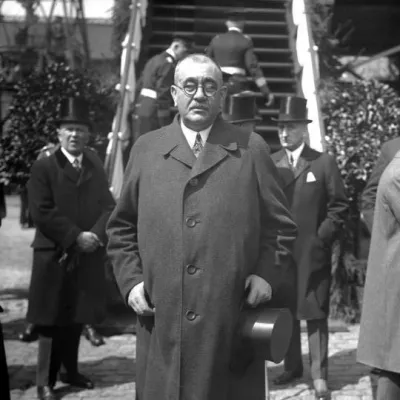
Gustav Noske
Human Design Chart
Biography
A member of the Reichstag (parliament), Noske became controversial within his own party for his support of imperial military and colonial programs. He joined other conservative socialists after 1914 in supporting Germany’s participation in World War I. Regarded as his party’s military expert, he was commissioned by the last imperial government to restore order at Kiel following the sailors’ mutiny of October 1918. In December he was elected to the six-member ruling council, which, until the accession of the Weimar National Assembly (February 1919), provided an interim republican government for Germany.
In January 1919 Noske was called upon to suppress the communist insurrection in Berlin, a task that he accomplished brutally but with dispatch. He served as minister of defense in the first Weimar Cabinet from February 1919 until he resigned in March 1920 under growing socialist criticism in the aftermath of an abortive right-wing attempt to overthrow the government (the Kapp Putsch). Subsequently, Noske served as governor of the province of Hanover (1920–33) and in July 1944 took part in the unsuccessful coup against Adolf Hitler.
He died 30 November 1946.
Gustav Noske — Manifesting Generator with Profile 3/5
Manifesting Generator 3/5 — Design at a Glance
Gustav Noske revealed himself as someone with a hybrid energy type: the manifesting generator. This design combined the constant, sacral energy of a generator with the ability of a manifestor to skip steps and quickly draw things into his life. He possessed immense creative power that allowed him to push multiple projects forward simultaneously, provided his inner authority agreed.
The challenge of this design lay in its speed. If Gustav Noske acted too quickly and skipped important intermediate steps, he often had to backtrack and make up for them. This could lead to frustration, the specific non-self theme of his type. Additionally, he tended to react simultaneously to many different impulses, which could fragment his energy if strategy and authority were not in harmony.
The optimal use of his power was through responding rather than initiating. He had to answer life and check whether his sacral center confirmed the impulse with a clear 'yes'. Once this condition was met, he entered into a play mode that brought him deep satisfaction from his work. In this state, the parallel handling of various tasks was no obstacle but a source of his vitality and joy.
Emotional Authority
Gustav Noske showed a decision-making stance that did not rely on spontaneous impulses but rather on the necessity to let feelings run their course. His inner authority was Emotional Authority carried by the Defined Emotional Center. This mechanism meant for him: every emotional activation generated wave movements in feeling, constant ups and downs of mood. The world appeared always colored by his current emotional state; a moment of intense enthusiasm could quickly turn into deep skepticism.
Since his immediate feeling was only a snapshot, not an ultimate truth, quick, spontaneous decisions based on emotion were often counterproductive and error-prone for him. His strategy consisted in gaining time. By letting decisions sleep and tuning himself to them several times, he gained emotional distance. Only when the intense feelings subsided did the necessary clarity and calmness set in. This process of maturation was essential for long-term, life-defining steps. Gustav Noske had to learn to properly deliberate to ensure that his actions were based on deeper insight, not just transient excitement or sorrow.
The 3/5 Profile — Martyr / Heretic
Gustav Noske revealed himself as someone who did not acquire knowledge from books but through direct, often painful experimentation. His design showed a tendency to initially be skeptical of pre-fabricated truths and test everything himself – the line 3 of the experimenter. He learned from these experiments and resulting failures, later using this practical experience to solve problems for others.
This attitude shaped him as a classic adventurer and storyteller. The Profile 3/5 described a person who matured through their own mistakes and made these insights accessible to others. Line 5 confers natural attractiveness; others saw in him an authority that had learned from life. Gustav Noske enjoyed presenting this treasure trove of experiences, making him interesting for his environment.
At the same time, he carried the weight of high expectations. The fifth line brings with it the pressure to be perceived either as a hero or a failure. This tension between the need for security and harmony (line 3) and the necessity to endure shocks and public judgment (line 5) defined his inner dynamics. He had to learn to deal with the possibility of failing in others' eyes while simultaneously taking on the role of offering solutions he himself had fought hard for.
Split Definition — Defined & Open Centers
Gustav Noske revealed himself as someone with a deeply rooted inner direction and a consistent way of self-expression. His defined G Center gave him a clear identity and a sense of where he belonged; he could guide others into their own center without becoming dependent on them. This inner security contrasted with the allure of his open Heart Center: Here, there was no steady energy for willpower in terms of competition or promises. Noske tended to feel pressured by external expectations and coupled his self-worth with performance rather than living it from his own authority.
His ability to act was based on his defined Sacral Center, a source of immense vitality. As a Generator, he was designed to react to what came his way and use his energy only when there was an inner consent ("Yes"). Initiated actions without this sacral confirmation often led him to frustration or exhaustion, as the necessary power was then not available.
Communication and manifestation occurred through his defined Throat Center. It functioned as a pivot point that translated impulses from other centers into clear words or deeds. This allowed for a reliable yet limited form of expression. Simultaneously, his open Head Center shaped his mental landscape: Noske was vulnerable to the pressure of finding answers to questions that were not his own. He tended to get entangled in others' doubts and confusions rather than remaining a neutral observer of his thoughts.
His defined Solar Plexus Center also determined his decision-making process through emotional clarity. Truth revealed itself to him not in the immediate moment but after going through an emotional wave. Patience while waiting for these cycles was essential to avoid impulsive action and gain deep insights.
Channels for intuitive power, charisma and emotional depth.
Gustav Noske radiated immense, almost insatiable urgency. His design was marked by the Channel of Charisma 34-20, where raw physiological energy (Gate 34) was directly translated into language and action in the present moment (Gate 20). This generated a powerful manifestation force: He could barely sit still as his inner drive sought immediate expression. However, this energy did not act in isolation; it was supported by the Channel of Power 34-57, which linked sacral power with intuitive insight from the Spleen center. This gave him razor-sharp awareness and the ability to react swiftly to dangers or opportunities driven by a deep survival instinct.
Alongside this direct action capability, Gustav Noske also possessed potential for profound directional shifts. The Channel of Beat 14-2 connected competence in handling material resources (Gate 14) with higher knowledge about identity and direction (Gate 2). This allowed him to transform innovative impulses into concrete, material changes often carried by a certain melancholy or sense of the unusual. At the same time, his emotional waves traversed the Channel of Feeling Release 39-55. This channel linked provocation (Gate 39) with the emotional depth of the mind (Gate 55), leading to a moody yet authentic expression. His mood swung between ecstatic joy and melancholic uncertainty, a process he could not rationalize but only integrate by accepting this pulsating wave. This combination of immediate action capability, intuitive sharpness, and emotional depth shaped his way of moving in the world: directly, impulsively, often driven by an inner restlessness that cried out for expression and change.
Individual Circuitry — Circuit Signature
Gustav Noske was marked by separate, parallel acting energetic poles. His design consisted of two non-directly connected groups: on one side a combination of Identity, Sacral Center, Throat and Spleen center, on the other an isolated connection between Root and Solar Plexus centers. This separation meant that his vital power and emotional sensitivity did not work together as a single flow but rather as separate, coexisting forces.
The Knowledge Circuit specifically connected Noske's Throat with his Spleen Center (Flash of Insight), Identity with Sacral energy (Beat) as well as Solar Plexus with Root center (Feelings Release). This promoted innovative impulses and individual forms of expression without merging these areas energetically. Additionally, the Integration Circuit worked in him connecting Throat, Sacral and Spleen centers (Charisma and Power). Here it was about securing survival through intuitive reactions and acting in the present moment.
Noske's design laid a tendency to pulsating, acoustic creativity that remained fragmented due to divided definition. The connection of Identity and Sacral center supported his action capability while the isolated Root-Solar Plexus axis generated emotional waves not directly flowing into his willpower stream. This resulted in a personality oscillating between impulsive inspiration and emotional intensity without being able to unify these aspects into a homogeneous whole. Thus, the mechanics described a tension field between individual empowerment and separate emotional processing structuring his actions.
Right Angle Cross of Penetration 2
Gustav Noske exhibited a fundamental disposition that aimed at direct and often painful confrontation with the status quo. His design bore the signature of the 'right cross of penetration', a specific configuration that did not allow for superficial adaptation. This structure implied an unavoidable urge to break through established systems and illusions in order to get to the core of things. It was not about arbitrary destruction, but rather a deep-seated necessity to identify what was false or outdated and remove it radically so that space could be created for something more authentic.
The mechanics of this cross described a process of purification through resistance. Gustav Noske lived in tension between the desire for order and the realization that existing structures often rested on lies or weakness. His energy worked like a surgical instrument: precise, cold, and without regard for feelings that stood in its way. This did not mean he was malicious, but rather that his nature required him to endure hardness and spread it himself in order to bring about profound change. The penetration often came at great personal cost, as it brought isolation and misunderstanding in its wake. Gustav Noske accepted this price as a necessary part of his existence, for without this radical separation from the old, no true renewal could take place. His path was marked by the readiness to proclaim unpopular truths and sever old ties to protect the integrity of the new.
Saturn Return · Uranus Opposition · Chiron Return · 2nd Saturn Return — Life Cycles
Gustav Noske revealed himself as someone whose inner compass needle was strongly shaped by the necessity to create structure in chaotic times and assume responsibility for the whole. His design showed a tendency to be activating in crisis situations, often driven by external circumstances that challenged his own resources.
In 1907, at age 39, Noske gave an expert speech that made him a target of the left wing within the SPD. This event fell into a Uranus opposition cycle, which often brings unexpected breaks and public conflicts. For his design, this was a moment when his strategic positioning had to prove itself under extreme pressure; the opposition acted as a catalyst sharpening his role in the political fabric but also provoking isolation and resistance.
Ten years later, in 1918 at age 50, his Chiron return cycle began – a period of fulfillment and flowering of one's life purpose. Noske was elected chairman of the local workers' and soldiers' council. Although he took on this position, he could not prevent the revolution from spreading across the entire empire. This contrast between personal responsibility-taking and the uncontrollability of larger currents highlighted the tension in his design: The desire for order met a self-unfolding historical dynamic that he could steer but not fully control.
Manifesting Generator · Emotional Authority — Synthesis
Gustav Noske's life was marked by an ongoing interplay between the drive for rapid implementation and the necessity of emotional maturation. As a Manifesting Generator (MG), he possessed the ability to quickly initiate things – fueled by sacral energy and a direct connection to the Throat Center – yet his emotional authority required time to clarify decisions. This combination of initiatory power and emotional wave shaped his path, as he started experiments (Line 3) and then tried to find solutions for others from the results (Line 5), with Channel Beat (14/2) driving him into new directions.
A central paradox lay in his ability to advance innovations – supported by the knowledge circuit and associated creativity – while simultaneously confronting deep crises (documented through Uranus opposition and Chiron return). This constellation led Noske to often act in situations requiring quick action, yet his inner truth only became apparent through a longer emotional process. The melancholy of tantric channel 14-2 seemed to accompany him constantly as he sought to find his individual path and bring about transformation.
5 Defined Channels
Incarnation Cross - Right Angle Cross of Penetration 2
Solar Return
The Solar Return shows the moment when the sun returns to its exact birth position - your personal solar year.
Life Cycles
Discover the life cycles with a detailed triple view (birth chart, cycle chart, composite).
Human Design Profile
- Strategy
- To respond - wait for something to respond to
- Authority
- Emotional Authority
- Profile
- 3/5 - Martyr / Heretic
- Definition
- Split Definition
- Incarnation Cross
- Right Angle Cross of Penetration 2
- Date of Birth
- 09.07.1868 16:00
- Place of Birth
- Brandebourg, GER
Frequently Asked Questions
What was Gustav Noske's Human Design type?
What Profile did Gustav Noske have in Human Design?
What Authority did Gustav Noske have?
What incarnation cross was assigned to Gustav Noske?
When was Gustav Noske born?
Discover your own Human Design
Are you also a Manifesting Generator? Find out in a personal reading how to unfold your multi-talents and direct your energy wisely.
More Personalities
Back to overviewAldair

Alizée

Angeli

Arletty

Artus
Balthus