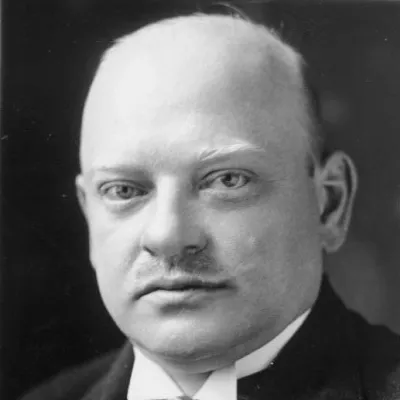
Gustav Stresemann
Human Design Chart
Biography
He was elected to the Reichstag in 1906. Later, he became the leader of the National Liberal party and eventually of the German People's party. After he assisted in the authoring of the Locarno pact, he was named the co-winner of the 1926 Nobel Peace prize with French Minister Aristide Briand.
Stresemann popularized the style of substituting a short dark lounge-suit jacket for a morning coat but otherwise wearing morning dress for men's day wear. The look became so identified with Stresemann that such outfits are often called "Stresemanns."
Gustav Stresemann died of a stroke on 3 October 1929 at the age of 51.
The Human Design of Gustav Stresemann: Projector 1/3
Projector 1/3 — Design at a Glance
Gustav Stresemann's design inclined towards focused perception. As a projector, he did not have an intrinsic energy source like other types but operated in phases of high intensity followed by necessary rest periods for regeneration. His aura was similar to a bright light beam: it immediately identified weaknesses and errors in the system around him. This direct confrontation with others' deficits could quickly be perceived as unpleasant or aggressive, akin to shining a spotlight directly into someone's face.
His optimal strategy involved not actively pushing but waiting for a respectful invitation from his environment. By living harmoniously on his own path, he naturally attracted others who then sought out his advice independently. If Gustav Stresemann lived by the principle of patience and waiting for invitations, he was rewarded with success. Ignoring this dynamic and trying to impose his insights against others' will led sooner or later to bitterness, his non-self theme. His influence thus relied less on constant action than on the ability to show others their path once they were ready.
No Inner Authority
Gustav Stresemann's design lacked an inner authority – a rare configuration that did not rely on Solar Plexus or Emotional Centers. Instead of orienting himself towards physical impulses, he found his answers through interaction with his environment. As a mental projector, he had no defined centers below the Throat Center; this made him highly sensitive to other people's energies. Through dialogue, dormant potentials in his open centers were activated, allowing him to view and express issues from multiple perspectives. This high resonance capability served to identify the right environment and conversation partners for trustworthy exchange.
The evaluation of the information gained was a complex process requiring time and solitude. Gustav Stresemann needed these quiet periods to discern the thread in a mass of data and separate what mattered from what did not fit him. Through this filtering, he developed specific intelligence to structure complex relationships – his central capital for success. A key element for him lay in being in an environment where he felt comfortable and could exchange with suitable people. This trusting dialogue deepened over time his sense of which decisions truly belonged to him and made sense.
The 1/3 Profile — Investigator / Martyr
Gustav Stresemann appeared as someone who always validated theoretical knowledge through practical experience. His design as a 1/3 profile – researcher and experimenter – established a fundamental attitude based on learning through trial and error. The first line drove him to develop new insights and seek authority in these understandings, often with an expansive, rule-breaking impulse. Yet this theoretical planning alone was not enough for him; it could even lead to paralysis if he felt there was still too much unknown.
Therefore, the energy of the third line took control: it compelled him to act to dispel doubts and test outdated structures through personal experience. This line highlighted a certain dissatisfaction with the status quo and promoted revolutionary potential that could break old bonds once recognized as hindrances. Gustav Stresemann's judgment was only trustworthy when he had both intellectually penetrated an issue and practically tested it on his heart and gut. His authority did not stem from mere theory but from the hard school of experimentation, where negative consequences were accepted to gain self-discovered truths.
Single Definition — Defined & Open Centers
Gustav Stresemann's Human Design profile indicated a tendency towards constant mental pressure to ask questions and seek answers. The definition between the Head Center and Ajna Center created an ongoing internal drive to understand connections. This state was not a choice but a fixed characteristic of his thinking. However, since these centers did not have direct access to energy sources, he could not simply enforce his ideas through sheer willpower. Instead, he acted as an inspirational source for others who took on the implementation.
His communication occurred through a defined Throat Center connected to Ajna. This meant that he spoke what his mind conceptualized. His words were expressions of his mental processes, reliable and consistent in their nature. He could articulate his thoughts clearly without being impulsive or emotionally driven.
In contrast, Gustav Stresemann had several open centers making him vulnerable to external influences. His open G Center meant that he did not have a fixed identity or direction. He tended to reflect himself within relationships and environments to understand who he was. The search for a stable identity was an ongoing challenge; he learned through experiencing different directions which were correct for him.
The open Heart Center led to him not being driven by constant willpower. He avoided making promises that he had to keep out of sheer ambition or the need for validation. Instead, he learned to prove his worth without relying on performance.
His open Sacral Center made him sensitive to other people's energy. He could easily overextend himself when working with borrowed energy. It was important for him to respect his own limits and rest rather than being drawn into the rhythm of the environment.
The open Solar Plexus Center absorbed emotions from the surroundings. Gustav Stresemann had to learn to distinguish between his own feelings and those of others to avoid being overwhelmed by emotional waves. Confrontations were often difficult for him as he feared emotional reactions.
His open Spleen Center made spontaneous decisions risky. He tended to cling to things that gave him a false sense of security or let go of things that were actually good for him. Patience and waiting were crucial here.
The open Root Center absorbed stress from the environment. Gustav Stresemann could find himself under pressure when trying to escape this external adrenaline rush by overworking. Realizing that this pressure did not come from within helped him use or avoid it rather than being driven by it.
Channels for inspired insight and rational processing.
Gustav Stresemann's Human Design profile indicated a tendency towards innovative, mutative thinking. His mind did not work linearly or logically-prognostically but sought sudden breakthroughs and new perspectives. This attitude resulted from the Awareness Channel 61-24. This channel connected the Head Center to the Ajna Center through the Gate of Secrets (61) and the Gate of Rationalizing (24). As a result, an individual thinker emerged whose knowledge came not through planning but through spontaneous inspiration and inner truth. Gustav Stresemann received thoughts as acoustic noise or atmospheric disturbances that only coalesced into clear insight at the right moment. His mind was designed to know the unknown and break old cycles with new insights without being able to control when this mutation would occur.
These inspired impulses directly flowed into his way of communicating. The Structuring Channel 43-23 connected his Ajna Center to the Throat Center via Gate of Insight (43) and Gate of Assimilation (23). Gustav Stresemann did not immediately process the breakthroughs received by his mind but let them mature. Only when the timing was right, he expressed these unique perspectives. His ability lay in formulating complex, innovative ideas so simply and efficiently that they prompted others to rethink. He used key words and metaphorical processes to reinforce efficiency. However, this process depended on strategy and inner authority; without proper timing, his unique knowledge often got misunderstood or rejected. Gustav Stresemann had to learn to let go of control and allow his mind to work at its own pace. His challenge was to develop skillfulness in clear explanation so that his gift as a genius would be recognized rather than dismissed as an outsider.
Additionally, the Gate of Revolution (49) and the Gate of Formulating (4) influenced him. Gustav Stresemann responded sensitively to emotional waves and principles while simultaneously developing logical formulas for future security. The Gate of Contribution (8) challenged him to individually advocate for group goals and embody new roles through reinforcement.
Individual Circuitry — Circuit Signature
Gustav Stresemann's Human Design profile indicated a tendency towards following his own path and acquiring new knowledge. As a person with simple definition, his energetic focus was clearly bundled: Head, Ajna, and Throat Center formed a continuous flow. This allowed him to directly translate innovative insights from the Ajna Center into speech. The active Awareness Channel 24-61 promoted creative intuition while the Structuring Channel 43-23 helped bring these impulses into understandable forms. Gustav Stresemann used this configuration to initiate change through expression. His energy was pulsating and acoustically marked; he sought not only answers but formulated them in a way that others could take up. The connection between thinking (Ajna) and speaking (Throat) stood at the forefront. It mattered to him to affirm his unique identity by sharing new knowledge. Often, he acted impulsively driven by the necessity of carrying inner insights outward immediately. This mechanism shaped how he processed and passed on information: quickly, intuitively, with the goal of transforming existing structures through new insights. Gustav Stresemann lived this dynamic of the Knowledge Circuit by articulating his individual perspectives and thus setting impulses for change in his environment.
Right Angle Cross of Explanation 2
Gustav Stresemann's Human Design configuration indicated the right cross of the Declaration. This structure characterized a specific approach to complex problems: it required first the careful gathering and organizing of information before finding a clear position or solution could be found. In Human-Design, this cross describes a process where inner clarity arises through the integration of different perspectives. Gustav Stresemann was not someone who offered immediate answers but rather needed time to fully grasp the connections and present them in an understandable form. The mechanics of this cross emphasize the need to first clarify the 'What' and 'How' before the 'Why' or final action takes place. It was a holistic approach that combined logical analysis with a certain emotional or intuitive component to develop a comprehensive viewpoint. Gustav Stresemann used this ability to bring order into uncertain situations and guide others through his structured way of explaining things. The energy of this design acted like a filter, transforming chaos into clear, understandable messages. This did not happen impulsively but as the result of a mature maturation process where various influences were carefully weighed. Gustav Stresemann lived out this dynamic by preparing complex issues in such a way that they became tangible and manageable for his environment.
Saturn Return · Uranus Opposition · Chiron Return — Life Cycles
Gustav Stresemann's design showed a tendency towards strategic adaptation and political pragmatism, which was evident in the steps of his career. In 1906, at age 28, he was elected to the Dresden city council. This first Saturn return marked a point of condensation on his chart: years of groundwork and solidifying his position culminated in a concrete, sustainable institutional anchoring. It was a moment when his political structure stabilized.
Later, in 1918 at age 40, he found himself in opposition following the November Revolution. This corresponded to the Uranus opposition, a phase of extreme tensions and necessary breaks. His design did not react passively but through a fundamental reorientation in the political field where old structures collapsed and new, often chaotic realities challenged adaptability.
The peak of his incarnation purpose occurred in 1926 with the Chiron return. At age 48, he received the Nobel Peace Prize along with Aristide Briand. This fulfillment cycle confirmed that his life increasingly aligned with his deepest strategy. The Nobel Prize was not a random success but the visible unfolding of his life's meaning: diplomatic work and the will for reconciliation were now experienced as the highest confirmation of his existence, a culmination where his entire political career condensed into clear, meaningful recognition.
Projector · No Inner Authority — Synthesis
He was a projector who played a formative role through his ability to recognize patterns and uncover potential in others (Design View). The lack of inner authority (Authority) forced him to always be in dialogue with his environment to gain clarity – a process amplified by the line 1/3 of his profile (Profile Role), as he tested insights both theoretically and practically. This constant dialogue and search for confirmation were not only necessary but also a driving force for his development and work.
A central paradox lay in the tension between his mental definition (Centers) and the channel of structuring (Channels/Gates). He was constantly under mental pressure to ask questions and understand, which led him to develop new perspectives. At the same time, this process required a clear expression to initiate change – a balancing act between inspiration and pragmatic implementation. The cycles showed that he always sought new paths during phases of crisis (Uranus opposition) and success (Chiron return), thereby reinforcing his unique identity in the knowledge circuit (Circuit).
2 Defined Channels
Incarnation Cross - Right Angle Cross of Explanation 2
Solar Return
The Solar Return shows the moment when the sun returns to its exact birth position - your personal solar year.
Life Cycles
Discover the life cycles with a detailed triple view (birth chart, cycle chart, composite).
Human Design Profile
- Type
- Projector
- Strategy
- Wait for the respectful invitation
- Authority
- No inner authority - learn more
- Profile
- 1/3 - Investigator / Martyr
- Definition
- Single Definition
- Incarnation Cross
- Right Angle Cross of Explanation 2
- Date of Birth
- 10.05.1878 12:30
- Place of Birth
- Berlin, GER
Frequently Asked Questions
What was Gustav Stresemann's Human Design type?
What Profiles did Gustav Stresemann have?
What Authority did Gustav Stresemann have?
What incarnation cross did Gustav Stresemann have?
When was Gustav Stresemann born?
Discover your own Human Design
Are you also a Projector? Find out in a personal reading how to unfold your leadership qualities and recognize the right invitations.
More Personalities
Back to overviewSissy Spacek

Alain-Fournier
Anémone

Ann-Margret

Bourvil
Christian-Jaque