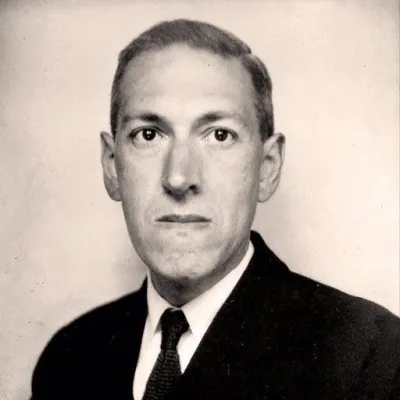
H. P. Lovecraft
Human Design Chart
Biography
Born in Providence, Rhode Island, Lovecraft spent most of his life in New England. After his father's institutionalization in 1893, he lived affluently until his family's wealth dissipated after the death of his grandfather. Lovecraft then lived with his mother with reduced financial security until her institutionalization in 1919. He began to write essays for the United Amateur Press Association and in 1913 wrote a critical letter to a pulp magazine that ultimately led to his involvement in pulp fiction. He became active in the speculative fiction community and was published in several pulp magazines. Marrying Sonia Greene in 1924, Lovecraft moved to New York City and later became the center of a wider group of authors known as the "Lovecraft Circle". They introduced him to Weird Tales, which became his most prominent publisher. Lovecraft's time in New York took a toll on his mental state and financial conditions. He returned to Providence in 1926 and remained active as a writer for 11 years, until his death at the age of 46.
H. P. Lovecraft as a Projector 4/6 in Human Design
Projector 4/6 — Design at a Glance
H.P. Lovecraft revealed himself as someone who, through his specific aura, had a focusing effect on his environment. As a projector, he did not have a constant, intrinsic source of life energy, leading to phases of high activity that necessarily had to be followed by necessary rest periods to prevent burnout. His design indicated a tendency to immediately recognize errors in systems or other people – comparable to a bright flashlight shining directly into the dark. This ability to identify problems in others instantly could, however, be perceived as unpleasant when addressed directly. The appropriate strategy for him was to wait for a respectful and sincerely meant invitation from others rather than taking the initiative himself. By radiating his own harmony, he attracted others who then sought his advice. If he lived according to this structure, he was rewarded with success; if he deviated from it, sooner or later the non-self theme of bitterness would come to light. His undefined Sacral Center significantly determined this rhythm of tension and relaxation.
Emotional Authority
H.P. Lovecraft showed an internal decision-making process that was strictly bound to his emotional wave movement. His design dictated that the defined Solar Plexus Center functioned as inner authority. This configuration held true regardless of all other defined centers in his chart; emotional truth always took precedence over any other inner voice or logical analysis.
This mechanism meant that H.P. Lovecraft could not make decisions immediately. His feelings were subject to constant ups and downs, coloring his perception of the world strongly by current mood. What seemed absolutely right at one moment could appear completely negative in the next. These initial impressions were only snapshots, no final truth. Quick, spontaneous actions from such an emotional peak often led to negative results.
Instead, his design required patience and time. H.P. Lovecraft had to let decisions mature, ideally over several nights. Only when intense feelings subsided and emotional distance was gained did clarity set in. This process of pondering and multiple re-evaluations was crucial for long-term life decisions. Only through this waiting for calm after the emotional wave could he recognize his deeper, comprehensive truth and act accordingly.
The 4/6 Profile — Opportunist / Role Model
H.P. Lovecraft revealed himself through his 4/6 Profile as someone who, in the first decades of life, was experimental and intensively tested relationships and friendships. In this early phase, the sixth line still acted similarly to a third: It was about direct experience and testing various roles within the social fabric.
With the return of Saturn, that is after the 30th year of life, this dynamic fundamentally changed. H.P. Lovecraft now faced an internal conflict between the desire for belonging (line 4) and the urge to distanced reflection on the meaning of things (line 6). This often created confusion as the heart's longing for community clashed with the head wanting to stand on the
Split Definition — Defined & Open Centers
H.P. Lovecraft was characterized by a defined Throat Center, which directed his communication and actions from inner sources directly. His voice was not an arbitrary product of the mind but a reliable transmutation of energy flowing out into the world from his system. This aligned with his defined Solar Plexus Center, functioning as internal authority. He had the capacity to wait through emotional waves before making decisions; clarity did not arise in impulsive moments but rather by cycling through emotional phases. Such patience allowed him to recognize deeper truths instead of being led astray by fleeting moods.
Additionally, he possessed a defined Spleen Center, which endowed him with spontaneous and intuitive intelligence in the moment. His body awareness was a reliable compass for health and well-being; he responded to existential signals without rational filtering. This instinctive protective mechanism worked alongside his defined Root Center, providing constant pressure to move forward in the material world and manage stress.
Simultaneously, his design revealed specific vulnerabilities through several open centers. His open Head and Ajna Centers meant that he lacked a fixed mental processing; he tended to identify with others' questions and doubts or become mentally entangled rather than possessing his own conceptual truths. His open G Center lacked a firm identity; he relied on initiating through interaction with his environment and other people to find direction and meaning. Furthermore, his open Heart Center suffered from the pressure of needing to prove its worth, which could plunge him into spirals of self-doubt. His undefined Sacral Center made him vulnerable to exhaustion by absorbing foreign energies since he lacked a consistent vital force to set boundaries or work continuously. This constellation created a tension between his inner emotional and intuitive clarity on one hand and the constant threat of mental overload as well as energetic depletion on the other.
Channels for focused intuition, deep knowledge and mastery.
H.P. Lovecraft's design inclined towards profound intuition, which through repeated experimentation and refinement transformed into concrete talent. This approach resulted from Channel Wave 48-16. Gate 48 sought life-critical information beyond the mind while Gate 16 experimentally tested new possibilities and gradually led skills to excellence. Through this connection, intuitive depth developed into precise mastery, yet it required recognition and resources to sustain.
Parallel to this was a strong drive for new experiences driven by restlessness and emotional anticipation. The Recognition Channel of Wave 41-30 connected the Root pressure from Gate 41 – generating countless scenario fantasies – with the emotional wave of Gate 30 in Solar Plexus, creating a strong need to embrace new situations where emotional authority needed time to gain clarity before making decisions.
Additionally, other Gates were at work: Gate 8 promoted individual contribution towards group goals and the enlivening of uniqueness. Gate 14 handled power and greatness with grace and self-control, guiding direction-finding. Gate 29 stood for persistence and saying yes in the face of challenges. In his design, Gates 12 (restraint, poetry), 35 (change through interaction), 19 (resources, spirituality within community), and 20 (awareness here and now, authentic self) contributed. Gate 45 gathered tribal energy while Gate 32 sought continuity and tested radical changes. This configuration shaped a being that combined intuitive depth with technical refinement and was simultaneously driven by an insatiable desire for emotional experience and new knowledge.
Collective Circuitry — Circuit Signature
H.P. Lovecraft's design inclined towards separate, parallel operating energetic fields. Through Split Definition, two independent streams existed: one focused on rational structure and future while the other centered on emotional reflection of past. These groups were not connected but coexisted as side-by-side forces.
The Understanding Circuit in him linked Throat with Spleen Center through Wave Channel (Gates 16 and 48). This enabled an emotionless ratio, aiming to share logical insights free from conditioning. The energy was visual and future-oriented, striving to improve things through focus and strategy.
Simultaneously, the Meaning Circuit connected Solar Plexus with Root Center (Recognition Channel, Gates 30 and 41). Here it revolved around cyclical emotional waves from past. Feelings and experiences were reflected upon to find their meaning and process these insights emotionally. In contrast to the cool logic of the first stream, this process was inexplicable and wave-like.
Both circuits shared the theme of splitting but on different levels: once through rational, structured communication into the future, the other through emotional resonance from the past. Since no connection existed between these groups, these aspects experienced as separate experiences without forming a common energetic flow.
Right Angle Cross of Contagion 3
H. P. Lovecraft's Human Design shows a tendency towards a deep, almost fateful dedication to what touches him - whether it be a person, an idea, or a cause. This attitude did not manifest as superficial interest but rather as an inner commitment that transcends the boundaries of self and fully immerses one in the other.
This configuration is described in Human Design by the right-hand Cross of Infection 3. It refers to a specific energetic structure aimed at establishing connections on a very personal and intense level. Those who carry this cross in their chart tend to identify strongly with others emotionally and energetically. This 'infection' here does not mean losing one's identity negatively, but rather as a powerful ability to absorb the energy of others, understand it, and strengthen or transform it through dedication.
For H. P. Lovecraft, this meant that his relationships and interests were often marked by great intensity. He did not seek detached observation but rather fusion with the object of his attention. This energy acts like a magnet creating closeness while blurring the lines between 'I' and 'You'. It is a force that works through dedication, opening up to others and thus generating deep resonance. This kind of engagement shaped how he interacted and felt, where the quality of connection was paramount, not its duration or external form.
Saturn Return · Uranus Opposition — Life Cycles
H. P. Lovecraft's creative expression was marked by cyclical phases of condensation and transformation. His design tends to externalize internal impulses into concrete acts of creation, while external life circumstances structure or challenge these processes.
In 1917 at the age of 27, he wrote the short stories 'The Tomb' and 'Dagon'. This coincided with his first Saturn Return. In Human Design mechanics, this cycle often marks the point where years of groundwork and inner maturation condense into a viable result. For H. P. Lovecraft, this phase was effective as a moment of artistic consolidation, in which his literary ambitions crystallized and laid the first stable foundation for his later work.
Ten years later, in 1927 at the age of 37, he published 'Supernatural Horror in Literature'. This corresponded to the Uranus Opposition, a cycle that initiates deep changes and breaks old patterns. This configuration often accelerates the transition from private engagement to public visibility or a new form of expression. For H. P. Lovecraft, this change was shown as a step towards theoretical grounding for his genre, where he did not only write stories but also defined the intellectual basis for his specific horror style and thus solidified his role in literary context.
Projector · Emotional Authority — Synthesis
He was a projector who developed a deep connection to the world around him through the ability to recognize patterns and reveal weaknesses (Throat Center, Gates 16 & 48). This gift, combined with emotional authority, led him not to share information immediately but rather to process it through an inner maturation and evaluation. The profile as Networker/Role Model suggests that he increasingly fulfilled expectations of providing insights and serving as a reference point for others throughout his life - always driven by an inner need for authenticity and deep understanding.
A central paradox in his design lay in the interplay between the desire for belonging (Line 4) and the inclination towards isolation and contemplative reflection (Line 6). He sought connection with others to share his insights, yet he repeatedly withdrew to explore profound questions about life. This tension was evident during creative periods interrupted by phases of inner retreat - a dynamic that intensified over time (Saturn Return) and through external impulses (Uranus Opposition).
2 Defined Channels
Incarnation Cross - Right Angle Cross of Contagion 3
Solar Return
The Solar Return shows the moment when the sun returns to its exact birth position - your personal solar year.
Life Cycles
Discover the life cycles with a detailed triple view (birth chart, cycle chart, composite).
Human Design Profile
- Type
- Projector
- Strategy
- Wait for the respectful invitation
- Authority
- Emotional Authority
- Profile
- 4/6 - Opportunist / Role Model
- Definition
- Split Definition
- Incarnation Cross
- Right Angle Cross of Contagion 3
- Date of Birth
- 20.08.1890 09:00
- Place of Birth
- Providence, Rhode Island, United States
Frequently Asked Questions
What was H. P. Lovecraft's Human Design type?
What profile did H. P. Lovecraft have?
What authority did H. P. Lovecraft possess?
What incarnation cross did H. P. Lovecraft have?
When was H. P. Lovecraft born?
Discover your own Human Design
Are you also a Projector? Find out in a personal reading how to unfold your leadership qualities and recognize the right invitations.
More Personalities
Back to overviewSissy Spacek

Alain-Fournier

Anémone

Angeli

Ann-Margret

Bourvil