Habib Bourguiba
Human Design Chart
Biography
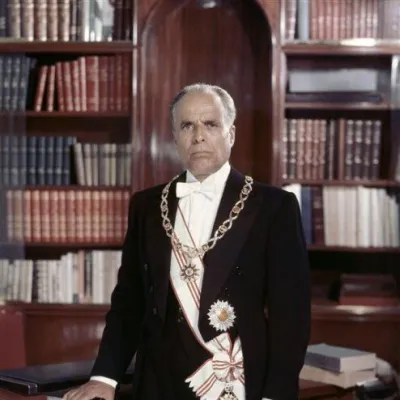
Having worked as a lawyer in France in the 1920s, he returned to Tunisia and started being more active in the country's nationalist movement. In 1934, when he was 31 years old, he co-founded the Neo Destour that spearheaded the Tunisian movement for independence. After being arrested and exiled several times by the occupying French protectorate, he decided to both negotiate and put pressure on the Fourth Republic to put forward his nationalist agenda. Following the country's independence on 20 March 1956, Bourguiba put an end to the monarchy, declared the republic of which he served as first president on 25 July 1957 and then focused on building a modern Tunisian state.
His main priorities upon taking over power included the improvement of the country's educational system, fighting gender inequality, developing the economy and maintaining a neutral foreign policy, which made him an exception among other Arab leaders. This, however, did not prevent a cult of personality to develop around him as he held the title of "Supreme Combatant" and established a twenty-year single-party state. The end of his rule was marked by his declining health, the rise of clientelism and Islamism, which was concluded by his removal from power by his then prime minister Zine El Abidine Ben Ali on 7 November 1987. He was later kept under house arrest in a residence in Monastir, where he remained until his death in 6 April 2000, and was buried in a mausoleum he had previously built there.
Habib Bourguiba as a Manifesting Generator 3/5 in Human Design
Manifesting Generator 3/5 — Design at a Glance
Habib Bourguiba's design shows a tendency towards lightning-fast action paired with the ability to skip conventional steps. As an Manifesting Generator, he possessed a blend of Manifestor and Generator traits. His defined Sacral Center provided constant energy, yet his strategy was not about initiating but responding to impulses. This configuration allowed him to quickly draw things into his life, but it carried two specific risks: He tended to overlook important stages, which could lead to residues and frustration, or he spread his attention across multiple parallel projects.
The multitasking trap loomed if strategy and inner authority were not aligned; the joy of creation would then quickly turn into dissatisfaction. His path to deep satisfaction lay in the „Play Mode“. This required a correct reaction to life impulses: He acted only when his Sacral Center gave a clear „Yes“ and his inner authority agreed. With this approach, parallel work was no obstacle but rather a source of energy. Variety and fun were crucial to keep his creative power going. Without this focus on responding instead of accelerating, his natural speed could become aimless. Thus, his design proved powerful yet required constant self-reflection to avoid frustration and draw deep satisfaction from creation.
Sacral Authority
Habib Bourguiba's decision-making was based on direct physical resonance rather than intellectual analysis. As a Generator, he had Sacral Authority, an inner guidance unique to this type whose strategy – waiting for the impulse – also defined his authority. This simplified his process: He reacted to external stimuli with a noticeable surge of energy or a „gut feeling“.
The authenticity of his choice was evident in physical signals like grunting, humming, or a confirming „Mhm“. Activated, he felt vital and alive; his Sacral motor provided inexhaustible energy and enthusiasm. He accomplished his work with great joy without having to view it as purpose-driven. This inner satisfaction replaced the need for rational justification.
This mechanism was supported by his Spleen Center. It allowed quick, instinctive reactions and immediate access to physical well-being. Bourguiba could reliably orient himself towards this spontaneous perception. His authority thus lay in the physical „Yes“ or „No“, which arose as a response to external stimuli. This configuration shaped a lifestyle where energy and enthusiasm were driving forces as long as he waited for the right impulse and did not anticipate it. The connection between Sacral and Spleen Center ensured him quick, intuitive responsiveness in everyday situations.
The 3/5 Profile — Martyr / Heretic
Habib Bourguiba was someone who acquired knowledge through personal experimentation rather than theory, often painful trial and error. His design inclined him to test everything himself first before developing practical solutions for others based on his own failures. This dynamic between experimental failure and heroic rescue shaped how he interacted with the world.
Line 3 of his Profile required withdrawal for reflection and adaptation. Bourguiba had to emerge from this retreat to let others benefit from his insights. This was a process of responsible withdrawal as a path to success. Simultaneously, Line 5 demanded courage to confess past ignorance. Revealing mistakes from the past became justification and created an attractiveness that bound others to him.
The paradox of his design lay in being only truly effective when he admitted his own errors from the experimental phase. Failing before an audience was painful but necessary for his later role as an advisor. Bourguiba learned from his experiments and solved other people's problems with this self-acquired knowledge. This practical experience made him appear to others as someone possessing a rich treasure of life experiences, which he gladly presented. The heroic role flattered him, yet could be painful when he tested things before everyone else and failed.
Split Definition — Defined & Open Centers
Habib Bourguiba was characterized by a strong foundation of six defined centers, which provided him with constant inner authority and willpower. His mental clarity (defined Ajna) flowed directly into his communication (defined throat) and his will (defined heart), translating concepts immediately into decisive actions. This 'Power Axis' was anchored by a stable identity (defined G Center), while the defined sacral center supplied the necessary vital energy, and the defined spleen center offered intuitive protection. Thus, he had a consistent system of thinking, speaking, and acting that was not easily influenced from outside.
At the same time, his design revealed three sensitive areas: head, solar plexus, and root were open. This meant that inspiration, emotional waves, and adrenal stress did not originate from his own source but were absorbed from the environment. He tended to interpret mental pressure from others as his own pressing questions or find himself in their emotional confusion without personalizing it. He also took on external stress, sometimes unconsciously amplifying it, yet was not designed to withstand this constant pressure.
His central life task lay in the tension between this immense inner stability and the need to clearly distinguish signals from open centers. It involved differentiating his 'own signal' – the clear voice from Ajna, heart, and sacral – from the 'surrounding noise' of absorbed emotions and foreign pressures. Only through this distinction could he fully unleash his power without losing himself in the conditioning of his open centers or wasting energy on problems that were not his.
Channel 15-5: The Rhythm — Channels & Gates
Habib Bourguiba's design showed a tendency towards a deep, biological connection to the life flow. He was someone who operated by an inner rhythm and timing that magnetically drew others into his energy flow. This natural authority did not rest on intellectual argumentation but on presence and synchronization with the collective.
This dynamic was particularly shaped by the Rhythm Channel 5-15. It connected the sacral center to the G Center: Gate 5 held onto fixed habits and rituals, while Gate 15 integrated the diversity of humanity into the life flow. This channel created a social energy flow that moved groups forward. Bourguiba acted as a 'Magnetic Monopol', dissolving illusions of separation and bringing others into a shared, viable flow. His frequency drew people impersonally, like sharing the spirit of life universally.
Additionally, the Channel of Curiosity 11-56 shaped his expression. It connected Ajna Center to throat center: Gate 11 sought ideas while Gate 56 yearned for inspiration. This allowed him to tell stories and philosophical reflections that taught or entertained others. His creativity showed in weaving narrative parables from few ideas, stimulating imagination and emotions.
The Channel of Flash of Insight 57-20 gave him intuitive insight in the present moment. Gate 57 (intuitive insight) flowed directly into Gate 20 (the now) in throat center. This gave his communication a penetrating clarity and spontaneous truth that encouraged others to awaken their own inner survival intelligence.
Finally, the Channel of Devotion 44-26 supported his strategic perception. It connected spleen center with heart center: Gate 44 (alertness) used instinctive awareness to recognize threats or improvements, while Gate 26 (egoist) brought in willpower. This allowed him to intuitively assess what the tribe needed and convey these insights persuasively, often before others knew their own need.
Collective Circuitry — Circuit Signature
Habib Bourguiba's design inclined towards innovative, impulsive insights that expressed themselves acoustically and pulsatingly. This stemmed from the Knowledge Circuit where Channel 20-57 (Flash of Insight) connected throat center with spleen. Here, creative ideas were immediately expressed – an energy of 'now', free from long-term planning. Parallel to this, in the Understanding Circuit, Channel 15-5 (Rhythm) linked identity and sacral centers. This connection fostered a focused, logical flow aimed at future structures and shared rational insights, separate from emotional waves.
A third aspect was Curiosity (Channel 11-56) in the Sensemaking Circuit, which connected Ajna and throat center. This enabled reflecting on past experiences and sharing visual insights with others often in cyclical patterns. Finally, Devotion and Cooperation shaped the Ego Circuit through Channel 26-44 (Heart-Spleen). Here it was about creating resources through mutual support, a timeless, conservative force that needed pauses as it was not directly connected to the life force of sacral center.
As a person with Split Definition, Habib Bourguiba's identity consisted of two parallel, non-directly connected groups: on one side, the stable base from sacral and G Center; on the other side, the complex web of Ajna, throat, spleen, and heart. This separation meant he needed external validation to integrate his various inner powers and experience himself as a whole. The tension between individual knowledge transformation and collective resource cooperation shaped his essence.
Right Angle Cross of the Four Ways 2
Habib Bourguiba's Human-Design contained the structure of the Right Cross of Four Paths. This configuration served as a fundamental architectural element in his chart, influencing his energetic orientation and internal dynamics. The Right Cross of Four Paths symbolically represents a specific life task or a particular path through life often associated with themes of service, leadership, or a unique form of interaction with the world. In Bourguiba's design, this element was present without further mechanical details such as specific centers or channels being assigned in the available material. It thus constituted a structural feature that shaped his overall energy. Since no additional descriptive facts about the energetic effects or concrete behavioral patterns of this cross were provided, its interpretation remained limited to the mere existence of this structure. This meant that his design bore this particular cross configuration, which served as a framework for his individual experiences without allowing specific character traits to be derived from it. The presence of this element was an integral part of his energetic signature and distinguished him from other constellations. It was an essential part of his design but did not receive further differentiation in this depiction.
Saturn Return · Uranus Opposition · Chiron Return · 2nd Saturn Return — Life Cycles
Habib Bourguiba's design showed a tendency towards structured anchoring that culminated in middle age. He emerged as someone whose inner authority and outer reality increasingly synchronized until they became one. This aligned with the mechanics of the second Saturn return, a cycle marking the peak of structural consolidation. Here, the life work set out during youth coalesced into a stable foundation; years of effort found their final form and recognition in the material world.
In 1957, at age 54, Habib Bourguiba became the first president of the Tunisian Republic. This event exemplified this phase: The clarity of his design met with the external opportunity for implementation. It was no coincidence that precisely during this period his role institutionalized and became firmly anchored. The second Saturn return served as a confirmation point where personal strategies and societal position fully aligned. The structure he had built proved to be robust and complete. Through this synchronization, he not only unleashed his potential but poured it into a sustainable form with broader impact. His actions were thus an expression of mature, integrated energy that met both internal demands and external realities.
Manifesting Generator · Sacral Authority — Synthesis
Habib Bourguiba lived a life marked by dynamic tension between inner drive and the need for external validation. His design as a Manifesting Generator with sacral authority points to a person who possesses constant energy but should not initiate it but rather respond to impulses. The connection to the Throat Center enhanced his ability to quickly spark things and communicate – a trait evident in his actions. The Profile of Explorer/Hero suggests that he learned through personal experiences and wanted to convey this knowledge to others. The Channel of Rhythm (5/15) underscores a deep connection to the natural flow of life, while the Channels of Curiosity (11/56) and Devotion (44/26) emphasize his ability to impart knowledge and recognize other people's needs.
A central paradox in Bourguiba's design lies in the combination of the manifesting aspect of his type and his sacral authority. He had the energy to spark things, yet his authentic action depended on internal, bodily confirmation. This tension between quick action and waiting for the 'yes' from the body points to an inner struggle that made him a dynamic but possibly indecisive actor. The openness of certain centers amplified this dynamics by making him receptive to external influences and emphasizing the need to listen to his inner voice.
4 Defined Channels
Incarnation Cross - Right Angle Cross of the Four Ways 2
Solar Return
The Solar Return shows the moment when the sun returns to its exact birth position - your personal solar year.
Life Cycles
Discover the life cycles with a detailed triple view (birth chart, cycle chart, composite).
Human Design Profile
- Strategy
- To respond - wait for something to respond to
- Authority
- Sacral Authority
- Profile
- 3/5 - Martyr / Heretic
- Definition
- Split Definition
- Incarnation Cross
- Right Angle Cross of the Four Ways 2
- Date of Birth
- 03.08.1903 05:00
- Place of Birth
- Monastir, Tunisia
Frequently Asked Questions
What is Habib Bourguiba's Human Design type?
Which Profile did Habib Bourguiba have in Human Design?
Which Authority guided Habib Bourguiba in his decisions?
What incarnation cross did Habib Bourguiba have?
When was Habib Bourguiba born?
Discover your own Human Design
Are you also a Manifesting Generator? Find out in a personal reading how to unfold your multi-talents and direct your energy wisely.
More Personalities
Back to overviewAldair

Alizée

Angeli

Arletty
Artus

Balthus