
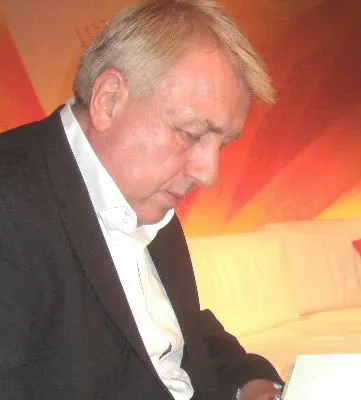
Hanns-Josef Ortheil
Human Design Chart
Biography
He has written many autobiographical and historical novels, some of which have been translated into 11 languages, according to WorldCat: French, Dutch, Modern Greek, Spanish, Chinese, Lithuanian, Japanese, Slovenian, and Russian.
What does Projector 5/1 mean for Hanns-Josef Ortheil?
Projector 5/1 — Design at a Glance
Hanns-Josef Ortheil's design tends towards a focused and penetrating perception. As a projector, he does not have the constant intrinsic energy source that the Sacral Center provides but works in phases of high intensity followed by necessary rest periods for regeneration. His specific mechanism is like a bright flashlight: He could immediately see where errors lay in others or in systems and bring 'light into darkness'.
This ability to directly perceive core issues, however, came with a risk. If he expressed these insights uninvited or too directly, it often felt like blinding light to those around him – disruptive and off-putting. The optimal strategy for Hanns-Josef Ortheil was not in actively pushing his viewpoint but waiting for an honest, appreciative invitation from the environment. Only then could he effectively fulfill his leadership role without provoking resistance.
Living by this principle of awaiting invitations led to success. Ignoring this dynamic and trying to go against the flow of his own energy economy or uninvitedly instruct others would sooner or later lead to his non-self theme: Bitterness. His design challenged him to hold back his sharp observational skills until explicitly asked, thereby achieving an attractive rather than confrontational effect.
Emotional Authority
Hanns-Josef Ortheil's design tends towards emotional volatility paired with the need to delay decisions over time. His inner authority lies in the defined Solar Plexus Center – the emotional authority. This mechanism is universal: When the Emotional Center is activated, it always takes charge of decision-making regardless of other defined centers in the chart.
This means that Hanns-Josef Ortheil was constantly under a wave of mood swings. The world appeared to him colored by his current mood: A topic could seem highly inspiring at one moment and deeply negative the next. However, this immediate emotional reaction was only a snapshot, not a final judgment. Quick decisions based on initial emotion carried the risk of proving false or harmful later as they were based on transient impulses.
The correct handling of this configuration required patience and strategic delay. Hanns-Josef Ortheil had to give himself time for decisions to mature – ideally over several nights. Only when the initial emotional high or low faded and a neutral distance set in, true clarity emerged. This process of emotional condensation was essential for long-term life decisions that should shape his path sustainably.
The 5/1 Profile — Heretic / Investigator
Hanns-Josef Ortheil's design tends towards a specific form of knowledge dissemination: deep, isolated research (Profile Line 1) serves as the basis to provide solutions for others (Line 5). This configuration generates a magnetic aura; people actively sought him out for answers to their problems. The mechanism describes this as the 'Hero/Researcher' profile: Those who research in the One-Line gather thorough knowledge, while the Five-Line carries this knowledge outward and thus unconsciously attracts those who need help.
This process was, however, fraught with risks. Without clear boundaries, there was a danger of overload from constant requests for solutions – comparable to an expert answering questions until exhaustion. The underlying energies emphasize hierarchy and clan security (Gate 44), meaning that structure and clearly defined roles are essential to avoid failure. At the same time, Thor 7's first line shows an authoritative leadership quality: Leadership is based on careful study and deep understanding of things. This authority can appear rigid or limiting for collective intelligence if not handled flexibly. The balance lay in learning 'no' to protect his research phase while also optimally utilizing his gifts without self-sacrifice.
Split Definition — Defined & Open Centers
Hanns-Josef Ortheil's Human Design profile points towards an unrelenting mental activity and strong-willed self-assertion. His defined Ajna Center provided constant, independent thinking, while his defined Heart Center gave him the energy to keep promises and prove his worth through action. This combination marked him as someone who not only thought concepts but also carried them into the world with determination. The also defined Throat Center functioned as a reliable channel: It articulated what his mind had conceived and his will supported, making his communication clear and authentic.
This internal structure contrasted with his open centers, which made him vulnerable to external influences. His open Head Center left him open to inspirations but prone to getting entangled in others' confusion or interpreting mental pressure as a personal necessity. His open G Center meant that he did not carry a fixed identity or life direction from birth; instead, he reflected the environment and often sought borrowed security in relationships or places to find a sense of belonging.
His open Sacral Center was another weakness: Hanns-Josef Ortheil easily absorbed the vital energy of his surroundings, which could lead him to feel overburdened and work on borrowed energy rather than feeling his own rhythm. Additionally, his open Spleen Center was sensitive to health and survival fears, causing him to resist spontaneous decisions out of fear or cling to situations that gave a false sense of security. Finally, the open Root Center took in external stress he did not generate himself, which could make him feel pressured and frantic to escape this foreign adrenaline rush.
Channels for mental order and communal connectedness.
Hanns-Josef Ortheil's Human Design profile points towards precise logical structuring. The Accepting Channel 17-62 connects his Ajna Center with his Throat Center, translating visual patterns (Gate 17) into detailed language (Gate 62). This created an internal pressure to mentally organize information and only understand it if it fit within his worldview. Communication aimed at conveying opinions in all details, timing being crucial to avoid resistance.
Parallel to this, the Community Channel 37-40 connected Solar Plexus and Heart through Gate of Friendship (37) and Gate of Solitude (40). Hanns-Josef Ortheil sought his place within the whole and built bridges for individuals. This configuration required direct personal contacts and carefully balanced agreements to form loyal groups where everyone had an honorable place. Hierarchy played no role; instead, it was about mutual support and closing contracts that were beneficial for both sides.
Additionally, isolated Gates shaped his attitude: Gate 44 promoted watchfulness and transformation through interaction without conditions, while Gate 24 induced mental mutations in the rhythm of the pulse. Gate 7 projected leadership patterns for the future, and Gate 13 collected experiences towards continuity. In his design, Gate 6 acted as a motor for emotional waves and growth, and Gate 21 with the need to control material things and recognition in service to the community rounded out the profile by interpreting historical patterns and developing future formulas.
Collective Circuitry — Circuit Signature
Hanns-Josef Ortheil's Human Design profile points towards clear, strategic communication. The Understanding Circuit connected his Ajna Center with his Throat Center through the Accepting Channel. This created a direct flow of logical insights to linguistic articulation – an emotionally detached ratio aimed at improving things through structure and focus. Parallel to this, in the Ego Circuit, separate energy was at work: Here, Heart and Solar Plexus Centers connected through the Community Channel, linking willpower with emotional reaction. This promoted a give-and-take relationship as well as mutual support, but without direct connection to the constant life force of the Sacral Center. Both circuits formed two independent blocks in Hanns-Josef Ortheil due to Shared Definition: on one hand, rational future shaping through words; on the other, emotional resource management within groups. This separation meant that strategic clarity and interpersonal dynamics existed side by side but did not automatically interconnect. Thus, Hanns-Josef Ortheil was someone who formulated logically structured messages while also reacting to emotional feedback in social exchange processes – two different tools for distinct life areas.
Left Angle Cross of Incarnation 2
Hanns-Josef Ortheil's Human Design reveals a tendency towards deep, often painful confrontations with one's essence. This configuration, the left cross of incarnation 2, describes a path driven not by external validation or social recognition but by an inner compulsion to question and transform one's existence down to its core.
It is a life task of radical self-discovery. The focus here is less on achieving status or material goals and more on developing an authentic identity independent of external expectations. This process often requires letting go of old structures and patterns that no longer fit the true nature. It is a path of inner alchemy, where suffering and challenges serve as catalysts for profound personal change. The energy of this cross urges one to break free from superficial bonds to find an unshakable inner truth. Hanns-Josef Ortheil was thus marked by the necessity to understand and integrate his own soul before presenting it to the world. This is not a path of quick success but rather a slow, often solitary maturation that ultimately leads to immense inner strength and clarity.
Saturn Return · Uranus Opposition · Chiron Return · 2nd Saturn Return — Life Cycles
Hanns-Josef Ortheil's Human Design shows a clear structure where internal maturation processes connect with external recognition. In 1979, at the age of 28, he debuted with the novel 'Fermer'. This marks his first Saturn Return, a cycle often bringing years of inner work to a stable and visible result – here concretely as a literary start.
The phase around 1991 brought the Villa Massimo Scholarship. At age 40, Hanns-Josef Ortheil stood at his Uranus Return (Opposition), a time of upheaval and breaking free from old structures that often create new spaces for creative independence.
His Chiron Return around the year 2000, when he received the Brandenburg Literature Prize, marks a peak. At this age (49), the incarnation cross increasingly unfolds; it is not healing old wounds but experiencing meaning and fulfillment of one's purpose if one follows their strategy. The prize documents this blooming phase of self-realization.
In 2007, with the Nicolas Born Prize at age 56, came his second Saturn Return. This cycle confirms and stabilizes the previously achieved position. It shows how the foundations set during the first Saturn Return have condensed over decades into a sustainable, recognized life task. The sequence of these events illustrates a design that gradually translates inner development into external validation.
Projector · Emotional Authority — Synthesis
A central red thread in this design is the deep ability to recognize patterns and make them accessible to others. The projection (Projector type) combined with the defined mental center (Ajna) and the channel of acceptance (Gate 17/62) creates a strong aptitude for grasping details and logically connecting them. This is reinforced by Line 5 in Profile, bringing the urge to share this knowledge and offer solutions as a Hero. The repeated recognitions in the form of prizes and scholarships (1979, 1991, 2000, 2007) indicate that this ability is indeed seen and valued in the outer world – a process essential for a Projector.
At the same time, there is an evident tension between the need for knowledge and the emotional wave (Emotional Authority). The defined Ajna Center continuously provides concepts and analyses while the emotional authority requires time for maturation and deliberation. This discrepancy could lead to inner conflict as the urge to quickly offer solutions (Line 5) collides with the necessity of making decisions only after emotional balancing. A paradox arises between the mental drive for clarity and natural emotional variability.
2 Defined Channels
Incarnation Cross - Left Angle Cross of Incarnation 2
Solar Return
The Solar Return shows the moment when the sun returns to its exact birth position - your personal solar year.
Life Cycles
Discover the life cycles with a detailed triple view (birth chart, cycle chart, composite).
Human Design Profile
- Type
- Projector
- Strategy
- Wait for the respectful invitation
- Authority
- Emotional Authority
- Profile
- 5/1 - Heretic / Investigator
- Definition
- Split Definition
- Incarnation Cross
- Left Angle Cross of Incarnation 2
- Date of Birth
- 05.11.1951 09:35
- Place of Birth
- Köln, GER
Frequently Asked Questions
What is Hanns-Josef Ortheil's Human Design type?
Which profile does Hanns-Josef Ortheil have?
What authority is decisive for Hanns-Josef Ortheil?
What is Hanns-Josef Ortheil's incarnation cross?
When was Hanns-Josef Ortheil born?
Discover your own Human Design
Are you also a Projector? Find out in a personal reading how to unfold your leadership qualities and recognize the right invitations.
More Personalities
Back to overviewSissy Spacek

Alain-Fournier

Anémone

Angeli

Ann-Margret

Bourvil
